On this page
Customer churn is expensive. It’s a slow, painful leak in your revenue bucket that everyone worries about but few fix effectively. And here’s the real kicker: the fix isn’t a shinier product or a lower price tag. It’s better support. Period. This guide is for founders, support leads, and ops managers at small-to-mid teams who are tired of watching customers walk away because of slow, clunky service.
Use this playbook when you’re ready for a practical, tool-agnostic framework that actually reduces churn. But don’t bother if you’re hunting for a quick marketing gimmick; this stuff demands real operational change.
Quick Answer:
- Churn is almost always a support friction problem, not a product or price problem.
- Proactive support (reaching out first) prevents churn far better than waiting for the customer to complain.
- Live chat and self-learning AI are the two highest-impact channels for real-time churn interception.
- A flat-rate support platform removes the financial barrier to hiring the team your customers need.
- One tweak, automating a proactive chat invite, can measurably reduce cancellations.
What Actually Causes Customer Churn
Here’s what most people get wrong: customers don’t leave because of a missing feature. They leave because of friction. They hit a wall, can’t get a timely answer, and get frustrated enough to bounce.
Support is the only team that sees churn signals forming in real time. You can spot a cancellation brewing before the customer even clicks "cancel", if you know what to watch for. That makes addressing these signals the fastest, cheapest way to prevent customer churn.
- Churn signals to watch: repeated contact about the same issue, ticket abandonment (they give up mid-conversation), and negative CSAT scores.
- The expectation gap: customers expect instant replies. Most teams still deliver hours or days.
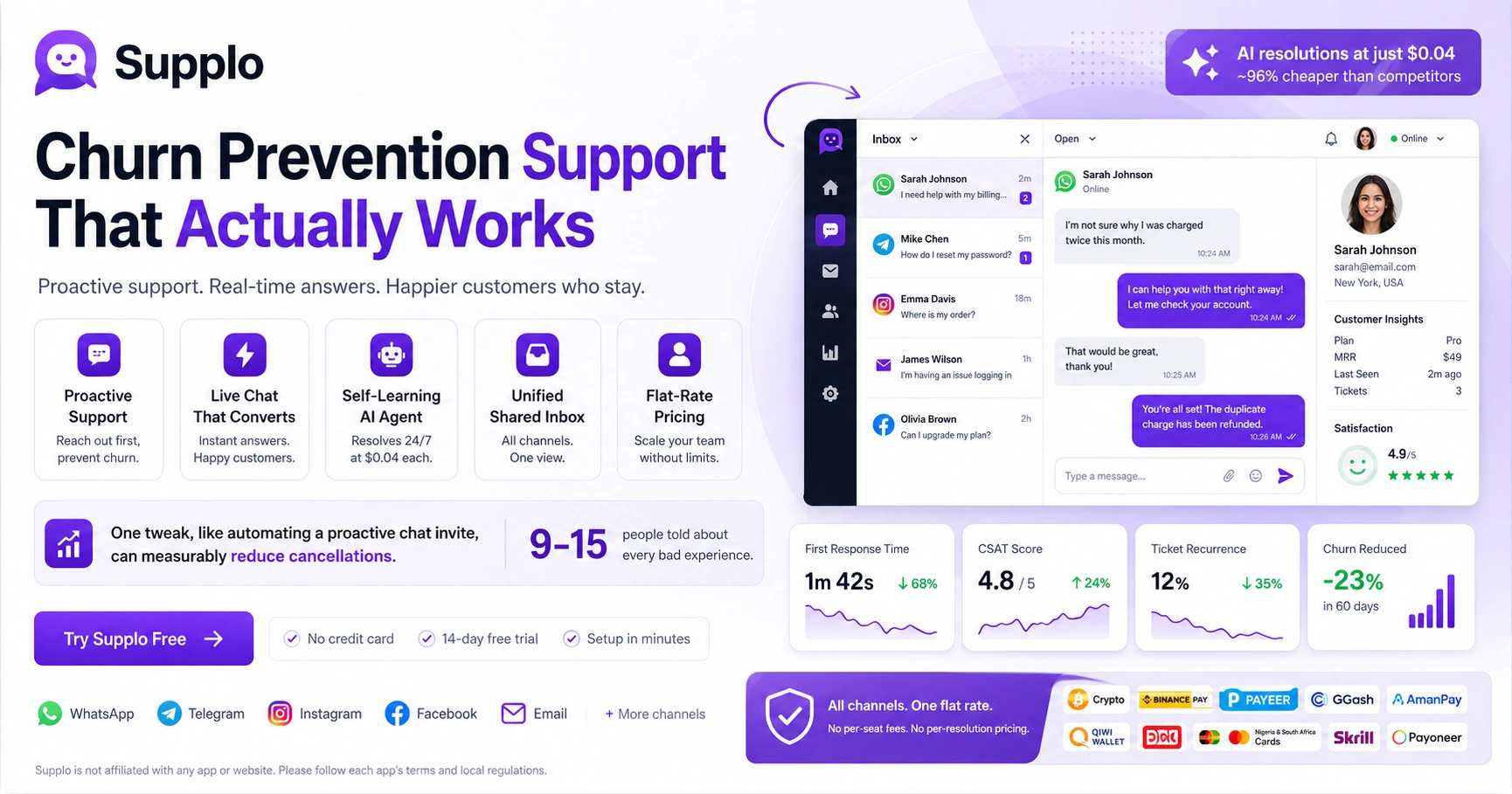
- The hidden cost: a churned customer tells 9–15 people about their bad experience. That’s a reputation leak on top of revenue loss.
Product-market fit doesn't matter if your support experience feels broken. A great product with bad support will still bleed customers.
The Hard Truth About Proactive Customer Support for Churn
Proactive customer support for churn means solving a problem before the customer knows they have one. Think of it like a smoke alarm instead of a fire extinguisher. When you reach out first, via live chat, an in-app nudge, or a well-timed email, you reduce escalations and signal to the customer that you’re paying attention.
Most teams wait for the fire. The smart ones stop it before it starts.
- Proactive triggers: abandoned onboarding, unused features after day 7, billing confusion, or a visit to the cancellation page.
- The impact: a proactive chat invite alone can significantly reduce support ticket volume.
- The difference: proactive support saves money. Reactive support spends it.
Proactive support builds long-term trust instead of just fixing short-term problems. It's the difference between a customer who stays and one who leaves.
How Live Chat for Customer Retention Creates a Stickier Experience
Live chat for customer retention isn’t just a nice-to-have. It’s arguably the highest-converting channel for preventing cancellations. Customers who use live chat are measurably more likely to renew, because they feel heard in real time.
Email doesn’t do that. Email makes you wait. Live chat lets you resolve confusion on the spot, turning a potential cancellation into a positive interaction. And with a flat-rate platform like Supplo, you can offer this without stressing about per-agent costs spiraling out of control.
- Instant resolution stops the "I'm frustrated" spiral cold.
- Customers who chat before canceling often stay because the problem gets solved in that conversation.
- Speed wins every time. Ticket-based systems lose.
Learn how to make this work with Supplo's widget.
Using Real-Time Support for Churn to Intercept Friction Before It Escalates
Real-time support for churn means catching small problems before they become the reason someone leaves. A customer waiting 15 minutes for a billing answer is already halfway out the door. Real-time support, whether a human agent or an AI agent, crushes that window down to seconds.
Supplo’s self-learning AI agent handles the routine questions instantly (password resets, order status, FAQ stuff). That frees your team to focus on the complex, high-stakes conversations that actually impact retention.
- The critical first two minutes: most cancellations happen after a single bad interaction. You don’t get many chances.
- Real-time data (chat transcripts, response times) reveals churn patterns you’d otherwise miss.
- A shared inbox keeps all those real-time conversations from falling through the cracks.
Real-time support reduces repeat contacts by solving issues fully the first time. That's the difference between a customer who stays and one who churns.
Do Chatbots for Churn Reduction Actually Work?
Chatbots for churn reduction work, but only when they’re good at what they do. A poorly designed bot that can’t understand simple requests will frustrate customers and accelerate churn. That’s a real risk.
But a self-learning AI agent that pulls answers from a knowledge base and routes complex stuff to a human? That’s a completely different story. Supplo’s AI agent resolves common issues at $0.04 each. That means you can offer instant answers without burning cash. The big caveat: always give customers an easy escape to a human.
- Where bots excel: password resets, order status, and typical FAQ questions.
- Where bots fail: nuanced emotional problems (e.g., "I'm unhappy with the service").
- The "escape hatch" rule: every bot interaction must offer a clear path to a human agent.
Supplo's self-learning AI agent is built for exactly this, handling the routine stuff while intelligently routing complex issues to your team.
A Practical Framework to Reduce Customer Churn with Support
To reduce customer churn with support, you need a simple three-step loop: detect, intercept, resolve. Here’s how it looks in practice.
- Detect churn signals. Watch three numbers: first response time, CSAT score, and ticket recurrence rate. If a customer contacts you multiple times about the same issue, that’s a flashing red light.
- Intercept with proactive outreach. Set up triggers, a live chat invite when a user visits the billing page, or an automated check-in if they haven’t logged in for 30 days.
- Resolve fast using a unified inbox. Every agent should see the full history across WhatsApp, Telegram, email, and chat. No context switching, no asking the customer to repeat themselves.
Supplo's shared inbox keeps context intact across all channels. See how PVAPins turned support into a retention engine using this exact framework.
Want to see this framework in action? Set up a free Supplo workspace and test proactive live chat triggers with your own team—no credit card required. Start reducing churn today. → Try Supplo Free
The Exposed Flaw in Most Customer Support Best Practices for Churn
Most customer support best practices for churn focus on the agent, faster replies, better scripts, and more training. But the real flaw isn’t the people. It’s the tooling.
If your support platform charges per seat, per resolution, or per channel, you’re effectively incentivized to limit how much help a customer gets. That’s backward. The actual best practice is a flat-rate platform that lets you scale support without penalty.
Supplo’s per-seat-free model lets you add agents, channels, and AI without your bill tripling. That changes your strategy entirely.
- Per-agent pricing discourages hiring the support team you actually need.
- Resolution-based billing punishes helping more.
- The simple test: would your support platform let you double your team tomorrow without a pricing shock?
The best practice for churn prevention isn't a better script; it's a better pricing model that lets you invest in retention.
Why Customer Engagement Live Chat Beats Email for Preventing Cancellations
Customer engagement live chat beats email for one simple reason: speed controls emotion. When someone is about to cancel, they’re already frustrated. A 6–12-hour email reply adds fuel to the fire.
Live chat lets you resolve the emotional part of the problem in seconds and the logistical part in minutes. Supplo’s widget integrates directly into your website, making it the first thing a hesitant customer sees, and the quickest way to turn them around.
- The emotional arc of a cancellation: confusion → frustration → decision.
- Email is the worst channel for de-escalating emotional customers.
- Live chat quickly turns a negative interaction into a positive memory.
How to Minimize Customer Churn with One Tweak
Minimize customer churn by switching from passive to proactive support. Passive support sits back and waits for the customer to come to you. Proactive support goes to them.
One tweak is all it takes: set up a system that automatically sends a live chat invite when a customer shows a churn signal, such as visiting the billing page 3 times or hovering over the "cancel my account" button.
Supplo’s workflow builder lets you automate these triggers without needing a developer. It turns passive support into an active churn prevention machine.
- The difference: "waiting" vs. "inviting", one feels helpful, the other feels absent.
- Proactive triggers: page visits, time since last login, support ticket submission.
- Why it works: A small tweak (adding a proactive chat invite) can reduce churn by measurable percentages.
One tweak is all it takes. If your support platform can't automate a proactive chat invite, you're leaving money on the table. Try Supplo for free and see how easy it is to switch to proactive. → Create Your Workspace
When Your Support Stack Costs More Than Churn (How Supplo Fixes the Math)
Here’s a trap many teams fall into: their support platform costs so much that they’re afraid to add capacity. So responses stay slow, customers get frustrated, and churn increases. The tool itself becomes part of the problem.
Supplo flips this math. You get live chat, a shared inbox, a self-learning AI agent, and multi-channel routing (email, Telegram, WhatsApp, Instagram, Facebook) all for one flat monthly fee. No per-seat fees. No per-resolution meter. AI resolutions cost $0.04 each, roughly 96% cheaper than competitor bots.
That math means you can support every customer as if they’re your only one.
- The comparison trap: per-seat pricing forces you to under-staff support.
- Flat-rate pricing changes your ability to invest in retention tools.
- Multi-channel support (WhatsApp, Telegram, Instagram, Facebook) without per-channel fees.
- Payment flexibility: crypto, Binance Pay, Payeer, GCash, AmanPay, QIWI Wallet, DOKU, Nigeria and South Africa cards, Skrill, Payoneer.
Supplo supports multi-channel routing across all major platforms. Check our flat-rate pricing to see how much you can save.
Your support stack shouldn't be a churn risk. Get live chat, an AI agent, a shared inbox, and multi-channel support for one flat monthly rate. No per-seat fees. AI resolutions at $0.04 each. → Start Your Free Trial
Key Takeaways:
- Churn is a support friction problem, not a product or price problem.
- Proactive support (reaching out first) prevents churn far better than reactive support.
- Live chat and self-learning AI are the highest-impact channels for real-time churn interception.
- A flat-rate support platform removes the financial barrier to hiring the team your customers need.
- One tweak, automating a proactive chat invite, can measurably reduce cancellations.
Supplo is not affiliated with any app or website. Please follow each app's terms and local regulations.
FAQ
What is the single most effective support strategy to prevent customer churn?
Proactive support beats reactive every time. Reach out to customers before they complain. A simple live chat invite triggered by a specific action (such as visiting the billing page) can intercept a cancellation before it occurs.
Can a chatbot really help reduce churn rather than cause it?
Yes, but only if the bot is good and offers an easy escape to a human. A self-learning AI agent that resolves routine issues instantly can reduce churn by providing customers with fast answers. A bad bot that can't solve anything makes churn worse.
How does live chat specifically improve customer retention?
Live chat creates a sense of immediacy and attention. Customers who feel heard within seconds are far less likely to cancel than those left waiting for an email reply. It’s the fastest way to de-escalate frustration.
What are the cheapest ways to reduce customer churn through support?
Use a platform with no per-seat fees. That frees you to add agents and AI without financial penalty. Proactive chat invites and a knowledge base that the AI agent pulls from are both nearly free to set up but high-impact.
How do I know if my support platform is actually causing churn?
Check your first response time and ticket recurrence rate. If customers are contacting you multiple times about the same issue, or waiting more than a few minutes for a reply, your platform is contributing to churn.
What exactly is proactive customer support for churn?
It’s any support action initiated by you, not the customer. Examples: a live chat that pops up when a user looks at the cancellation page, an email checking in on a user who hasn't logged in, or a prompt when a billing error is detected.
Does switching to a flat-rate support platform really lower churn?
It can, because it removes the financial barrier to hiring more help or adding channels. When you're not paying per agent or per ticket, you’re free to invest in the exact team size your customers need, not the one your budget allows.
Compliance line: Supplo is not affiliated with any app or website. Please follow each app's terms and local regulations.