On this page
Let's cut through the hype. You've got a support team that's drowning in tickets, costs are climbing, and someone mentioned AI like it's a magic wand. Is it? Kind of. But not how you think.
The real answer isn't AI or humans. It's knowing exactly where each one crushes it and building a system that lets them tag-team. This guide is for anyone running support, team leads, ops managers, and founders who are tired of watching ticket volume eat their budget and burn out their best people.
Quick Answer
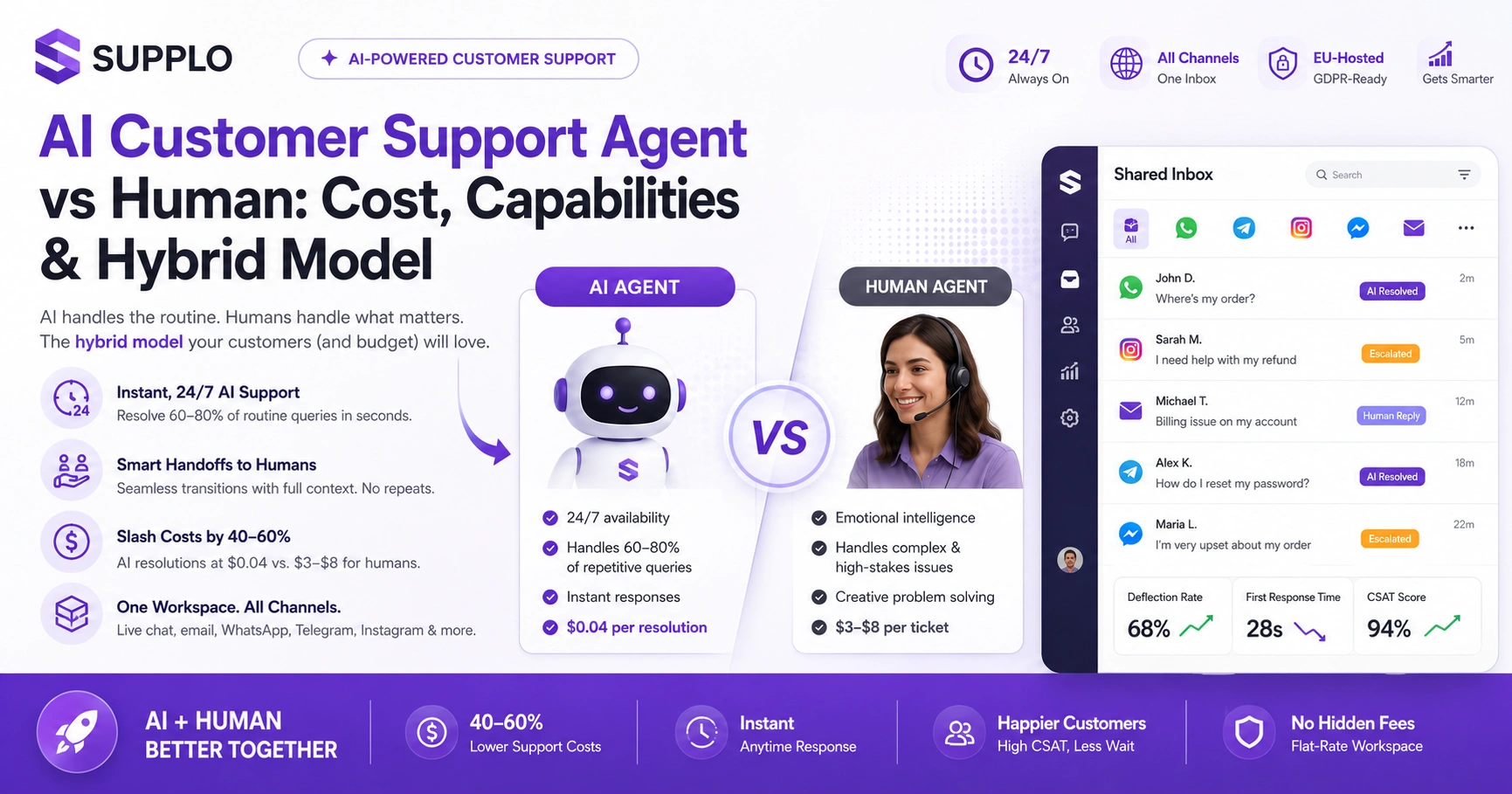
- AI agents handle 60-80% of routine queries instantly, 24/7, for as low as $0.04 per resolution.
- Human agents are essential for emotional nuance, gray-area disputes, and de-escalating angry customers.
- The hybrid model (AI first, human when needed) is the most cost-effective and customer-satisfying approach.
- A seamless handover between AI and humans is critical; never make a customer repeat themselves.
- Integration matters: your AI and human agents must share the same inbox and context.
What is an AI Customer Support Agent, and What Can It Actually Do?
An AI customer support agent is essentially a software brain that reads your knowledge base and interacts with customers. No ego, no lunch breaks, no sick days. It handles the boring stuff, password resets, tracking orders, and FAQ answers, so your humans don't have to.
Here's what that looks like in practice:
- Instant answers, any time of day. "Where's my order?" gets a response in seconds, not minutes.
- Works across every channel, live chat, WhatsApp, Telegram, Instagram, email, and Facebook Messenger. One AI, many doors.
- Learns from every conversation and gets sharper over time. Feed it good data, and it keeps improving.
- Triggers smart handoffs based on mood, intent, or topic. If a customer sounds pissed, it flags a human.
But here's the catch nobody tells you: your AI is only as smart as the knowledge base it reads. Invest time here, or your AI will be the customer service equivalent of a confused intern.
A self-serve knowledge base setup is the foundation of every good AI agent; invest time here.
Where Human Agents Still Win: The Real Value of a Human Brain
Let's be honest, AI can't feel empathy. It can simulate it, mimic it, even get pretty good at pretending. But real empathy? The kind where a customer is about to cry on the phone because their order got lost, and it's their mom's birthday gift? AI doesn't have that.
Humans win where the rules get fuzzy:
- Unpredictable edge cases, billing gray areas, account security disputes, and multi-step troubleshooting that doesn't follow a script.
- Emotional conversations, cancellations due to hardship, complaints that need an apology more than a solution
- Creative problem-solving when there's no documented answer in the knowledge base
- Building long-term rapport, customers remember when a human went the extra mile.
- High-stakes interactions where one wrong response costs a client relationship
AI can handle 80% of queries, but the 20% that require empathy, judgment, or creative problem-solving are where humans earn their keep.
AI Agent Capabilities: What Modern AI Can Handle and What It Can't
A well-trained AI agent can comfortably handle 60-80% of inbound queries without a human touching them. That's password resets, order status checks, FAQ answers, product recommendations, basic troubleshooting, and even multi-language support.
But AI fails, and fails hard, when queries require reading between the lines, handling vague complaints, or dealing with customers who insist on speaking to a "real person."
What AI does well:
- Language translation and multilingual support (Supplo's built-in translate feature handles this seamlessly)
- Handling identical queries at scale, AI never gets bored answering "Where's my order?" for the 500th time
- Speed: responds in seconds vs. minutes (or hours) for human agents
Where AI falls apart:
- Ambiguous requests like "I have a weird issue with my account," with no clear context
- Novel situations where no training data exists
- Customers who are clearly upset and need emotional validation
The smartest setup knows exactly where AI stops, and humans start. A modern AI agent with self-learning capabilities gets better every day, but it needs clear guardrails and a solid escalation path.
See what an AI agent can actually do for your team, try Supplo's AI agent free →
Human Agent Limitations: Burnout, Context Switching, and the 9-to-5 Wall
Here's the uncomfortable truth about human support agents: they're expensive, they're limited, and they're fragile. Not because they're bad at their jobs, but because they're human.
One support agent costs $30,000–$50,000 per year in salary alone. Add benefits, training, and turnover costs, and you're looking at a serious line item. Humans get tired. They make mistakes after the fourth hour of back-to-back tickets. They take vacations, call in sick, and can only handle 3–5 conversations at once.
- Average human agent handles 3–5 conversations simultaneously; AI handles unlimited
- Human error rate creeps up after the 4th hour of back-to-back tickets
- 9-to-5 coverage means overnight queries pile up waiting for the morning
- Training takes weeks; AI trains in minutes from your existing knowledge base
- Turnover costs: replacing an agent costs 30-50% of their annual salary
A human agent's single biggest limitation isn't skill, it's biology. They need sleep, weekends, and mental breaks. AI doesn't.
The Hybrid Customer Support Model: AI + Human Collaboration (Done Right)
This is the sweet spot. Not AI or human. AI first, human when needed.
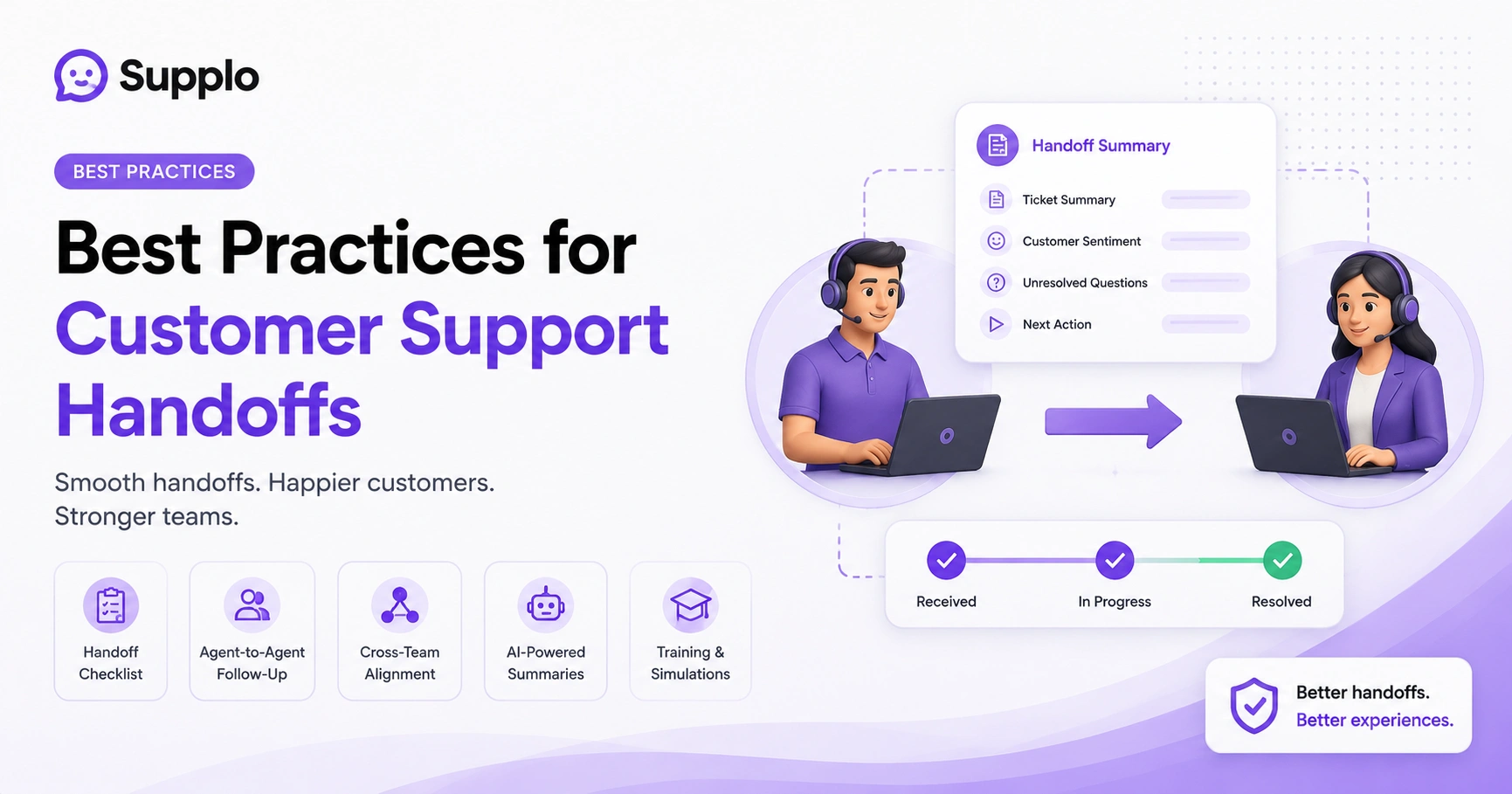
Here's how it works: The AI agent handles the first touch, resolves the quick wins, and passes only the complex, high-emotion, or high-value cases to a human agent. Done right, the human sees a full transcript of what the AI already tried. The customer never repeats themselves.
- AI defuses simple friction (password reset, order lookup) before a human steps in
- Human agents get a pre-populated context window, no "can you repeat your issue" nonsense
- AI can suggest draft replies that the human approves in one click (AI augmentation mode)
- SLAs improve dramatically: AI handles after-hours, human picks up during business hours
- This isn't theoretical. Supplo's AI agent and shared inbox were built for exactly this workflow.
Checklist for a successful hybrid model:
- Train your AI on your best knowledge base articles first
- Define clear escalation rules (sentiment score, intent, topic)
- Give human agents full context from the AI interaction
- Monitor deflection rate weekly and update your KB based on common escalation reasons
- Let your AI keep learning from every human-resolved ticket
Seamless Handover: How to Make AI-to-Human Transfers Feel Like Magic
Bad handoff: Customer has to explain their problem all over again.
Good handoff: Customer gets a full transcript and flagged intent passed to the human.
Great handoff: the customer doesn't even realize they switched from AI to a human.
The secret? Your AI agent and your shared inbox must live on the same platform. Not two different tools held together with duct tape and prayer.
- AI should flag priority: urgent billing issue vs. general question vs. angry customer
- Human agents need to see the AI's attempted solution and the customer's response to it
- Handover should be instant, with no queuing delay except for busy periods
- If AI can't solve it in 3-4 messages, escalate automatically
- The customer should never hear "let me transfer you to someone who can help."
Common issues and fixes:
- Problem: Customer repeats information. Fix: Use an integrated platform where AI and humans share the same inbox.
- Problem: Handover is slow. Fix: Configure AI to escalate after 3 failed attempts, not 10.
- Problem: Humans don't know what AI tried. Fix: Ensure the handover includes the AI's attempted solution and the customer's response.
A shared inbox for AI and human collaboration eliminates these issues by keeping every interaction in one place.
AI Customer Support Agent Cost vs Human Agent: The Real Numbers
Let's talk money, because that's usually why you're here.
A human support agent costs $35,000–$50,000 per year, fully loaded (salary, benefits, taxes, equipment). A solid AI customer support agent from Supplo? $0.04 per AI resolution. That's roughly 96% cheaper than similar solutions.
For a team handling 10,000 queries per month, AI can save $3,000–$5,000 monthly vs. hiring additional humans. And that's before you factor in reduced training, zero turnover, and 24/7 coverage.
The cost comparison significantly favors AI agents over traditional human staffing. While human agents require an annual salary and overhead between $35,000 and $50,000, Supplo’s AI agent operates with a $0 platform fee. Per-ticket costs drop from $3–$8 for humans to just $0.04 per AI resolution. Furthermore, AI agents can be trained in minutes from a knowledge base compared to 2–4 weeks for humans, allowing a single monitoring agent to handle 10,000 monthly tickets instead of a team of 3–5. AI also provides 24/7 off-hours coverage as a standard feature, eliminating the need for overtime pay.
Supplo accepts crypto, Binance Pay, Payeer, GCash, AmanPay, QIWI Wallet, DOKU, Nigeria, and South Africa cards, Skrill, and Payoneer, with no hidden fees and no per-seat surprises.
See the full pricing comparison: AI agent vs human agents for your specific volume.
At $0.04 per AI resolution, your AI agent pays for itself after resolving just 125 tickets, less than a day's work for most teams.
Integrated Support Stack: One Workspace for AI, Live Chat, Email, and Social
Worst move you can make: AI agent in one tool, live chat in another, email tickets in a third. That's how responses get lost, handoffs break, and customers end up telling their story to three different people.
An integrated support stack means your AI agent, shared inbox, live chat, email ticketing, WhatsApp, Telegram, Instagram, and Facebook all live under one roof. Supplo was built for exactly this: a flat-rate workspace with no bolt-on integrations required.
- Single inbox view: all channels (chat, email, social DMs, WhatsApp) in one timeline
- AI agent reads every conversation, even ones handled by humans, to keep learning
- Customers can start on one channel and continue on another without losing context
- Flat monthly pricing covers the entire stack, no per-channel add-ons
- EU-hosted data for privacy compliance (GDPR-friendly)
Supplo brings it all together: WhatsApp customer support integration, Telegram, Instagram DMs, Facebook Messenger, email ticketing, and a live chat widget, all in one workspace.
Reducing Support Costs with AI Without Sacrificing Quality
Here's the trap most teams fall into: cutting support costs means hiring cheaper agents, which tanks quality. AI doesn't have that trade-off.
You can reduce your human team by 30-50% while actually improving response times and customer satisfaction. The key is routing the right queries to AI and keeping humans on the high-value, high-empathy interactions. You're not replacing humans, you're redeploying them where they actually matter.
- Eliminate overtime and night-shift premiums (AI covers after-hours)
- Reduce training cycles: AI learns from your KB, not from weeks of onboarding
- Lower cost-per-ticket: AI resolutions at $0.04 vs. human at $3–$8 per ticket
- Quality stays high because human agents handle fewer tickets with more context
- No per-seat costs, pay one flat rate for the entire team, not per agent
A team using Supplo's hybrid model saw a 40% reduction in support costs while maintaining CSAT above 90%. Read the case study: how one team reduced support costs to see the full breakdown.
Ready to cut support costs without cutting quality? Supplo's hybrid model costs less than one human agent's monthly salary. Calculate your potential savings →
Reducing support costs with AI isn't about cutting heads; it's about cutting friction. Let AI handle the repetitive 70% and let your humans focus on the meaningful 30%.
How to Choose Between AI Support, Human Support, or Both
Simple framework: volume + complexity = your answer.
If your support volume is under 200 tickets/month and your queries are deeply personal (think therapy or high-end consulting), stick with humans. You don't need AI for ten conversations a day.
If you're getting 500+ tickets/month with repetitive questions like "track my order" or "reset my password," you need AI. Badly.
Most businesses land in the middle: AI for the boring 70%, humans for the spicy 30%. Start with a hybrid model, measure deflection rate, and adjust.
Decision checklist:
- Volume < 200 tickets/month → Stick with humans
- Volume 200-500 tickets/month, mostly diverse queries → Hybrid model recommended
- Volume 500+ tickets/month, >60% repetitive queries → AI-first with human escalation
- High-emotion industry (counseling, luxury) → Primarily human, AI for basic FAQs only
- E-commerce, SaaS, logistics → AI-first hybrid model
Still unsure? Start with a flat-rate workspace that lets you toggle AI on or off per channel. Start your free trial →
Key Takeaways
- AI agents deliver 24/7 support at $0.04 per resolution; humans cost $3-$8 per ticket
- Hybrid model (AI + human) cuts costs 40-60% while maintaining or improving CSAT
- Seamless handovers require AI and humans to share the same inbox and context
- Track deflection rate, first response time, and CSAT to measure success
- Start with AI handling 60-80% of routine queries, humans for complex and emotional cases
FAQ
Is it legal to use AI for customer support?
Yes, but you must disclose AI interaction in some jurisdictions (e.g., California's CCPA). Supplo is not affiliated with any app or website. Please follow each app's terms and local regulations.
Can AI completely replace human support agents?
No, not reliably. AI handles 60-80% of routine queries but struggles with emotional nuance, gray-area disputes, and novel situations. Hybrid is the proven model.
How much does an AI customer support agent cost vs hiring a human?
AI resolutions run about $0.04 each (Supplo pricing). A human agent costs $3–$8 per ticket after salary and overhead. AI is 50-100x cheaper per resolution.
Does AI reduce customer satisfaction?
Not if done right. AI actually improves CSAT on simple queries by responding instantly. The risk is poor handoffs; this is solved by using an integrated platform where AI and humans share the same inbox and context.
What industries benefit most from AI customer support?
E-commerce, SaaS, logistics, travel, and any business with high ticket volume and repetitive questions. Low-volume, high-empathy industries (healthcare counseling, luxury concierge) still need predominantly human support.
How do I know if AI is working for my support team?
Track deflection rate (tickets resolved without human touch), first response time, and CSAT. If deflection is under 30%, your knowledge base needs work. Above 60%, you're saving serious money.
Can AI handle multi-channel support (WhatsApp, Instagram, email)?
Yes, when the platform supports it. Supplo's AI agent works across live chat widget, WhatsApp, Telegram, Instagram, Facebook Messenger, and email from a single inbox.
Compliance line: Supplo is not affiliated with any app or website. Please follow each app's terms and local regulations.