On this page
Your return policy? That's often the very first thing a potential buyer reads before they dare click "add to cart." If yours is buried in tiny footer text or reads like a legal summons, you're bleeding sales, plain and simple. Good ecommerce return policy support is about making the whole process feel safe, not like a test of the customer's patience.
This one's for ecommerce founders, support leads, and ops managers who want to cut through the return-related friction, automate the boring stuff, and actually keep customers coming back. Use this if you're building a policy from scratch, fixing a broken workflow, or shopping for automation tools. Skip it if you're after generic legal templates, we're here for practical execution, not legalese.
Quick Answer
- A clear, visible return policy slashes cart abandonment and builds trust before anyone even buys.
- Let an AI agent handle about 80% of return questions, but keep real humans for damage claims and emotional meltdowns.
- Live chat can shrink return resolution time from hours to minutes, plus bump up exchange rates.
- A shared inbox and knowledge base unify return management, no more "I already emailed you" loops.
- Always, always honor the policy the customer saw at checkout. Changing it retroactively? Legally risky and trust-killing.
Why Your Ecommerce Return Policy Support Is the First Thing Customers Judge
Supplo is not affiliated with any app or website. Please follow each app's terms and local regulations.
Here's a stat that should hit home: 67% of shoppers check the return policy before buying. If it's hidden in a footer, they'll assume returns are a nightmare and click away. A confusing policy can spike cart abandonment by up to 30%. Meanwhile, customers who actually have a smooth return experience? They're 3x more likely to buy from you again.
Your policy should answer "How do I return this?" in under 10 seconds. No hunting. No guessing. Ecommerce return policy support isn't some back-end detail you can ignore, it's a straight-up conversion lever.
How to Set Up an Ecommerce Return Policy Template That Reduces Confusion
A solid ecommerce return policy template is short, scannable, and answers the three big questions: What can I return? How long do I have? Who pays for shipping? Don't just copy-paste from a competitor, tailor it to your specific products and margins.
What to include:
- Use plain language: "You have 30 days from delivery" beats "Returns accepted within 30 calendar days of receipt" every time.
- Add a clear "What's not returnable" section (think: final sale items, opened consumables).
- Lead with a one-sentence summary at the top for mobile shoppers.
- Link directly to your return portal or chat support, don't make them search for it.
Test your return policy flow for free. Set up a live chat widget and see how fast your team can actually handle a return request. No credit card needed. → Start free trial at Supplo
Handling Ecommerce Return Requests
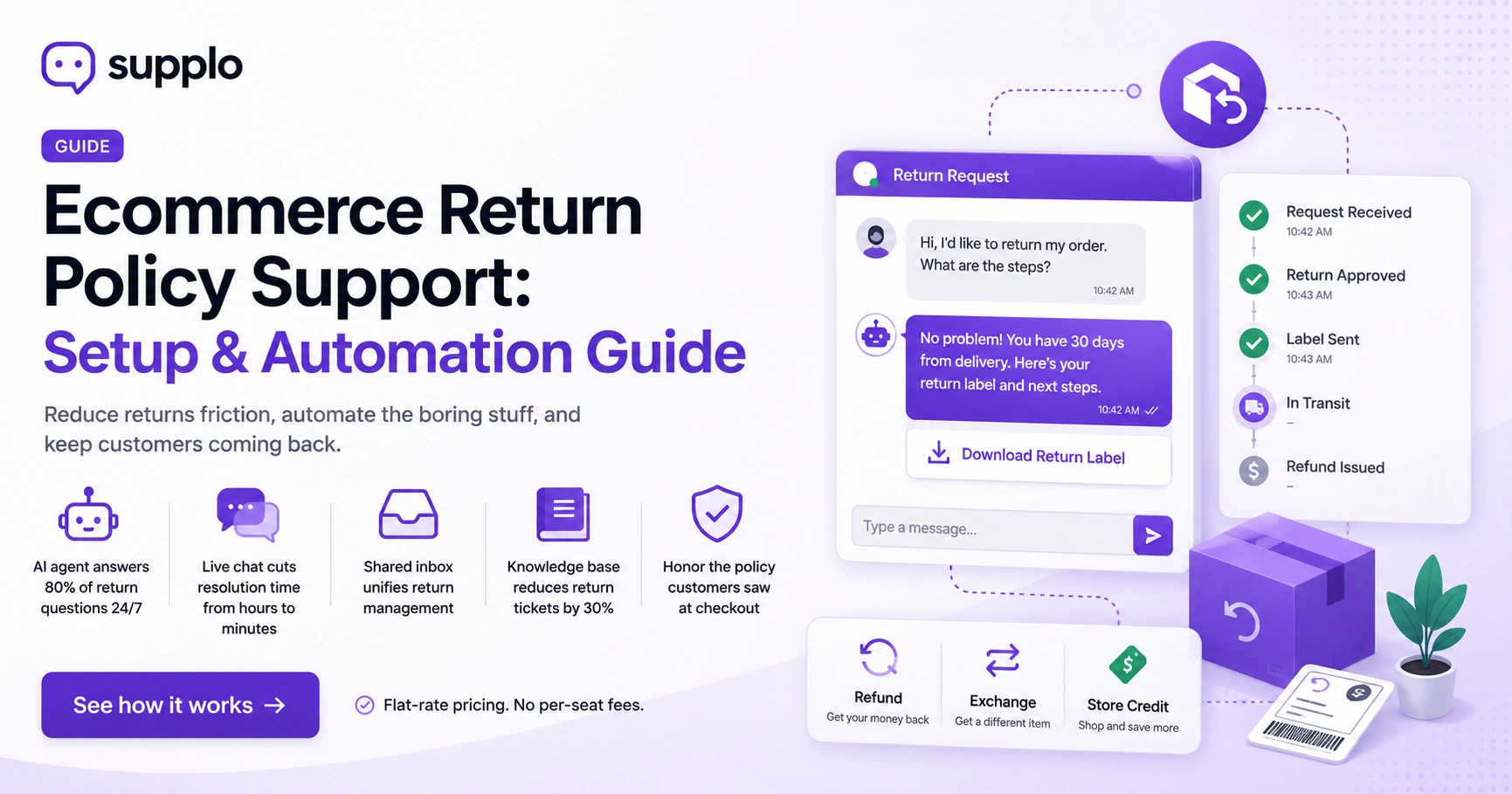
Handling ecommerce return requests isn't just about saying "yes" or "no." It's a full workflow: receive the request, verify the order, assess the reason, approve or deny, issue the label, and track the return. Without a system, you'll lose packages, money, and customer trust fast.
- Capture the return reason (size, defect, changed mind), this data helps you improve your product.
- Verify the order within 60 seconds using order ID or email.
- Decide approval based on policy, automate common approvals, manually review edge cases.
- Send a prepaid return label or QR code immediately.
- Update inventory and trigger refund or exchange upon carrier scan.
How to Automate Ecommerce Return Policy Responses Without Losing the Human Touch
Automate ecommerce return policy responses for the 80% of questions that are repetitive, "Where's my refund?" "How do I print a label?", but keep a human ready for the 20% that need nuance, like damaged items or late returns. The trick is routing, not replacing.
- Use an AI agent to answer policy FAQs instantly (24/7, no waiting on hold).
- Set up triggers: if a customer types "return," auto-send the policy link plus return portal.
- Escalate to a human when sentiment turns negative or the request falls outside policy.
- Never automate apologies, a real person should handle "I'm sorry."
Streamlining Ecommerce Returns with Live Chat: Real-Time Help That Cuts Friction
Live chat ecommerce return policy support is the fastest way to turn a frustrated customer into a happy one. Instead of waiting hours for an email reply, they get an answer in 30 seconds, and you get to upsell an exchange instead of processing a refund.
- Live chat can reduce return-related email volume by up to 40%.
- Agents can send return labels, policy links, and exchange options directly in the chat.
- Real-time help catches mistakes: wrong size, missing parts, user error.
- Combine with a live chat widget and shared inbox so nothing falls through the cracks.
Customer Service Ecommerce Returns: What to Do When a Customer Says "It's Broken"
When a customer claims damage, don't assume fraud, assume frustration. Ask for a photo, apologize, and offer a solution (replacement, refund, or credit) within the same conversation. The goal is to resolve in under 5 minutes, not escalate to some "claims department" black hole.
- Request photo evidence but don't make it a hurdle, accept blurry pics.
- Offer instant replacement for low-cost items; refund for high-value with return.
- Log the issue to spot patterns (bad batch, rough shipping, misleading listing).
- Train agents to say "Let's fix this" instead of "Our policy says…"
Ecommerce Return Chat Support: How to Handle Refunds, Exchanges, and Store Credit in One Conversation
Ecommerce return chat support should let customers choose their outcome without starting over. If they want an exchange, don't make them re-enter their order number. A good chat system keeps context across the whole conversation, refund, exchange, or store credit.
- Offer three clear options at the start: refund, exchange, or store credit.
- Store credit is the highest-margin outcome, make it the default suggestion.
- Keep the chat history visible so the customer doesn't repeat themselves.
- If out of stock on exchange, auto-suggest similar items or a rain check.
Customer Support Automation Ecommerce: Where AI Fits and Where It Doesn't
Customer support automation ecommerce works best for predictable, high-volume tasks: policy lookups, label generation, status updates. It fails at empathy, nuance, and edge cases. Use AI to handle the boring stuff so your humans can handle the messy stuff.
- AI can answer "What's your return window?" instantly, no human needed.
- AI should not handle "My item arrived destroyed and I'm crying", that's a human moment.
- Automate refund triggers for orders under $20 (no questions asked).
- Use AI to tag and route tickets by urgency and sentiment.
If your return policy keeps failing, your tool is the problem. Stop losing customers to slow email threads. Supplo's AI agent answers return questions in seconds, and your team steps in only when needed. → See how it works
Real-Time Ecommerce Returns Help: Why Speed Matters More Than Policy Wording
Real-time ecommerce returns help isn't a luxury, it's the difference between a customer who exchanges and one who chargebacks. When a return request sits for 24 hours, frustration compounds. Respond in minutes, and you control the narrative.
- 90% of customers say an immediate response is important when requesting a return.
- Delayed responses increase the likelihood of a negative review by 50%.
- Real-time help lets you catch "buyer's remorse" and convert it to an exchange.
- Use chat, not email, for return-related conversations, it's 10x faster.
The Tools You Actually Need for Ecommerce Return Automation
Ecommerce return automation requires three things: a shared inbox that tracks every return request, an AI agent that answers policy questions 24/7, and a knowledge base that customers can self-serve. Spreadsheets and email threads don't scale, you need a platform that unifies everything.
- A shared inbox prevents "I already emailed" loops.
- An AI agent can handle 60% of return questions without human intervention.
- A knowledge base reduces return-related tickets by 30% (customers find answers themselves).
- Look for flat-rate pricing, per-seat fees punish growing teams.
Ongoing return support shouldn't cost a fortune. Flat-rate pricing, no per-seat fees, and AI resolutions at $0.04 each. Built for teams that want enterprise features without the enterprise invoice. → View pricing
Key Takeaways
- A clear, visible return policy reduces cart abandonment and builds trust before purchase.
- Automate 80% of return questions with an AI agent, but keep humans for damage claims and emotional complaints.
- Live chat cuts return resolution time from hours to minutes and increases exchange rates.
- Use a shared inbox and knowledge base to unify return management, no more lost emails.
- Always honor the policy the customer saw at checkout. Changing it retroactively is legally risky and erodes trust.
FAQ
Do I legally have to accept returns for all products?
No. Laws vary by country, for example, the EU mandates a 14-day cooling-off period for online purchases, while the US has no federal return law. Always check local regulations and state your policy clearly.
Why do return codes or labels sometimes fail?
Expired labels, incorrect shipping addresses, or carrier restrictions are common causes. Always generate labels with a 7-day validity and confirm the customer's address before sending.
Should I offer free returns or charge a fee?
Free returns increase conversion rates but eat margins. A middle ground: free exchanges, paid refunds. Or offer free returns for store credit and charge a small fee for cash refunds.
What's the difference between a one-time return and a rental return?
A one-time return is a standard purchase being sent back. A rental return involves inspecting for damage, cleaning, and restocking, it's a different workflow entirely.
What should I NOT use automated return systems for?
Don't automate decisions on high-value items, suspected fraud, or emotional complaints. Those need human judgment. Automation is for speed; humans are for nuance.
How do I troubleshoot a customer who says "the return portal isn't working"?
First, ask for the error message. Common fixes: clear cache, try a different browser, or use a direct link. If it persists, generate the label manually and email it.
Can I change my return policy after a customer purchases?
No. The policy in effect at the time of purchase applies. Changing it retroactively is legally risky and erodes trust. Always honor the policy the customer saw at checkout.
Compliance line: Supplo is not affiliated with any app or website. Please follow each app's terms and local regulations.