On this page
If your support team is drowning in live chat requests while also fielding emails, social DMs, and WhatsApp messages, you already know the problem: real-time support doesn't scale. Every agent can only handle one conversation at a time, and customers expect instant answers. But what if you could respond thoughtfully, without anyone waiting on hold?
Asynchronous customer support offers that alternative. It's a model built for teams that need to scale without burning out, serve global customers without overnight shifts, and deliver complete answers instead of rushed placeholders.
This guide is for support managers, operations leaders, and founders who want to understand what asynchronous support really means, when it works, and how to implement it without breaking your existing workflow.
Who should NOT use async-only support: Businesses handling urgent financial transactions, medical emergencies, or account security breaches need real-time escalation paths. Async support complements, but does not replace, sync channels for critical issues.
Quick Answer
- Definition: A support model where customers and agents don't need to be present simultaneously. Customers submit questions anytime; agents respond when they can.
- How it works: Uses tickets, emails, and threaded inboxes instead of live chat or phone lines.
- Best for: Complex issues, cross-timezone teams, and businesses scaling support without scaling headcount.
- Not for: Urgent account lockouts, payment failures, or security emergencies requiring immediate resolution.
- Key benefit: Agents handle multiple conversations simultaneously, reducing the cost per ticket and improving response quality.
What Is Asynchronous Customer Support? A Clear Definition
Here's the simplest way to think about it: your team and customers don't have to be present at the same time to solve a problem. The customer submits a question anytime, and your support team responds when they can, without anyone waiting on hold, watching a chat bubble, or scheduling a call. It's the difference between messaging a friend and calling them: one expects an instant reply; the other trusts the reply will come when it makes sense.
- Asynchronous support uses tickets, emails, and shared inboxes instead of live chat or phone lines.
- The model works best for complex issues, cross-timezone teams, and businesses scaling support without scaling headcount linearly.
- Customers still get fast replies, but fast means within hours, not milliseconds.
- Supplo supports async email workflows, threaded inboxes, and self-service AI that resolves common questions instantly, without requiring a human to be present.
- This shift in expectation is the foundation of modern, sustainable customer service.
Asynchronous support doesn't mean slow support. It means thoughtful, documented, and traceable support that gives agents time to get the answer right.
Asynchronous Customer Service: Why Delayed Doesn't Mean Worse
Let's get one thing straight: the meaning of asynchronous customer service isn't about being slow. It's about being intentional. Because responses don't have to be instant, agents have time to research, double-check, and write clear answers. The result? Higher first-contact resolution rates and fewer back-and-forth exchanges. Customers prefer this for non-urgent issues; they get a complete answer instead of a rushed placeholder.
- Async support reduces agent burnout by removing the pressure of real-time availability.
- Responses are recorded, making knowledge-sharing and training easier across the team.
- Customers can pick up the conversation when it's convenient for them, not when you're available.
- Supplo's AI agent resolves tickets automatically and hands off cleanly to humans when needed, keeping every interaction threaded and visible.
- Async support means setting clear response expectations so customers know when to expect a reply.
The Core Difference: Asynchronous vs Synchronous Customer Support
Synchronous support requires both parties to be active simultaneously. Think phone calls, live chat, or video calls. Asynchronous support lets the conversation happen over time without simultaneous presence. One isn't inherently better; they solve different problems. Sync is great for urgent, simple issues. Async is superior for complex, nuanced, or non-urgent support that requires thought and follow-up.
- Synchronous support examples Include Phone, live chat, video calls, and real-time chat apps.
- Asynchronous support examples: Email, ticket systems, SMS (non-live), threaded inboxes.
- Most teams need both, but async-first teams see lower cost per interaction and higher agent satisfaction.
- Supplo offers both modes: async email ticketing and a live website chat widget that can escalate to async when the human team is offline.
- The differences between async and synchronous support often come down to scalability: async wins at scale.
Async vs Sync Support Channels: When to Use Each
Choosing async vs sync support channels depends on urgency and complexity. Use sync for account lockouts, payment failures, or any time-sensitive issue that requires immediate resolution. Use async for feature questions, troubleshooting steps, refund requests, or anything that benefits from a written, traceable response. Smart teams design their support flow to start async and offer sync as an escalation path, not the default.
- Sync channels: Live chat (when manned), phone, video, and real-time WhatsApp messages.
- Async channels: Email, ticket portals, social media DMs (with delayed response), threaded messaging apps like Telegram.
- A healthy support system uses both: real-time chat for simple queries and async for everything else.
- Supplo's WhatsApp and Telegram support feeds into the same threaded inbox, allowing your team to respond asynchronously across channels without switching tools.
- Async vs sync support channels also affect team schedules: async allows for shift-based coverage without requiring full overlap.
The best support teams don't choose between async and sync. They design a flow that starts async and escalates to sync only when urgency demands it.
Benefits of Asynchronous Customer Support Backed by Business Logic
The biggest benefits of asynchronous customer support come down to three things: lower cost, higher quality, and happier teams. Every time a customer sends a message and doesn't demand an instant response, your team buys time to get the answer right. That reduces repeat contacts, agent stress, and the need to staff every hour of the day. Async support also scales better because each agent can handle multiple active conversations without being forced to handle them one at a time.
- Async support reduces cost per contact because agents handle more conversations at once.
- Written, thoughtful responses reduce customer effort and increase satisfaction for non-urgent issues.
- Support becomes naturally multilingual when there's time to translate. Supplo's inbox includes built-in translation for any language.
- Teams can work across time zones without burning out on night shifts.
- The advantages of async support are especially clear for B2B and SaaS companies, where answers often require checking logs, billing data, or documentation.
A knowledge base for self-service amplifies these benefits by letting customers find answers before they ever contact your team.
Why Use Asynchronous Support? The Case for Your Support Team's Sanity
Why use asynchronous support? Because support teams focus on synchronous work, they burn out faster. Forcing agents to be always on with live chat leads to cognitive fatigue, shorter attention spans, and higher turnover. Asynchronous support frees your team from the pressure of typing while the customer watches. It lets them think, check resources, and respond when they're ready, not when the timer runs out.
- Async support reduces the mental load of support by converting fragmented real-time chatter into organized, written cases.
- Teams on async schedules report better work-life balance and fewer cases of burnout.
- Async support also provides built-in documentation: every resolved ticket becomes a training example for new agents or AI models.
- Supplo's self-learning AI automatically resolves repeat questions, reducing volume before your team sees the ticket.
- Async support for customer service isn't a downgrade; it's a strategic shift toward sustainable, scalable support.
Asynchronous Communication in Support: How It Works in Practice
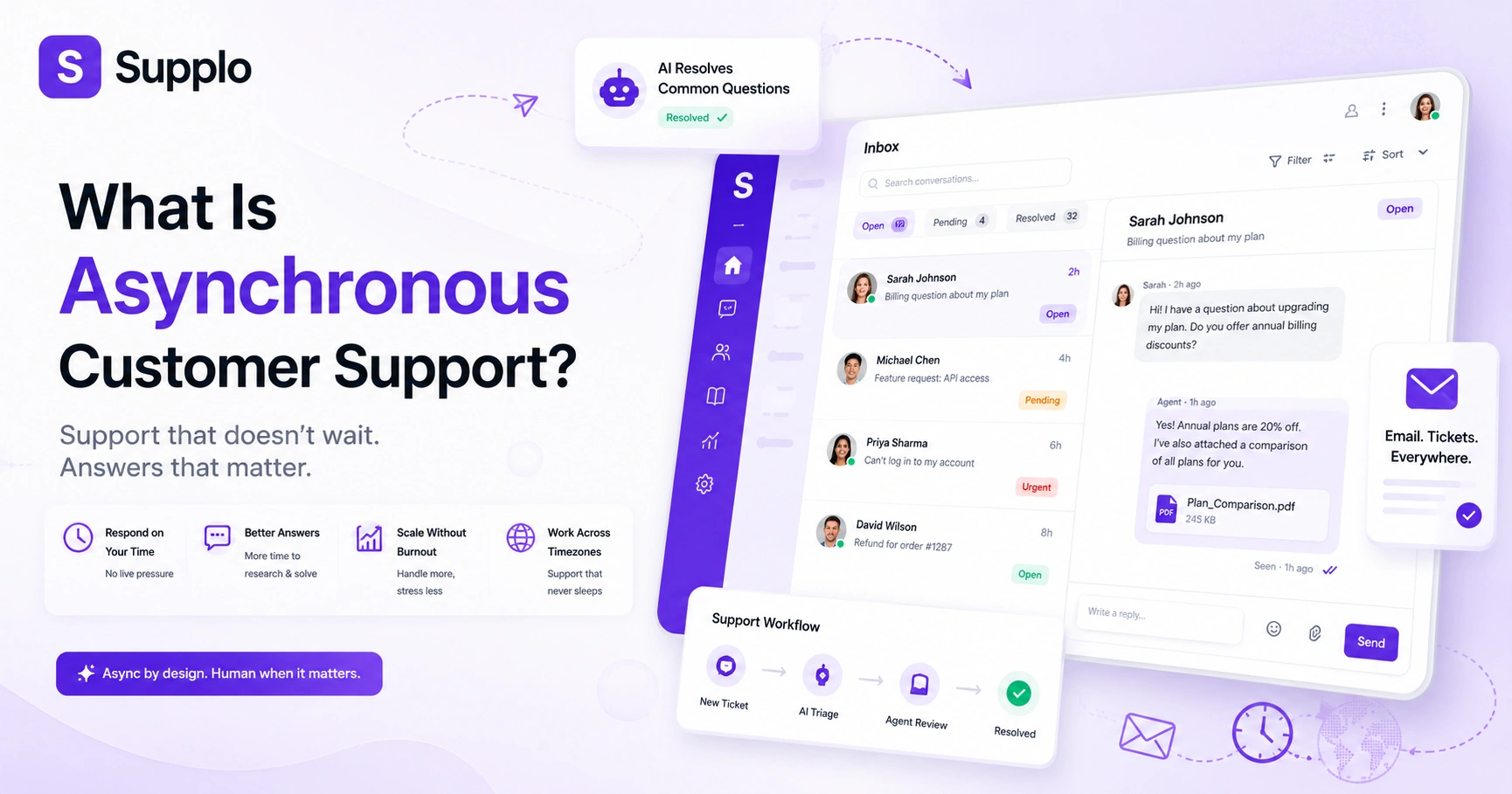
Asynchronous communication in support means the conversation happens in steps rather than a single stream. A customer sends an email or submits a form. Your system creates a ticket and assigns it to the right agent. The agent reviews the issue, writes a response, and sends it. Hours later, the customer reads the reply and continues the thread, without ever needing to explain the problem again. The entire history stays intact, visible, and searchable.
- Practice example: A customer emails support at 9 PM. The AI agent resolves the ticket before morning. If it can't, it creates a thread for the team to review during business hours.
- Key feature: a shared team inbox where every response is attached to the original thread, not scattered across DMs.
- Async communication works best when you set response time expectations on your contact page or help center.
- Supplo's knowledge base and AI share the same data, so the bot gets smarter with every resolved ticket, reinforcing the async loop.
- This model also supports async-first workflows, such as taking a ticket home or batch responses during deep work blocks.
Support Without Real-Time Response: The Reliability Advantage
There's a common fear about support without real-time response: that customers will feel ignored. But in practice, async support is often more reliable than live chat. Why? Because every message is stored, tracked, and accountable. In live chat, conversations vanish when the window closes. With async support, the thread lives forever. Customers never have to repeat themselves, and agents never lose the full picture.
- Reliability in async support comes from a structured approach: tickets, statuses, assignments, SLAs, and response-time tracking.
- AI can fill the gap when humans aren't available. Supplo's AI agent resolves tickets around the clock, including on weekends and holidays.
- Customers trust async support more when they receive clear acknowledgment and expected response times upfront.
- Every channel (email, widget, Instagram DMs, WhatsApp) feeds into the same threaded inbox, no more supporting black holes.
- The reliability advantage is especially clear for global teams supporting multiple time zones without overnight coverage.
With async support, every conversation is documented, trackable, and never lost. Customers never have to repeat themselves, and agents never lose context.
Async Support for Remote Teams: Why Distributed Teams Need Async First
Async support for remote teams isn't optional; it's the foundation of efficient global support. When your team spans four time zones, expecting everyone to be available for live chat is unrealistic and unfair. Async support means agents in Tokyo pick up threads created during US business hours and respond when they start their day. There's no handoff meeting, no shift-swapping chaos. The work arrives in the inbox, and the agent works through it without the overhead of coordination.
- Remote async support eliminates the need for overlapping schedules or follow-the-sun staffing plans.
- Each agent sees the full conversation history; no one has to guess what happened before their shift.
- Supplo's AI translation means a Spanish-speaking customer can get a response from an English-speaking agent without language barriers.
- Asynchronous workflows give remote agents the autonomy to manage their own time and workload.
- Async support offers business benefits for remote teams, including lower turnover, higher productivity, and better customer outcomes across all regions.
Asynchronous Support Business Benefits: Cost, Capacity, and Customer Satisfaction
The asynchronous support business benefits are measurable: lower cost per ticket, higher ticket throughput per agent, and improved customer satisfaction scores. Because agents can handle multiple async conversations simultaneously without the one-at-a-time constraint of live chat, throughput increases, and because responses are written and complete, customers get answers they can refer back to. That reduces repeat contacts and improves CSAT.
- Async support is typically 30-50% cheaper per interaction than synchronous-only models.
- Each agent can manage 5–10+ async conversations concurrently vs 1 live chat.
- Written responses create a permanent knowledge library that the AI and your team can reuse.
- Supplo pricing for async-first teams is $0.04 per AI resolution, with no per-seat costs that penalize scaling.
- The combination of async workflows and AI automation makes this model practical even for very small teams.
How to Implement Asynchronous Support Without Breaking Your Existing Workflow
Implementing asynchronous support doesn't require a complete overhaul. Follow these steps to transition smoothly:
Audit your channels. Identify which are currently real-time and ask if they need to be. Move the email to a tracked ticket system.
Set response time expectations publicly. Add expected response times to your help center, chat widget, and auto-reply messages. Customers trust async support more when they know what to expect.
Implement an AI agent tier. Use email ticketing for async workflows and pair it with an AI that handles common questions before they reach humans.
Unify all async channels into one inbox. Consolidate email, WhatsApp, Telegram, Instagram, and Facebook Messenger into a single threaded view.
Train agents to batch responses. Encourage deep work blocks where agents respond to multiple tickets at once, using templates for common questions.
Keep live chat for urgent issues only. Set a threshold, account lockouts, and payment failures; route everything else to async.
Monitor and iterate. Track response times, resolution rates, and CSAT. Adjust SLAs and staffing as you learn what works.
How Supplo Makes Asynchronous Support Simple and Automated
Supplo was built from the ground up to support asynchronous-first. Our AI agent resolves tickets around the clock, our shared inbox keeps every async channel threaded in one view, and our pricing model ($0.04 per AI resolution) doesn't penalize you for embracing async workflows. Whether your team answers emails at 10 AM or WhatsApp messages at midnight, every response lives in the same thread. Translation is built in, so language is never a barrier to async communication.
- Supplo unifies email, website widget, WhatsApp Customer Support, Telegram, Instagram DMs, and Facebook Messenger into a single asynchronous inbox.
- The AI agent learns from your knowledge base and past conversations to accurately answer without human intervention.
- Human escalation is clean: if the AI can't resolve, the thread hands off to your team with full context.
- Pricing is flat per workspace, not per seat, so adding async channels costs nothing extra.
- Start with a 14-day free trial to see how async support works with your actual traffic and team.
Asynchronous support, automated and affordable. Supplo costs $0.04 per AI resolution, not $0.99. No per-seat pricing. No surprise bills as your team grows. Start your 14-day free trial and see how async support works with your actual tickets.
Key Takeaways
- Asynchronous customer support allows customers and agents to communicate without being present at the same time, no holds, no instant replies required.
- Async support reduces cost per ticket, improves response quality, and prevents agent burnout by removing real-time pressure.
- It pairs well with AI automation: Supplo's AI agent resolves tickets automatically and cleanly hands them off to humans when needed.
- Global teams, remote-first companies, and high-volume support centers benefit most from async-first workflows.
- Implementation requires auditing channels, setting expectations, and unifying all async channels into a single inbox.
FAQ
What exactly is asynchronous customer support?
Asynchronous customer support is a model where the customer and support team don't need to be present at the same time. The customer submits a question, and the team responds when they can, without anyone waiting on hold or watching a live chat bubble.
What's the difference between async and sync support?
Synchronous support requires both parties to communicate in real time (phone, live chat). Asynchronous support lets the conversation unfold over time (via email, ticket systems, or threaded inboxes). Async is better for complex or non-urgent issues; sync works for simple, time-sensitive problems.
Is async support slower for customers?
Not necessarily. Async support can feel faster because customers get a complete, thought-out answer instead of a quick placeholder. Combined with AI automation, many async questions resolve in minutes without any human involvement.
Can I use async support for live chat?
Yes. Many tools let you run your live chat widget in async mode, customers leave a message when no agent is online, and you reply when available. Supplo supports both live and async chat in the same widget.
What channels work best for async support?
Email, ticket portals, threaded messaging apps (Telegram, WhatsApp), social media DMs (Instagram, Facebook Messenger), and async chat widgets all work well. Supplo unifies all of these into one shared inbox.
Is async support suitable for remote teams?
Absolutely. Async support is ideal for remote teams spread across time zones. Agents respond during their working hours, and the inbox retains full conversation history, so no context is lost between shifts.
How do I get started with async support?
Start by evaluating your current channels, setting response time expectations, and using a tool that supports async workflows across email, chat, and social. Supplo offers a 14-day free trial to help you test the model.
Compliance line: Supplo is not affiliated with any app or website. Please follow each app's terms and local regulations.