On this page
First Response Time (FRT) is the time between when a customer sends a message and when a human (or AI) sends the first reply. It's the single most visible metric for how "fast" your support feels. While resolution time matters for your budget, FRT is what customers actually remember when they decide whether to trust you.
Who this is for: Support team leads, operations managers, and solo founders who want to set realistic, data-backed response time goals without burning out their team.
When to use this guide: When you're setting up a new support workflow, auditing your current SLAs, or trying to justify a tool investment to your boss.
When NOT to use this guide: If you're a one-person team handling 10 tickets a week. In that case, focus on accuracy first, speed second.
Quick Answer
- Live chat: Median under 60 seconds is good; under 30 seconds is elite.
- Email: First human reply within 1-4 hours is standard; auto-reply is expected immediately.
- Measure median, not average. A single long chat can skew your average by minutes.
- Pair FRT with CSAT. Speed without accuracy is just fast frustration.
- AI agents can handle 60-80% of first-contact questions instantly, dropping your FRT without adding headcount.
What Exactly Is First Response Time and Why Does It Matter?
First Response Time (FRT) is the time between when a customer sends a message and when a human (or AI) sends the first reply. It's the single most visible metric for how "fast" your support feels. While resolution time matters for your budget, FRT is what customers actually remember when they decide whether to trust you.
Here's the thing: FRT is the moment of truth in customer service. That first impression? It's everything.
- FRT is a vanity metric if tracked in isolation; pair it with CSAT for the full picture.
- A slow first reply erodes trust faster than a slow fix, because the customer feels ignored.
- The clock starts ticking the moment the customer hits send, not when your team clocks in.
- Live chat FRT expectations are seconds to minutes; email FRT expectations are hours.
- Speed comes from workflow, not heroics. The fastest teams use triage, not panic.
Compliance note: Supplo is not affiliated with any app or website. Please follow each app's terms and local regulations.
Live Chat First Response Time Benchmarks: The Numbers That Actually Mean Something
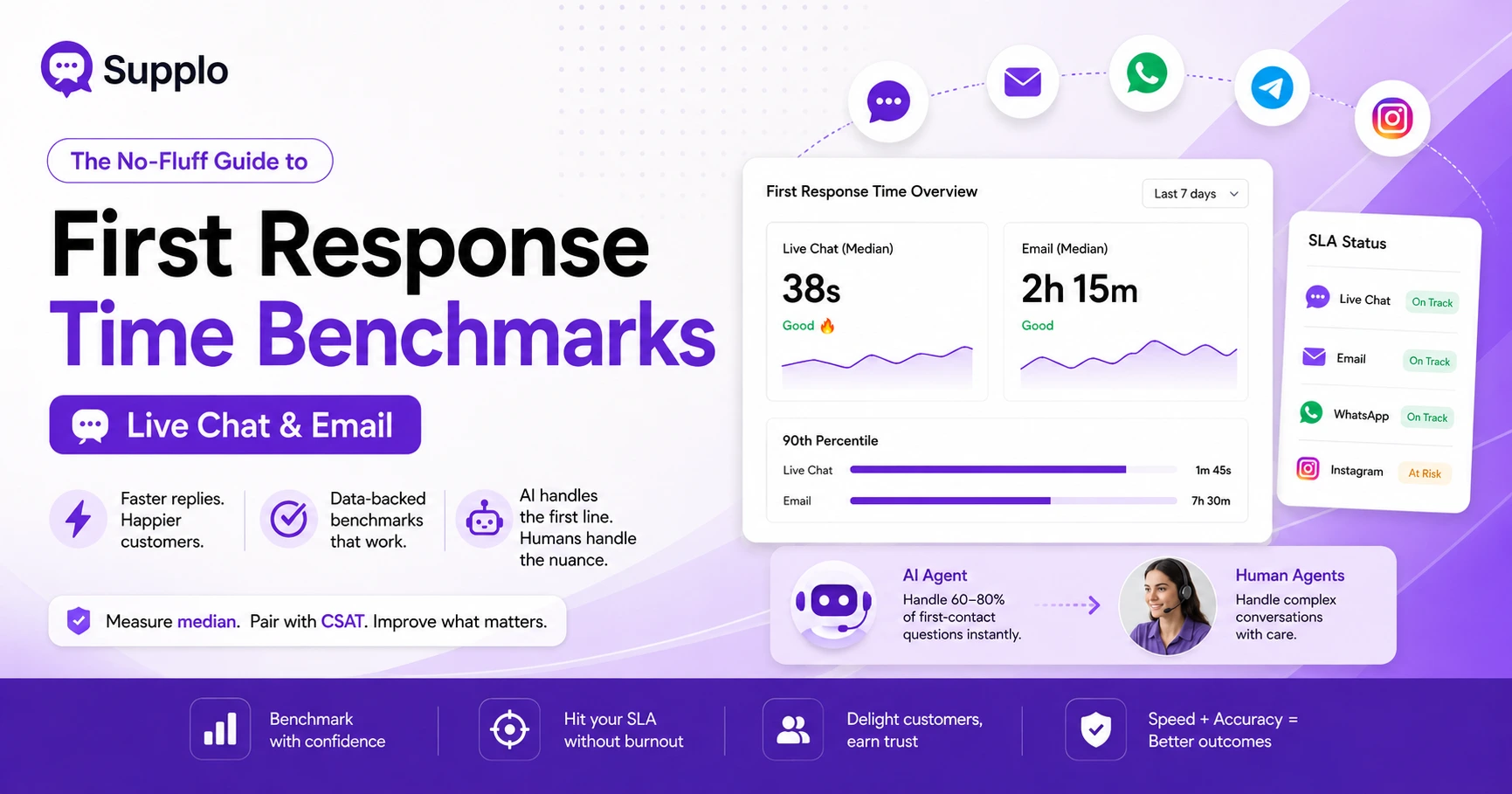
For live chat, the widely cited benchmark is a first response time of under 60 seconds. But here's the nuance: the median response time is a better metric than the average, because a few long-winded chats can skew your average. The real target for most B2B teams is 30-45 seconds, with a 90th percentile cap at 2 minutes.
Let's be real, a 60-second average sounds great until you realize one 20-minute chat just inflated your numbers. That's why smart teams track the median instead.
- A 60-second average FRT with a 10-minute standard deviation is a disaster in disguise.
- Top-performing support teams aim for a median under 40 seconds.
- Response speed is heavily influenced by routing; a smart conversation routing system can cut FRT in half.
- Real-time chat support works best when agents can see what the customer is typing before they send it.
- Quick chat response times are often a function of avoiding context switching, not of typing faster.
If you're using a live chat widget for your website, make sure it shows the customer when an agent is typing. That simple UI cue makes wait time feel 30% shorter.
These first response time benchmarks aren't just numbers; they're the difference between a customer who feels heard and one who feels ignored.
Email Support First Response Time Benchmarks: Realistic Goals for Real Teams
Email support has a different tempo. The industry standard for a first email reply is within 4 hours, but best-in-class teams shoot for 1-2 hours. The trick is to send an auto-acknowledgment immediately, then follow up with a real human reply that actually answers the question, not just a "we're looking into it."
No one likes getting a generic "we'll get back to you" that never materializes. Acknowledge the ticket, but don't stop there.
- An immediate auto-reply buys you time, but it doesn't count as a first response in most SLA definitions.
- Average email response time drops drastically when you use templates, snippets, and shared drafts.
- Customer email response benchmarks show that replies sent within 1 hour get 40% higher satisfaction scores.
- Email ticket response time is harder to control because it breaks the back-and-forth cadence of chat.
- Support email quick replies can be achieved by batching replies at the top of the hour, rather than answering every ping.
Suppose you're routing emails and live chat in a single workspace; set separate SLA targets for each channel. Don't let a slow email reply drag down your chat stats.
How "Best First Response Time" Varies by Industry (And Why You Shouldn't Obsess)
The "best" first response time is industry-dependent, but the gap is closing. E-commerce customers want instant answers on shipping; SaaS customers want competent answers more than fast ones. A 2-minute reply about a broken feature is worse than a 10-minute reply that fixes it. Stop chasing a number and start chasing relevance.
Here's the uncomfortable truth: your customers don't care about your benchmark; they care about their problem getting solved.
- E-commerce: Under 1 minute. If you're selling physical goods, people are anxious about their money.
- SaaS: Under 2 minutes for billing, under 5 minutes for technical issues (but prioritize accuracy).
- Healthcare & Legal: Speed is secondary to compliance; a 15-minute FRT with a correct answer beats a 30-second one with a disclaimer.
- Enterprises often have SLAs that penalize slowness with credits, making FRT a legal requirement.
- The worst mistake is to treat all customers the same. Your VIPs and your self-service users need different response cadences.
Chat Response Speed vs. Resolution Quality: The Trade-Off You Can't Ignore
Fast responses are useless if they're wrong or incomplete. The real goal isn't the shortest FRT; it's the shortest path to a resolution. If your team is slinging templated replies in 10 seconds but the customer has to re-explain themselves three times, you've optimized for the wrong metric. Measure FRT in the context of CSAT and first-contact resolution.
Think about it, would you rather wait 2 minutes for an answer that works, or 15 seconds for one that makes you type everything again?
- A high CSAT with a moderate FRT (e.g., 3 minutes) is far healthier than a low CSAT with a 45-second FRT.
- The best teams use a triage system: one person handles the initial response, another handles the deep dive.
- Automated ticket categorization and assignment directly improve both speed and quality.
- Real-time chat support benchmarks often ignore the "quality" half of the equation. Don't be that team.
- Live chat efficiency metrics should always include FCR (First Contact Resolution) paired with FRT.
Real-Time Chat Support Benchmarks: How to Measure What Matters (Median vs. Average)
When measuring response speed, stop relying on the arithmetic average. One lovely 90-minute chat will raise your average FRT by 30 seconds. Use the median (the middle value of all your response times) or the 90th percentile to understand how slow your slowest experiences actually are. Median below 1 minute is world-class.
If you're still looking at averages, you're lying to yourself about how you're doing.
- The median is the "typical" experience. The average is the "accountant's" experience.
- For a team of 5 handling 200 chats/day, a 2-minute average can hide a scenario where 20 people waited 8 minutes.
- Set a 90th percentile cap: e.g., "90% of all chats will receive a first response within 2 minutes."
- Tools like Supplo's shared inbox let you see live FRT dashboards for each agent and channel.
- Quick chat response times are best benchmarked against your own historical data, not industry averages.
Quick Chat Response Times Without Burning Out Your Team
No team can sustain 30-second responses for 8 hours straight without breaking. The solution combines AI triage, smart routing, and batching. Let your AI agent handle the initial response or routing for common questions, route complex tickets to senior agents, and batch less urgent email replies. You get speed without the burnout.
Your team isn't a machine. Don't treat them like one.
- The AI-first approach: your AI agent answers the "where's my order?" and "password reset" questions instantly.
- Human agents only touch conversations that need empathy, judgment, or escalation.
- Batch email replies in 20-minute blocks at set times during the day (e.g., 9 am, 12 pm, 3 pm).
- Live chat should be staffed with a dedicated rota to avoid context-switching hell.
- Quick chat response times come from a system, not from telling people to "type faster."
Catch your customers before they bounce. You don't need to scream into the void of a 2-minute wait. Supplo's AI agent handles the first line, and your human team handles the rest. Try it free for 14 days, no card required.
Email Support SLA Benchmarks: Setting Goals That Won't Kill Your Sanity
An email support SLA is a promise to reply within a certain time, not a promise to solve the problem. A realistic SLA for most B2B support teams is a reply within 4 hours, with a stretch goal of 2 hours. The key is to set different SLAs based on ticket priority: critical bugs get a 1-hour SLA, and feature requests get a 24-hour SLA. The mistake is having one SLA for everything.
Not every email deserves the same urgency. Know the difference.
- Priority 1 (billing/payment down): 60-minute SLA for first reply.
- Priority 2 (feature broken but workaround exists): 4-hour SLA.
- Priority 3 (feature request or bug report): 24-hour SLA.
- Use an auto-reply for P3 and P4 tickets to acknowledge receipt and set expectations.
- Support email quick-reply strategies often fail because teams try to apply the same SLA to all ticket types.
Why Your First Response Time Benchmarks Are Wrong (And How to Fix Them with AI)
Most teams set benchmarks based on outdated industry averages from 2019, or worse, from what their competitors claim. Your FRT benchmark should be based on your own data: ticket volume, team size, time zones, and complexity. AI agents can dramatically bring down your FRT by handling the first line, but the benchmark must still be human-validated.
Stop guessing. Start measuring.
- Your first step: audit your FRT data over the last 6 months. Find the median for each channel separately.
- Set a baseline, then improve by 10% per quarter. Don't try to jump from 5 minutes to 30 seconds.
- AI agents (like Supplo's self-learning AI agent that handles first-contact questions) can answer 60-80% of first-contact questions instantly.
- The AI handles the "what's my refund status?" while the human handles the "why did my subscription fail?"
- Fixing your benchmarks means fixing your routing. A ticket that pings the wrong agent is already late.
One team cut response times with AI by 40% in the first month by letting the AI handle the first line of common queries.
Your current first response time benchmarks are probably wrong. Let's fix it. Stop guessing. Supplo gives you real-time, per-channel FRT dashboards that show you the median, not just the average. AI handles the first reply, humans handle the nuance. Start your free trial.
The Tools That Help You Hit Your Response Time Goals
You can't optimize what you can't measure. A shared inbox that shows live FRT per channel is your first tool. Supplo's shared inbox with real-time response stats provides metrics on chat response time, email response SLA adherence, and AI agent resolution rates. Combine that with a smart routing system and a self-learning AI agent, and you're not just chasing benchmarks, you're setting them.
Here's what that actually looks like in practice:
- Supplo's shared inbox unifies live chat, email, Telegram, WhatsApp, Instagram, and Facebook into one view.
- The AI agent learns from your knowledge base and past conversations to answer common questions instantly.
- Multi-channel routing ensures a customer from email doesn't clog up your live chat queue.
- Flat-rate pricing with no per-seat fees means you can add agents without FRT-destroying budget decisions.
- Crypto, Binance Pay, and regional payment options make it globally accessible for teams on a budget.
Stop paying per seat to chase a number. Pay once, fix your response times. With Supplo, you get a shared inbox, an AI agent, and multi-channel routing for a flat monthly rate. No per-seat fees. No per-resolution meter. Just fast, human-friendly support.
Key Takeaways
- Live chat FRT benchmark: Median under 60 seconds. Email FRT benchmark: Under 4 hours.
- Measure median, not average. The average is easily skewed by one long conversation.
- Speed without accuracy is frustrating. Pair FRT with CSAT and First Contact Resolution (FCR).
- AI agents can handle 60-80% of first-contact questions instantly, lowering FRT without burning out your team.
- Set channel-specific SLAs. Don't treat email like chat, and don't treat a bug report like a billing issue.
FAQ
What is a good first response time for live chat?
A median first response time under 60 seconds is good; under 30 seconds is elite. Focus on the median, not the average, to avoid being misled by outlier conversations.
What is a realistic first response time for email support?
1-4 hours is standard for a first human reply. Immediate auto-replies are expected, but they don't count as your SLA. Critical tickets should have a shorter SLA.
How do I measure first response time correctly?
Track the median (middle value) and the 90th percentile (max time for 90% of chats). The average is easily skewed by one long conversation.
Does a faster first response time always mean better support?
No. Speed without accuracy is frustrating. Pair your FRT with CSAT and First Contact Resolution (FCR) to ensure you're fast and helpful.
Can AI help me improve my first-response time?
Yes. An AI agent can handle initial responses to common queries (password resets, order status) instantly, freeing your human team to focus on complex issues.
Should I set different first-response time goals for different channels?
Absolutely. Live chat should take less than 1 minute. Email can be under 4 hours. SMS and messaging apps like WhatsApp should take less than 5 minutes. Set channel-specific SLAs.
What is a good first response time for a small support team?
For a team of 1-5 people, a live chat median under 2 minutes is realistic. For email, aiming for a 4-hour SLA is achievable with smart batching and templates.
Compliance note: Supplo is not affiliated with any app or website. Please follow each app's terms and local regulations.