On this page
You run a successful e-commerce or SaaS company. Your team is lean, your product is solid, and your customers love you. Then peak season hits. A holiday flash sale goes viral, or your annual launch drops with a thud of customer questions. Ticket volume spikes 300–500% overnight, and your inbox turns into a war zone.
This article is for founders, support leads, and operations managers at small to mid-size teams who need to handle high ticket volume during peak season without tearing their hair out or blowing their budget. Use this guide when you see the surge coming. Do not use it if you are still running a pre-revenue side project; focus on building a great product first.
Quick Answer
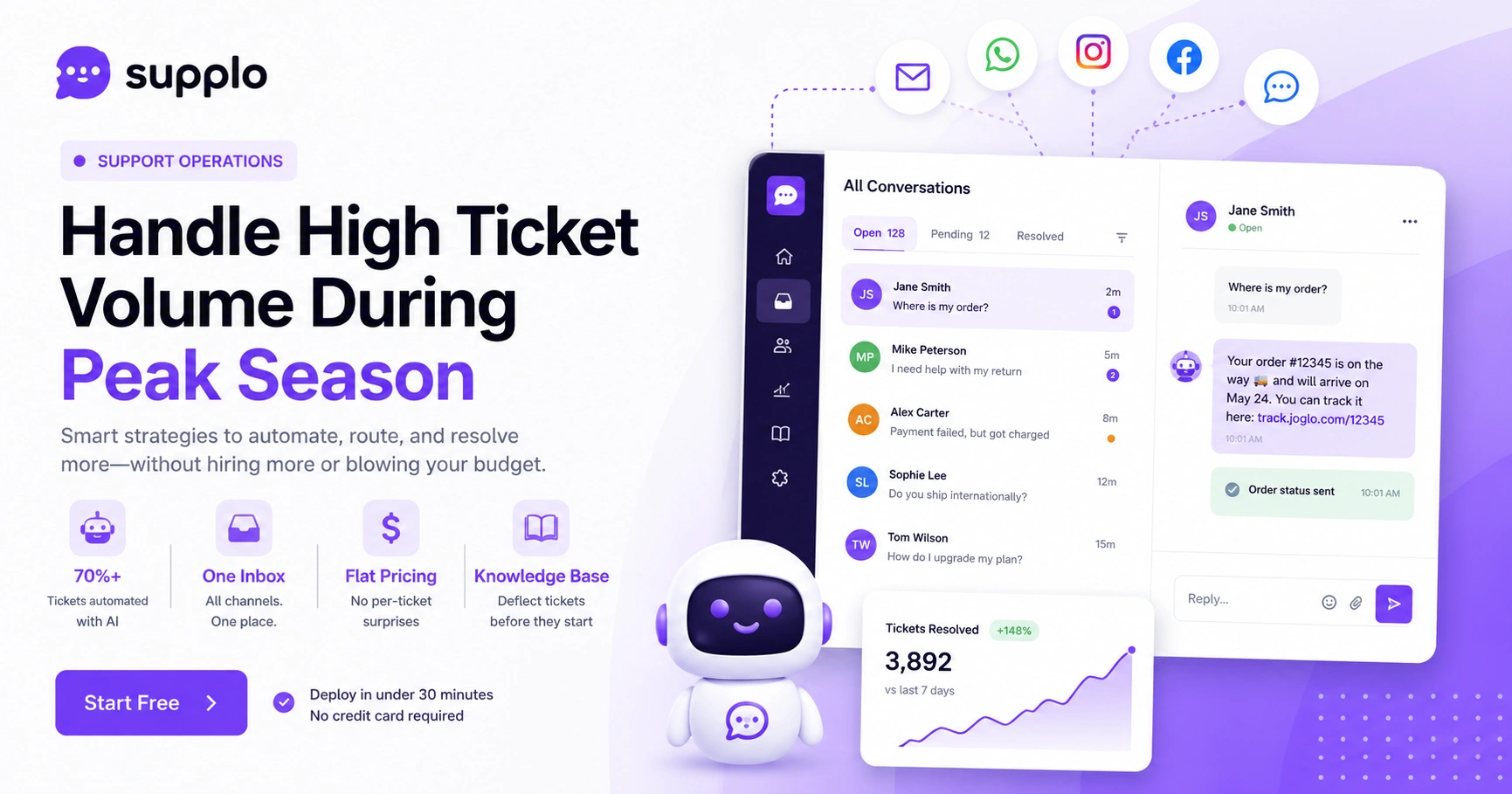
- Deploy an AI agent to automate 70%+ of repetitive tickets (shipping, returns, tracking) so humans handle only escalations.
- Use a unified inbox to route chat, email, WhatsApp, Instagram, and Facebook messages into a single queue, with priority rules.
- Ditch per-seat or per-resolution pricing; switch to a flat rate to avoid surprise invoices when volume spikes.
- Pre-build a peak-season knowledge base with your top 3 most common ticket categories to minimize ticket creation before a human even sees it.
Why Peak Season Customer Support Volume Crushes Most Teams
Here's the thing most people miss: most support teams run at 60–70% capacity during normal months. That's fine for Tuesday at 2 PM. But when holiday sales, flash promos, or seasonal launches hit, ticket volume can spike 300–500% overnight. Literally.
The crushing part isn't the volume itself; it's that most tools are priced per-seat or per-resolution. So scaling up means a bill that destroys your margins before you've even closed the sale. Teams panic. They hire temps. They buy more licenses. And they end up with a mess.
A team with five agents on a per-seat platform might pay $30/seat. Adding ten more agents for eight weeks costs $9,600 before overtime. That dead cost eats into revenue from the very sales that caused the surge. Your four-hour SLA becomes an empty promise, and customers during peak season are far less patient; waiting 20 minutes can trigger a chargeback or a refund request.
Peak season isn't a test of how fast your team types. It's a test of how smart your support infrastructure is.
The 4 biggest mistakes teams make when tickets spike 5x overnight.
- Hiring first, routing second. Teams add people before fixing how tickets are assigned. Most support queues route everything to the same person because "that's how we always did it."
- Ignoring deflection until it's too late. Without a knowledge base or AI triage, agents answer, “Where is my order?” 40 times a day. That time could be spent on issues that require real judgment.
- Using tools that charge per resolution. A well-intentioned AI chatbot with per-resolution billing (like some legacy tools at $0.99/resolution) can turn a good sales week into a $5,000 surprise invoice.
- Forgetting the customer's real-time expectation. During peak season, customers expect answers in under 60 seconds, not 60 minutes. Queue abandonment after 30 seconds is already 40%.
The 4 Peak Season Customer Service Challenges You Can’t Ignore
Every seasonal surge brings four specific pain points that compound fast. Solve these four, and you survive. Ignore anyone, and you're in trouble.
- Queue bloat, tickets pile up faster than you can dispatch them because routing is broken, not because agents are slow.
- Agent burnout: the same people answer the same shipping questions for 12 hours straight. Seasonal temp agents often quit mid-season, doubling recruitment costs.
- Tool friction, your live chat platform crashes or lags under load. Most lightweight solutions break at 200+ concurrent conversations.
- Cost explosion, every extra ticket costs you $0.50 to $3.00 each under per-resolution billing. A good week becomes a margin disaster.
The "real-time" expectation worsens during peak hours. Customers who waited politely during the normal season suddenly expect instant support the moment they hit "submit." Addressing these four challenges with a structured plan is the only way to handle high ticket volume during peak season without losing control.
How to Build a Customer Service Peak Season Plan That Actually Works
A good peak season plan isn't a spreadsheet of "who works Black Friday", it's a redundancy-first strategy. Start by auditing your current ticket types: shipping, returns, billing, and account issues. Assign each to a routing lane based on complexity and urgency.
Pre-write 80% of your standard replies and your peak-season knowledge base into the platform. A knowledge base that agents and customers can search reduces ticket creation by up to 40% before a human even sees it.
Then test your live chat widget under load by simulating 500 concurrent conversations in a staging environment. Most tools crash at 200 concurrent chats. Supplo's widget is built to handle this surge without performance loss.
Finally, budget for overflow. Define the triage tiers: urgent (payment failures), medium (order questions), and low (feature requests). Route each tier to the appropriate human or AI handles.
Ready to test your peak season plan without spending a dime? Start free at supplo.io, deploy your AI agent in under 30 minutes—no credit card required.
Scaling Support for Seasonal Spikes, It’s Not Just About Headcount
The instinct when tickets double is to hire more people. That is expensive, slow, and creates onboarding overhead that eats into your peak window. Scaling support for seasonal spikes means layering automation on top of your human team, so your existing agents handle only the complex, high-touch tickets. In contrast, an AI agent automatically resolves the repetitive ones.
Think of it as "horizontal scaling" your support capacity without adding to your payroll.
- Human-only scaling: hire 5 temps, train for 2 weeks, work for 4 weeks, let them leave. Repeat next year. Cost: ~$8k–$15k per agent annually.
- Automated scaling: deploy an AI agent in the morning. Handles shipping, return, and FAQ tickets. Costs $0.04 per resolution. Scales infinitely.
- Hybrid approach: AI deflections + human triage for escalations. You can handle 5x volume with 2x headcount.
A merchant using Supplo's AI agent handled 4,200 tickets in a peak week with just 1.5 human agents, a 73% deflection rate. See case studies how a team handled 4,200 tickets in one peak week with 1.5 agents. That is scaling support for seasonal spikes without the headache.
Already overwhelmed, and tickets are piling up? Head to supplo.io/pricing and get flat-rate access. AI resolutions at $0.04 each. No per-agent fees, no surprise bills.
Live Chat High Ticket Volume: How to Keep Queues Moving in Real Time
When live chat queues grow past 5–7 conversations per agent, response times tank and customers abandon. The fix isn't "type faster", it's structured queue management.
Use priority routing: pay premium customers or urgent issues, skip the queue. Set auto-away triggers so agents are not accidentally overloaded: when an agent reaches 8 concurrent conversations, the system automatically marks them as away.
Deploy an AI triage layer that answers simple questions instantly while passing complex tickets to humans. Supplo's live chat widget handles this natively, no plugin circus. The AI agent answers "Where is my order?" in under 2 seconds. Only refund disputes or technical issues escalate to a human.
The math is brutal: after 30 seconds without a response, 40% of chat visitors leave. After 60 seconds, it's 70%. Live chat high ticket volume demands speed, not hiring.
Scaling Live Chat During Peak Without Hiring 20 Temp Agents
The biggest trap during peak season is the "agent reflex", throwing bodies at the problem. Instead, scale your live chat by turning it into a multi-modal system.
Route WhatsApp, Instagram, Facebook Messenger, and email into the same multi-channel inbox that unifies chat, email, and social DMs. One agent can handle all channels simultaneously without toggling between tabs. Automated responses for common intents, shipping, return, tracking, and get pre-trained AI answers in under 2 seconds.
Supplo combines live chat, email, and social DMs into one workspace with a flat rate, no per-seat pricing to punish you for growing volume. Handling 10,000 AI-resolved tickets at $0.04 each costs $400. The same tickets on legacy per-resolution tools cost $9,900. Scaling live chat during peak shouldn't bankrupt your company.
The Only Sane Way to Handle Instant Support for Seasonal Demand
Instant support for seasonal demand sounds great, but most AI chatbots are either too dumb (they give wrong answers) or too expensive (they charge per conversation). The sane middle ground is a self-learning AI agent that trains itself on your existing knowledge base and conversation history.
It learns from each interaction and improves accuracy over time. For peak season, you train it on your most common holiday questions in one afternoon, then turn it loose. Supplo's AI agent is built for this exact scenario, no training data dumps required.
The "waiting room" effect is real: AI answers the queue while humans handle escalations. No customer waits more than 10 minutes. Supplo's AI agent scores a 95%+ satisfaction rate on automated resolutions in real-world deployments. AI customer support peak season doesn't mean sacrificing quality; it means meeting volume with speed and accuracy.
How to Automate 70%+ of Repetitive Tickets Without Making Customers Angry
Customers hate talking to robots that can't understand them. But they love fast answers when the robot actually works. The key to automating 70%+ of high-volume tickets is a conversation-first AI agent, not a dumb keyword matcher.
It needs to understand intent (not just words), pull answers from your knowledge base in real time, and gracefully hand off to a human when it's stuck. Supplo's AI agent that automatically handles repetitive tickets does exactly this: it reads your previous conversations, learns your responses, and starts resolving tickets with zero setup.
High-volume tickets are repetitive tickets. Shipping status, password resets, and billing issues are 100% automatable. The handoff is critical: when the AI agent can't answer, it transfers the full context to a human so the customer doesn't have to repeat themselves. Supplo's AI agent trained on your knowledge base in minutes. No machine learning degree required.
AI Chatbot Peak Season vs. Human Agents: When to Use Each for AI Ticket Resolution Peak
During peak season, you'll hear two opposing takes: "AI chatbots are the only way" vs. "Customers need humans." The truth is a tiered system.
Use AI for the first 3 interactions; it lowers the cost of entry and defuses the simplest questions. Then hand the issue off to a human if it escalates. AI ticket resolution peak works best for order status, return policy, shipping delays, and account access. Human agents handle refund disputes, damaged items, loyalty complaints, and escalated issues.
- AI handles: "Where's my package?" "Can I change my shipping address?" "What's your return policy?", all under 5 seconds.
- Humans handle: "My order arrived broken, AND you charged me twice", anything requiring nuance or judgment.
The tier system, AI → human triage → supervisor, reduces human interaction by 60–80%. AI ticket-resolution peak means your AI agent handles the surge of simple tickets, so humans don't drown in the complex ones.
Strategies for High Ticket Volume That Don’t Require an Engineering Degree
You don't need to build custom integrations or hire a team of developers to survive peak season. The strategies that work are straightforward.
- Use a unified inbox so one agent handles all channels, email, chat, WhatsApp, Instagram, Telegram, and Facebook.
- Deploy an AI agent that trains itself, no training data dumps required. Just upload your FAQ or connect your knowledge base.
- Use flat-rate pricing, no per-seat fees, no per-resolution fees. AI resolutions cost $0.04 each. Supplo offers a flat monthly rate with AI resolutions at $0.04 each, making it predictable and affordable.
- Pre-write your peak season knowledge base, cover shipping cutoffs, return windows, gift wrapping options, and common billing questions.
Supplo checks all these boxes in minutes. No-code setup: the widget is a 2-line snippet. The AI agent trains itself from your conversation history. Flat-rate billing means no surprise invoices, no matter how high-volume spikes.
Supplo is not affiliated with any app or website. Please follow each app's terms and local regulations.
Don't let peak season crush your team again. Go to supplo.io now. Set up your unified inbox and AI agent in one session. Flat rate. No engineering degree required.
Key Takeaways
- Peak season support volume spikes 300–500% overnight, and per-seat pricing is the fastest way to destroy your margins.
- Automate 70%+ of repetitive tickets with an AI agent that resolves at $0.04 each, significantly cheaper than legacy per-resolution tools.
- Use a unified multi-channel inbox with priority routing so agents can handle all channels from a single workspace.
- Build a peak-season knowledge base before the surge, and test your live chat widget under a simulated 500-concurrent-chat load.
- The hybrid approach (AI for the first 3 interactions, human for escalations) reduces human interaction by 60–80% while maintaining high customer satisfaction.
FAQ
Why do customer support queues get so long during peak season?
Most teams still use per-agent pricing or legacy tools that can't scale. When volume spikes, the bottleneck is usually routing and tool capacity, not agent efficiency.
Can AI really handle 70% of peak season tickets without making customers angry?
Yes, if the AI understands intent (not just keywords) and can hand off to a human gracefully. Supplo's AI agent does exactly this, achieving 95%+ satisfaction with automated resolutions in real-world deployments.
What's the cheapest way to scale support during seasonal surges?
Use an AI agent that costs $0.04 per resolution instead of hiring temp agents or paying per-resolution fees. Supplo's flat-rate model means no surprise invoices.
Is it better to hire more agents or use AI for peak season?
Both, but start with AI for the first 70% of high-volume tickets. Then add 1–2 human agents for complex escalations. This costs less than hiring 10 temp agents.
How quickly can I set up an AI agent for peak season?
With Supplo, you can connect your knowledge base in under 30 minutes. The AI starts learning from your conversation history immediately and resolves tickets by the end of the day.
What types of tickets should I automate vs. keep human?
Automate: shipping status, returns, order tracking, and billing questions. Keep human: refund disputes, damaged items, loyalty complaints, complex escalations.
How do I prevent my live chat widget from crashing during peak load?
Use a tool built for high concurrency. Supplo's widget handles 500+ concurrent conversations without lag. Always load-test your chat widget in a staging environment before peak.
What happens when the AI agent can't answer a question?
The AI transfers the full conversation context, including history, to a human agent. The customer never has to repeat themselves, and the human picks up right where the AI left off.
Compliance line: Supplo is not affiliated with any app or website. Please follow each app's terms and local regulations.