On this page
If you're shopping around for customer support AI, you've almost certainly run into Intercom Fin. It's the flashy AI agent they market as a self-learning ticket resolver that pulls answers straight from your help center. Sounds great on paper. But does it actually deliver without burning a hole in your budget? This Intercom Fin AI review cuts through the marketing fluff to look at what Fin actually does, where it stumbles (especially on cost), and why a growing number of teams are ditching the per-resolution model for something more predictable.
This guide is written for support managers, ops leaders, and founders at small-to-mid-market teams. Whether you're considering Fin or already using it and wondering if there's a smarter way, you're in the right place.
Quick Answer:
- What it is: An AI chatbot layer that lives inside the Intercom platform to answer support questions automatically.
- Cost trap: Charges roughly $0.99 per AI resolution. As your ticket volume grows, so does your bill, fast.
- Performance: Solid on simple, straightforward FAQs. Struggles with nuanced, multi-step, or multilingual queries.
- Biggest problem: The per-resolution model punishes automation success. The more you use it, the more you pay. That's backward.
- Better alternative: Flat-rate platforms like Supplo offer comparable AI performance with predictable billing and no per-seat fees.
What Is Intercom Fin AI?
Intercom Fin is an AI agent built directly into the Intercom customer service platform. Its job is to handle routine support questions by learning from your help center articles and past conversations.
Key features include:
- Train your knowledge base content to answer questions on its own.
- Handles multilingual replies, but only if you've already translated your help center content. No real-time magic here.
- Supports escalation rules so it can hand off to a human when it gets stuck.
- Fully integrated into the Intercom ecosystem, there's no standalone version.
Fin works best when your help center is well-organized, and your customers ask predictable, single-step questions. In that scenario, it can deflect a decent chunk of low-tier tickets.
But here's the catch: Fin is tightly locked into Intercom. You can't use it as a standalone chatbot. And its performance takes a nosedive when faced with less structured content or non-standard phrasing.
Intercom Fin AI Pricing Review: The Per-Resolution Tax Explained
Alright, let's talk money. This is where things get rough. Intercom Fin charges per resolution, roughly $0.99 each on top of your base seat price. That means you get billed every time Fin successfully answers a question without escalating. For a small team handling 5,000 automated resolutions a month, that's nearly $5,000 monthly just for the AI layer. And you're already paying hundreds per seat for the base platform.
The pricing model has several pitfalls:
- Opaque tiers: You have to contact sales for a quote. Per-resolution costs are rarely disclosed upfront.
- Monthly reset: Resolution tiers reset each month. If you exceed your limit, overage fees kick in.
- No unlimited plan: Every successful automated answer grows your invoice.
- Budgeting nightmare: Costs fluctuate with volume, making support spend unpredictable.
For growth-stage teams, this is a real problem. The more efficient your AI becomes, the more you pay. That's the exact opposite of what automation should deliver.
Intercom Fin AI Performance & Effectiveness Review
Fin performs well on routine, structured questions pulled straight from a well-maintained knowledge base. If your FAQ is tight and your help center articles are clear, Fin can handle 30–40% of inbound queries autonomously. But the moment a question is nuanced, multi-step, or relies on context from a previous ticket, accuracy drops noticeably.
Performance limitations include:
- Struggles with nuance: Multi-step queries, regional slang, or non-standard English often lead to incorrect or irrelevant answers.
- No real-time translation: Multilingual support requires your help center content to be pre-translated in every language you serve.
- No third-party data access: Fin can't natively pull order status, billing info, or CRM data, so custom integrations are required.
- Heavy human QA: The training loop improves over time but requires manual review to flag bad resolutions.
Fin is a useful tool for first-line deflection of simple tickets, but it is not a fully autonomous solution for complex support environments.
What Real Intercom Fin AI Customer Reviews Say
Customer reviews on platforms like G2 and Capterra paint a mixed picture—the praise centers on Intercom's polished chat interface and Fin's ability to deflect obvious questions. But the pain points are consistent: costs spiral unpredictably, the AI hallucinates when it lacks data, and migrating away from Intercom feels impossible once you've deep-integrated.
Common positive feedback:
- Setup is straightforward with clear onboarding.
- Deflects easy tickets immediately, reducing initial human workload.
Common negative feedback:
- Unexpected overage bills of $2,000–$3,000+ are frequently reported.
- No automatic hold on questionable answers; wrong replies go directly to customers.
- Strong platform lock-in makes switching difficult.
- Only cost-effective if you already use the full Intercom suite.
Fin caught 100+ easy tickets on day one, but our AI bill doubled in month three without warning. The per-resolution model feels like a tax on success.
The Biggest Problem with Intercom Fin AI: The Cost Reality
Let's be blunt: the per-resolution model punishes success. The more your AI agent resolves, the more you pay, exactly opposite of what you want from automation. For a team that grows its ticket volume, costs can inflate to $5k–$10k+ per month without any seat increase. That's not a feature; it's a ceiling on scalability for SMBs.
Why this matters for most teams:
- Designed for enterprises: Fin's pricing is suited to high-CAC B2B models, not mid-market or smaller teams.
- Budget volatility: Without a flat rate, monthly support costs are a moving target.
- Savings vanish: Reduce human headcount? The cost moves to the AI layer.
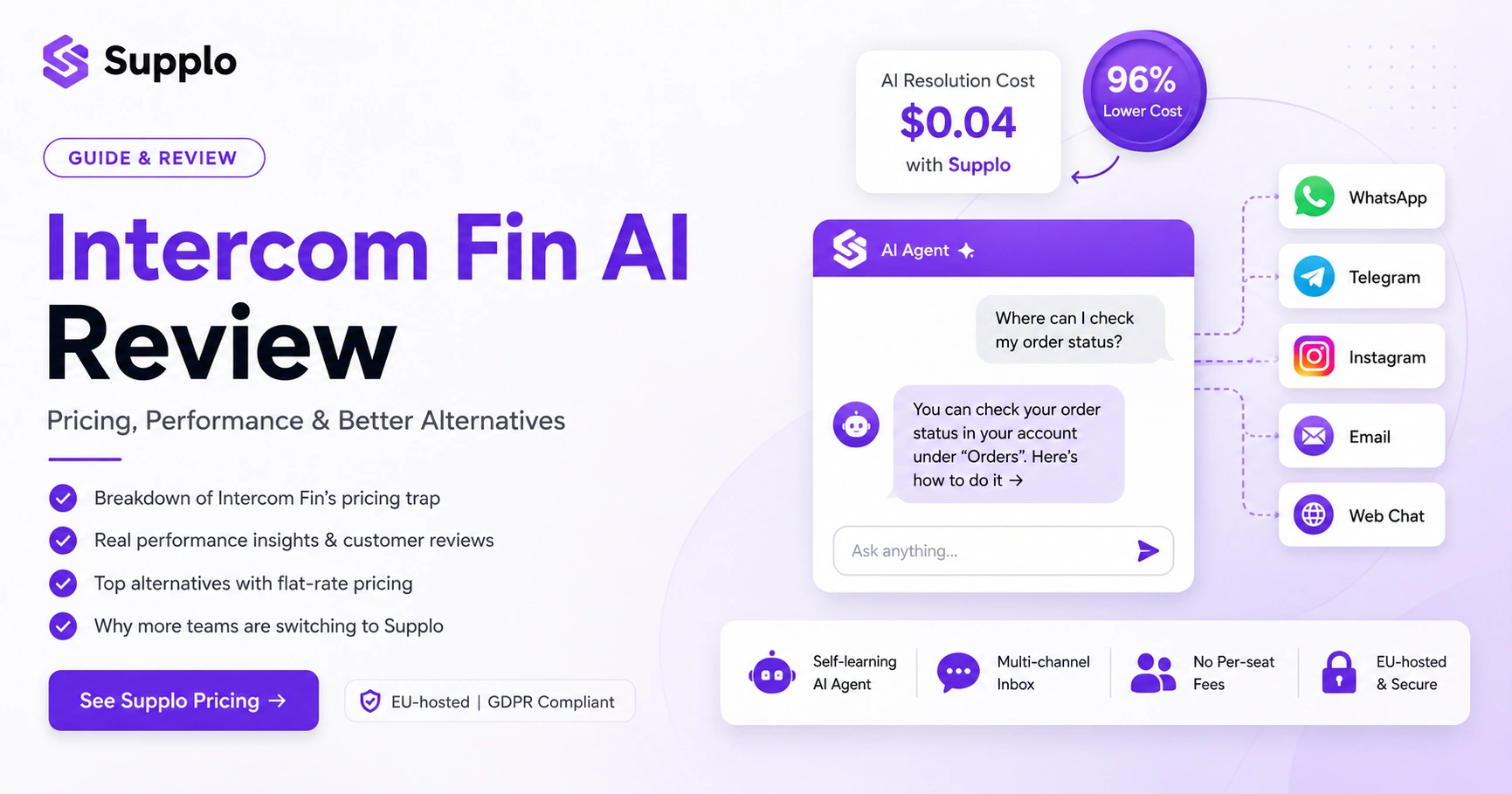
- Competition gap: Flat-rate alternatives charge roughly $0.04 per AI resolution, which is a 96% cost difference.
Many teams report that, after six months, Fin's AI costs exceed the savings from their human agents. You end up paying more for automation than you ever saved on labor.
If Intercom Fin's overage model makes you nervous, your alternative is one click away. Supplo charges $0.04 per AI resolution on a flat monthly plan, no overages, no seat fees. See Supplo pricing →
Best AI Chatbot for Support Teams: What to Look for Beyond Fin
The ideal AI chatbot isn't just smart, it's cost-predictable, easy to set up, and works across the channels your customers actually use. Look for flat-rate pricing (no per-resolution tax), no per-seat fees (so your whole team can reply without licensing costs), and native multichannel support beyond just web chat.
Key checklist for evaluation:
- Flat-rate billing: Know your maximum monthly cost upfront.
- No per-seat fees: Add agents, freelancers, or tools without price hikes.
- Native multichannel: WhatsApp, Telegram, Instagram DMs, email, and web chat in one inbox, no paid add-ons.
- Conversation-trained AI: Learns from actual ticket history, not just static FAQs.
- EU hosting option: Important for GDPR compliance and data privacy.
A great AI chatbot isn't just smart at answering, it's smart about how it charges you. Predictable cost is a feature, not an afterthought.
Top Alternatives to Intercom Fin AI (Without the $0.99 Per-Resolution Fee)
Some alternatives match or beat Fin on features while solving the cost problem. The best ones are all-in-one platforms that combine live chat, a shared inbox, and an AI agent under a flat monthly rate. They also tend to support more channels natively and have simpler onboarding without complex ecosystem lock-in.
What to prioritize:
- Native support for email, WhatsApp, Telegram, Instagram, and Facebook Messenger.
- An AI agent is included in your plan, not charged per resolution.
- Built in the last decade, newer platforms (like Supplo) are often EU-hosted and privacy-compliant by default.
Switching from a per-resolution model to a flat rate can save you thousands per month, especially if your team handles more than 1,000 automated tickets.
How Intercom Fin Alternatives Compare on Features & Reliability
Most Fin alternatives fall into two buckets: "cheap but feature-poor" or "feature-rich but just as expensive." The sweet spot is a platform that gives you Fin-level AI, multichannel routing, shared inbox, and analytics, all without the per-resolution or per-seat fees. Reliability means uptime, consistent AI answers, and predictable pricing.
Feature comparison checklist:
- Auto-translation: Natively translate messages in real time; Fin requires pre-translated content.
- Multi-platform inbox: One unified inbox for email, Telegram, WhatsApp, Instagram, and Facebook.
- AI review queue: Surface unresolved questions for human review without guesswork.
- No lock-in: Ensure you can export your data and switch platforms if needed.
The real test of an alternative isn't just feature parity, it's whether it works across your customers' preferred channels without nickel-and-diming you for each one.
The Smart Alternative: Why More Teams Are Switching from Intercom Fin
Teams are moving to platforms like Supplo for one reason: they get the core features of Intercom Fin without worrying about monthly AI bills. Instead of a $0.99 per-resolution model, you get a self-learning AI agent for $0.04 per resolution, no seat fees, and EU-hosted data security. It's built for teams that want premium support software without the premium invoice.
What Supplo offers that Fin doesn't:
- Supports 40–60% of inbound queries after training, comparable to Fin, at roughly 96% lower marginal cost.
- Native translation in the inbox; one agent can serve any language without a separate setup.
- Zero per-seat cost, add contractors, night team members, or overflow agents for free.
- See real team migration stories from teams that made the switch.
Ready to migrate from Intercom without the headache? Supplo imports your existing knowledge base and conversation history. You keep the features you love, multichannel, inbox, AI automation, and drop the unpredictable invoices. Get started now →
How to Test Your New AI Support Stack
Before committing to any platform, test with real traffic. Most AI support stacks (including Supplo) offer free trials and on-demand demos. The goal: see how the AI handles your actual customer questions, not a test dataset. Set up the widget, connect one channel (email or WhatsApp), and let it run on low-deflection mode for a week.
Testing plan:
- Start with a free trial of your chosen platform.
- Train the AI on your existing knowledge base and deploy on one channel.
- Measure deflection rate, what percentage did the AI answer without escalation?
- Monitor the "unanswered" queue to identify gaps and add content.
- Check speed: Answers should load in under 3 seconds.
- Test multichannel consistency: Does the same answer work on email and WhatsApp identically?
Run your test for at least two weeks. Initial deflection rates often drop once the AI sees diverse real-world queries; that's when you'll see its true capabilities.
Key Takeaways
- Intercom Fin works well for simple FAQ deflection but struggles with nuance and multilingual queries.
- Its $0.99 per-resolution pricing model creates unpredictable bills that scale poorly.
- Flat-rate alternatives like Supplo deliver comparable AI performance at roughly 96% lower marginal cost.
- Prioritize platforms with native multichannel support, no per-seat fees, and transparent billing.
- Always test with real traffic before committing to any platform.
FAQ
Is Intercom Fin AI worth the cost for a small team?
It depends on your volume. For teams with under 1,000 monthly tickets, Fin can be cost-effective. Above that, per-resolution charges add up fast. A flat-rate alternative often makes more sense.
How does Intercom Fin pricing work exactly?
Fin charges ~$0.99 per AI resolution—a resolution = a successful answer without human intervention. Overage penalties apply if you exceed your plan's resolution tier. There is no unlimited plan.
What happens if Fin AI gives a wrong answer?
Wrong answers get sent directly to the customer unless you have manual approval on. Intercom provides a "fin review" log where you can flag bad responses, but there's no automatic hold.
Can I use Intercom Fin without Intercom's full platform?
No. Fin is an add-on to Intercom's paid support suite. You cannot use Fin as a standalone chatbot.
What's the best alternative to Intercom Fin AI for mid-market teams?
Flat-rate platforms like Supplo offer comparable AI performance, live chat, shared inbox, and multichannel support without per-resolution fees. Supplo is not affiliated with any app or website. Please follow each app's terms and local regulations.
Does Intercom Fin support WhatsApp and Instagram?
Yes, through paid channel integrations. These are often additional add-ons. Some alternatives (like Supplo) include WhatsApp, Telegram, Instagram, and Facebook Messenger by default in the base plan.
How reliable is Intercom Fin for multilingual support?
Fair if your knowledge base has pre-translated content. Fin cannot translate in real-time. Alternatives with native auto-translation cover more languages more reliably.
Compliance line: Supplo is not affiliated with any app or website. Please follow each app's terms and local regulations.