On this page
If you're running a small-to-mid support team, you've probably asked yourself: AI chatbot vs live chat, which is better? The short answer is that neither wins alone. The best support system uses both, but knowing when to deploy each is the difference between a cost center and a competitive advantage.
This article is for founders, support leads, and ops managers who want to cut costs without cutting quality. Use it to decide where to invest your next support dollar.
Quick Answer
Here's the truth in one glance:
- AI chatbots handle 70–80% of routine queries (password resets, order tracking, FAQs) faster and cheaper than humans. No contest there.
- Live chat agents are irreplaceable for complex, emotional, or high-stakes issues (such as billing disputes, cancellations, or technical escalations). You can't fake empathy.
- Hybrid systems (AI deflects, human escalates) deliver the best CSAT while cutting costs by 40–60%. That's the sweet spot.
- Pricing trap to avoid: per-seat fees + per-resolution charges. Look for flat-rate models. Your budget will thank you.
- Bottom line: Don't pick one. Build a system that uses both.
Aren't AI Chatbots Just Fancy Autoresponders?
Nope. That assumption is about five years old. Modern AI chatbots, especially LLM-powered ones, don't just trigger canned replies; they understand context, recall conversation history, and even sense tone. The gap between an "auto-reply bot" and today's AI agent is roughly the same as the one between a flip phone and a flagship smartphone.
- AI chatbots now handle multi-intent queries (e.g., "I need a refund, but also check my order status").
- They can query your knowledge base, not just an FAQ menu.
- Self-learning models improve response accuracy over time without manual re-training.
- Some platforms (like Supplo's AI agent) resolve tickets end-to-end with zero human touch.
Modern AI chatbots don't just trigger canned replies; they understand context, recall conversation history, and even sense tone.
What an AI Chatbot Can Actually Do These Days
A capable AI chatbot can handle about 70–80% of first-contact support queries without escalation, password resets, order lookups, policy explanations, or even multi-step troubleshooting. They pull data from your knowledge base, CRM, and order systems in real time. The catch? They're only as smart as the data you feed them.
- Real-time translation across 100+ languages (Supplo's translation feature does this natively).
- Seamless handoff to a human agent when the bot hits its confidence threshold.
- Automated ticket creation and routing based on query urgency and department.
- Sentiment detection, if a customer types "I'm furious," the bot can flag it for immediate human review.
A capable AI chatbot can handle about 70–80% of first-contact support queries without escalation.
Quick Start: See it in action, not a demo, your own data. Start a free trial at Supplo.io. No credit card. No sales call. Just test the AI against your real tickets in minutes. Try Supplo Free.
Where Live Chat Still Wipes the Floor With AI
Let's be honest: live chat wins on empathy, nuance, and handling the weird edge cases AI can't predict. A human agent can read between the lines, apologize with a genuine tone, and pivot when a customer throws a curveball. AI still fumbles on sarcasm, complex negotiations, and emotional escalation.
- Humans can "break policy" gracefully (e.g., issuing a goodwill refund AI wouldn't authorize).
- Live chat handles multi-threaded conversations (switching between order, billing, and shipping issues) better.
- Customers rate human agents higher on satisfaction surveys for emotionally charged issues.
- But humans cost more, tire out, and need breaks. AI doesn't.
Live chat wins on empathy, nuance, and handling the weird edge cases AI can't predict.
AI Chatbot Automation Benefits That Actually Save You Money
The biggest automation win is deflecting tickets before they reach a human. Each deflection saves your team 3–8 minutes of handle time. At scale, that's tens of thousands of dollars annually. Supplo's AI agent costs about $0.04 per AI resolution, roughly 96% less than comparable solutions. That math changes your entire support budget.
- 24/7 coverage without night shift differentials or overtime pay.
- Simultaneous handling of unlimited conversations (humans max out at 3–5 concurrent chats).
- Auto-tagging, routing, and prioritization based on intent, not just keywords.
- Reduced average first response time from hours to seconds.
Each deflection saves your team 3–8 minutes of handle time. At scale, that's tens of thousands of dollars annually.
Pros and Cons of AI Chatbot vs Live Chat
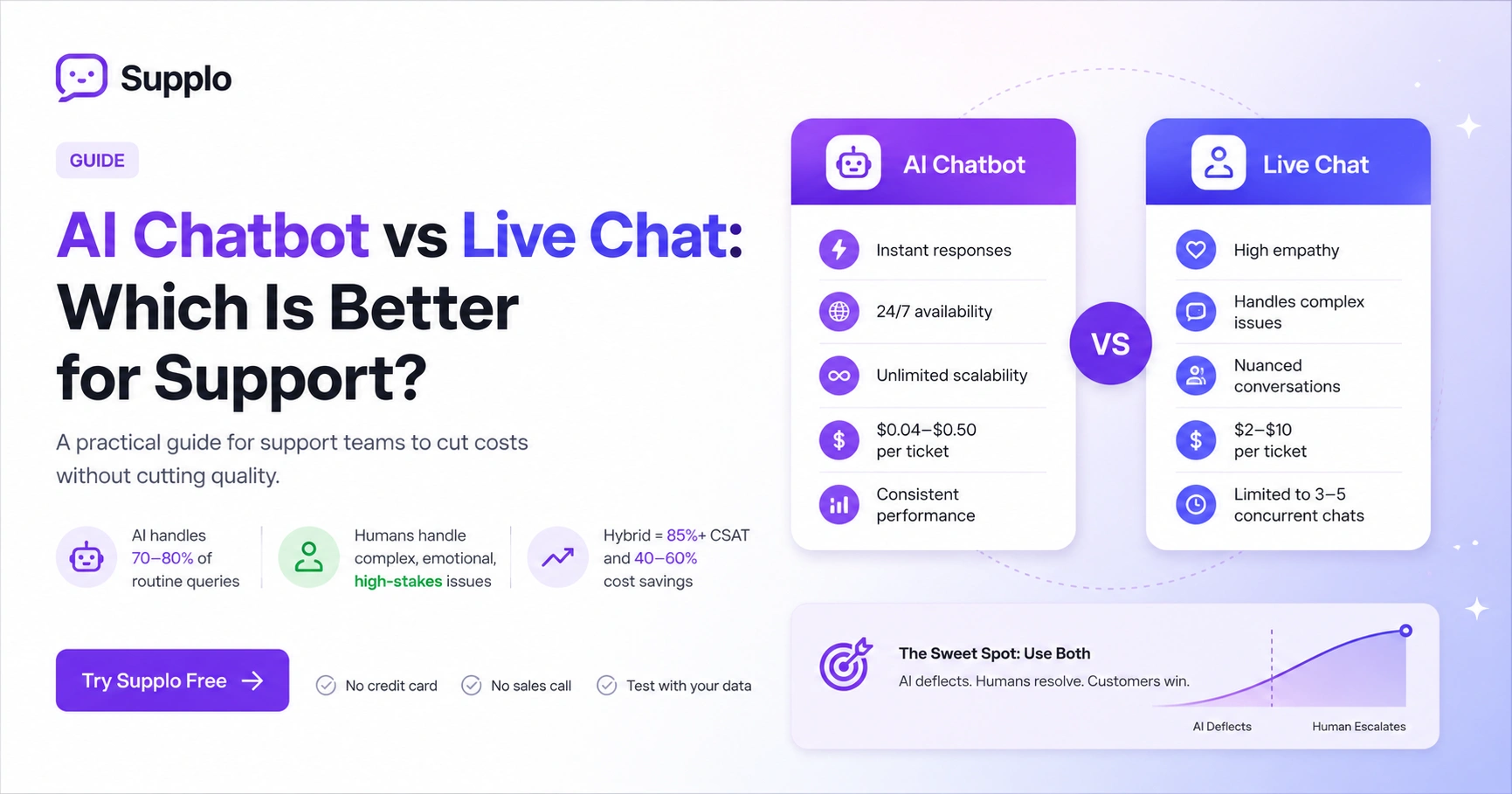
When comparing AI chatbots and live chat agents, the primary differences lie in their operational strengths. AI chatbots offer near-instant response times, unlimited concurrent chat scaling, and 24/7 availability, with costs typically ranging from $0.04 to $0.50 per ticket, while maintaining high response consistency. In contrast, live chat agents demonstrate high empathy and excel at handling complex issues. However, shifts limit them to managing only 3–5 concurrent conversations and cost $2–$10 per ticket, with performance naturally varying based on mood and fatigue.
- AI is better suited to high-volume, low-complexity queries (e.g., order status, password resets, FAQs).
- Live chat wins for high-stakes, low-volume issues (such as billing disputes, cancellations, and technical escalations).
- Hybrid models (AI deflects, human escalates) achieve 85%+ CSAT while cutting costs by 40–60%.
- The "wrong" choice usually comes from not analyzing your ticket data first.
AI Chatbot vs Human Agent for Support: When Do You Need a Pulse?
If the query fits a pattern, order tracking, password reset, policy lookup, and basic troubleshooting, AI handles it better and faster. If the query involves negotiation, complex troubleshooting, emotional support, or account-specific nuance, you need a human. The line blurs with advanced AI, but for now, humans still own the high-touch zone.
- Use AI for: "Where's my order?" "I forgot my password." "What's your return policy?"
- Use humans for: "I need a discount because my package arrived damaged", "Can you help me configure this custom setup?"
- AI with emotion detection can auto-escalate when sentiment dips below a threshold.
- Best practice: let AI handle the first 2–3 turns, then decide whether to escalate.
The Reliability Scorecard: Which One Crashes Less?
Reliability depends on implementation, not modality. A well-trained AI with a solid knowledge base will answer correctly 95%+ of the time on routine queries. But it can hallucinate or get stuck on edge cases. A human agent never hallucinates, but they call in sick, take vacations, and make mistakes when overwhelmed. The most reliable system is a hybrid that catches each other's failures.
- AI uptime is essentially 100% (servers are redundant). Humans have 70–80% availability (due to breaks, shifts, and sick days).
- AI consistency is high; it answers the same way every time. Humans vary by mood and fatigue.
- AI reliability degrades gracefully (it can say "I don't know" and escalate). Stressed humans snap.
- Monitor both with a feedback loop: track AI resolution rate, human escalation rate, and CSAT per channel.
How to Build a Hybrid Chat System That Scales
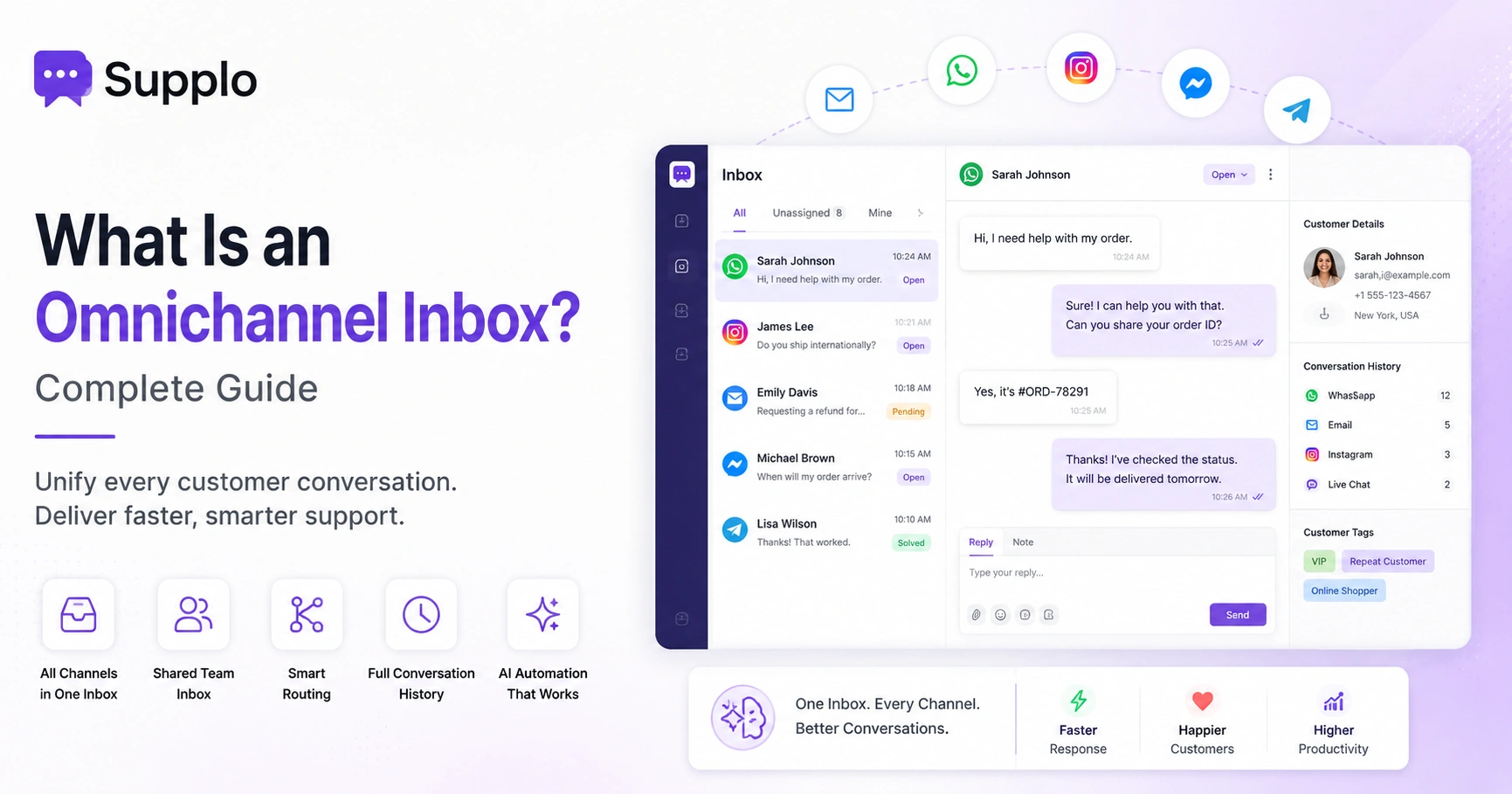
Start with a single shared inbox that (like Supplo's inbox) unifies live chat, email, WhatsApp, Telegram, Instagram, and Facebook DMs into a single queue. Train your AI on your top 20 ticket types; these typically account for 80% of the volume. Set escalation rules: AI handles level 1; humans handle levels 2 and 3. Then measure, tweak, and repeat.
- Use intent-based routing: billing queries to billing agents, tech issues to tech agents.
- Give your AI access to structured data (pricing tables, policy docs, order systems), not just free-form FAQs.
- Let your human agents "teach" the AI by correcting its answers; some platforms (like Supplo) enable this.
- Report on the containment rate (queries resolved without human intervention) weekly.
Step-by-step checklist:
- Audit your last 500 tickets and categorize them by complexity.
- Identify the top 20 query types (these will be your AI's first training set).
- Set up a shared inbox that routes all channels to a single queue.
- Configure AI to handle level 1 queries with a confidence threshold of 0.85.
- Define escalation rules for sentiment, intent, and confidence.
- Train your AI on your knowledge base and structured data.
- Launch with a "talk to a human" button always visible.
- Measure containment rate, CSAT, and AHT weekly for two weeks.
The Pricing Trap Most Businesses Fall Into
Many platforms charge per seat ($30–$100 per agent per month) AND per AI resolution ($0.50–$1.50 each). That math kills you at scale. Supplo's flat-rate pricing flips it: flat monthly rate for unlimited human agents, and AI resolutions at $0.04 each—no per-seat fee trap. No getting nickel-and-dimed every time a bot answers a question. For small-to-mid teams, this is the difference between profitable support and a cost center that bleeds.
- Competitors like Intercom charge per resolution AND per seat. Supplo vs Intercom shows the difference.
- If your team handles 2,000 AI-deflectable tickets/month at $0.04 vs $1.00, that's $80 vs $2,000, a $1,920 monthly difference.
- Beware of "free" chatbots that charge per contact or per knowledge base entry.
- Request a pricing audit using your current ticket volume to see real savings.
If your team handles 2,000 AI-deflectable tickets/month at $0.04 vs $1.00, that's $80 vs $2,000, a $1,920 monthly difference.
If your AI resolution costs feel high, you're paying too much. Switch to flat-rate pricing with AI at $0.04/resolution. Get a free migration analysis, see how much you'd save before committing. See Your Savings →
Which One Should You Pick?
You don't pick one. You build a system. Use an AI chatbot for 80% of repetitive, low-complexity volume. Use live chat (human agents) for the 20% that requires judgment, empathy, or flexibility. Pick a platform that unifies both in a single workspace with no per-seat gouging. And above all, pick one that makes the AI cheaper than the human, so you actually want to scale automation.
- If your team has fewer than 10 agents and is flooded with repeat questions, start with AI deflection.
- If your tickets are mostly unique or complex, start with live chat and gradually add AI.
- Measure: first contact resolution rate, average handle time, CSAT, and cost per ticket.
- Test-drive a platform like Supplo that offers both a free trial and no sales calls required.
Supplo is not affiliated with any app or website. Please follow each app's terms and local regulations.
What if you could run both AI and live chat under one flat roof, with no per-seat gouging? That's exactly what Supplo does. Unified inbox, self-learning AI, multi-channel routing. Billed flat monthly. No surprises. Start Your Hybrid Setup →
Key Takeaways
- AI chatbots are not just autoresponders; they handle 70–80% of routine queries with context and sentiment awareness.
- Live chat agents are essential for complex, emotional, or high-stakes issues.
- Hybrid systems (AI + human) deliver the best balance of cost, speed, and satisfaction.
- Avoid pricing traps: per-seat + per-resolution fees can double your costs.
- Start with a shared inbox, train AI on your top 20 ticket types, and measure containment rate weekly.
- Supplo case studies show real teams cutting costs while maintaining CSAT.
FAQ
Can an AI chatbot completely replace live chat and human agents?
No. AI handles about 70–80% of routine queries well, but the remaining 20–30% require human empathy, judgment, and flexibility. A hybrid approach delivers the best balance of cost, speed, and satisfaction.
What kind of queries should I route to a chatbot vs a live human agent?
Route simple, repetitive tasks to AI (password resets, order tracking, FAQs, policy lookups). Route complex, emotionally charged, or high-value queries to humans (billing disputes, cancellations, technical escalations, custom configurations).
Does using an AI chatbot reduce customer satisfaction scores?
It can if you deploy it poorly (no escalation path, robotic tone, incomplete answers). But when set up right, with smart handoff and natural conversation design, CSAT often improves because response times drop from hours to seconds.
How much does an AI chatbot actually cost compared to a live support agent?
A good AI chatbot can cost $0.04–$0.50 per resolution, while live agents cost $2–$10 per ticket (salary, benefits, overhead). At scale, AI is 10–50x cheaper, but you need to budget for setup and training.
Are there compliance or data privacy issues with AI chatbots?
Yes, especially if you're handling PII or financial data. Choose a platform that's EU-hosted (like Supplo) and ensure your AI vendor signs a DPA. Avoid tools that route data through third-party servers without encryption.
Will a hybrid setup confuse my customers?
Not if you design it well. Clearly label the chatbot as an AI assistant upfront. Offer an easy "talk to a human" button. Never hide that it's a bot; customers prefer transparency.
Which is more scalable in the long term: AI chatbots or live chat teams?
AI chatbots scale nearly perfectly (add customers without increasing costs). Live chat teams scale linearly (add customers, add agent headcount). For high-growth businesses, AI is the only scalable option, but you still need human backup for edge cases.
Compliance line: Supplo is not affiliated with any app or website. Please follow each app's terms and local regulations.