On this page
Who this is for: Support team leads, customer success managers, and operations heads at small-to-mid businesses who want to cut ticket volume without cutting headcount. This guide is for teams tired of paying per-resolution fees and ready for a flat-rate approach to AI support.
When to use AI ticket deflection: When your team is drowning in repetitive questions about pricing, account resets, shipping status, or product specs. Use it 24/7 to handle the easy stuff, freeing humans for complex issues.
When NOT to use it: Don't deflect refund disputes, legal complaints, or inquiries about sensitive data. Those need human judgment and empathy.
Quick Answer
- AI ticket deflection intercepts common queries via chat, email, or social DMs and resolves them without a human agent.
- The best strategies start with a knowledge base, use a self-learning AI agent, and route across multiple channels (WhatsApp, Telegram, Instagram, email).
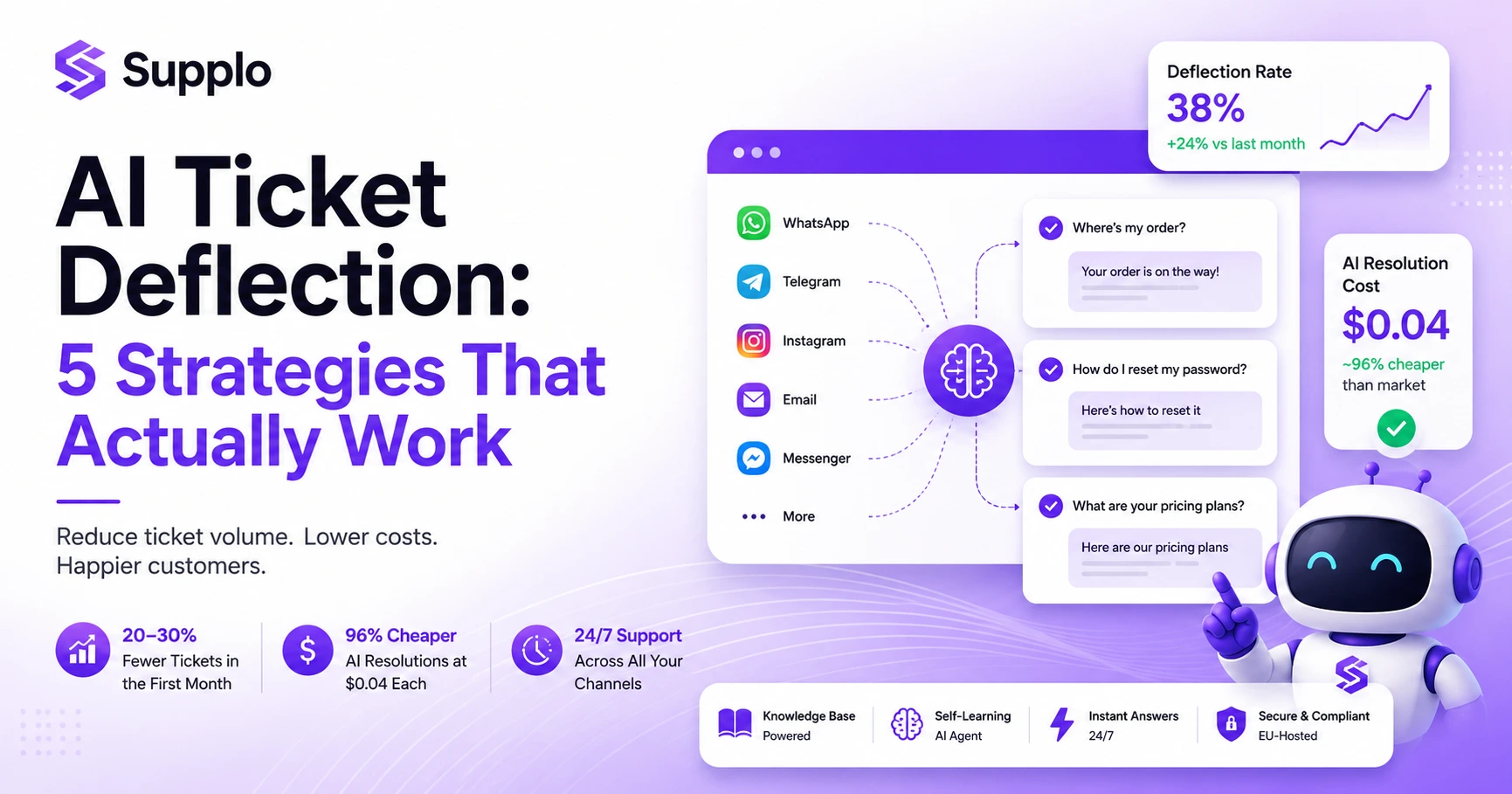
- Expect a 20–30% reduction in ticket volume within the first month if your knowledge base is solid.
- Reliable deflection depends on tools with flat-rate pricing; otherwise, per-resolution costs eat your savings.
- Supplo is not affiliated with any app or website. Please follow each app's terms and local regulations.
What is AI Ticket Deflection and Why It Matters for Your Bottom Line
Here's the thing: AI ticket deflection isn't about dodging your customers. It's about giving them answers before they even finish typing. The AI catches incoming requests from chat, email, or social DMs and serves up instant answers from your knowledge base or past conversations. No human touches it.
Why does this matter? Because every query deflected costs you pennies. Everyone who reaches a human? Dollars. The math doesn't lie.
You're not ignoring people. You're guiding them to solutions that work in seconds, not minutes. Customers actually prefer this for simple stuff; nobody wants to wait for an agent to tell them where their package is.
A well-tuned AI deflection system can reduce your support costs by over 60% in the first quarter.
Here's what makes it work: a solid knowledge base and a smart AI agent that actually learns. Without those two pieces, you're just throwing a chatbot at the problem and hoping for the best.
The Top 5 AI Ticket Deflection Strategies for Customer Support Teams
Let's cut through the noise. These five strategies actually move the needle. Pick three, implement them right, and you'll see your ticket count drop within weeks.
- Instant answer suggestions via a widget before a ticket is created. A small pop-up on pricing pages or the help center catches 90% of repetitive queries.
- Automated routing to FAQ sections based on keyword detection. When a customer types "password reset," the system displays the relevant article immediately.
- An AI agent that drafts responses for review. The agent handles the first draft; the human approves or adjusts it. Saves your team hours every day.
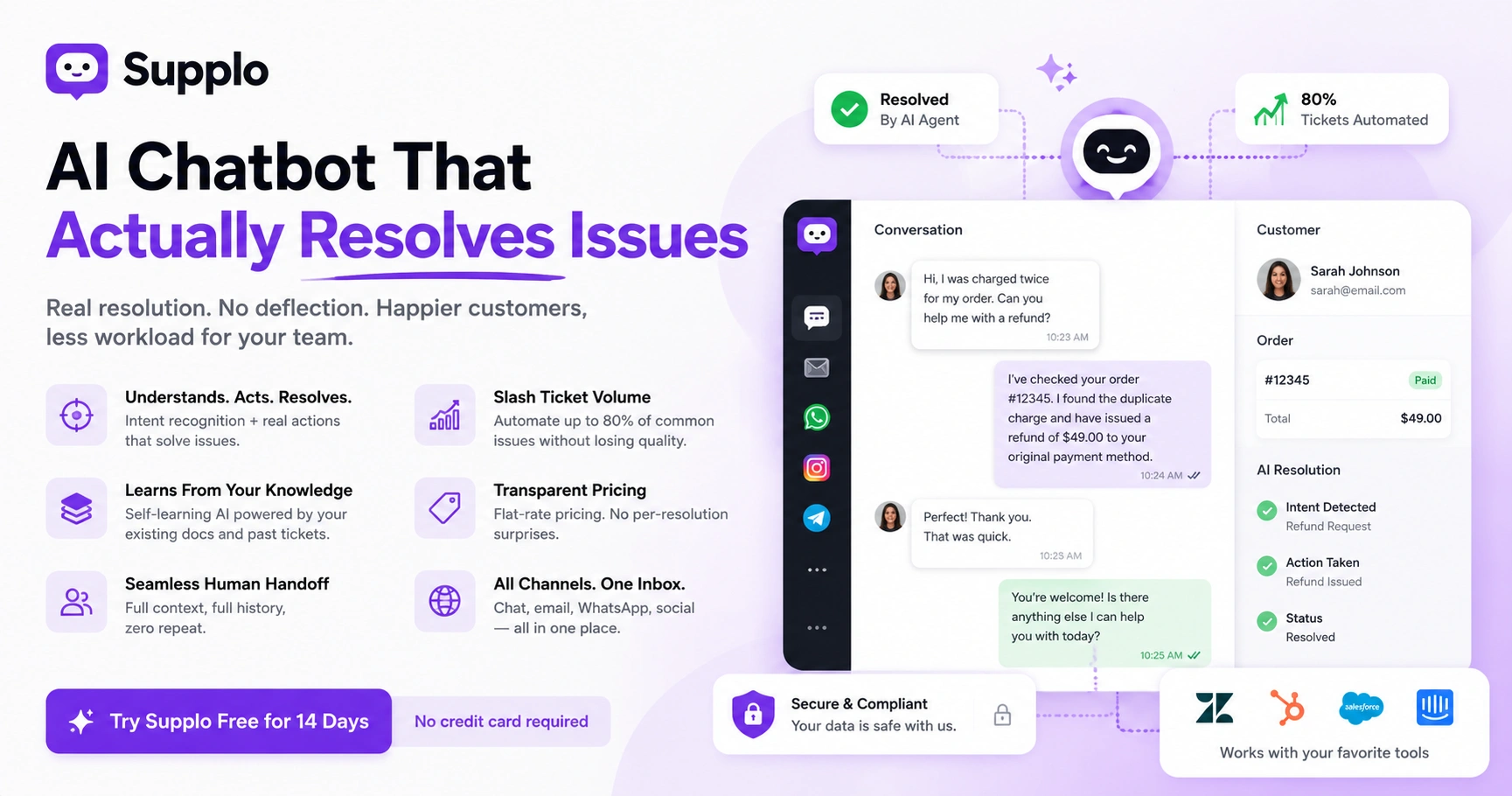
- Channel-specific deflection. Set up auto-replies on WhatsApp for tracking and account questions using Supplo's WhatsApp customer support integration. Works the same for Telegram and Instagram, too.
- Proactive pop-ups that answer questions before the customer asks. Does someone linger on your login page for 30 seconds? Your widget offers "Need help resetting your password?"
The secret to high deflection rates isn't a smarter bot. It's a better knowledge base.
That quote? It's true. Your AI is only as good as the material you feed it.
How to Set Up Automated Ticket Deflection Without Breaking Your Workflow
- Good news: you don't need a team of developers to set this up. It's honestly simpler than most people think.
- Audit your top 20 most-asked questions. These are your deflection targets.
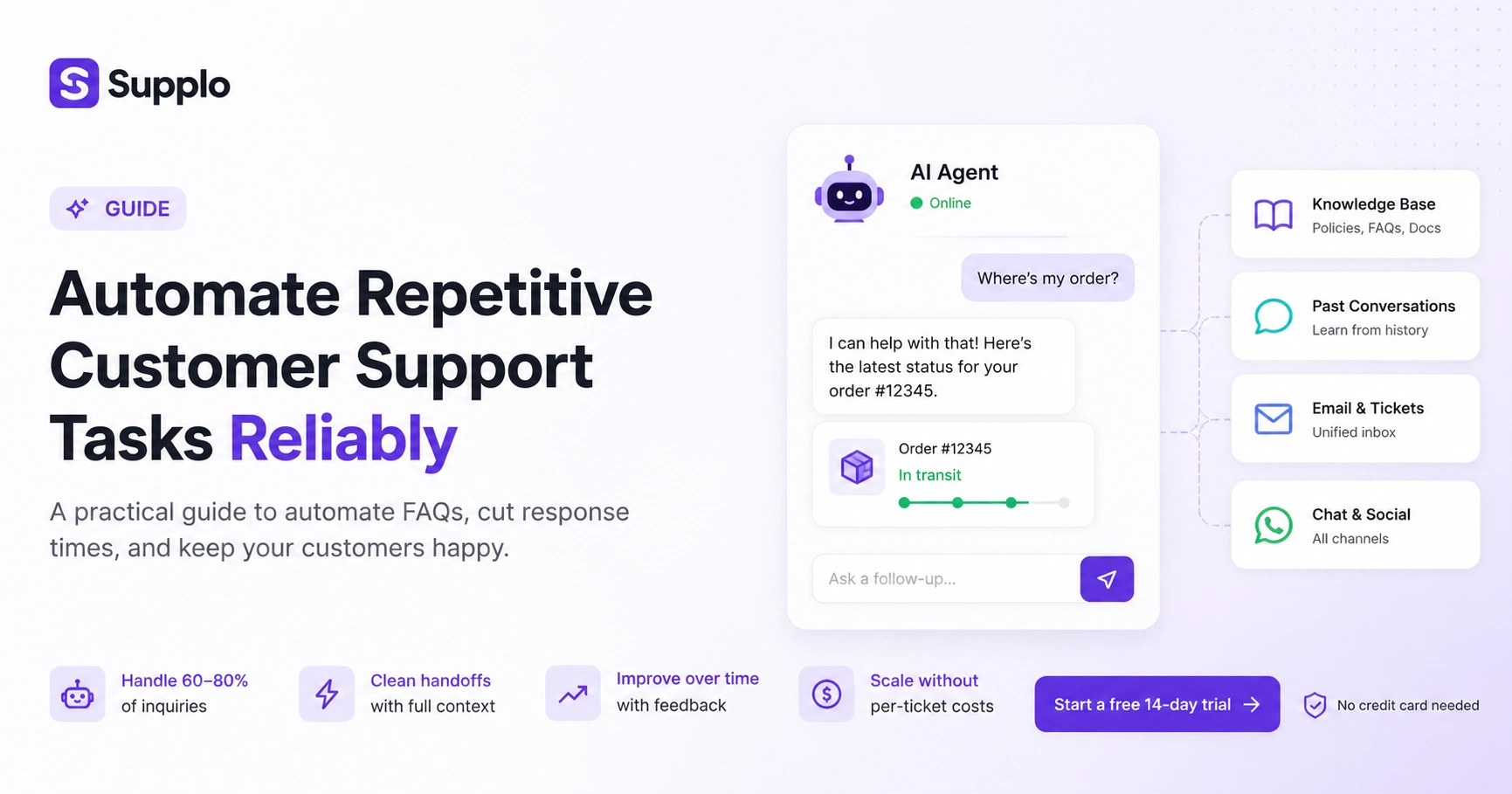
- Load those answers into a knowledge base. Supplo's knowledge base connects directly to the AI agent, so it just pulls from what you've already written.
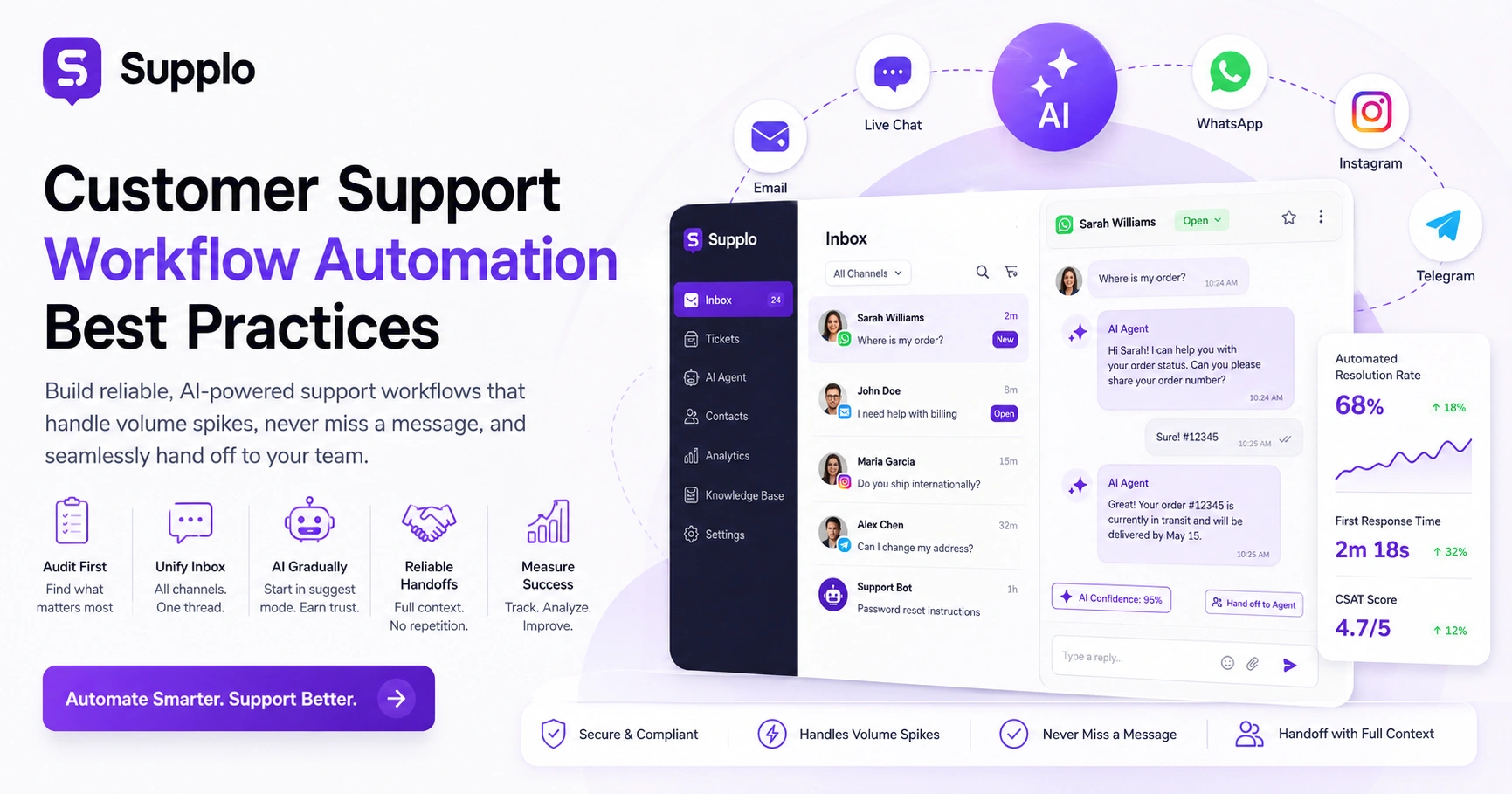
- Connect your channels. Use Supplo's shared inbox to route email, Telegram, Instagram, and Facebook messages into one thread. Everything in one place.
- Set deflection rules. Simple stuff like "if keyword = tracking, auto-reply with tracking link."
- Test your deflection rate weekly. When the AI fails, update your knowledge base. It's that iterative.
No technical skills required. Look for platforms with zero-code setup; most offer a widget or API integration that takes minutes.
Ready to test deflection that works? Start free on Supplo's platform and set up your first AI agent in minutes, no credit card required.
The Role of a Self-Learning AI Agent in Ticket Deflection
A self-learning AI agent doesn't just spit out canned responses. It gets better with every conversation.
Here's how it works: the agent studies past tickets, predicts what customers will ask next, and refines its answers over time. It's basically an FAQ that evolves on its own.
The beauty of this system is that it catches patterns you might miss. Peak hours for certain questions. Recurring issues that keep popping up. The AI sees the forest and the trees.
Supplo's AI agent does exactly this. It's not working from a static script; it's learning from every resolution. Give it three months, and you'll see it deflect tickets it couldn't handle in week one.
"A self-learning AI agent is like hiring a support rep who remembers every conversation they've ever had."
No forgetting. No retraining. Just steady improvement.
Why "Self-Healing" Tickets Are the Future of Customer Support
Self-healing tickets sound like sci-fi, but they're already working. These are automated fixes that resolve issues before a customer even submits a request.
Example: a payment notification detects a failed transaction and automatically retries it. Or a bot notices you're stuck on a login page and resets your password without you asking.
This is support ticket deflection at its most elegant; the ticket never exists in the first place.
Self-healing runs on event triggers, not keyword matching. That means deeper integration with your backend. But even partial self-healing (such as auto-tagging and routing) saves hours each week.
For most small-to-mid teams, full self-healing is a goal to work toward. Start with auto-tagging and routing. Then move to automated fixes. Supplo's email ticketing system can detect billing failures and automatically trigger retries.
Customers trust you more when issues vanish before they notice them.
Proactive Ticket Deflection vs. Reactive Support: A Comparison
Proactive deflection answers questions nobody asked yet. Reactive support waits for tickets to arrive. Both matter, but they serve different purposes.
Proactive:
- Pop-up suggestions
- Tooltips on complex pages
- Automated onboarding flows
- Cuts tickets by 30% or more
Reactive:
- Traditional ticketing systems
- Email support
- Live chat with human agents
- Necessary for complex problems
Most teams need both. Proactive handles the predictable stuff (pricing, shipping, account issues). Reactive catches everything else.
Supplo's widget can be configured either way. Land someone on your pricing page, and it proactively offers "Need help choosing a plan?" before they type a word.
Measuring Success: KPIs for Effective Ticket Deflection
If you're not measuring, you're guessing. Here's what actually matters for ticket deflection:
- Deflection rate: Math is simple. What percentage of tickets did AI handle without a human? Aim for 30–50% for simple queries.
- First response time: Target under 60 seconds for AI-handled tickets. Anything slower defeats the purpose.
- CSAT: Keep it at 85% or higher. If deflection hurts satisfaction, something's off.
- Escalation rate: How often does the AI kick things to a human? Watch this number closely.
- Cost per ticket: Compare pre- and post-deflection costs. This is where the ROI lives.
Supplo's pricing page shows the numbers: AI resolutions at $0.04 each. That's roughly 96% cheaper than market alternatives, including human handling costs.
A deflection rate under 20% means you're leaving money on the table. Aim higher every month.
Common Pitfalls in AI Customer Service Deflection and How to Avoid Them
The biggest mistake? Expecting your AI to know everything on day one. It won't. Another common one: using deflection as a wall that frustrates customers into leaving.
- Over-reliance on AI for complex issues, always have a human fallback.
- Ignoring multilingual support, use translation tools (like Supplo's translation feature) to deflect in 30+ languages.
- Not updating the knowledge base, stale answers hurt trust fast.
- Forgetting compliance, data privacy rules vary by region. Supplo uses EU hosting for reliability.
Fix: Start small. Monitor feedback. Keep the human path open. Use a platform that learns and updates.
If your AI keeps failing on complex queries, switch to something that learns. Try Supplo's self-learning AI agent free for 21 days.
A Practical Framework for Reducing Incoming Tickets with AI
Here's a system that actually works. Call it "ticket triage":
Three buckets:
- Easy: AI resolves completely (password resets, tracking info, pricing questions)
- Medium: AI assists but human reviews (refund eligibility, account changes)
- Hard: Human only (legal disputes, sensitive data, complex technical issues)
Start by training your AI on the Easy bucket. As it learns, move Medium into the AI zone. This phased approach keeps your team sane while the system gets smarter.
Steps:
- Audit the last 500 tickets and tag the difficulty for each.
- Load your FAQ and knowledge base into the AI agent.
- Set conditional routing, if the keyword "password," send to self-service.
- Review unresolved AI tickets daily.
- Expand to multi-channel (WhatsApp, Telegram, Instagram) for full coverage.
See real results in Supplo's case studies. Teams following this framework report a 40% reduction in ticket volume within 90 days.
Don't let per-resolution fees kill your budget. Get unlimited shared inbox, live chat, and AI deflection on Supplo for one flat monthly rate, with crypto, card, and local payment options. Start now.
Tools and Features That Enable Real Automated Deflection
Real deflection isn't just a chatbot. You need infrastructure:
- Multi-channel routing: Deflect across email, Telegram, WhatsApp, Instagram, and Facebook. Supplo's Telegram support and Instagram DM integrations make this seamless.
- Self-learning AI agent: Gets smarter over time, no static rules.
- Knowledge base integration: AI automatically pulls from your docs.
- Widget and pop-ups: For proactive deflection on your site.
- Translation feature: Deflects in multiple languages without extra headcount.
Key Takeaways
- AI ticket deflection can cut your support costs by over 60% when done right.
- Start with 20 common queries, train your AI, then expand channel by channel.
- Avoid per-resolution pricing models; they eat your savings. Go flat-rate.
- Measure deflection rate, CSAT, and cost per ticket weekly.
- Always keep a human fallback for complex or sensitive issues.
FAQ
Is AI ticket deflection safe for handling sensitive customer data?
Yes, if the platform complies with data regulations such as GDPR. Supplo, for example, is EU-hosted and designed with data privacy as a priority. Always check that your provider offers data encryption and does not store sensitive information insecurely. Supplo is not affiliated with any app or website. Please follow each app's terms and local regulations.
Why do some AI deflection systems fail to resolve simple tickets?
Usually, because the knowledge base is incomplete or outdated, the AI can only answer what it has learned. Regular updates and a "human fallback" option are critical for reliability.
What's the difference between deflection and escalation in AI support?
Deflection resolves the ticket without a human being involved. Escalation routes it to a human agent. Good systems do both, deflect simple queries and escalate complex ones, in one seamless flow.
Can I use AI deflection for WhatsApp and Instagram messages?
Absolutely. Many platforms, including Supplo, support multi-channel deflection. Your AI can handle inbound messages from WhatsApp, Instagram DMs, Telegram, and Facebook Messenger just like it handles live chat.
How long does it take to see results from automated deflection?
Most teams see a 20–30% reduction in ticket volume within the first month if they have a well-prepared knowledge base. Results improve as the AI learns from real interactions.
What types of tickets should I NOT try to deflect with AI?
Avoid using deflection for refund disputes, legal issues, or complex technical escalations. These require human empathy and nuanced judgment. AI should handle FAQs, password resets, and account queries.
How much does reliable AI ticket deflection cost?
Costs vary dramatically. Most per-resolution models charge $0.99 per resolution. Supplo offers AI resolutions at $0.04 each, with a flat monthly platform fee: no per-seat fees, no surprise invoices.
Compliance line: Supplo is not affiliated with any app or website. Please follow each app's terms and local regulations.