On this page
If you run a customer support team, you've probably seen "average handle time" (AHT) pop up in your dashboards. But what does that number actually mean, and when should you care? This article is for support team leads, call center managers, and operations folks who want to understand AHT benchmarks by industry, learn practical ways to reduce handle time, and avoid the common traps that hurt customer satisfaction. Use this guide when you're reviewing your team's performance or planning process improvements. Skip it if you're looking for a one-size-fits-all "perfect" AHT number that doesn't exist.
Quick Answer
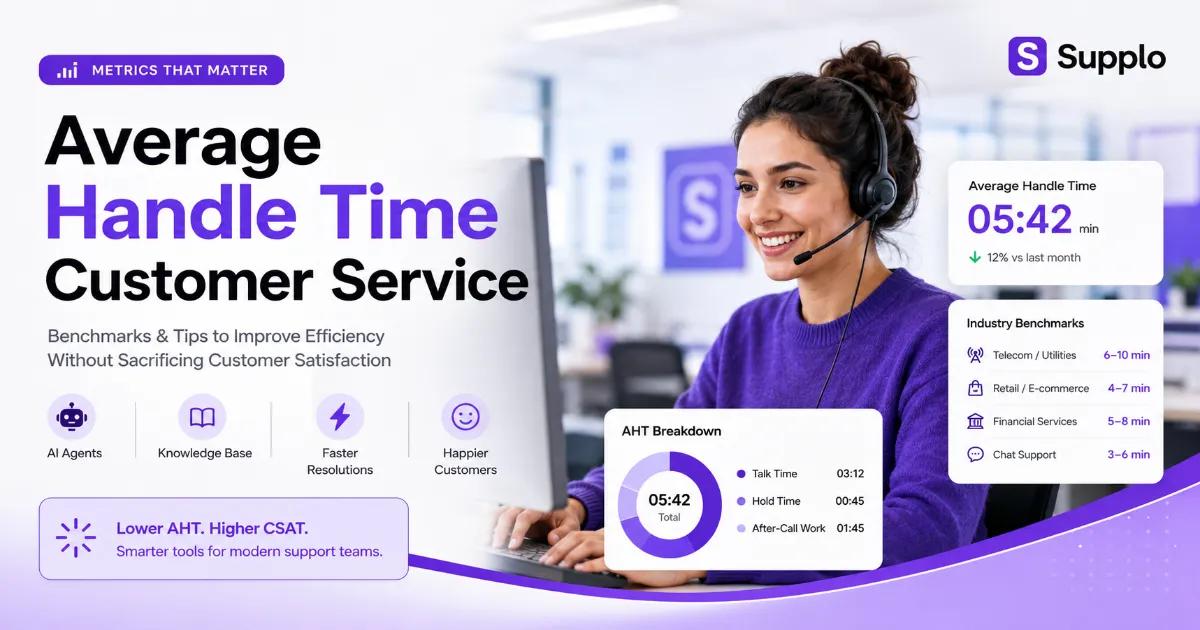
- What is AHT? The total duration of a customer interaction, including talk time, hold time, and after-call work. In chat, it includes typing, reading, and post-chat tasks.
- Industry benchmarks: Telecom 6–10 min, retail 4–7 min, finance 5–8 min, chat 3–6 min.
- How to reduce AHT: Use AI agents, build a knowledge base, automate after-call work, route queries to the right agent first.
- The golden rule: Never sacrifice first contact resolution (FCR) for a shorter AHT.
What Is Average Handle Time (AHT)? A Clear Definition
Average handle time measures how long a customer interaction takes, from start to finish. For phone support, that includes talk time, hold time, and after-call work (ACW). For chat and messaging, it covers typing, reading, and any post-conversation tasks.
Here's the breakdown:
- Talk time/chat duration: The time spent actively communicating with the customer.
- Hold time: Any time the customer is put on hold during a voice call.
- After-call work (ACW): Time spent documenting the interaction, tagging the ticket, or scheduling follow-ups after the conversation ends.
Formula: AHT = (Total talk time + total hold time + total ACW) ÷ Number of interactions.
Supplo is not affiliated with any app or website. Please follow each app's terms and local regulations.
AHT is a core metric used across contact centers, live chat teams, and help desks. Understanding it is the first step to improving both efficiency and customer experience.
"Average handle time is the pulse of your support operation; it tells you how efficiently your team resolves issues, but only when balanced with quality metrics."
Why Average Handle Time Matters for Customer Support Teams
AHT directly impacts your operational costs, staffing decisions, and, most importantly, how customers feel about your service.
- Cost efficiency: Longer handle times mean you need more agents to handle the same volume, increasing your payroll.
- Customer retention: Customers expect fast, efficient service. Every extra minute can hurt satisfaction and loyalty.
- Agent workload: High AHT signals agents may be struggling with knowledge gaps or cumbersome tools.
- Balanced metric: AHT works best when tracked alongside CSAT, FCR, and quality scores. A low AHT with poor satisfaction is a red flag.
"The importance of the AHT metric isn't the number itself; it's what the trend tells you about your team's efficiency and your customers' experience."
Industry Benchmarks: Average Call Handling Time Statistics
AHT varies significantly by industry and channel. Here are realistic ranges based on common operational data:
- Telecom / Utilities: 6–10 minutes higher complexity due to billing, outages, and technical issues.
- Retail / E-commerce: 4–7 minutes mostly transactional inquiries like orders, returns, and shipping.
- Financial Services: 5–8 minutes. Regulatory compliance adds time for verification and disclosures.
- Healthcare: 5–8 minutes. Privacy and medical details require careful handling.
- Chat Support (all industries): 3–6 minutes faster because agents can handle multiple chats simultaneously.
Note: These are rough averages, not hard targets. Your actual benchmark depends on issue mix, agent experience, and tooling. If your average handle time customer service numbers fall outside these ranges, dig into why before making changes.
What Is the "Best" AHT for Customer Service?
There is no universal "best" AHT. The right number balances speed with quality for your specific situation.
- Simple, transactional support: Aim for AHT under 4 minutes.
- Complex billing or technical issues: 8–10 minutes may be completely reasonable.
- The real goal: Align AHT with high CSAT and FCR. If customers are happy and issues get resolved on the first try, your AHT is probably fine.
- Use industry medians as starting points, then optimize around your team's unique workflows.
"The best AHT for customer service is the one that lets your team resolve issues efficiently without making customers feel rushed or undervalued."
Top Methods to Decrease Customer Service Handle Time
Reducing AHT starts with removing friction, not rushing agents. Here are proven methods:
- Build a searchable knowledge base that gives agents and customers instant access to answers.
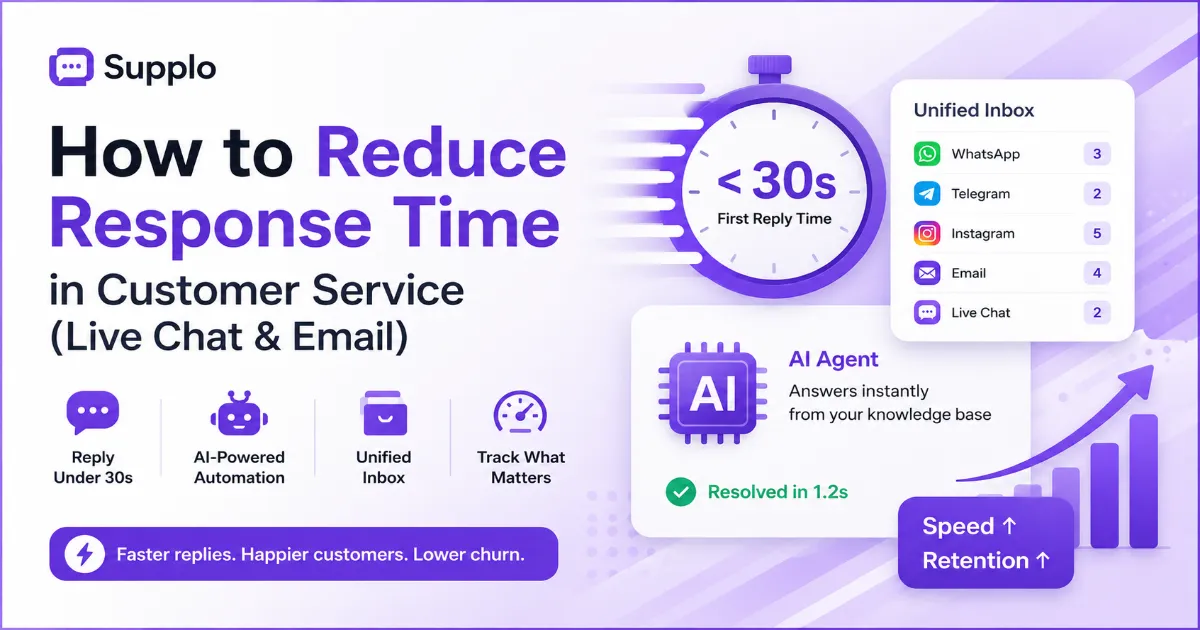
- Use an AI agent to handle tier-1 inquiries, such as password resets, order status, and FAQs. Check out Supplo's AI agent features to see how this works.
- Create canned responses and macros for repetitive questions to save seconds per interaction.
- Route queries to the right team or agent from the start; avoid transfers that restart the clock.
- Provide real-time agent coaching, second-chance prompts, and post-call feedback loops.
Test the fastest support tools yourself. Supplo offers a full-featured workspace with an AI agent, a shared inbox, and multi-channel routing. Start with a free demo or trial at Supplo. No credit card needed.
How to Reduce AHT in a Call Center Without Sacrificing Quality
Cutting AHT at the expense of quality is a classic mistake. Here's how to do it right:
- Train agents on call structure and de-escalation techniques. Efficient conversations don't have to feel rushed.
- Use a screen-popping display to show customer history and relevant data before the agent even picks up.
- Automate post-call documentation: AI summarization captures resolution notes automatically.
- Empower agents to resolve issues themselves, avoiding unnecessary transfers or escalations.
- Monitor quality scores alongside AHT and double-check that shorter calls still result in tickets being resolved.
Troubleshooting tip: If AHT drops but FCR plunges, your agents are probably cutting corners. Revert to a training-first approach.
Tips for Faster Customer Support That Actually Work
Faster support is about removing friction from your team's tools and workflows.
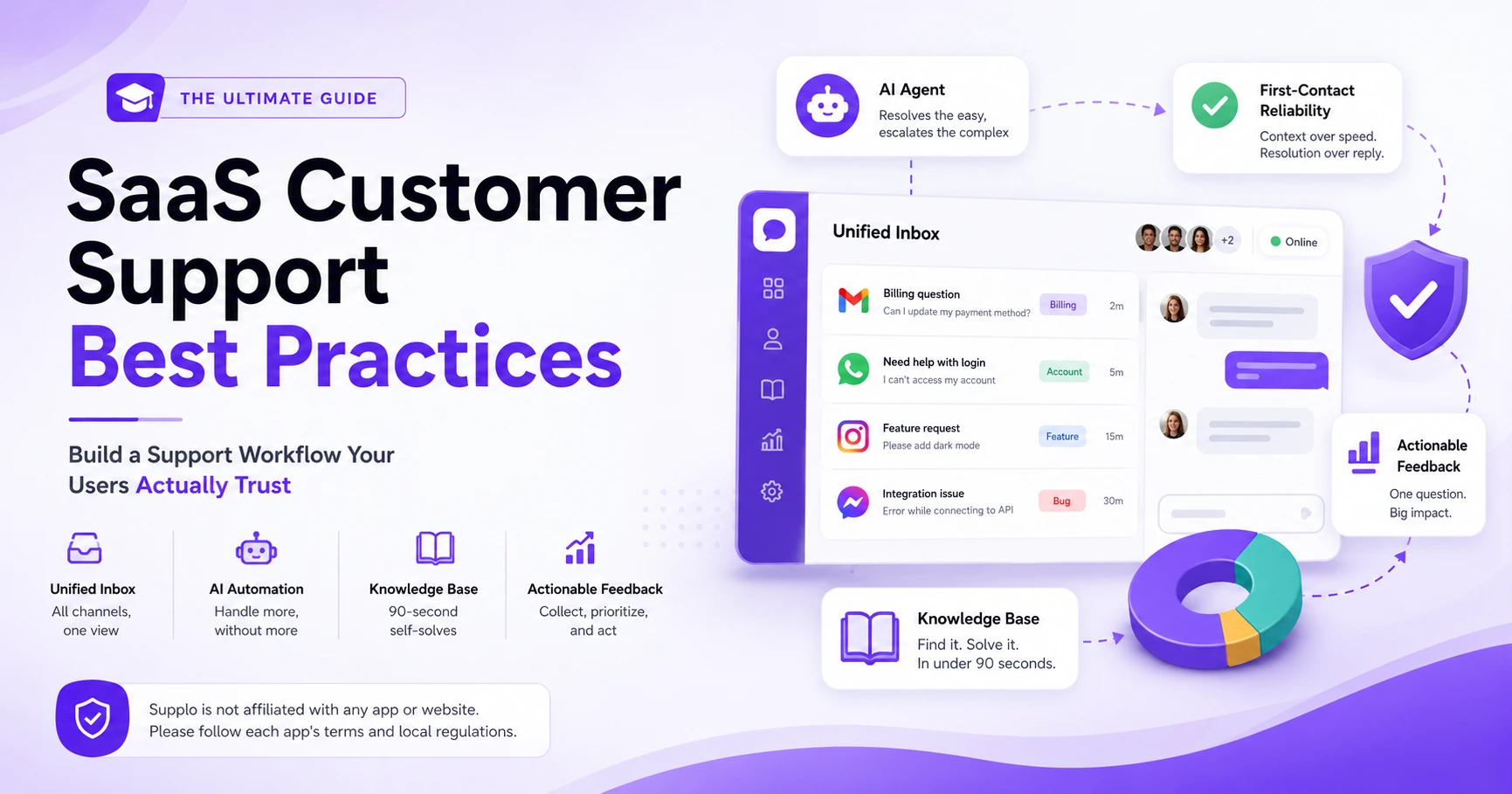
- Unified inbox: Manage email, WhatsApp, Telegram, Instagram, Facebook, and live chat from one view. See how a customer support knowledge base can speed up agent responses.
- Pre-built response templates type once, reuse across similar queries.
- AI-powered translation supports global customers without delays. (Supplo's translation feature handles this instantly.)
- Real-time availability indicators know which agents are free before assigning tickets.
- Integrated knowledge base agents find answers without hunting across multiple tabs.
Improving Agent Efficiency: AHT vs. First Contact Resolution
Focusing solely on AHT can backfire if it leads to unresolved tickets. First contact resolution (FCR) should always stay the priority.
- High FCR reduces total handle time, and resolving an issue on the first call eliminates follow-ups.
- Agents under AHT pressure may rush, leading to escalations and longer overall resolution times.
- Measure AHT per resolution, not per touchpoint. A single 8-minute resolution beats three 3-minute follow-ups.
- Invest in training that prioritizes complete resolution over speed.
- Best practice: Track FCR and AHT together for the clearest picture of efficiency.
"Improving agent efficiency means optimizing for completed resolutions, not just faster conversations. A 6-minute solve beats a 3-minute pass-off every time."
Common Pitfalls When Optimizing Handle Time
Optimizing AHT is good, but watch out for these traps:
- Over-optimizing lowers quality, makes customers feel rushed, reduces FCR, and hurts CSAT.
- Ignoring the channel mix email, AHT will always be longer than chat. Comparing them directly inflates benchmarks.
- Using AHT as a punitive metric demoralizes agents and increases turnover.
- Ignoring after-call work time ACW can hide the real AHT picture.
- Benchmarking against the wrong industry leads to impossible or irrelevant targets.
Pro tip: If your AHT is fine but CSAT is low, the problem isn't speed; it's quality.
If your current tools are slowing your team down, it's time for a change. Supplo's flat monthly rate includes an AI agent that resolves queries at $0.04 each, roughly 96% cheaper than industry alternatives. See pricing at Supplo.
How Supplo Helps You Reduce AHT and Keep Customers Happy
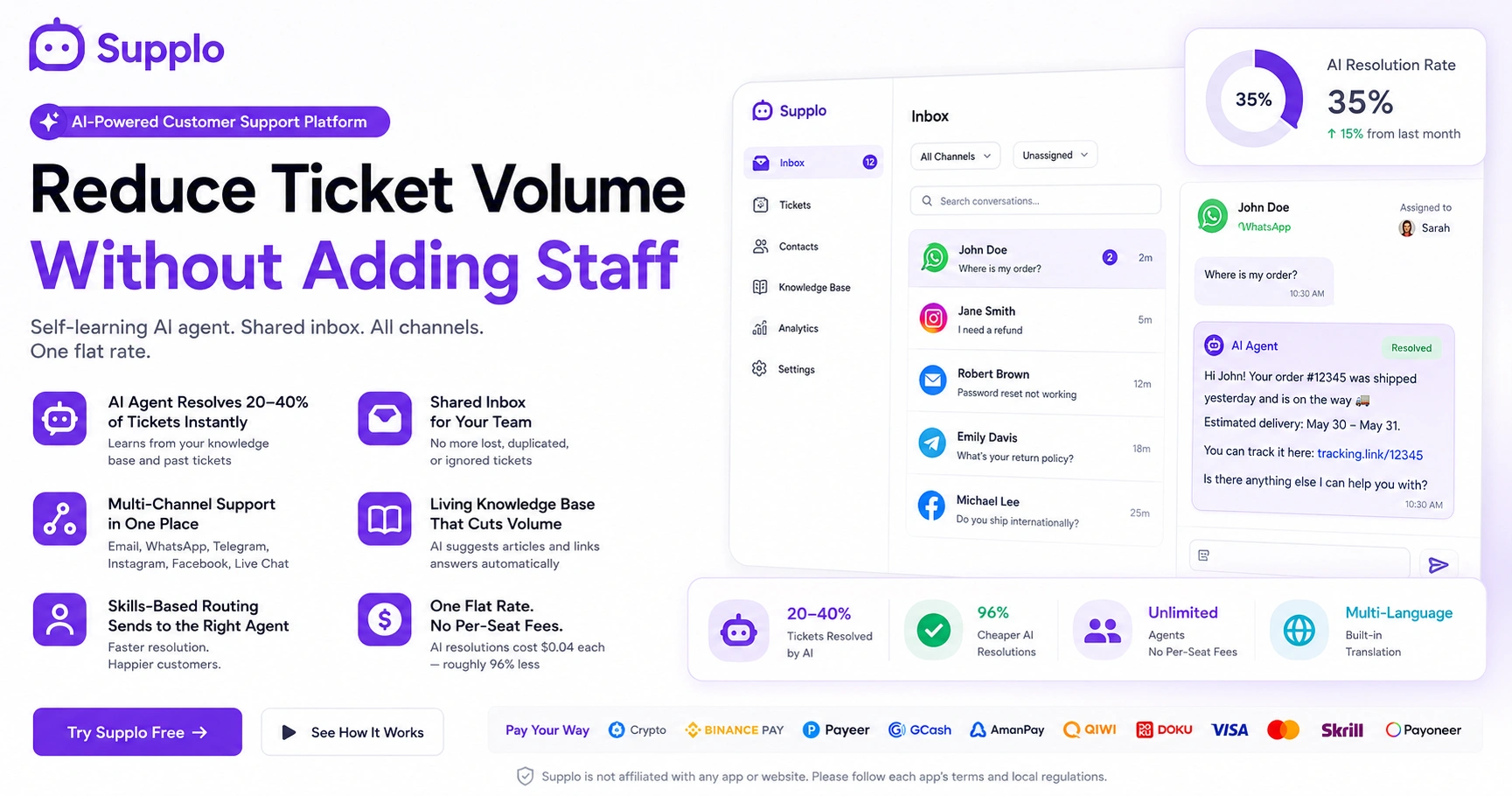
Supplo combines AI automation and a unified team inbox to slash handle times without cutting corners.
- An AI agent handles tier-1 queries autonomously for $0.04 per resolution, freeing humans to handle complex issues.
- Unified shared inbox manages email, WhatsApp, Telegram, Instagram, Facebook, and live chat in one view, with no more switching between tabs.
- Built-in knowledge-base agents help customers find answers instantly.
- Multi-channel routing ensures that queries reach the right agent the first time. Explore full multi-channel customer support options.
- Flat-rate pricing with no per-seat or per-resolution fees. Teams grow without penalty.
If you're comparing tools, check out the Supplo vs. Intercom pricing comparison to see how much you can save.
Keep your customers happy and your handle times low. Supplo gives you AI-powered support, a unified inbox, and transparent pricing. No per-seat fees, no hidden costs. Get started at Supplo.
Key Takeaways
- Average handle time includes talk time, hold time, and after-call work.
- Industry benchmarks vary: telecom 6–10 min, retail 4–7 min, finance 5–8 min, chat 3–6 min.
- Reduce AHT by using AI agents, knowledge bases, automation, and proper routing.
- Never sacrifice first contact resolution for shorter handle times.
- Track AHT alongside CSAT and FCR for a complete view of customer experience.
FAQ
What is the average handle time in customer service?
Average handle time (AHT) measures the total duration of a customer interaction, including talk time, hold time, and after-call work. It's calculated by dividing total handle time by the number of interactions.
What is a good average handle time for customer service?
A good AHT varies by industry. Telecom and utilities average 6–10 minutes, retail and e-commerce average 4–7 minutes, and chat support averages 3–6 minutes. The best AHT balances speed with quality.
How do you reduce average handle time without hurting quality?
Reduce AHT by using AI agents for tier-1 queries, building a knowledge base, automating after-call work, and routing issues to the right agent from the start. Always track first contact resolution alongside AHT.
Why is average handle time important?
AHT directly impacts operational costs, staffing, and customer satisfaction. Monitoring AHT helps teams identify inefficiencies, training gaps, and workflow bottlenecks.
What is the difference between AHT and FCR?
AHT measures the duration of interactions, while first contact resolution (FCR) measures whether an issue was resolved on the first interaction. Both should be tracked together for a complete picture of efficiency.
What factors increase average handle time?
Lack of agent knowledge, poor call routing, complex issues, language barriers, and inefficient tools can all increase AHT. Providing agents with a unified inbox, knowledge base, and translation tools helps reduce handle time.
How often should you benchmark AHT?
Review AHT benchmarks monthly or quarterly. Compare against your industry and channel mix. Avoid comparing phone AHT directly to chat AHT.
Compliance note: Supplo is not affiliated with any app or website. Please follow each app's terms and local regulations.