On this page
Let's be real for a second. Shopping for customer service automation tools right now feels like walking through a carnival of broken promises. Every vendor you talk to swears their AI is magic. But then you get the pricing sheet, and suddenly there are per-seat fees, per-resolution charges, and "premium" add-ons for basic features like routing a message to the right person.
You don't need magic. You need something that actually works without nickel-and-diming you.
This guide is for founders who are tired of spreadsheets and trying to figure out whether they can afford to hire another support agent. It's for ops managers who've watched their ticket queue explode while their budget stayed flat. And it's for team leads who want a system that doesn't require a PhD to set up.
Quick Answer
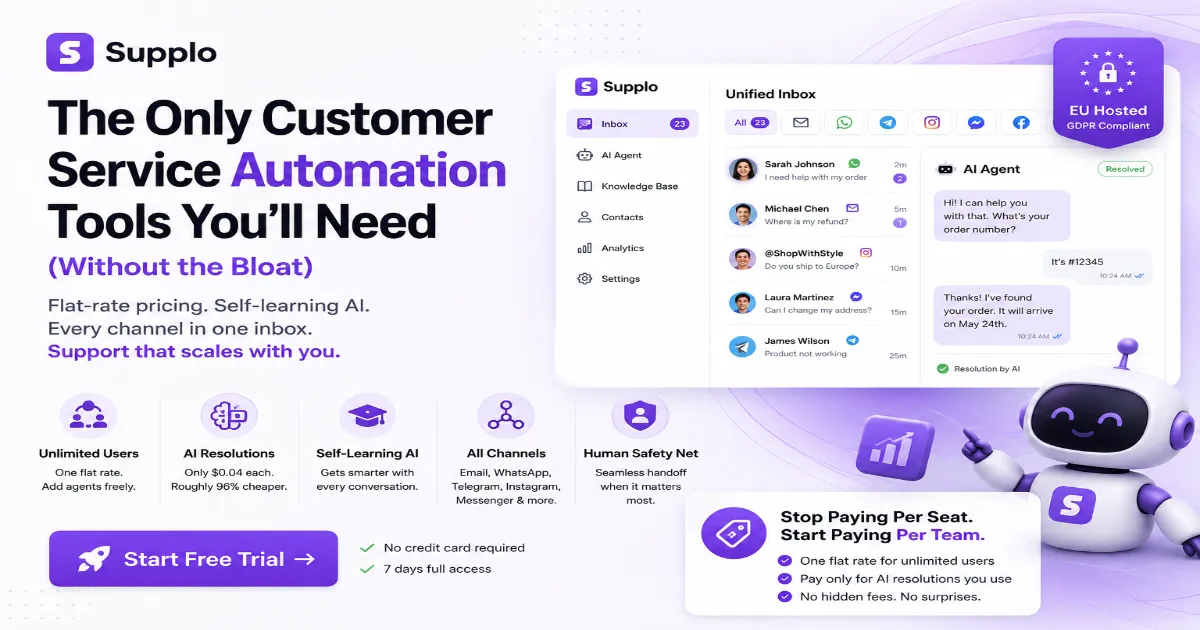
- Flat-rate pricing, not per-seat nonsense. Pay one price for unlimited human agents. Hiring shouldn't be a tax.
- AI resolutions that don't break the bank. At $0.04 each, they're roughly 96% cheaper than what the big guys charge for building a good bot.
- The AI actually learns. It feeds on your knowledge base, gets smarter with every conversation, and tells you where it's struggling.
- Every channel, one inbox. Email, WhatsApp, Telegram, Instagram, Facebook Messenger—all in one place. No extra fees for adding channels.
- Humans are still in charge. When the AI hits its limit, the handoff is seamless. No trapped customers. No lost context.
What Exactly Is Customer Service Automation (And Why Does Reliability Matter More Than Features)?
Customer service automation is basically AI handling the boring, repetitive stuff so your team can focus on the problems that actually need a human brain. But here's the thing nobody tells you: a flashy demo means nothing if the system crashes at 3 PM on a Monday.
Reliability isn't a nice-to-have. It's the whole game.
- It's not a magic switch you flip. It's a layered system of routing, knowledge, and AI working together.
- Reliability means the AI actually understands context, not just keywords. "I need a refund" and "Tell me about your refund policy" are different things.
- Most tools claim they're "self-learning" but require you to tune everything manually. That's not learning. That's you doing their job.
- A reliable system doesn't ghost customers mid-conversation. If your bot times out during checkout, you've lost that sale.
The best features in the world don't matter if your system can't handle a Monday morning rush.
The Hidden Cost of Most AI Customer Service Tools: Per-Seat Pricing
Here's the dirty secret most support platforms don't want you to know: they charge you for every human agent you add. Every single one. So when you need to hire someone to handle growing volume, your software bill goes up, too.
That's not pricing. That's a tax on growth.
Supplo does it differently. You pay one flat monthly rate with unlimited users. Want to add five more agents? Go for it. Your bill doesn't change. This completely changes the math on scaling support.
- Per-seat pricing forces you to choose between hiring a person and saving money. That's a terrible choice.
- Hidden costs pile up fast. "Premium" features like AI agents? That's extra. Multi-channel support? Also extra.
- Flat-rate billing means you know exactly what your ops budget looks like every month. No surprises.
- You only pay extra for AI resolutions if you actually use them.
Per-seat pricing is a tax on team growth. Flat-rate billing is the only honest way to scale support.
Why Your Help Desk Automation Software Shouldn't Be Held Hostage by Resolutions
This one really gets me. Most platforms charge you every time the AI answers a question. Think about that for a second. The better your bot gets, the more you pay. It's like being punished for building an efficient support system.
We think that's backwards.
That's why our AI resolutions cost $0.04 each. That's roughly 96% cheaper than the category leaders. You can compare our AI agent pricing directly with Intercom Fin's to see the math.
- Per-resolution pricing creates a conflict of interest. The vendor makes more money when your automation is less efficient.
- It penalizes you for building a good self-service system. That's just bad business.
- Supplo's model actually encourages automation because it's cheap to use.
- You can test and iterate on AI answers without worrying about your bill exploding.
Here's the thing: Charging per AI resolution is like charging per mile for a car you already bought. It punishes you for moving faster.
How Automated Customer Service Actually Works: A Self-Learning Loop
Let's demystify this. Your knowledge base feeds the AI agent. The AI learns from every interaction to improve its answers. When it can't answer something, it flags that gap for your team. You fill in the missing info, and the AI gets smarter.
It's a continuous loop. And it works.
See how our self-learning AI agent works in practice.
- The AI agent first searches your Knowledge Base before escalating to a human.
- Unanswered questions become "learning opportunities" for your team. No more guessing what customers are asking.
- The system learns which answers actually close the ticket successfully. It tracks what works.
- This reduces your team's cognitive load over time. Less repetition, more problem-solving.
The result? Your AI gets smarter every week without you having to retrain it manually. Feed it data, and it improves.
Which Channels Actually Matter for Customer Engagement Automation?
Your customers are everywhere. Email. WhatsApp. Telegram. Instagram. Facebook. And they expect you to be there too.
A truly reliable customer engagement automation tool brings all those conversations into a single inbox. One place to manage everything. No more tab-hopping. No more missed messages.
It's about omnichannel presence without the operational chaos. Our unified inbox for multi-channel routing is designed exactly for this.
- Email ticketing is still the backbone of professional support. Don't neglect it.
- WhatsApp and Telegram are critical for global, real-time communication. Especially outside the US.
- Instagram DMs and Facebook Messenger are essential for social commerce. That's where your customers are shopping.
- Multi-channel routing means a customer gets the same quality of support everywhere, regardless of how they reach you.
Here's the truth: A customer who messages you on Instagram at 11 PM should get the same quality of support as one who emails you at 9 AM. Anything less is a broken experience.
The "Set It and Forget It" Myth: Building a Reliable AI Chatbot for Business
I hate to break it to you, but there's no such thing as "set it and forget it" with AI. A truly reliable AI chatbot for business requires monitoring. You need to see what it gets right, what it gets wrong, and feed it better data.
But here's the good news: the work pays off. Once it's tuned, it handles most Level 1 questions. Your human team gets to focus on the nuanced, complex stuff that actually requires a brain.
- A good AI bot never says "I don't know" without offering an escalation path.
- Tuning involves analyzing "failed handoffs" in which the bot gave a bad answer.
- The best bots use a confidence threshold. They only answer if they're sure.
- Supplo's self-learning aspect reduces the manual tuning required over time.
Steps to build a reliable AI chatbot:
- Start with your top 10 FAQs. Import them into your Knowledge Base.
- Set a confidence threshold (e.g., 85%). Below that, the bot escalates to a human.
- Review the "knowledge gaps" report weekly. Add missing answers.
- Monitor customer effort score and first response time to measure success.
Your First AI Answer Isn't Perfect—And That's Okay.
Our self-learning loop gets smarter the more data you feed it. The key is to start now, not wait for perfection. If your AI fails a question, you see it immediately and can fix it. No penalties. No hidden costs.
Why Your Conversational AI for Support Needs a Human Safety Net
Customers can tell when they're trapped in a bot loop. It's frustrating. It makes them angry. And it makes your brand look bad.
That's why the best conversational AI for support knows its limits. It should seamlessly hand off to a human when the conversation gets complex or the customer asks for one. Automation without a human backup is just a faster way to frustrate people.
- The AI should detect sentiment and escalation keywords (like "speak to a manager").
- Handoff must be context-rich. The human sees the full history, not a blank slate.
- Over-reliance on automation can damage brand reputation. Don't do it.
- Supplo's shared inbox ensures the human team can jump in without friction.
Troubleshooting bad handoffs:
- If customers keep asking to speak to a human, your AI is probably misinterpreting their requests.
- Check your Knowledge Base for outdated or misleading information.
- Lower the confidence threshold if the AI is answering too aggressively.
The Real Cost of Downtime: Finding Reliable AI Customer Service Automation
Every minute your customer service is down, you're losing trust and potentially revenue.
Reliability means EU-hosted infrastructure with high uptime and fast response times. It means your AI agent isn't hallucinating answers or timing out during a critical transaction. It means your customers can actually get help when they need it.
- Downtime is a silent revenue killer for eCommerce and SaaS businesses.
- EU-hosted services (like Supplo's) provide data sovereignty and GDPR compliance.
- Response time consistency is a hallmark of a reliable platform.
- Check for latency issues. A slow bot is worse than no bot at all.
Supplo is not affiliated with any app or website. Please follow each app's terms and local regulations.
Getting Started with Automated Chat Solutions Without the Learning Curve
The best automated chat solutions are dead simple to set up. You shouldn't need a PhD in prompt engineering to get your first bot online.
Start with your top 10 FAQs. Plug them into your Knowledge Base. Let the AI start resolving them immediately. It's that simple.
- Most platforms require weeks of setup. A good one takes hours.
- Importing an existing FAQ document is often the quickest way to get started.
- The widget is the front door. Make sure it's customizable to your brand.
- You can test the AI privately before making it live.
Steps to get started in under an hour:
- Sign up for a free trial (no credit card required).
- Import your FAQ doc into the Knowledge Base.
- Customize the chat widget to match your brand.
- Test the AI privately using the dashboard.
- Go live and monitor the first 50 interactions.
Want to See It in Action Before You Commit?
No onboarding fee. No credit card for the first 7 days. You can test the widget, the AI agent, and the inbox entirely for free. Start Free Trial
What Happens When Your Customer Support Automation Actually Works?
When it clicks, everything changes.
Your team stops drowning in repetitive tickets. They focus on high-value work. Your customers get instant answers at 2 AM. Your support costs drop. It's not a silver bullet, it's a well-oiled machine that requires maintenance. But the payoff is a sustainable, scalable support operation.
- Ticket deflection rates go up meaningfully, not just on paper.
- First response times drop from hours to seconds.
- Customer satisfaction often improves because issues are resolved faster.
- Your human team becomes a high-level problem-solving squad, not a Q&A desk.
Want to see a real example? Read how PVAPins scaled their support using this exact approach.
Stop Paying Per Seat. Start Paying Per Team.
Most tools make you pay for every human you add. Billing is simple: one flat rate for unlimited users. You only pay extra for AI resolutions if you use them. No surprises. See Pricing & Start Free.
Key Takeaways
- Customer service automation must be reliable, not just feature-packed. A crashing bot is worse than no bot at all.
- Per-seat pricing is a hidden tax. Flat-rate billing removes the penalty for scaling your team.
- Per-resolution pricing punishes efficiency. Cheap AI resolutions encourage automation.
- A self-learning loop reduces the need for manual tuning over time. Feed it data, and it improves.
- Omnichannel routing is non-negotiable. Your customers expect support everywhere they are.
- A human safety net is essential. Never let a bot trap a customer.
FAQ
Is AI customer service automation reliable for handling sensitive data?
Yes, but only if the platform is hosted in a secure, compliant environment. Supplo is EU-hosted and adheres to strict data protection controls. Supplo is not affiliated with any app or website. Please follow each app's terms and local regulations.
Why do some AI chatbot responses fail or sound robotic?
It usually means the AI isn't trained on your specific data. If your Knowledge Base is thin or poorly written, the AI will give generic or incorrect answers. It's a data problem, not a tool problem.
How does conversational AI handle multi-language support?
A good AI agent detects the language of the incoming message and responds in kind. Supplo's built-in translation feature provides real-time support for 50+ languages.
Can I try the chatbot before making it public?
Absolutely. You can test the AI agent privately using a widget on a staging environment or directly within the Supplo dashboard before deploying it to your live site.
What happens if the AI can't answer a customer question?
The AI should not just fail silently. It should either route the query to a human agent or flag it as an unresolved topic for your team to add to the Knowledge Base.
Is it worth paying for a dedicated automated chat solution vs. a free tool?
Free tools often lack the self-learning loop, reliable uptime, and multi-channel routing of paid platforms. For a growing business, the ROI of a reliable paid tool usually outpaces the cost of free-tier limitations.
How do I know if my help desk automation is actually improving?
Track deflection rate (percentage of queries handled by AI without human touch), first response time, and customer satisfaction scores. If those are trending up, your automation is working.
Compliance note: Supplo is not affiliated with any app or website. Please follow each app's terms and local regulations.