On this page
So you're growing. Tickets are piling up. And you're stuck with the classic decision: hire a bunch of humans (outsourcing) or buy more software tools?
It's a tough spot.
This article is for founders, support team leads, and ops managers at small- to mid-sized companies. If you've ever felt the pinch of a peak season and regretted your support setup, you're in the right place. We'll break down the customer support outsourcing vs software debate, show you the hidden costs, and explain the hybrid setup that actually works.
Quick Answer:
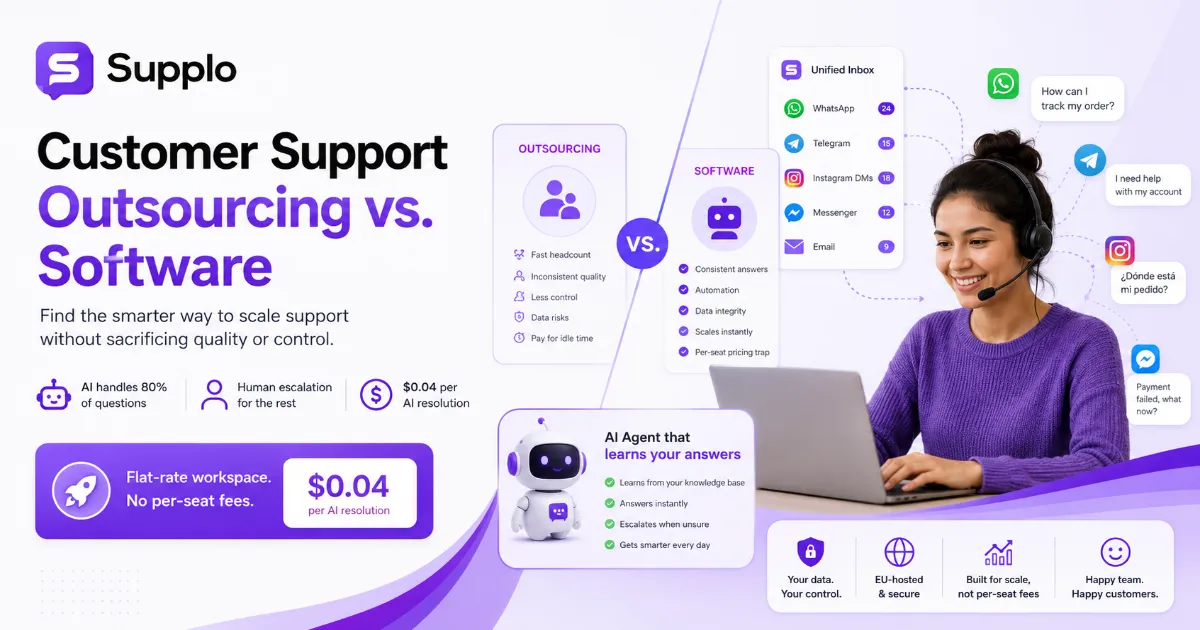
- Outsourcing = fast headcount, but you lose control over quality, brand voice, and data.
- Software = consistency and automation, but often rigid and costly per seat.
- The best option = a self-learning AI agent that handles 80% of questions, with human escalation for the rest.
- The pricing trap = per-seat fees and per-resolution meters punish growth.
- The fix = flat-rate workspace + $0.04 per AI resolution.
Why This Debate is Heating Up (And Why It Matters for Your Bottom Line)
Let's be real for a second. The "outsourcing vs. software" debate? It's the wrong question entirely. What you really need to ask is: Can my support system handle a random spike in tickets on a Sunday night without blowing up my payroll or my patience?
Outsourcing gives you human flexibility, sure, but you often sacrifice quality and control to get it. Software gives you automation, but it can be rigid and expensive as hell. The smartest teams are already moving toward a hybrid model that steals the best from both worlds without the hidden fees.
The old playbook was dead simple: hire a BPO agency or buy a seat-based SaaS tool. The failure point? Neither is built for the unpredictable volume of modern support. The new hybrid is AI agents that learn your specific answers, plus human escalation when things get tricky.
"Reliability isn't about how many agents you have, it's about consistency. A system that learns your answers is worth more than a team that reads a script."
The Pros and Cons of Customer Support Outsourcing: Speed vs. Control
Outsourcing gets you warm bodies fast, real fast. But you trade control over quality, brand voice, and data security. Basically, you're renting someone else's culture and hoping it fits.
The upside is obvious: rapid scaling during peak seasons without the hiring nightmare. The downside? You often have zero visibility into how your customers are actually being treated unless you micromanage every single interaction. That's exhausting.
Pros:
- Quick ramp-up, no hiring headaches.
- Language coverage and 24/7 availability.
Cons:
- Inconsistent brand voice (your customers notice).
- Data leakage risks you can't fully control.
- Training overhead and the "offshoring" stigma.
Real cost: You pay for human time even when the agent is waiting for a customer to respond. That's a lot of idle cash burning a hole in your budget.
"When you outsource, you're renting someone else's culture. When that culture doesn't match yours, your customers feel it instantly."
The Pros and Cons of Customer Support Software: Power vs. Complexity
Software gives you control, consistency, and analytics so granular that you could impress a data scientist. But it can also be a nightmare to set up and a budget drain to maintain.
Tools like a self-learning AI agent can handle 80% of those repetitive questions instantly, freeing your actual humans for the complex stuff. The trade-off? You need someone internal to manage the tool, and per-seat pricing can spiral out of control faster than you'd think.
Pros:
- Consistent answers and data integrity.
- Automation, reporting, and audit trails that save your ass during reviews.
Cons:
- Implementation time and a learning curve that hurts.
- The dreaded "per-agent" pricing model that punishes growth.
Best software: The kind that learns from your existing knowledge base without manual retraining. That's the real win, no bot-building courses required.
"Software gives you perfect answers every time, but only if you've trained it perfectly. That's where most teams fail."
Scaling Customer Support Outsourcing vs. Software: The Hidden Cost of Headcount
Here's the dirty secret nobody talks about: when you outsource, you pay for headcount even when tickets are slow. When you use software, you pay for seats even when agents are idle. Both models punish you for being efficient.
The hidden cost is that neither is designed for variable volume. You end up overpaying during slow months and scrambling during surges. A flat-rate platform with per-resolution AI costs removes this volatility entirely. You pay your flat rate and sleep well.
The math:
- Outsourcing cost: $2,000–$5,000 per agent per month, regardless of productivity.
- Software cost: $100–$200 per seat per month, plus overage fees for AI resolutions.
- At 10 agents: Outsourcing costs $20k–$50k/month vs. software at $1k–$2k/month.
The catch: Software requires you to do the work; outsourcing requires you to manage the people. Neither is truly hands-off.
"The real cost of scaling support isn't the tool or the team, it's the unpredictability. Flat-rate pricing is the only way to sleep at night."
Flexible Support Teams vs. Software Scalability: The Speed Gap
A flexible support team (freelancers, part-timers, BPOs) can scale up overnight, but the quality gap widens as you add bodies. Software scales instantly with zero quality variance, but only if you've trained it properly.
The gap is in speed of setup: a human takes weeks to onboard; an AI agent can be live in minutes, provided you have a knowledge base to feed it.
Human scaling: Great for nuanced, empathetic conversations. Slow to train. Expensive when idle.
Software scaling: Instant, consistent, but sometimes too rigid for complex situations.
The hybrid: Use AI for first response and simple queries; use humans for escalation. Simple as that.
Start for free – no credit card needed. Test your own knowledge base against our self-learning AI. See how it answers live customer questions in minutes. Try Supplo's AI Agent.
The Reliability Problem: Why Outsourcing Can Fail You on a Tuesday
Reliability isn't about how many agents you have; it's about consistency. An outsourced agent might give a different answer than your in-house team. A software bot might give the wrong answer because it hasn't been properly trained. Both scenarios are bad for business.
The real reliability comes from a system that learns your specific answers like a self-learning AI agent and flags uncertain responses for human review before they go out.
Supplo is not affiliated with any app or website. Please follow each app's terms and local regulations.
The outsourcing risks: agent churn, cultural mismatches, and data privacy concerns you can't control.
The software risk: Incorrect automated responses, lack of empathy, and poor escalation paths.
The reliability fix: Unified inbox with AI that knows what it knows (and what it doesn't). No guessing, no stress.
Troubleshooting tip: If your AI agent gives a wrong answer, check your knowledge base for missing or conflicting information. Fix the source, and the AI learns instantly.
"A system that admits when it doesn't know something is infinitely more reliable than one that guesses."
How a Self-Learning AI Agent Bridges the Gap Between Humans and Software
A self-learning AI agent learns from your existing support history and knowledge base; no manual bot training is required. It answers repeated questions instantly, learns from corrections, and escalates when unsure. It's like having a junior agent who gets smarter every day.
This bridges the gap perfectly: you get the speed and consistency of software with the adaptability of a human team. Cost per resolution? $0.04. That's roughly 96% cheaper than legacy AI tools.
How it learns: Scans your past tickets, FAQ documents, and product pages.
How it escalates: Routes to human agents via shared inbox when confidence is low.
The result: Humans handle fewer repetitive tickets and more complex issues. Your team stays happy, your customers stay satisfied.
If your AI agent is wrong, you're training it wrong. Get a free knowledge base audit. We'll show you what's missing. Book a walkthrough.
Multi-Channel Support Without the Chaos: Inbox, WhatsApp, Telegram, and Instagram
The worst part of scaling support? Managing multiple channels. Outsourcing forces you to train agents on each platform separately. Software often limits you to email and chat. It's a mess.
A modern platform consolidates WhatsApp support, Telegram support, Instagram DMs, Facebook Messenger, and email into one inbox, with AI routing and auto-translation. That's the reliability play right there.
Problem: Customers use different channels; your team shouldn't have to hop between five tabs.
Solution: One inbox, unified routing, and AI that responds in the customer's preferred channel.
Bonus: Auto-translate means your global team can handle any language without hiring translators.
The Pricing Trap: Per-Seat Fees vs. Flat Monthly Rates
Let's talk about money. Outsourcing charges you per head. Software charges you per seat. Both punish growth. Both feel like a tax on doing well.
A flat monthly rate with no per-seat fees and no per-resolution meters is the only way to scale without anxiety. At Supplo, you pay for the workspace, not the people using it. AI resolutions cost $0.04 each. Compare that to other platforms that charge $1+ per AI chat.
The math: If you're handling 10,000 AI chats a month, that's $400 vs. $10,000.
Hidden costs: Overage fees, API fees, and "premium" support tiers. Avoid them like the plague.
"Per-seat pricing is a tax on growth. Flat-rate pricing is a bet on efficiency."
When to Choose Outsourcing, When to Choose Software (And When to Do Both)
Choose outsourcing for high-touch, high-empathy interactions where a human touch is non-negotiable (health, finance, luxury goods, you get the idea).
Choose software that prioritizes volume, consistency, and cost efficiency (SaaS support, order status, password resets, and repetitive tasks).
Do both when you can afford it. But if you're a small-to-mid team, an AI-first platform with human escalation gives you 90% of the benefit at 10% of the cost. That's math you can take to the bank.
When to outsource: Crisis response, 24/7 multilingual support, complex sales support.
When to self-serve: FAQs, order tracking, account management, and technical troubleshooting.
The hybrid: AI handles first touch, humans handle escalation, best of both worlds.
Done with per-seat pricing? Good. Switch to a flat-rate workspace with AI resolutions at $0.04 each. See pricing, no hidden fees. No surprises.
Key Takeaways
- Outsourcing gives you humans fast, but you lose control over quality and data.
- Software gives you consistency, but per-seat pricing kills growth.
- A hybrid AI agent that learns from your own knowledge base is the best of both.
- Flat-rate pricing with per-resolution AI is the only way to scale without anxiety.
- Multi-channel support should live in a single inbox, not across five tabs.
FAQ
Is customer support outsourcing safe?
It can be, but you're trusting a third party with your customer data and brand voice. If security is a concern, an EU-hosted platform like Supplo gives you full data control without outsourcing the interaction.
Can software replace an entire outsourced team?
For simple, repetitive questions, yes, with high accuracy. For complex, emotional, or sales-driven interactions, no. The best setup is AI for first contact, humans for escalation.
Why do outsourced agents sometimes give wrong answers?
They're often trained on generic scripts rather than your specific products. A self-learning AI that trains on your own knowledge base is far more reliable.
What is the best pricing model for scaling support?
Flat-rate workspaces with pay-per-resolution AI. Avoid per-seat and per-chat billing. They punish growth and penalize efficiency.
Can software handle multiple channels, such as WhatsApp and Instagram?
Yes, but only if your platform is built for it. Supplo's inbox handles WhatsApp, Telegram, Instagram DMs, Facebook Messenger, and email in one place with AI routing.
What should I NOT use an AI agent for?
Never use an unverified AI agent for anything that could cause legal, financial, or health harm, like medical advice, contract disputes, or account security changes. Always have a human review.
How do I troubleshoot a failed AI response?
Check your knowledge base for missing or conflicting answers. A self-learning AI is only as good as its source material. Update the source, and the AI will learn within seconds.
Compliance note: Supplo is not affiliated with any app or website. Please follow each app's terms and local regulations.