On this page
If your support dashboard looks like a casino slot machine with lots of flashing numbers but no real payout, you’re not alone. Most SaaS teams track metrics that look good in a boardroom slide deck but do nothing to prevent churn. This guide is for support managers, ops leads, and founders who want to measure customer support KPIs that tie directly to retention, revenue, and reliability. These are the metrics that tell you whether your team is actually helping or just busy.
Quick Answer
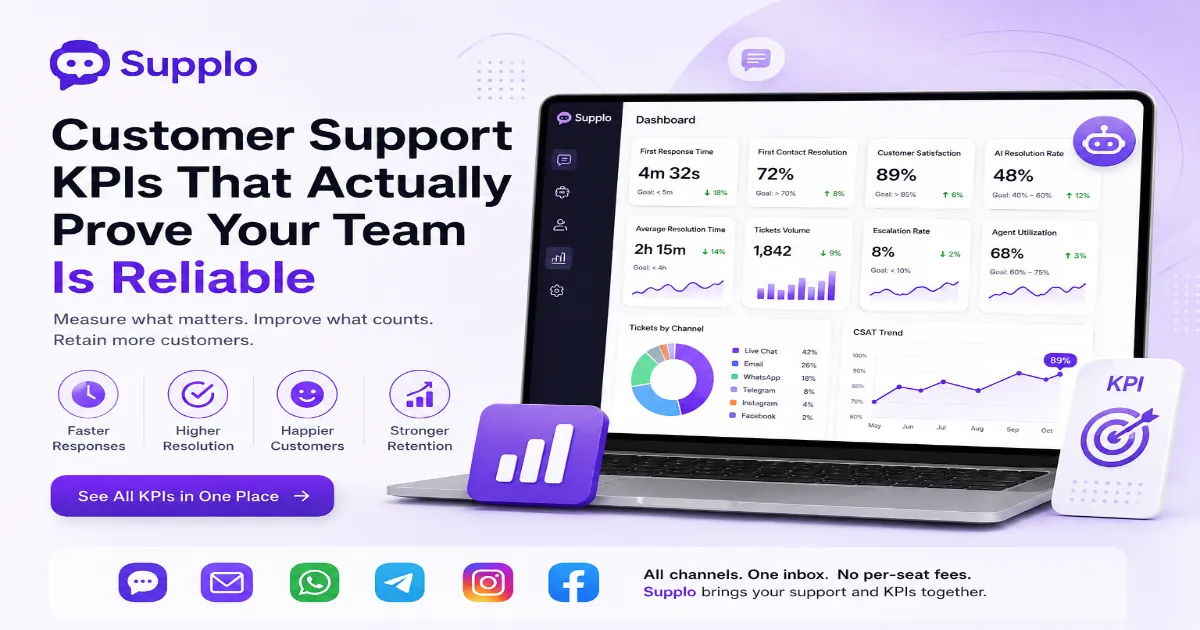
- First Response Time (FRT): Under 5 min for chat, under 1 hour for email. This sets the reliability tone.
- First Contact Resolution (FCR): Above 70% means your team solves issues on the first try.
- Customer Satisfaction Score (CSAT): Target 85%+. Pair with open-ended feedback.
- AI Resolution Rate: Aim for 40–60%. It cuts costs and frees humans for complex work.
When NOT to track these: If you’re a solo founder handling all support, skip the dashboards. Just ask customers, “Did we fix it?” and move on. These KPIs matter when you have a team to manage.
Supplo is not affiliated with any app or website. Please follow each app's terms and local regulations.
What Makes a Customer Support KPI Good for SaaS?
A good KPI isn’t just a number on a dashboard; it’s one that directly ties to customer retention and revenue. For SaaS, where churn hurts more than almost any other industry, your customer support performance metrics should measure speed, satisfaction, and resolution accuracy. If a metric doesn’t help you predict a renewal or a churn, you’re probably tracking it for the wrong reason.
- Focus on KPIs that correlate with contract renewals (e.g., CSAT for happy users, FRT for perceived reliability).
- Avoid vanity metrics like "total tickets closed" without context of quality.
- Tie each KPI to a specific operational lever. For example, "Improving FRT by adding a self-learning AI agent."
The best customer support KPIs are the ones your team can actually influence in a single shift.
First Response Time: The Metric That Sets the Tone
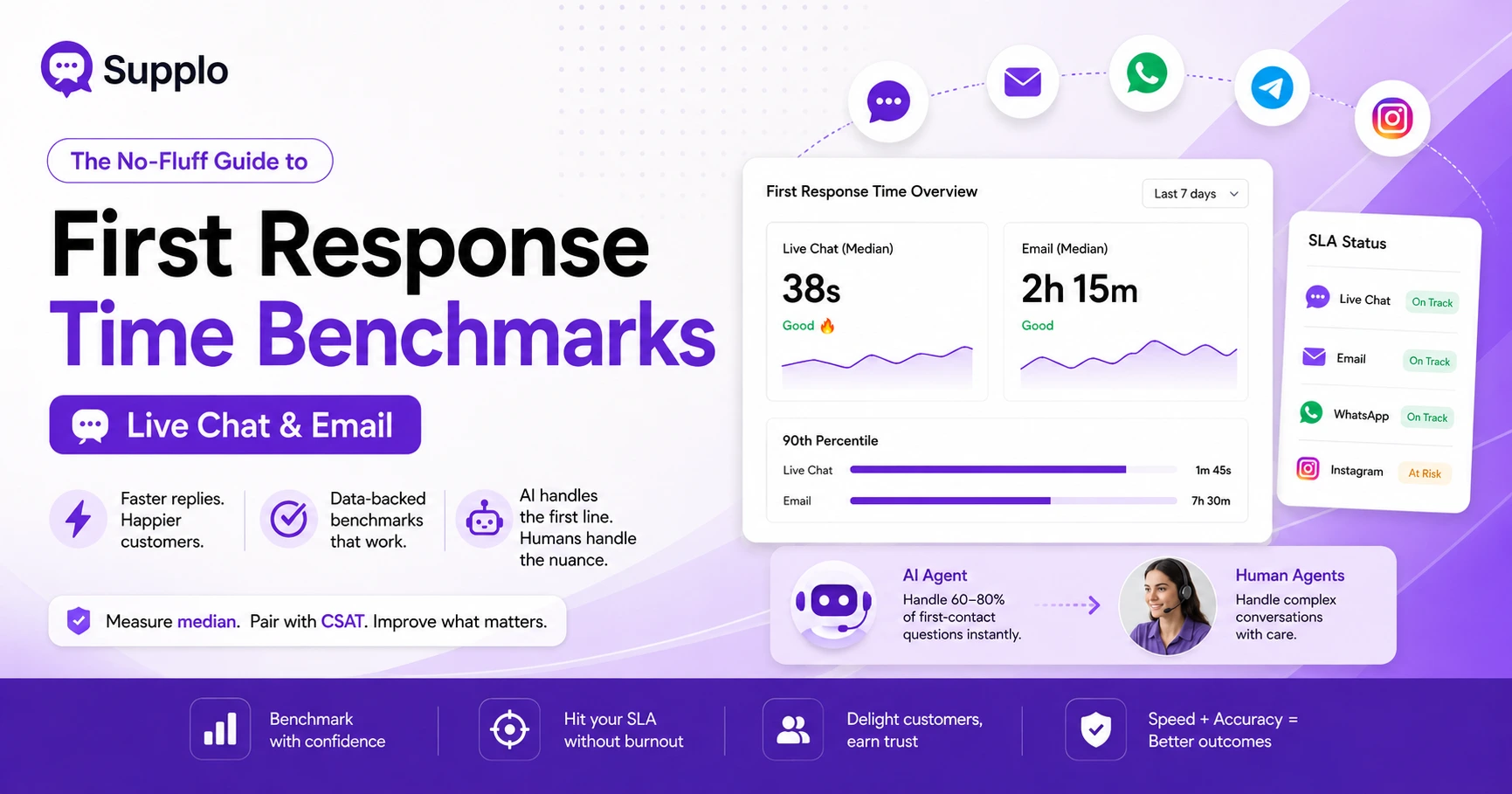
First Response Time is the most visible sign of reliability to your customers. If they wait hours for an initial reply, they assume you don’t care. For SaaS, the benchmark is under 5 minutes for live chat and under 1 hour for email. Anything slower signals to your users that your product support might be as unreliable as their current provider.
How to track it properly:
- Measure FRT separately for live channels (chat, WhatsApp, Telegram) vs. async channels (email, tickets).
- Use a self-learning AI agent or an automated response to acknowledge the ticket instantly, even if a human follows up later.
- A common mistake: confusing "bot response" with "first human response." Be honest about which you’re measuring.
Troubleshooting tip: If your FRT is high, check your ticket routing. Are you using automated ticket routing to send chats to the right agent? If not, start there. Tools like Supplo’s shared inbox can consolidate FRT tracking from all channels into a single view.
Want to test your team’s reliability? Start with a free trial at Supplo – route live chat, email, WhatsApp, Telegram, Instagram, and Facebook into one shared inbox, no per-seat fees. See your first FRT improvement in under an hour.
Average Resolution Time: Speed vs. Quality
ART measures the time from ticket creation to final resolution, including any back-and-forth. The trick is that fast ART can be terrible if it means agents are closing tickets prematurely just to hit a goal. The best approach for SaaS is to measure ART alongside a quality check, such as post-resolution surveys or reopen rate.
- Set different ART targets based on ticket severity. A P1 bug gets 4 hours; a password reset gets 10 minutes.
- Watch for "deflection" that actually delays addressing the issue, pushing users to a knowledge base they then leave.
- High ART often points to broken processes, not lazy agents. Check your handoff workflows.
Waiting for resolution costs you credibility every minute.
Customer Satisfaction Score: The Gold Standard for SaaS Customer Satisfaction KPIs
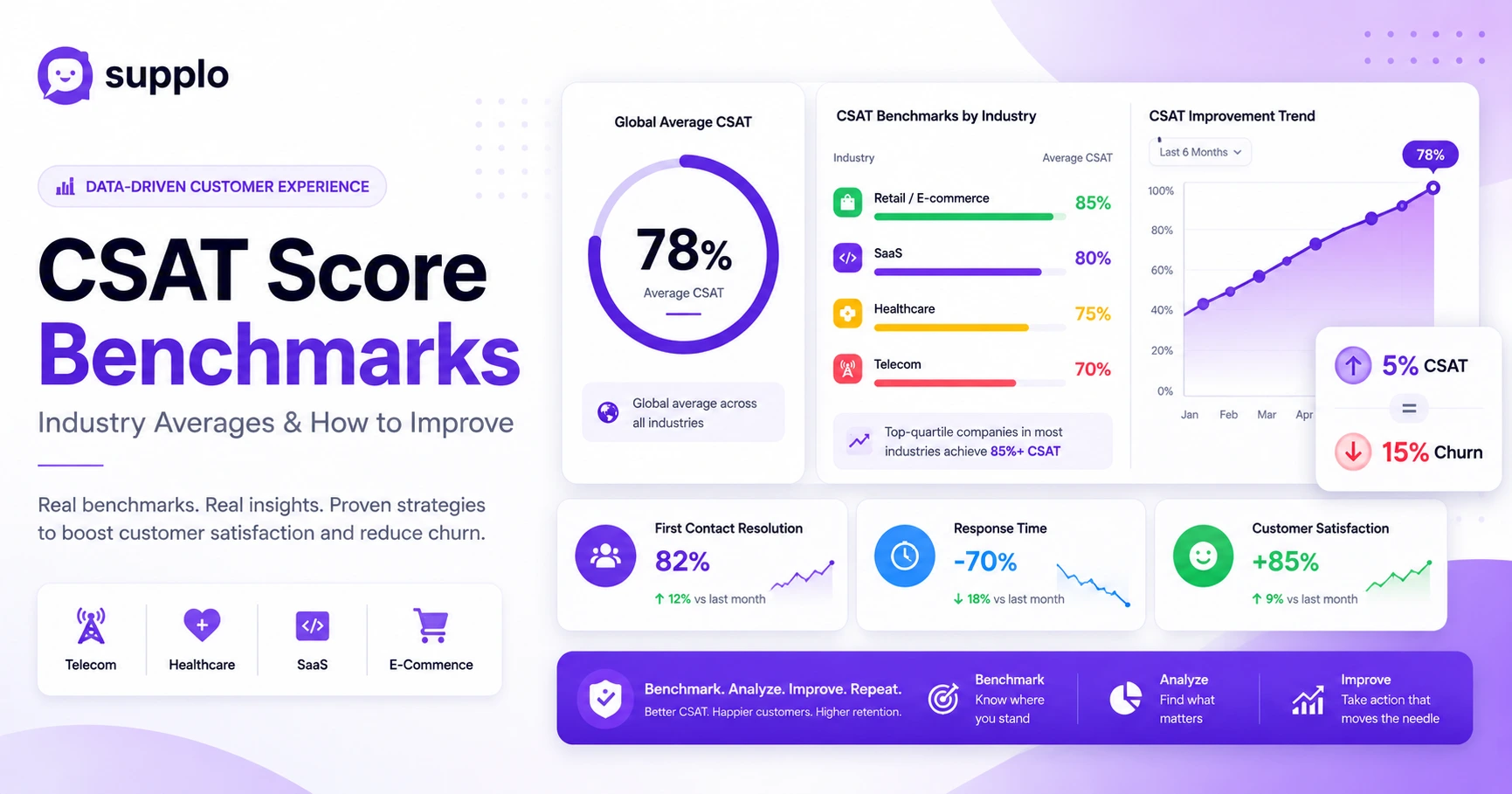
CSAT is the most direct customer support metric for SaaS because it asks one simple question: "Were you satisfied with the support you received?" It’s quick, cheap, and actionable. Target above 85% for healthy teams, but be aware that CSAT tends to skew positive, so always pair it with a verbatim feedback box.
- Send the survey immediately after resolution (within 1–4 hours) for the most honest responses.
- Use a 1–5 star scale or a binary "satisfied/unsatisfied" for higher response rates.
- Beware of "survey fatigue"; don’t ask after every single interaction.
- Important: CSAT is not predictive of long-term loyalty; that’s where NPS comes in.
Good SaaS customer satisfaction KPIs answer "Was this helpful?" not "Are you loyal?"
Net Promoter Score: Measuring Loyalty, Not Just Happiness
NPS measures whether your customer support experience makes users more likely to recommend your product. It’s less about the specific interaction and more about the overall relationship. A high NPS alongside strong support metrics suggests your help desk is a growth driver, not just a cost center.
- NPS is usually surveyed quarterly or post-onboarding, not after every ticket.
- Segment by Promoters (9–10), Passives (7–8), and Detractors (0–6).
- Linking NPS data to specific support interactions, did a bad resolution drop your NPS 10 points?
- SaaS companies with NPS above 50 are considered world-class; support is often the deciding factor.
Pair NPS with real-time dashboards to see how each interaction affects your score.
First Contact Resolution: The Efficiency King for Support Team KPIs
First Contact Resolution measures the percentage of issues resolved on the first interaction, with no follow-ups needed. It’s arguably the most important support team KPI because it captures both efficiency and customer satisfaction. High FCR means your team is empowered and your knowledge base is strong.
- FCR above 70% is excellent for SaaS; below 60% usually indicates training or tooling gaps.
- Track FCR per channel chat FCR is often higher than email FCR due to real-time iteration.
- Self-service (knowledge base, AI agent) can boost FCR by deflecting easy questions before they reach a human.
- Pitfall to watch: If FCR drops after you introduce automation, your AI is probably confusing users rather than helping. Revisit your bot containment rate.
Every ticket that requires follow-up doubles your labour costs and frustrates the customer.
Ticket Volume & Channel Breakdown: Where Is Your Support Actually Going?
Knowing which channels generate the most tickets is one of the most overlooked customer support performance metrics examples. It tells you where your users are most comfortable reaching out and which channels you should double down on (or kill). For global SaaS, WhatsApp and Telegram volumes often spike in markets where email is less trusted.
How to run the analysis:
- Break down volume by channel (email, live chat, WhatsApp, Instagram DMs, Telegram).
- Identify spikes: Is every Monday a "password reset day"? Push that to your self-service portal.
- Watch for channels with high volume but low resolution rates; that’s a red flag.
- Use a platform with multi-channel routing (like Supplo) to view all your customer support KPIs in a single unified view.
If you’re not tracking channel breakdown, you’re flying blind.
Escalation Rate: A Warning Signal for Your Help Desk KPIs
Escalation rate tracks the percentage of tickets that are escalated to a senior agent, developer, or manager. A high escalation rate suggests your frontline team lacks the autonomy or knowledge to solve common problems. For SaaS help desk KPIs, an escalation rate above 10–15% is a warning that either training is weak or your software is too complex.
- Categorize escalations by reason: permission issues, billing, feature requests, or actual bugs.
- If most escalations are "I don’t know the answer," invest in internal knowledge management.
- Low escalation rates are good, but zero escalations can also mean your team is avoiding tough issues.
- Pair escalation data with agent utilization to see if overworked agents drop the ball.
If your escalation rate is climbing, look at your agent handoff flow. Are your escalation paths clear? A flat-rate support platform removes the per-ticket pressure that drives unnecessary escalations.
If your escalation rate is creeping up, it’s a sign your tools aren’t keeping up. Supplo’s AI agent resolves tickets for $0.04 each, so your human team only handles what matters. Check our pricing here.
Agent Utilization & Capacity: Measuring Support Team Effectiveness Without Burnout
Agent utilization measures the percentage of an agent’s shift spent on active support work versus idle or admin time. For measuring support team effectiveness, it’s a balancing act: too low means you’re overstaffed, and too high means burnout is coming. Aim for 60–75% utilization for human agents; anything above 80% is unsustainable for more than a quarter.
- Separate utilization by shift type (day vs. night) and channel (voice vs. text).
- Use AI agents to handle repetitive questions (password resets, account status), so humans focus on complex tickets.
- Capacity planning: If your team consistently hits 85% utilization, hire or automate before churn spikes.
Your best agents are your most expensive assets; manage their time like it.
AI Resolution Rate or Deflection Rate: The Modern Support Efficiency Metric
AI resolution rate measures the percentage of customer inquiries resolved entirely by your AI agent without a human handoff. It’s the most important support efficiency metric for modern SaaS teams because it directly reduces cost and improves speed. A good AI agent should handle 40–60% of all questions, freeing humans to focus on complex issues.
- Track "containment rate" vs. "deflection rate." Containment means the AI resolved it; deflection means the user left or gave up.
- Monitor AI performance per intent: "billing" usually has higher AI resolution than "bug reports".
- Ensure your AI agent learns from resolved tickets to improve over time (a self-learning AI).
Key Takeaways
- Focus on First Response Time (FRT) and First Contact Resolution (FCR): They correlate most strongly with customer retention in SaaS.
- Use CSAT and NPS together: CSAT measures the moment; NPS measures the relationship.
- Track AI Resolution Rate: A modern support efficiency metric that directly reduces cost and improves speed.
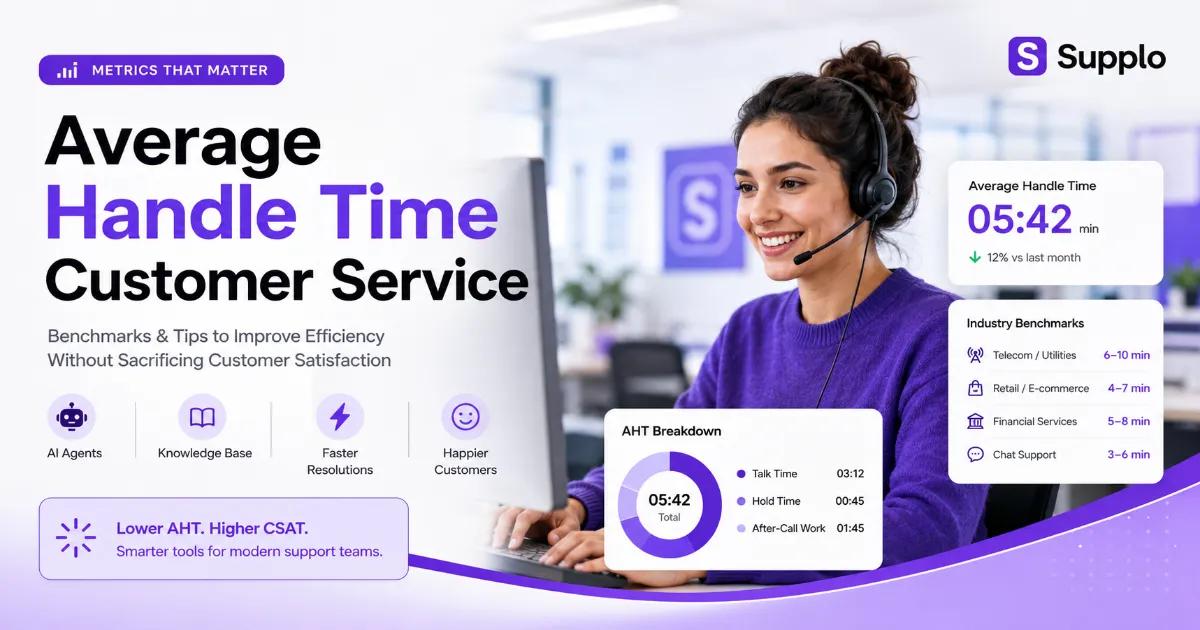
- Avoid vanity metrics: Total tickets closed or average handle time without quality checks tells you nothing useful.
- Pair every speed metric with a quality check: Fast but wrong is worse than slow but right.
Stop guessing which support metrics matter. Start measuring what actually moves the needle. Supplo gives you real-time dashboards for every KPI covered here, in one flat-rate workspace. No metered billing, no seat fees, no surprises, just a shared inbox and an AI agent that work together. Get started for free.
FAQ
What is the single most important customer support KPI for SaaS teams?
First Response Time (FRT) is often the most critical because it’s the first impression of your support’s reliability. However, it should always be paired with a quality metric, such as CSAT, to ensure speed doesn’t sacrifice service.
How often should I review my customer support metrics?
Core metrics like FRT, ART, and CSAT should be reviewed daily or weekly by the support manager. Broader metrics like NPS and escalation rate are best reviewed monthly or quarterly to spot trends.
Why is First Contact Resolution (FCR) so important for help desk KPIs?
FCR directly correlates with customer satisfaction and lower operational costs. Every time a customer has to follow up, it doubles your labour cost and increases the risk of frustration and churn.
What is a good CSAT score for a SaaS company?
Industry benchmarks suggest that a CSAT score of 80–85% is average, 85–90% is good, and 90% or higher is excellent. Anything below 75% indicates systemic issues in your support process or product.
Can AI agents replace humans for tracking support KPIs?
No, but they can drastically improve them. AI agents handle repetitive questions, improving FRT and ART, while humans focus on complex issues that require empathy. The most efficient support metrics come from a hybrid model.
How do I measure agent utilization without causing burnout?
Track "active time" versus "logged-in time" and set a target of 60–75% utilization. Anything above 80% consistently means you need to hire, automate, or streamline processes. Use tools like Supplo to see a unified view of workload.
What’s the difference between deflection rate and AI resolution rate?
Deflection rate counts any ticket that never reaches a human, including those where the user gives up. AI resolution rate specifically counts tickets that the AI agent resolved. The latter is the more honest metric for customer support performance.
Compliance note: Supplo is not affiliated with any app or website. Please follow each app's terms and local regulations.