On this page
Most support teams track everything and understand nothing. You know the drill, dashboards crammed with charts showing "total chats handled" and "average handle time." But do any of those numbers tell you if customers are actually happy? Is your team efficient? Probably not.
This one's for team leads, ops managers, and founders who want to measure what moves the needle, not just what's easy to count.
Quick Answer
- Stop tracking anything that doesn't help you make a decision today.
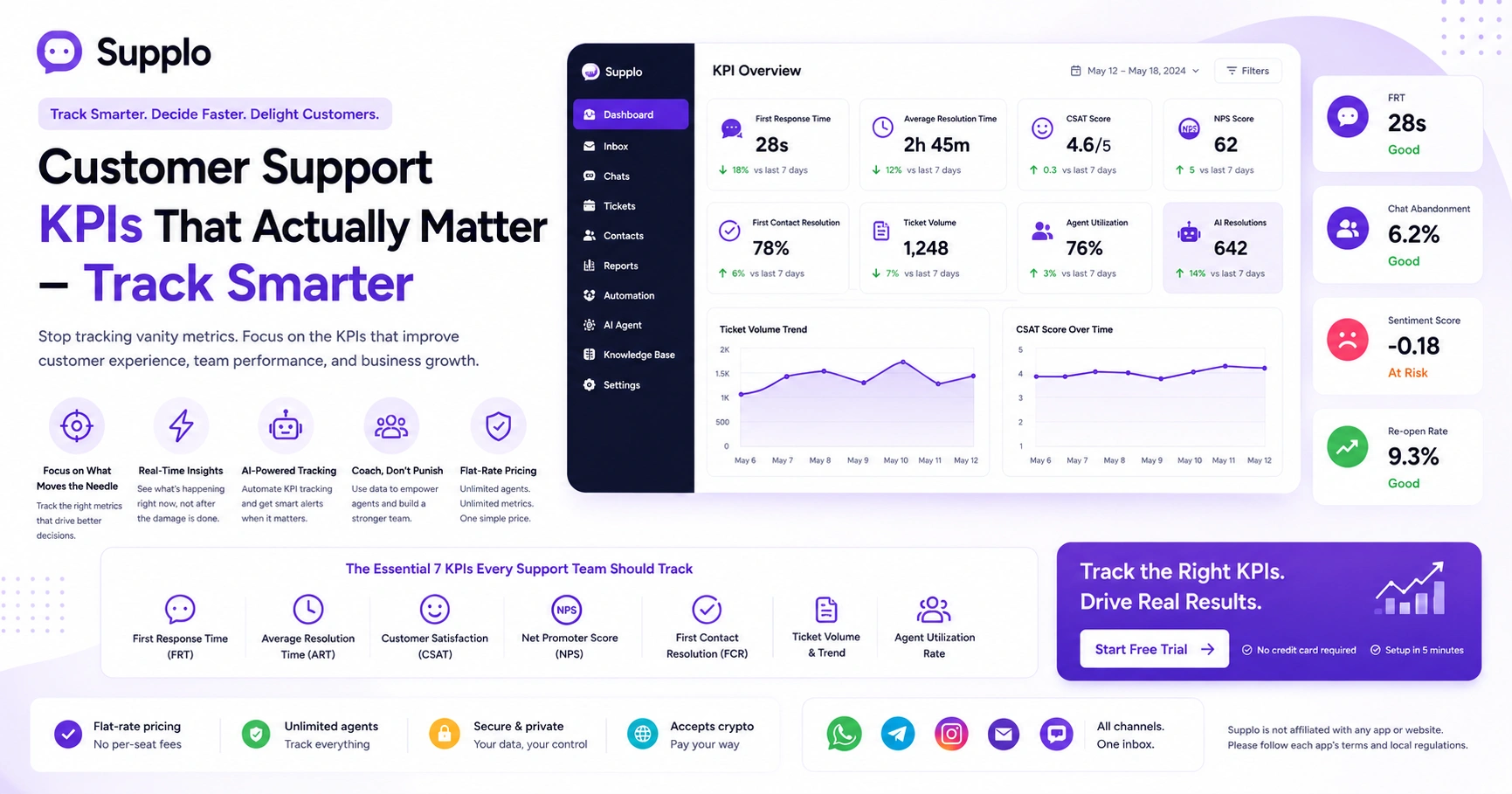
- Focus on the essential 7: FRT, ART, CSAT, NPS, FCR, ticket volume, and agent utilization.
- Live chat needs its own set of metrics, concurrent capacity, abandonment rate, and sentiment.
- Your tooling shouldn't make you choose between tracking well and staying within budget.
Why Most Customer Service Metrics Are a Waste of Time
Most teams drown in dashboards that show "activity" but not "impact." Metrics like total chats handled or average handle time can actually encourage bad behavior, rushing a customer to hit a number. The trick is to separate vanity signals from operational signals. If a metric isn't helping you make a decision today, stop tracking it.
Vanity vs. Actionable Metrics
- Vanity metrics: Total tickets closed per day, total chat volume, average handle time without context. These feel good but tell you nothing about quality or customer satisfaction.
- Actionable metrics: First Contact Resolution (FCR), Customer Effort Score (CES), and resolution rate by agent. These tell you where to intervene tomorrow morning.
- The danger of tracking everything: analysis paralysis and team resentment.
Tracking 20+ metrics means you're tracking none of them. The 80/20 rule applies: focus on the three that give you 80% of the insight.
The 7 Essential Support Team KPIs You Need to Track Today
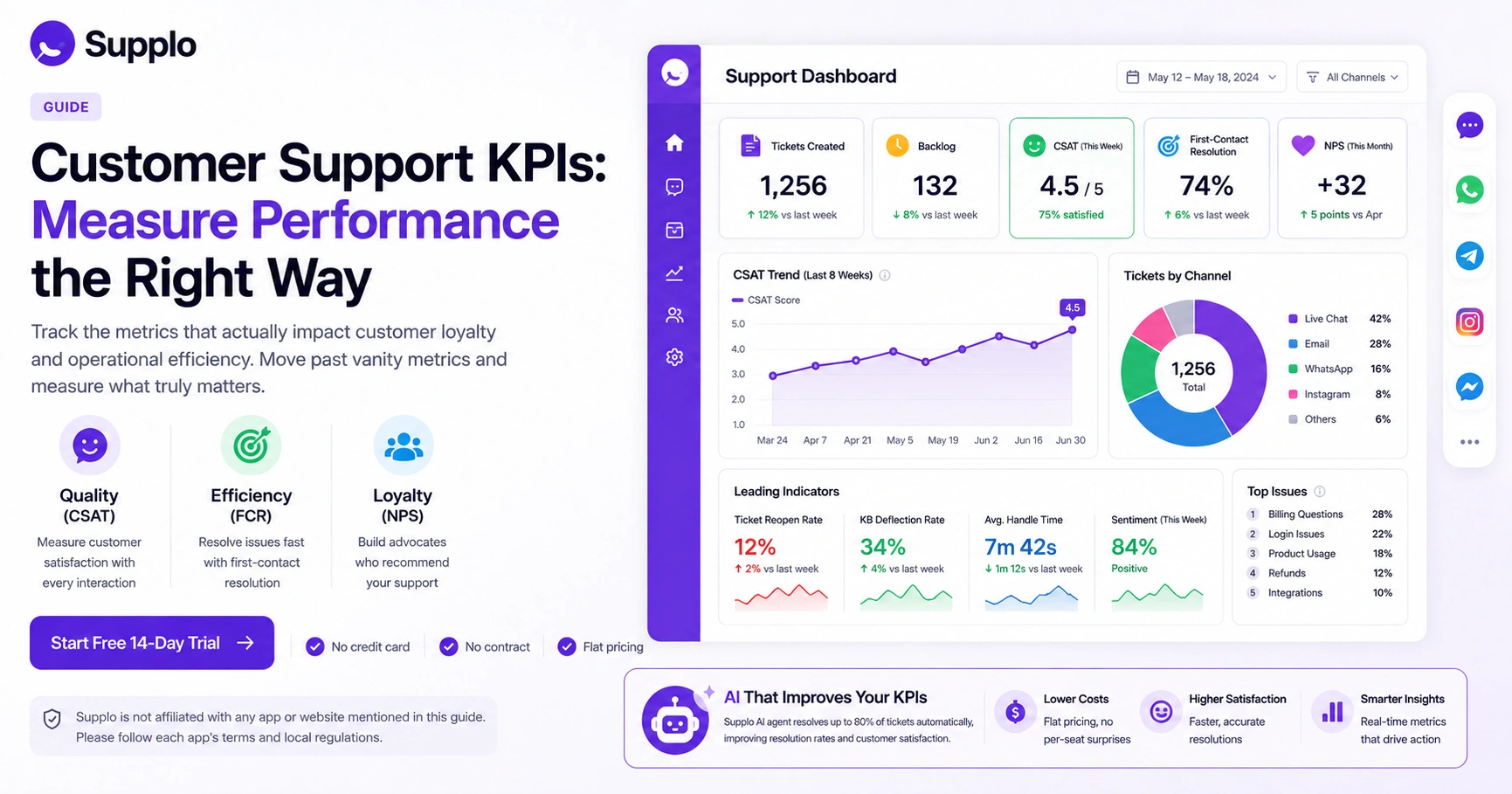
There are dozens of support metrics, but only a handful indicate whether your team is actually helping customers. The essential 7 are: First Response Time (FRT), Average Resolution Time (ART), Customer Satisfaction Score (CSAT), Net Promoter Score (NPS), First Contact Resolution (FCR), Ticket Volume & Trend, and Agent Utilization Rate. Track these, and you've got a full picture of speed, quality, and efficiency. These are the customer support team KPIs and metrics to track that actually move the business forward.
First Response Time (FRT) – The Speed Check
FRT measures how fast a customer gets an initial reply. For live chat, a good target is under 30 seconds. For email, under 4 hours. It's the first impression, slow here, and customers assume the rest will be slow too.
Average Resolution Time (ART) – Where Efficiency Lives
ART measures the total time from ticket creation to final resolution. But be careful: a short ART isn't always good. If tickets are being closed without real solutions (low FCR), ART will appear artificially low while customers remain frustrated.
Customer Satisfaction Score (CSAT) – The Honest Report Card
CSAT asks customers to rate a specific interaction on a 1-5 scale. It's your most direct feedback loop. Track it after every interaction, not just randomly sampled ones.
Net Promoter Score (NPS) – Loyalty, Not Just Happiness
NPS measures overall loyalty with a single question: "How likely are you to recommend us?" It's less granular than CSAT, but it predicts long-term retention.
First Contact Resolution (FCR) – The One-and-Done Metric
FCR is the holy grail. It measures the percentage of issues resolved in a single interaction. High FCR correlates strongly with high CSAT and low churn. If a customer has to contact you twice for the same problem, you haven't resolved it.
Ticket Volume & Trend – Are You Drowning or Cruising?
Track volume daily and weekly. A sudden spike could mean a product bug or a seasonal surge. A steady decline might mean your self-service resources (like your knowledge base) are working, or it could mean customers have given up.
Agent Utilization Rate – Burnout vs. Boredom
This measures how efficiently agents work, not just how busy they look. A healthy rate is between 70% and 85%. Above 85% risks burnout; below 60% suggests overstaffing.
Live Chat Support KPIs – Why They're Different And Harder
Live chat isn't email. Customers expect near-instant replies, and they can see when you're "typing." This makes concurrent chat capacity and chat abandonment rate critical metrics that don't exist in email support. A high live chat abandonment rate often means your agents are stretched too thin, not that customers are impatient. Our live chat performance tracking features are built to give you real-time visibility here.
Concurrent Chat Capacity – The Multi-Tasking Trap
The number of chats an agent can handle simultaneously without dropping quality. For complex technical support, that might be 1-2 chats. For simple FAQ queries, 3-4 is fine, anything more and both CSAT and resolution quality drop.
Chat Abandonment Rate – Why People Leave Mid-Talk
The percentage of visitors who start a chat and leave before resolution. If this number is above 10%, your agents are either responding too slowly or giving bad first answers.
Average Chat Duration – Short Isn't Always Sweet
A quick chat that ends with "sorry, can't help" is worse than a longer one where the problem gets solved. Always pair duration with CSAT.
Chat Customer Service Metrics That Predict Churn
Most support metrics are backward-looking; you see the problem after it happened. But a few metrics can actually predict churn. Sentiment Score Trend, for example, shows you when a customer's tone is souring across interactions. If a previously happy customer's sentiment drops over three conversations, they're likely to churn soon.
Sentiment Score Trend – Spot the Frown Before They Leave
Track the emotional tone of conversations over time per customer. A consistent drop over 2-3 interactions is a strong churn signal. Other predictive metrics include Re-open Rate (tickets reopened by the same customer, resolution wasn't complete) and Effort Score (how hard did the customer have to work? High effort = high churn risk).
How to Measure Support Team Success Without a Data Science Degree
You don't need a BI team to understand your support health. Start with one metric: Customer Satisfaction Score (CSAT) after every interaction. Then add First Response Time (FRT) for speed. That's your baseline. A simple dashboard with these three, CSAT, FRT, and Ticket Volume Trend, will catch 90% of issues. Our shared inbox for team collaboration makes this data visible from day one.
Setting Baselines & Benchmarks
Measure for 30 days before setting targets. Use industry benchmarks, but don't copy them unthinkingly; your product complexity matters. A software product with a steep learning curve will have longer resolution times than an e-commerce store.
The Dashboard You Actually Need
A good dashboard should have no more than 5 metrics. More than that, and you're decorating, not managing. Start with CSAT, FRT, FCR, ticket volume, and agent utilization. Add one more per quarter as you stabilize.
Want to See Your Real KPIs in 5 Minutes? Stop guessing what to track. Supplo's shared inbox and AI agent automatically surface CSAT, FRT, and FCR from day one. No setup required. Start Free Trial at supplo.io
The Hidden Cost of Bad KPIs – And How AI Fixes It
Bad KPIs aren't just useless; they're expensive. When you optimize for "average handle time," agents rush customers. When you ignore "re-open rate," you solve the same problem twice. Modern AI agents can automatically track these, surface trends, and even suggest improvements—no spreadsheets required. Our AI agent for automatic KPI tracking does exactly this.
Why Manual Reporting Slows You Down
Hours wasted pulling data that's already stale. By the time you spot a dip in CSAT, the damage is done, and you have no idea why.
AI-Generated Insights vs. Spreadsheet Guessing
AI agents (like Supplo's) can auto-flag when FRT spikes or sentiment drops. They reduce the lag between data and action from days to minutes, and they can suggest root causes based on ticket content.
Key Performance Indicators for Support Teams – The Tooling Trap
Many KPI problems are actually tooling problems. Per-seat pricing platforms often make you choose between tracking everything or paying a fortune. That's why flat-rate pricing vs. per-seat fees makes more sense; you get unlimited seats, so you can actually track the metrics that matter without worrying about the bill.
Why Per-Seat Platforms Skew Your Numbers
Per-seat platforms encourage you to limit agent access, skewing utilization data. You end up measuring only the agents you can afford to add to the system, not the full team. Compare Supplo vs Intercom on features and pricing to see the difference.
Tooling should be invisible. If your dashboard costs more than your agents, something's wrong.
Stop Tracking Everything – Focus on These Key Support Metrics Instead
If you're tracking 20+ metrics, you're tracking none of them. The 80/20 rule applies: 80% of your actionable insights come from 20% of your metrics. Focus on Customer Satisfaction (CSAT), First Contact Resolution (FCR), and First Response Time (FRT). Everything else is noise until those three are healthy.
The 80/20 Rule of Support Metrics
Three metrics tell you if your team is fast, effective, and liked. Add one metric per quarter as you stabilize; don't add all at once. If CSAT is high but FCR is low, customers like you but have to call back, that's a problem.
How to Improve Your Chat KPIs for Agents Without Micromanaging
The worst way to improve chat KPIs is to slap a target on the wall and yell at agents who miss it, the better way is to coach based on the data, not the number. If an agent's average resolution time is high, look at the types of tickets they handle. Maybe they're getting the hardest cases.
Coaching vs. Penalizing – The Right Way
Use FCR as a coaching tool: why did this ticket reopen? Share team averages, not individual targets, create a culture of improvement. Automate repetitive queries with an AI agent so humans can focus on complex work.
Your Chat KPIs Are Stuck – Here's Why. If your agents are drowning in repetitive questions, no coaching will fix it. An AI agent can handle the routine stuff, letting your humans focus on complex tickets that improve FCR and CSAT. See how the AI Agent Works at supplo.io/features/ai-agent/.
What Happens When You Track the Wrong Metrics
A team obsessed with "average handle time" will rush every customer, even the ones who need care. A team obsessed with "total tickets closed" will close tickets without solving the root issue. The result? Perfect dashboards, angry customers, and high churn.
The Case of the Perfect CSAT But Empty Pipeline
High satisfaction but still losing customers, often because resolutions were delayed. Or the case of the perfect FRT but terrible FCR: fast replies that don't actually solve anything. Always ask: "Does improving this metric actually help the customer?"
See a case study of real customer success with better KPIs for a practical example.
Pick one metric, improve it, and observe customer outcomes for 30 days. If customers aren't happier, you're optimizing the wrong thing.
Ready to Track Smarter, Not Harder?
You now know which metrics matter and why most dashboards are noise. The next step is to get a support platform that actually tracks them automatically, without per-seat fees or spreadsheets. Supplo gives you real-time CSAT, FRT, FCR, and sentiment tracking built into one flat-rate workspace.
Stop guessing which metrics to improve, let AI surface the insights—no more per-seat limits forcing you to choose between tracking and budget.
Track the Right KPIs Without the Spreadsheet Headache
Flat-rate pricing means you can add unlimited agents, track unlimited metrics, and never worry about a per-seat bill. Plus, we accept crypto payments.
Get Started at supplo.io/pricing/.
Key Takeaways
- Stop tracking vanity metrics; focus on CSAT, FRT, and FCR for 80% of insights.
- Live chat needs its own metrics: concurrent capacity, abandonment rate, and sentiment.
- Tooling matters; per-seat platforms distort your data; flat-rate is better.
- Use KPIs to coach, not punish, and always pair speed with quality.
Disclaimer: Supplo is not affiliated with any app or website. Please follow each app's terms and local regulations.
FAQ
What is the single most important customer service KPI?
First Contact Resolution (FCR) measures whether you resolved the problem in a single interaction. High FCR almost always correlates with high CSAT and low churn.
How often should I review support team KPIs?
Review high-level KPIs (CSAT, FRT, ticket volume) every week. Deep-dive into specifics like agent utilization or re-open rate once a month. Daily reviews cause micromanagement burnout.
Can AI actually improve my customer service metrics?
Yes. An AI agent can answer repetitive questions instantly, slashing your first response time and freeing up humans for complex issues.
What's the difference between CSAT and NPS?
CSAT measures satisfaction with a specific interaction. NPS measures overall loyalty. Both matter, but CSAT is more actionable day to day.
How do you calculate first response time?
Add up the time between when a ticket is created and when an agent first responds, then divide by the total number of tickets. A good target for live chat is under 30 seconds; for email, under 4 hours.
Why does first contact resolution matter so much?
Low FCR means customers contact you multiple times for the same issue, inflating volume, frustrating customers, and costing more. Improving FCR by just 5% can significantly reduce support costs.
Should I track individual agent performance or just team-level metrics?
Track team-level first. If a problem persists, use individual data to coach, not punish. Agents who feel spied on will game the system.
Compliance line: Supplo is not affiliated with any app or website. Please follow each app's terms and local regulations.