On this page
Figuring out how to measure customer support performance the right way isn't about collecting more data; it's about collecting the right data. If you're tired of staring at dashboards full of numbers that don't tell you whether customers are actually happy, you're in the right place.
This guide is for support leaders and teams who want to move past the vanity metrics, the ones that look good in a meeting but don't actually move the needle. We'll zero in on the KPIs that genuinely impact customer loyalty and operational efficiency. And yes, we'll show you how to track them without drowning in spreadsheets.
Quick Answer
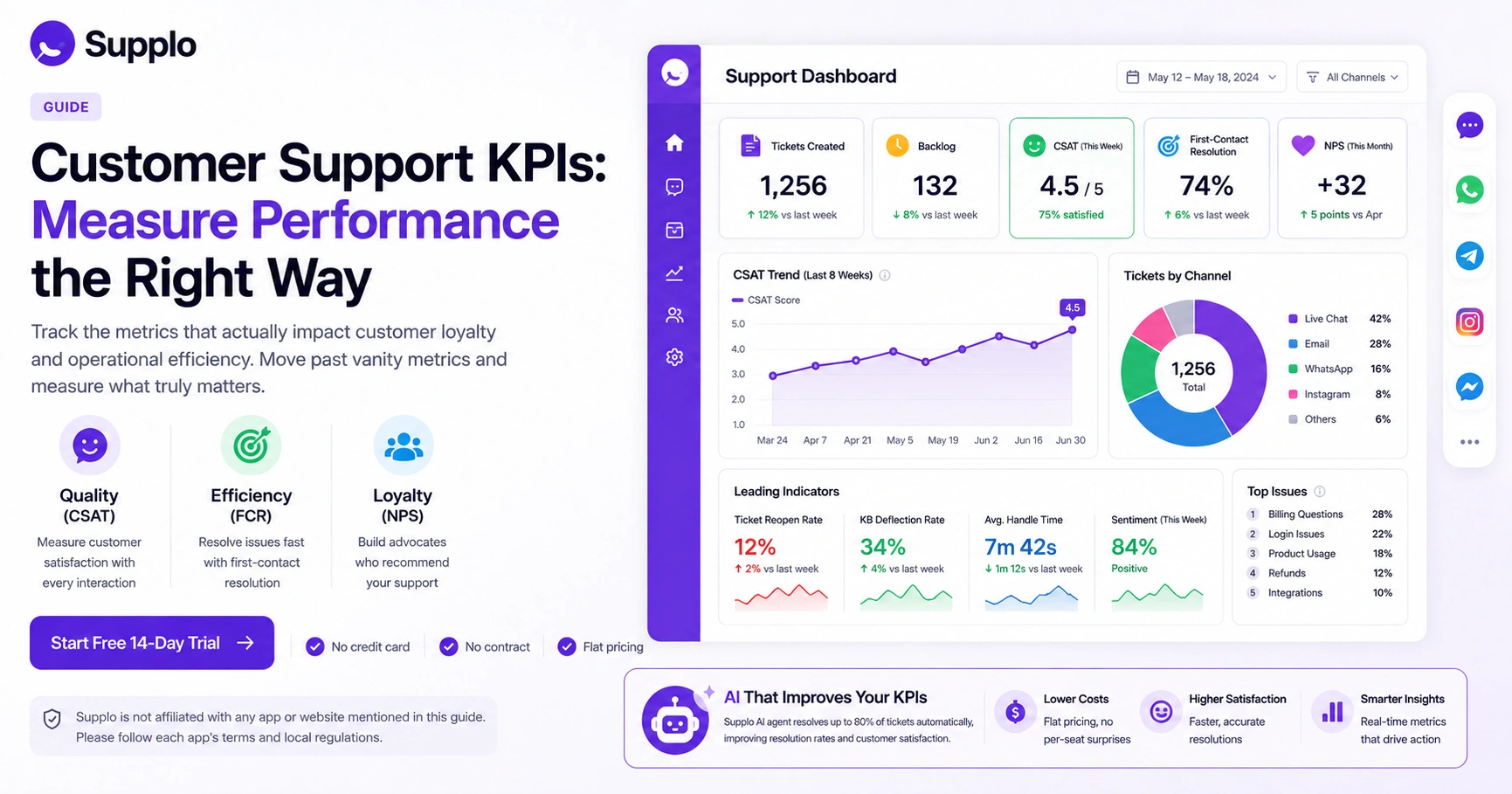
- Measure performance with three core KPIs: CSAT for quality, first-contact resolution for efficiency and NPS for loyalty.
- Calculate CSAT by dividing the number of satisfied responses by total responses, then multiply by 100.
- Track leading indicators like ticket reopen rate and sentiment to catch problems early.
- Use a single-pane dashboard with five metrics to avoid data overload.
Why Standard Customer Support Metrics Fail and What to Track Instead
Here's the thing about measuring customer support performance: most teams track ticket volume and first-response time, then scratch their heads when satisfaction doesn't budge.
The problem? Volume is a vanity metric. And speed without accuracy? That actually frustrates customers more than a slow but thorough reply. You need to pair efficiency metrics with quality indicators like resolution rate and CSAT.
- First response time means nothing if the answer is wrong; track first-contact resolution alongside it.
- Ticket volume can rise because your product is popular or because your knowledge base is weak, same number, completely different story.
- Avoid cherry-picking one metric; use a balanced scorecard of efficiency, quality and loyalty.
- A low CSAT might be a product issue rather than a support issue; isolate support-specific feedback through post-chat surveys.
Think of it this way: you wouldn't judge a restaurant just by how fast the food arrives. You'd also want to know whether the food was good, whether the server was helpful and whether you'd come back. The same logic applies here.
How to Calculate CSAT Score: The Customer Satisfaction Formula That Works
CSAT is calculated by dividing the number of satisfied responses (ratings of 4 or 5 on a 5-point scale) by the total number of survey responses and then multiplying by 100. For example, 45 satisfied responses out of 60 total gives you a CSAT of 75%. That single number gives you a quick read on how well your team resolved the specific interaction.
It's simple, but there's a right way and a wrong way to do it.
- CSAT score calculation methods vary slightly; some use a 3-point scale, but the 5-point scale is standard for benchmarking.
- Send the survey immediately after a ticket resolves; capture sentiment while it's fresh, not three days later.
- Don't average raw scores; use the "top two box" method (count only 4 and 5 as satisfied).
- Compare CSAT by channel; chat versus email versus social DMs often reveal very different satisfaction levels. You might find your WhatsApp support crushes it while your email responses need work.
- Supplo's shared inbox automates CSAT tracking so you don't have to hunt for this data. Learn more about our inbox.
Key Customer Service Metrics: Distinguishing Efficiency from Quality
Efficiency metrics tell you how fast your team moves, the average handle time, the first-response time and the tickets per agent. Quality metrics tell you how well: CSAT, first-contact resolution and sentiment score.
The trick is to watch both, because a super-fast team that leaves customers unhappy is actually slow to build loyalty.
- Average handle time under 5 minutes is good for chat, but don't let agents rush genuine escalations.
- First-contact resolution over 70% generally signals a strong knowledge base and well-trained team.
- Ticket backlogs that grow week over week are a leading indicator of team burnout, not just high volume.
- Use quality-assurance scoring (QA rubrics) to calibrate subjective metrics such as tone and accuracy.
- Supplo's AI agent deflection rate and ticket reopen reports provide valuable insights into both efficiency and quality. Learn more about our AI agent.
If you have to choose between being fast or being right, always choose being right. Speed can be improved. A bad reputation from rushed answers? That's much harder to fix.
How to Calculate NPS for Customer Service: Net Promoter Score for Support
Calculate NPS by subtracting the percentage of Detractors (0–6) from the percentage of Promoters (9–10). If 40% are Promoters and 20% are Detractors, your NPS is 20.
For support specifically, send a single-question survey, "How likely are you to recommend our support team?", after a ticket is closed and segment responses by reason for contact.
- NPS for service isn't the same as product NPS; keep them separate to understand each experience.
- Passives (7–8) are often ignored but represent a retention risk. They're satisfied but not loyal.
- Track NPS by agent to spot coaching opportunities without turning it into a punishment tool.
- A good support NPS benchmark is typically 30–50, but compare against your own industry.
If you're thinking about tying bonuses to NPS, think twice. It can encourage agents to pressure customers for high scores, which defeats the purpose.
Customer Support Performance Indicators: Leading vs. Lagging Measures
Lagging indicators like monthly CSAT and NPS tell you what already happened. Leading indicators, like sentiment during a live chat, ticket reopen rate and knowledge base deflection rate, tell you what's about to happen.
If reopen rates spike mid-week, you have a quality problem today, not next month when the CSAT report comes out.
- Ticket reopen rate above 15% suggests first replies aren't thorough enough.
- Knowledge base deflection rate above 30% means your self-help docs are working.
- A drop in sentiment during a conversation is a real-time red flag; agents can address it before the CSAT survey is sent.
- Daily and weekly cadences help you react faster than monthly reporting loops.
This is where most teams get tripped up. They wait for the monthly report to see what went wrong, when they could have caught it days or weeks earlier with the right leading indicators.
Measuring Customer Loyalty in Support: Beyond the Score
Loyalty isn't just a score on a survey; it shows up in repeat purchases, lower churn and customers who choose you over cheaper alternatives.
In support, measure loyalty through repeat contact rate (how often the same customer opens tickets) and customer effort score (how hard they had to work to get help).
- Customer effort score correlates strongly with repurchase intent; low effort equals higher loyalty.
- Repeat contact rate under 10% generally indicates good first-contact resolution and solid self-help.
- Combine NPS with cohort-level churn rate to see whether promoters actually stay longer than detractors.
- Qualitative feedback like "that was easy" or "I had to explain everything twice" reveals loyalty levers numeric scores miss.
Supplo's multichannel support inbox can help you track loyalty across WhatsApp, Telegram, Instagram and more, so you see the full picture. Learn more about our WhatsApp support.
Track Customer Support Success with a Simple Dashboard Setup
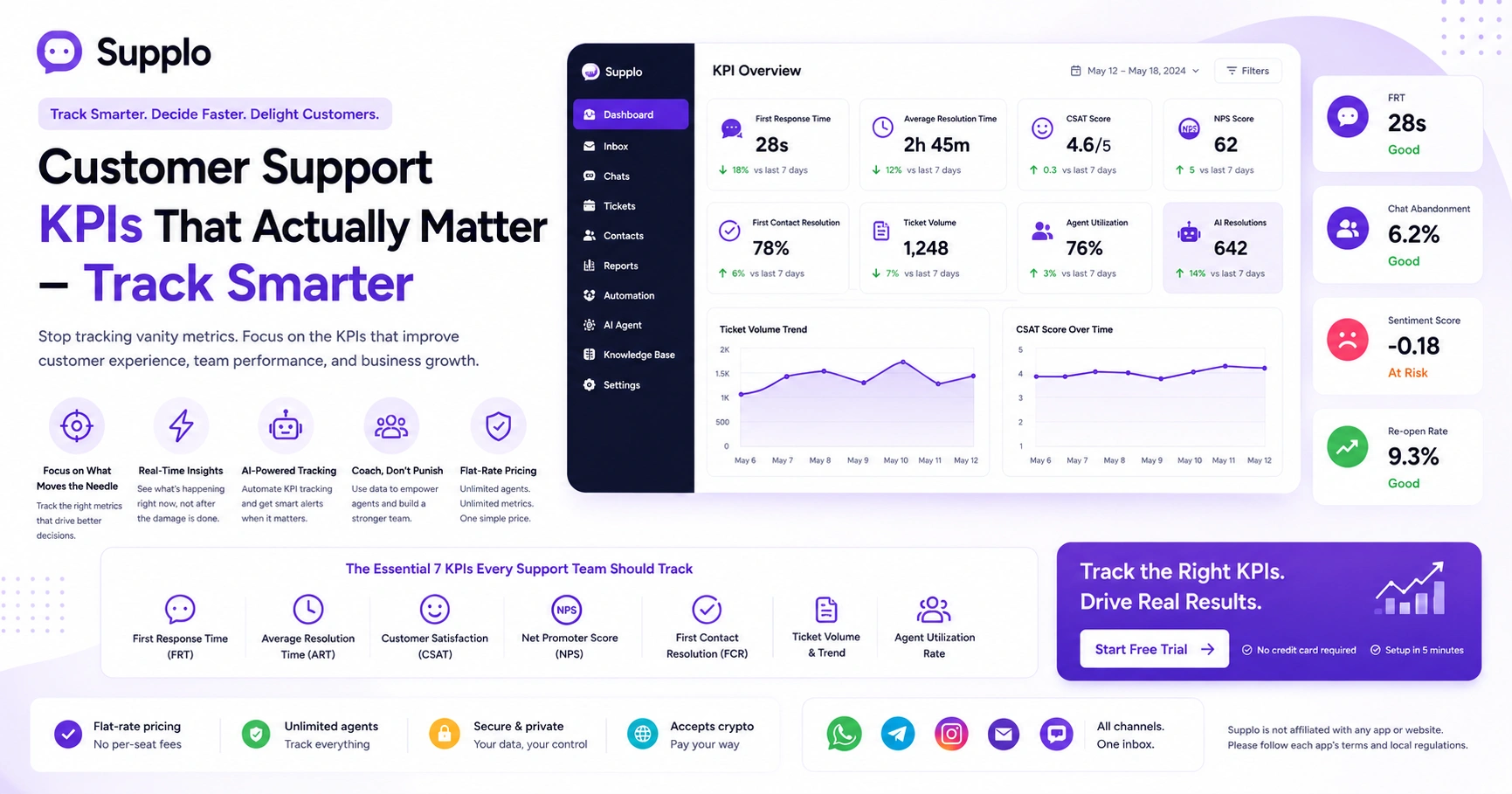
A practical support dashboard should fit on one screen and show: daily ticket volume, current backlog, average CSAT for the week, first-contact resolution rate and NPS trend.
Refresh it daily and resist the urge to add every possible metric. You want action signals, not data noise.
- Use a four-box layout: volume on the top left, quality on the top right, efficiency on the bottom left, trend lines on the bottom right.
- Set weekly targets, not monthly, so you can course-correct before the quarter ends poorly.
- Share the dashboard with the whole team, not just management; visibility drives ownership.
- Supplo's inbox and AI agent automatically log these metrics so you don't need a separate reporting tool. Learn more about our pricing and features.
If your dashboard has more than five numbers, you're probably overcomplicating it. Strip it down and see what actually gets used.
NPS Customer Support Strategy: Turning Feedback into Action
An NPS score without a follow-up process is just a vanity number.
- For promoters, ask for a testimonial or review.
- For detractors, send a personal follow-up from a senior team member within 48 hours.
- For passives, share a helpful resource or tip; they're the easiest segment to upgrade.
- Tag detractors in your CRM and trigger a workflow to schedule a manager call within 2 business days.
- Close the loop with promoters by inviting them to a product beta or loyalty program.
- Analyze NPS by topic (billing, technical, product) to see where support experiences differ.
- Benchmark your NPS quarterly but act on it weekly; the trend matters more than the point-in-time number.
Measuring Customer Advocacy: When Support Creates Promoters
Advocacy is what happens when a customer doesn't just stay; they tell others.
Measure it through referral requests from support interactions, social mentions and the percentage of customers who leave a review after a positive experience. The simplest advocacy metric is the share of promoters who actually recommend you.
- Track net promoter share (promoters minus detractors) as a raw count, not just a percentage.
- Ask "Would you refer us to a colleague?" as a standalone question in post-support surveys.
- Monitor third-party review sites and support tickets that mention "I recommended you to..." as organic advocacy signals.
- Advocate customers tend to have lower support costs and higher lifetime value; tie the data together in your reporting.
Supplo is not affiliated with any app or website. Please follow each app's terms and local regulations.
Setting Up Your First Customer Support KPIs
Start with three metrics: CSAT for quality, first-contact resolution for efficiency and ticket volume trend for workload. Set a baseline by tracking them for two weeks. Then add NPS for loyalty and ticket reopen rate for accuracy. Expand only after you're confident you can consistently track those five.
Steps:
- Define what "resolved" means for each ticket type; it varies by industry.
- Set up automated post-ticket surveys (Supplo handles this natively in the inbox).
- Choose a weekly review cadence, not a daily fire drill.
- Share the first two weeks of baseline data with the team before setting targets.
- Review and adjust metrics quarterly; your KPIs should evolve as your support matures.
Common Traps in Measuring Customer Service Quality and How to Avoid Them
The biggest trap is survey fatigue; if you ask after every single interaction, response rates drop and scores become unreliable.
Another common mistake is comparing CSAT across different ticket types (billing vs. tech support) without segmenting. Also, don't set targets without historical data; you'll frustrate your team.
- Sample 20–30% of closed tickets instead of surveying every interaction to improve data quality.
- Segment CSAT by issue type, channel and hour of the day; a low score at 2 AM probably says more about wait times than agent skill.
- Avoid tying bonuses to a single metric, such as first response time; it incentivizes speedy but shallow replies.
- Use a red-yellow-green alert system: green is on track, yellow needs attention, red needs escalation.
- Avoid survey fatigue with built-in feedback tools in Supplo's widget. Learn more about our widget features.
Free trial pitch
Want to see these KPIs in action without building a dashboard from scratch? Start your free 14-day trial at Supplo.io; your CSAT, NPS and resolution data populate automatically from day one.
Higher acceptance pitch
Tired of unreliable survey data and manual reporting? Supplo's AI agent resolves up to 80% of tickets automatically and logs every metric you need. Start your free trial at Supplo.io and see the difference.
Ongoing use pitch
Customer support KPIs aren't a one-time project; they're a continuous feedback loop. Supplo keeps your metrics live, your team aligned and your costs predictable at a flat rate with no per-seat surprises. Try it free for 14 days at Supplo.io.
Key Takeaways
- Measure performance with three core KPIs: CSAT for quality, first-contact resolution for efficiency and NPS for loyalty.
- Calculate CSAT by dividing the number of satisfied responses by total responses, then multiply by 100.
- Track leading indicators like ticket reopen rate and sentiment to catch problems early.
- Use a single-pane dashboard with five metrics to avoid data overload.
FAQ
How often should I measure customer support performance?
At minimum, weekly for leading indicators such as ticket reopen rate and backlog and monthly for lagging indicators such as CSAT and NPS. Daily tracking creates noise; quarterly tracking misses too much.
What's the difference between CSAT and NPS for support?
CSAT measures satisfaction with a single interaction. NPS measures overall loyalty and willingness to recommend your support team. Both are useful, but they answer different questions.
Is first response time still an important KPI?
Yes, but only when paired with a quality metric. A fast wrong answer is worse than a slightly slower correct one. Track first response time alongside first-contact resolution for a balanced view.
How do I calculate customer satisfaction score if I use a 10-point scale?
The formula stays the same: divide the number of satisfied responses (8–10 on a 10-point scale) by total responses, then multiply by 100. Or normalize to a 5-point scale for industry benchmarking.
Should I measure agent performance using individual KPIs?
Carefully. Individual metrics are fine for coaching and self-improvement, but avoid public rankings or bonus structures tied to a single metric. Team-level metrics usually drive better collaboration.
What is a good first-contact resolution rate?
Above 70% is generally considered good for most B2B and B2C support teams. A score below 60% suggests your knowledge base or agent training needs attention. Industry norms vary, so benchmark against your own past performance.
Can AI support tools like Supplo help me track these metrics automatically?
Yes, Supplo's AI agent and shared inbox log CSAT, NPS, ticket volume, reopen rates and resolution data automatically so you don't need a separate reporting layer. The AI agent can also deflect common questions, which improves first-contact resolution rates.
Compliance line: Supplo is not affiliated with any app or website mentioned in this guide. Please follow each app's terms and local regulations.