On this page
Let's be real, if your support team is still playing hot potato with customer tickets, you need a better system. A support escalation matrix question usually comes up when things start falling through the cracks. And honestly, that's a good sign you're ready to level up.
A support escalation matrix is basically your team's roadmap for handling customer issues. It defines exactly how a problem moves from one person to the next, ensuring the right expert gets the right ticket at the right time. Whether you're running a two-person startup or a hundred-person support team, this framework saves you from chaos.
This guide is for customer support managers, team leads, and business owners who want to stop guessing and start building something reliable. If you're tired of slow responses, confused agents, and frustrated customers, you're in the right place.
Quick Answer
- A support escalation matrix is a structured framework that maps how customer issues travel between support levels based on complexity.
- Its main job is to ensure issues are resolved predictably, with clear communication along the way.
- Common setups include the 3-tier model for general support and incident-specific matrices for emergencies.
- Benefits include faster resolution times, better first-contact fixes, and happier teams.
- Automating your matrix with AI tools can seriously boost both efficiency and consistency.
Define Support Escalation Matrix – What It Is and Why It Matters
So, what exactly is a support escalation matrix? Think of it as your support team's GPS. It tells everyone exactly where a ticket should go, who should handle it, and how long each step should take, no more guessing games.
A solid matrix includes defined levels of support (L1, L2, L3) with clear criteria for when a ticket moves up. It covers both the technical path, which team owns the issue, and the communication path, who talks to the customer at each stage. Without this, your team spends more time deciding who should take a ticket than actually solving problems.
The best part? A good matrix should be documented and visible to everyone. Not just stored in a manager's head or buried in a Google Doc no one reads. It needs to be living, breathing, and actually used.
The Purpose of a Support Escalation Matrix: It's Not Just About Tiers
Here's the thing: a support escalation matrix isn't just about sorting tickets into neat little boxes. Its real purpose is way bigger.
It's about creating a predictable process that protects both your team's sanity and your customer's experience. When an issue escalates, the matrix ensures the right person gets it at the right time, with all the context they need. No more, I already told the last agent this moment.
It prevents those dreaded hot potato situations where tickets get passed around like nobody wants to touch them. It sets clear expectations for response times and resolution ownership at each level. And honestly? It helps managers spot bottlenecks before they become disasters.
But here's my favorite part: it gives junior team members a clear panic button. They know exactly when and how to get help, which means less stress and more confidence.
Support Escalation Matrix Models – Which One Fits Your Team?
Different businesses need different approaches. Let's look at the most common models so you can pick the one that works for you.
The Classic 3-Tier Support Escalation Matrix
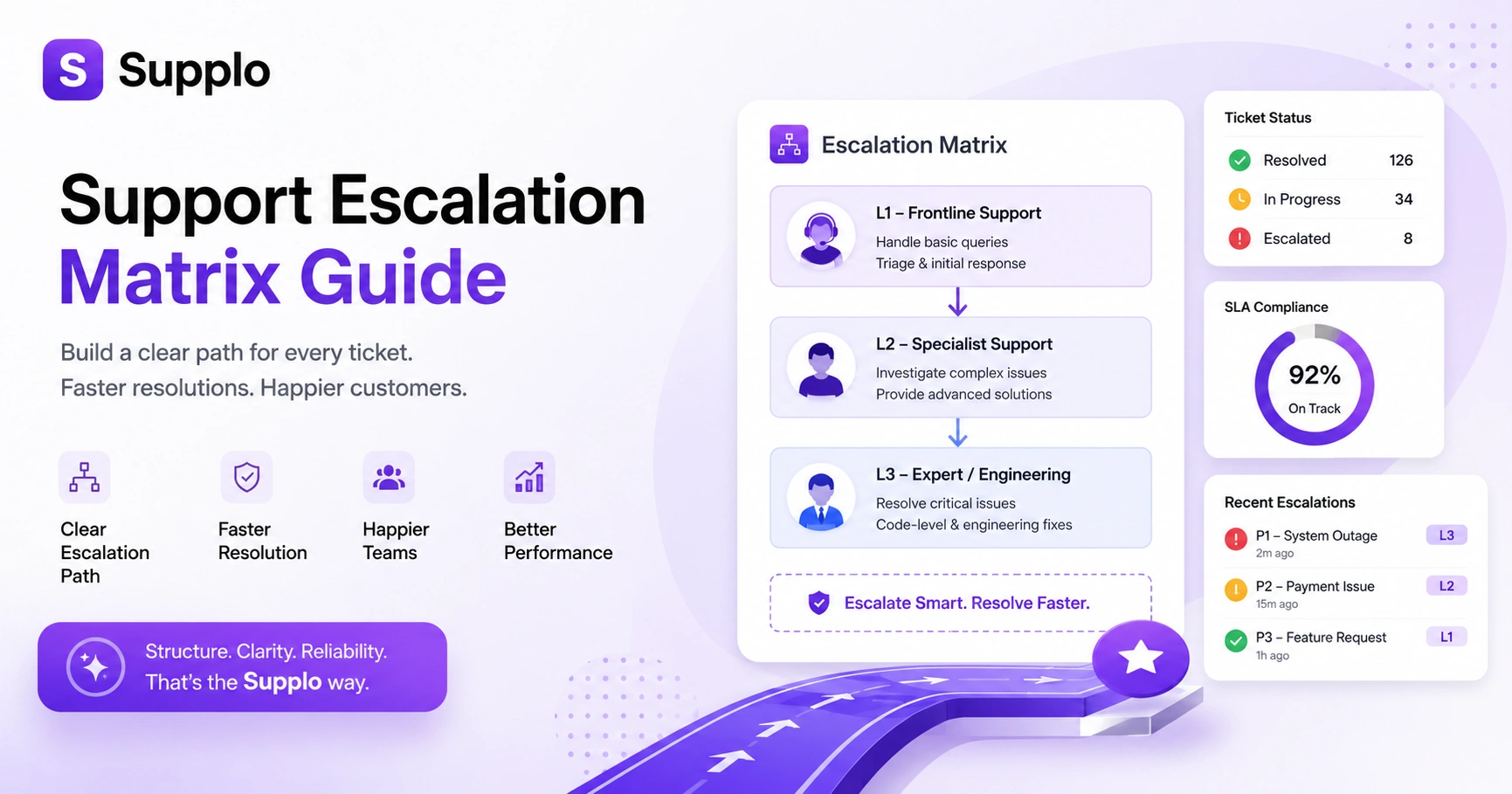
This is the bread and butter of support matrices. The 3-tier support escalation matrix is the most popular model, and for good reason. L1 handles basic queries and triage, L2 tackles more complex issues, and L3 involves product experts or engineering.
This model works great for most SaaS companies, e-commerce stores, and managed service providers. It's easy to understand and implement.
Here's how it typically breaks down:
- L1 (Frontline): Handles password resets, FAQ questions, basic troubleshooting, and initial ticket routing. They're the friendly faces customers see first.
- L2 (Specialist): Takes over when L1 identifies a bug, a configuration issue, or something that needs deeper product knowledge. These agents usually have more system permissions.
- L3 (Expert/Engineering): Only involved for code-level fixes, architecture changes, or critical incidents that need a developer's attention.
Incident Support Escalation Matrix For Critical Outages
Sometimes things go really wrong. An incident support escalation matrix is built for emergencies, full site outages, security breaches, and data loss events. It bypasses normal tiers and triggers an immediate SWAT team response.
This model uses severity-based triggers (think P1 = System down for everyone, P2 = Major feature broken for some users). It defines a responder tree with specific names and backup contacts, not just roles. And it includes a mandatory communication cadence, like updating leadership every 30 minutes.
Importance of a Support Escalation Matrix – How It Reduces Chaos and Builds Reliability
Let me put it this way: the importance of a support escalation matrix comes down to one word: reliability.
A well-defined matrix means every customer issue gets handled with consistent speed and expertise, no matter who's on shift. It transforms a chaotic, reactive support environment into a predictable, manageable one.
It directly reduces average handle time (AHT) by preventing your team from wasting time figuring out who should take it. It improves first-contact resolution (FCR) at L1 because agents know exactly when to escalate, and when not to. And it builds customer trust because they see a consistent, professional response every single time.
Plus, it protects your team from burnout. No more junior agents stuck on impossible tickets for hours. That's a win for everyone.
Levels of Support Escalation Explained L1, L2, L3 and Beyond
The levels of support escalation, L1, L2, and L3, represent increasing depth of technical expertise and decision-making authority. Think of them as a ladder, not a maze.
- L1: Agents should be great at communication and basic troubleshooting. They don't need deep product knowledge. Their job is to resolve simple issues and efficiently pass complex ones up.
- L2: These agents need deeper product understanding, database query skills, and advanced configuration knowledge. They handle issues that need more investigation than L1 can provide.
- L3: Usually reserved for developers, system architects, or senior product managers. These are your subject matter experts for highly technical or critical problems.
Some teams also include Levels 0 (self-service via knowledge base) and 4 (external vendor or partner). The key is having clear definitions for each level to prevent escalation creep, where L1 agents skip L2 and go straight to L3, overwhelming your senior team.
How to Build a Support Escalation Matrix
A well-crafted escalation matrix isn't just a document. It's a living system that guides your team every day.
Steps to Create a Support Escalation Matrix That Your Team Will Actually Follow
To build a support escalation matrix, start by mapping your most common issue types and the expertise needed to solve each one. Then, define clear escalation criteria for each tier, please, no vague rules like if it's hard. Document it, share it, and test it with real tickets before going live.
Here's the process:
- Audit Your Tickets: Review your last 100-200 support tickets. Categorize them by complexity, common issue types (like password reset, bug report, feature request), and who ultimately resolved them.
- Define Escalation Criteria: For each issue category, establish 3-5 clear, objective criteria that trigger an escalation. Instead of a complex issue, use specifics like Requires database access or Issue affects multiple users.
- Assign Ownership: Clearly assign primary and backup ownership at each level. Specify roles or names, not just 'senior support'. This prevents confusion about who's responsible.
- Set Time Limits: Establish maximum time limits for each tier for resolving or escalating a ticket. Like L1 must resolve or escalate within 30 minutes, or L2 must resolve or escalate within 2 hours.
- Document and Socialize: Create a clear, accessible document for your matrix. Share it with your entire support team and any involved departments.
- Test and Iterate: Before full implementation, run a dry run with 5-10 scenario tickets. Get feedback from your team and adjust based on what actually works.
How to Design an Effective Escalation Matrix: Avoiding Common Pitfalls
An effective escalation matrix is simple, transparent, and actually used. The biggest mistake teams make? Overcomplicating it. Too many tiers, vague criteria, or no time limits can kill its effectiveness.
Here are common pitfalls to avoid:
- Pitfall 1: Tier Bloat – Having 5+ tiers when 3 will often suffice creates unnecessary complexity. Keep it simple.
- Pitfall 2: Ghost Agents – Listing a team or person who's never available. Always include specific individuals and their backup contacts.
- Pitfall 3: No Feedback Loop – When L2 or L3 solves an issue, that knowledge should flow back to L1 to update your knowledge base and prevent future escalations.
- Pitfall 4: Static Document – Your matrix should be reviewed and updated quarterly as your product, services, and team evolve.
Support Escalation Matrix Template – A Simple Starting Point
A basic support escalation matrix template can live in a simple spreadsheet or document. It should include columns for: Tier Level, Issue Type/Criteria, Owner/Team, Response Time Target, and Escalation Path.
Template Structure Example:
The support escalation matrix consists of three primary levels. Level 1 handles password resets, basic how-to questions, and general inquiries via Frontline Support within a 15-minute response time, escalating to Level 2 if unresolved within 30 minutes. Level 2 addresses API errors, integration issues, and account configurations through Technical Support, with a 1-hour response time and escalation to Level 3 if it involves a confirmed bug or code-level diagnosis within 2 hours. Finally, Level 3 manages confirmed bugs, infrastructure outages, and data loss via the Engineering Team with a 4-hour response target (or immediate for P1), followed by communicating the fix to L1 for customer updates and conducting a post-incident review.
Use a real-time tool like a shared Google Doc, Notion, or your support platform's built-in automation rules. Make sure it's accessible in your team's daily workflow, not a separate, outdated PDF.
Technology That Makes Your Escalation Matrix Work Smarter
The best escalation matrix on paper is useless if your team doesn't follow it in practice. Modern AI customer support platforms, like Supplo, can automate the routing logic of your matrix. An AI agent can triage tickets, assign them to the correct tier based on your criteria, and even surface relevant knowledge base articles before an agent reads the ticket.
Here's how technology streamlines your process:
- AI-Powered Triage: AI can automatically classify tickets by complexity and route them to the correct L1, L2, or L3 queue.
- Unified Shared Inbox: A shared team inbox ensures all escalations are visible to the right people with full conversation history, eliminating context switching. This applies to your email ticketing, WhatsApp customer support, Telegram support, and even Instagram DMs.
- Automated Resolution: A self-learning AI agent can resolve up to 80% of L1 tickets automatically, freeing your team to focus on complex issues.
- SLA Enforcement: Automation rules can enforce time limits defined in your matrix, sending alerts to managers when a ticket sits in a tier for too long.
- Multichannel Integration: Multichannel support across your website chat widget, email ticketing, WhatsApp, Telegram, Instagram DMs, and Facebook Messenger should all funnel through the same escalation matrix.
If your matrix is ready but your tools aren't keeping up, try Supplo. We handle routing, handoffs, and AI resolution so your team can focus on the complex stuff. Get started free.
Quick Start – Build Your First Escalation Matrix in 30 Minutes
You don't need a week-long project. Here's a rapid-fire process: list your top 5 most common ticket types, assign each to a handle (L1) and a backup (L2), set a maximum time for each, and document it in a shared space. Then test it with your team for one full day.
Here's how to do it:
- (10 min) On a whiteboard or shared document, list your 5 most frequent issue categories (like Refund Request, Login Issue, Bug Report).
- (10 min) Next to each, write the name or role of the person who currently handles it best (L1) and who gets called if they can't (L2).
- (5 min) Add a specific time limit for each category at both L1 and L2.
- (5 min) Share the list in your team chat or morning stand-up and announce, We're testing this tomorrow.
- If you want to automate this, consider a tool like Supplo, which can route tickets based on your matrix rules. You can start a free trial to experiment.
Ready to test your matrix with live automation? Start a free 14-day trial of Supplo and see how our AI agent can enforce your escalation rules automatically—no credit card required.
Don't let your escalation matrix collect dust. Build it, test it, and automate it with Supplo. Start your free trial today and see how a reliable support system transforms your team.
Key Takeaways
- A support escalation matrix provides a clear, structured path for customer issues to move between different levels of support expertise.
- Its core purpose is to bring predictability and reliability to your support operations, reducing chaos and improving customer satisfaction.
- Common models include the classic 3-tier structure for general issues and specialized incident matrices for critical outages.
- Building an effective matrix involves auditing existing tickets, defining objective escalation criteria, setting time limits, and continuously testing and iterating.
- Leveraging AI-powered customer support platforms can automate ticket routing, enforce SLAs, and free your human agents to focus on complex, high-value interactions.
FAQ
What is the difference between a support escalation matrix and a support workflow?
A support escalation matrix focuses specifically on the path a ticket takes when it moves between tiers of expertise. A support workflow is a broader term that includes the entire process, including initial triage, resolution, and follow-up. The matrix is a subset of the workflow.
Can a small team (2-3 people) benefit from an escalation matrix?
Yes, even a small team benefits from a simple matrix. It defines who handles what when the primary person is unavailable, and it prevents the everyone solves everything chaos that leads to burnout. For a small team, a 2-tier matrix (L1 generalists, L2 founders/leads) is often enough.
What are the common mistakes when building a support escalation matrix?
The biggest mistakes are making it too complex (more than 3 tiers for most teams), using vague criteria like 'hard,' not including backup contacts, and never testing the matrix with real tickets. A good matrix is simple, specific, and tested.
How often should I update my escalation matrix?
You should review your escalation matrix at least quarterly, or whenever you add a new product feature, hire a new team member, or notice a recurring bottleneck. It's a living document, not a static rule.
What is the escalation creep problem, and how do I avoid it?
Escalation creep happens when tickets that should be handled at L1 or L2 get pushed to L3, overwhelming your senior team. Avoid it by clearly defining the criteria for each tier and by creating a feedback loop that documents L3 solutions so L1 can handle them next time.
Can I automate my escalation matrix?
Yes. Modern support platforms like Supplo allow you to automate ticket routing based on your escalation matrix rules. An AI agent can triage, categorize, and assign tickets to the correct tier, and even resolve common L1 issues automatically.
How do I handle a situation where the L2 person is unavailable?
Every tier in your escalation matrix should have a primary and a backup contact. If the primary is unavailable, the ticket should automatically route to the backup. If both are unavailable, there should be a defined emergency override path to a manager or L3.
Compliance Line: Supplo is not affiliated with any app or website. Please follow each app's terms and local regulations.