On this page
If your live chat collects names, emails, IP addresses, or chat transcripts, GDPR applies to you. Full stop. This guide is for support managers, founders, and compliance officers who need clear, actionable steps, not legal theory. Use it when setting up a new live chat, switching providers, or preparing for an audit. Don't use it as your only legal advice; always consult an attorney for your specific situation.
Quick Answer:
- GDPR applies to any live chat accessible from the EU, regardless of where your business is based.
- You must identify your lawful basis (consent or legitimate interest) before collecting any data.
- A signed Data Processing Agreement (DPA) with your chat provider is mandatory under Article 28.
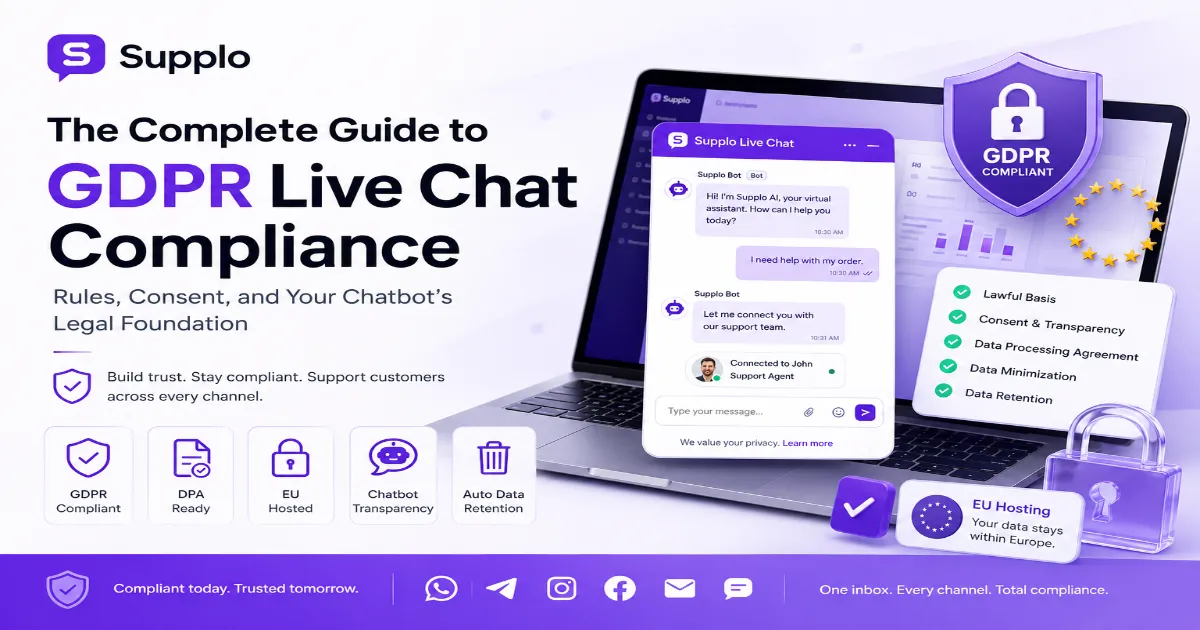
- Chatbots must be clearly labelled as bots, and users must be able to escalate to a human.
- EU hosting eliminates the complexity of cross-border data transfers.
What GDPR Actually Requires From Your Live Chat (And What Most Teams Get Wrong)
If your live chat collects any personal data, such as names, emails, IP addresses, or chat transcripts, GDPR applies. Period. The most common mistake teams make is assuming a privacy policy link in the footer covers them. It doesn't. GDPR requires you to identify your lawful basis for data collection before data collection begins, inform users clearly, and document your processing activities. Supplo is not affiliated with any app or website. Please follow each app's terms and local regulations.
Let's break down what actually trips people up:
- Personal data in live chat includes anything that can identify a person, such as their full name, email address, phone number, IP address, location data, or even their support history. Yes, that IP your widget collects passively counts.
- The six lawful bases under GDPR aren't optional; you must pick one and stick with it for each processing purpose. You can't just say "we'll figure it out later."
- Most live chat providers act as data processors, which means you need a signed Data Processing Agreement (DPA) with them. No DPA? You're already non-compliant.
- Consent isn't always required; legitimate interest can work if you pass the three-part test (purpose, necessity, balancing). But don't assume it's a shortcut.
- GDPR applies to any website accessible from the EU, even if your business is in the US or Asia. Geography doesn't exempt you.
Consent in Live Chat GDPR: When You Need It and When You Don't
Consent is the most straightforward lawful basis, but it's also the easiest to implement incorrectly. Under GDPR, consent must be freely given, specific, informed, and unambiguous, meaning pre-checked boxes or passive "by continuing you agree" language doesn't cut it. For live chat specifically, you need consent if you're collecting data for marketing purposes, sharing it with third parties, or using it in ways the customer wouldn't reasonably expect. If you're only using chat for direct customer support, legitimate interest may be a better fit.
Here's the practical breakdown:
- Explicit opt-in means the user takes a positive action, clicking a checkbox or button that clearly states what they're agreeing to. No workarounds.
- Implicit consent (like "by using this chat, you consent") fails GDPR's "unambiguous" standard every time. Don't bother trying.
- You need separate consent for different processing purposes; a blanket consent for everything isn't valid. Marketing consent and support consent are different things.
- Withdrawing consent must be as easy as giving it; include a clear opt-out mechanism in every chat. Make it obvious.
- Record when and how consent was obtained. You'll need this proof if your supervisory authority audits your company.
GDPR compliance isn't a one-time setup; it's an ongoing practice. Review your lawful basis and consent mechanisms quarterly, especially when adding new features.
Your Data Processing Agreement for Live Chat: The Document You Can't Skip
A Data Processing Agreement (DPA) is a legally binding contract between you (the data controller) and your live chat provider (the data processor). Under GDPR Article 28, this document is mandatory, not optional or "nice to have." Your DPA must specify what data is processed, for what purpose, how long it's stored, and what security measures are in place. If your live chat provider can't or won't sign a DPA, you're already non-compliant.
What your DPA needs to cover:
- The DPA must include clear instructions from you (the controller) about how data should be processed and when it should be deleted.
- Sub-processors (such as hosting providers or analytics tools) must be listed, and you must be notified before any new ones are added.
- Data breach notification timelines should be spelled out, typically within 72 hours of discovery.
- International data transfers require Standard Contractual Clauses (SCCs) or another valid transfer mechanism.
- Your DPA should specify whether chat transcripts are encrypted at rest and in transit.
GDPR Compliant Chatbot Live Chat: Building Privacy Into Your AI Agent From Day One
Your chatbot isn't exempt from GDPR just because it's automated. In fact, AI agents introduce additional privacy risks that require proactive management. Every conversation your bot has creates a data trail, and GDPR requires you to minimize what you collect, anonymize where possible, and set clear retention policies. The lawful bases still apply, and since chatbots often collect data before a human ever sees it, you need privacy controls built directly into the bot's logic. Supplo's EU-hosted infrastructure processes conversations entirely within Europe, making data localization compliance straightforward.
Here's how to build privacy from day one:
- Configure your chatbot to ask only for the data it genuinely needs; don't default to collecting full names and emails if a ticket number suffices.
- Chatbots that use third-party NLP APIs (such as OpenAI or Google) trigger additional transparency requirements regarding data sharing.
- Implement automatic data anonymization after a set period. GDPR doesn't require you to store chat logs indefinitely.
- Your chatbot's privacy notice should appear before the first message is sent, not buried in a footer link.
- If your chatbot escalates to a human, ensure the handoff doesn't expose more data than necessary.
Live Chat AI GDPR Rules: What Changes When Your Bot Handles Customer Data
AI-powered live chat tools introduce GDPR considerations that traditional chat doesn't: automated decision-making, profiling risks, and data used for model training. Article 22 gives users the right not to be subject solely to automated decisions that significantly affect them, which means your AI can't refuse refunds or ban users without human review. The key requirement is transparency: users must know they're talking to a bot, understand what data is being collected, and be able to request human intervention at any point. For a deeper look at how our AI agent's privacy design handles this, check our feature page.
The AI-specific rules you need to know:
- Clearly labelling your AI agent as a bot pretending to be human violates both GDPR transparency rules and basic trust.
- Automated decisions that have legal or significant effects (credit scores, insurance quotes, account bans) require explicit opt-in.
- If your AI trains on chat data, users need to be informed and given the option to opt out.
- Data retention for AI training sets must be documented and limited; don't keep training data forever "just in case."
- The right to explanation means you must be able to explain how your AI reached a particular conclusion about a user.
How to Handle GDPR Customer Data in Your Chatbot Without Overcomplicating Things
GDPR requires data minimization: collect only what you need, keep it only as long as necessary, and protect it adequately. For chatbots, this means auditing every field your bot asks for and removing anything you don't actually use. Encryption (both in transit and at rest), access controls, and regular data purges aren't optional extras; they're baseline requirements. If you're using a platform that handles this for you (like Supplo's EU-hosted infrastructure with automatic data lifecycle management), you remove most of the operational headache. Our shared inbox with data access controls gives you granular permission settings.
Practical steps to keep it simple:
- Map your data flows: what data enters via chat, where it lives, who can access it, and when it's deleted.
- Implement role-based access so agents only see data relevant to their tickets.
- Set automatic deletion policies for chat transcripts (e.g., 30 days for resolved chats, 90 days for active investigations).
- If you use chat for transactions, ensure payment data is handled separately from conversation data.
- Regular data protection impact assessments (DPIAs) help catch risks before they become violations.
Privacy Policy for Live Chat GDPR: What to Include and Where to Link It
Your privacy policy must specifically address how your live chat collects, processes, and stores personal data; a generic "we use cookies" paragraph isn't enough. GDPR Article 13 requires you to name your lawful basis, describe the categories of data collected, explain the purpose of processing, list any third-party recipients, state retention periods, and inform users of their rights. The privacy policy link should be placed both in your website footer and directly within the live chat widget itself, ideally before the user starts typing.
Here's what your privacy policy needs to say:
- Your privacy policy must be written in clear, plain language. GDPR explicitly discourages complex legal jargon.
- Include specific details about chatbot data processing if you use an AI agent, not just your human chat operations.
- List any sub-processors (chat platform, analytics, cloud hosting) and where their data centers are located.
- The rights of access, rectification, erasure, and data portability must be explained, along with instructions on how to exercise them.
- Update your privacy policy whenever you change your data practices; an annual review isn't sufficient.
Cookie Banner Live Chat GDPR: Do You Need One Just for Chat?
If your live chat sets cookies or trackers (for session management, analytics, or personalization), you need a cookie banner that covers it. The ePrivacy Directive (the "cookie law") runs parallel to GDPR and specifically governs the storage of information on a user's device. However, if your chat is purely functional and doesn't set non-essential cookies, you may not need an additional banner to clear privacy disclosure. The safest approach is a single, unified consent management platform that covers your entire website, including your chat widget.
The cookie rules simplified:
- Session cookies that keep the chat working during a single visit are usually exempt from consent (but still need disclosure).
- Analytics or tracking cookies set by third-party chat tools always require prior consent.
- "Legitimate interest" doesn't override the ePrivacy Directive; you still need consent for non-essential cookies.
- Your cookie banner must be just as easy to dismiss as it is to accept (no dark patterns).
- If your chat widget loads from a third-party domain, you're also responsible for their cookie practices.
GDPR Compliance for Live Chat Widget: Embedding Rules and Third-Party Risks
Embedding a live chat widget from a third-party provider creates a data processing relationship that GDPR strictly governs. Before adding any widget to your website, you need to verify where the provider hosts data, whether they sign DPAs, and what sub-processors they use. The widget itself should load in a privacy-preserving way, ideally with connection encryption from the moment the page loads. If your provider stores data outside the EU or in countries without adequacy decisions, you need SCCs or another valid transfer mechanism in place. Our multi-channel routing across platforms ensures all conversations stay in EU data centers.
Widget-specific risks to watch for:
- Audit what data your widget collects passively (IP addresses, browser fingerprinting, referral URLs) before the user even types.
- Widgets that preload on every page create a larger data-collection surface than those that activate on click.
- If your widget loads third-party scripts (analytics, tracking pixels, ad networks), each one requires its own consent.
- Test your widget on a staging site first, and verify that the data flows match your privacy policy descriptions.
- EU-hosted widgets eliminate the most common cross-border compliance headache.
Your 7-Step GDPR Live Chat Checklist (Use This Before You Go Live)
Before launching or updating your live chat, run through this checklist to ensure you're not exposing your business to GDPR liability. Confirm your lawful basis, sign your DPA, update your privacy policy, configure your consent mechanisms, set data retention rules, label your chatbot if applicable, and verify your data hosting location. This isn't a one-time exercise; review your compliance quarterly or whenever you change chat providers or add features. For transparent pricing with no surprise fees, see how Supplo keeps things simple.
- Step 1: Identify your lawful basis, document it in your records of processing activities.
- Step 2: Sign a DPA with your chat provider that covers all requirements of Article 28.
- Step 3: Update your privacy policy to include specific live chat disclosures, and link it in the widget.
- Step 4: Implement consent collection (if applicable) that meets GDPR's "freely given, specific, informed, unambiguous" standard.
- Step 5: Configure data retention to auto-delete transcripts after a reasonable period.
- Step 6: If using a bot, label it as a chatbot and ensure escalation to humans is available.
- Step 7: Verify data hosting location. EU hosting eliminates cross-border transfer complexity.
Key Takeaways:
- GDPR applies to any live chat collecting personal data from EU visitors, with no exceptions.
- Consent is required for marketing, analytics, and AI training; legitimate interest may work for direct support.
- A DPA is mandatory with your chat provider; never skip this step.
- Chatbots must be labelled, transparent, and allow human escalation.
- EU hosting is the simplest path to cross-border compliance.
Ready to Launch GDPR-Compliant Live Chat Without the Headache? Stop piecing together compliance requirements from regulatory docs. Start your free trial with Supplo and get EU-hosted, DPA-ready live chat with built-in data retention controls. No credit card required. Start Free Trial
Don't Let GDPR Compliance Slow Down Your Customer Support. Flat-rate pricing, no per-seat fees, EU hosting, and a platform built for GDPR from day one. Support your customers across WhatsApp, Telegram, Instagram, Facebook, email, and live chat all in one inbox. Get Started → Payment flexibility included: crypto, Binance Pay, and more.
FAQ
Is using live chat GDPR-compliant, or do I need to shut it down?
Live chat is absolutely GDPR-compliant when set up correctly. You need a valid lawful basis (consent or legitimate interest), a signed DPA with your provider, clear privacy disclosures, and proper data retention policies. Most compliance issues come from skipping the documentation and consent steps, not from using chat itself.
Do I need consent for every single chat conversation?
Not necessarily. If you're using legitimate interest for direct customer support (not marketing), you don't need explicit consent. However, you must still inform users about data collection and provide an opt-out option. If you're using chat data for marketing, analytics, or AI training, you do need consent obtained before data collection begins.
What happens if my live chat provider stores data outside the EU?
You need either an adequacy decision for the destination country or Standard Contractual Clauses (SCCs) signed between you and the provider. Without one of these, the data transfer is technically illegal under GDPR. Using an EU-hosted provider avoids this complexity entirely.
Does my chatbot need to identify itself as a bot?
Yes, both under GDPR transparency requirements and general consumer protection regulations. Users have the right to know they're interacting with automated systems. Hiding the fact that they're talking to a bot can also violate ePrivacy rules in some jurisdictions.
How long can I keep live chat transcripts under GDPR?
Only as long as necessary for the original purpose. For completed support tickets, 30–90 days is standard practice. There's no fixed legal limit, but "indefinitely" will fail any regulatory audit. Set automatic deletion policies and document your retention rationale.
What's the biggest mistake companies make with GDPR and live chat?
Assuming a privacy policy link in the footer covers everything. Most teams miss: having a signed DPA with their provider, properly labelling chatbots, documenting their lawful basis, and implementing actual data retention policies. The privacy policy is just one piece of the puzzle.
Do I need a separate cookie banner for my live chat widget?
Only if your chat sets non-essential cookies (tracking, analytics, personalization), purely functional session cookies don't require a separate banner but still need disclosure in your privacy policy. If you use a unified consent platform, it should cover your chat widget as well as the rest of your site.
Compliance note: Supplo is not affiliated with any app or website. Please follow each app's terms and local regulations.