On this page
Who is this for? This guide is for customer support agents, team leads, and small business owners who deal with angry customers daily, whether via live chat, email, WhatsApp, Instagram, or phone. It's for anyone who wants to reduce stress, resolve complaints faster, and build loyalty from frustration.
When to use this guide? Use it when you're dealing with an upset customer right now or when you're building a complaint-handling process for your team. When NOT to use it? Don't rely on this guide alone if you face safety threats, legal risks, or repeated harassment that requires immediate escalation to management and security.
Quick Answer:
- Start with acknowledgment: The first 5 seconds matter. Validate the customer's frustration before solving the problem to lower tension fast.
- Use a clear escalation policy: Escalate when you can't solve within two interactions, or when the customer requests a supervisor. Always hand off with full context.
- Track complaint patterns: Proactive complaint management reduces volume. Update your knowledge base for the top 10 recurring issues.
- Centralize all channels: A shared inbox prevents lost context on angry messages from email, chat, Instagram, and WhatsApp.
Why Customers Get Angry (And What They Actually Want)
Let's be real, angry customers aren't angry at you. They're angry at a broken expectation. Maybe they waited too long, got the wrong product, or spent 20 minutes searching your FAQ for nothing.
Here's the thing they're actually asking for: to be heard, to be understood, and to see the problem fixed fast. Not complicated. But most support teams skip the first two and jump straight to fixing.
- Most anger stems from a lack of control or a perception of indifference. Customers feel powerless when their time is wasted.
- Customers expect a response within hours, not days. Speed is a reset button that can defuse tension immediately.
- Acknowledge the emotion before you address the issue: validation lowers defences and opens the door to cooperation.
- Hidden triggers often include billing errors, broken promises, or silent support queues. These create a sense of being ignored.
"Angry customers aren't usually angry at you; they're angry at a broken expectation. Beneath the frustration, they want three things: to be heard, to be understood, and to see the problem fixed fast."
The 5-Second Rule: Your First Move When Dealing with an Upset Customer
Your first five seconds set the tone for the entire conversation. Take a breath. Resist the urge to defend or explain. Lead with acknowledgment.
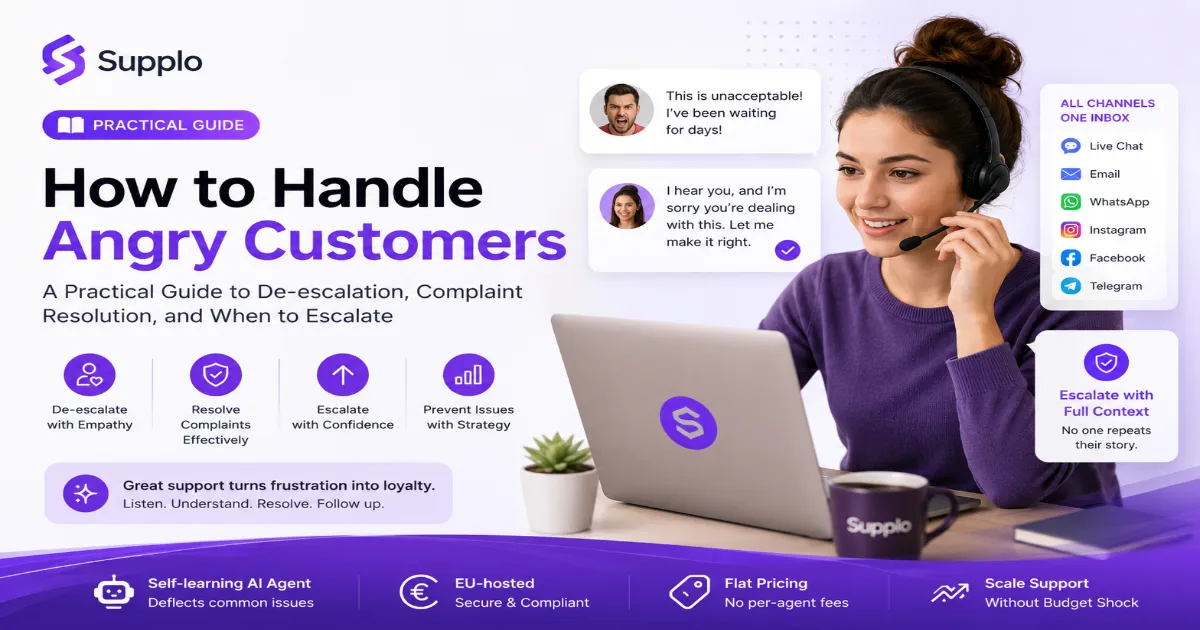
A simple "I hear you, and I'm sorry you're dealing with this" immediately drops the temperature. That pause is what separates reactive support from reliable support.
- Do not interrupt, even if you know the answer. Listening is the first fix. Let them vent.
- Use the customer's name early to build a personal connection and shift from transaction to relationship.
- Avoid "I understand how you feel" (often backfires); use "I can see why that's frustrating" instead.
- The first reply should validate, not justify; save the explanation for later when they're calmer.
De-escalation Techniques That Actually Work in Customer Service
De-escalation isn't about winning an argument; it's about guiding a conversation from emotional to logical. Use open body language (in person) or a calm tone (in chat), and mirror their language to build rapport. When a customer hears their own words reflected to them, they feel understood. That shortens the escalation window dramatically.
If they start raising their voice, lower yours.
- Use "I" statements ("I want to help get this sorted") over "You" statements ("You need to calm down").
- Offer a clear next step; ambiguity fuels frustration. Say "Here's what I'll do now."
- If the customer is wrong, correct gently with data, not ego. Say "Let me check our records."
- Set a realistic timeline: "I can check this now and have an answer within 30 minutes." Over-promising backfires.
"De-escalation isn't about winning an argument, it's about guiding a conversation from emotional to logical."
How to Handle Difficult Customer Feedback Without Losing Your Cool
Difficult feedback is still feedback, and often the most valuable data you'll get. The trick is separating the delivery from the message.
Don't take criticism personally. Take it as a signal that a process needs attention. When you respond with curiosity rather than defensiveness, you turn a complaint into a loyalty builder.
- Ask clarifying questions: "Can you tell me more about what happened?" This shows you're listening.
- Avoid phrases like "That's not our policy" – reframe as "Let me see what we can do here."
- Thank the customer for the feedback, even if it stings. A simple "I appreciate you telling me this" goes a long way.
- Escalate internal process issues to your team post-resolution to prevent the same anger from recurring.
Managing Customer Complaints Effectively: A Step-by-Step Resolution Process
An effective complaint resolution process has four stages: acknowledge, investigate, resolve, and follow up. Skip any step, and you risk reopening the wound.
Stage 1: Acknowledge within one hour (automated or human). Use an email or chat template.
Stage 2: Investigate with the customer looped in, not left in the dark. Update them every few hours if needed.
Stage 3: Resolve with compensation if appropriate (refund, credit, or expedited fix). Don't haggle over small amounts.
Stage 4: Follow-up – surprise them. It's rare enough to be memorable. A 48-hour check-in can turn a detractor into a promoter.
Need help managing complaints on platforms like WhatsApp? Supplo's shared inbox centralizes all channels, so you never miss a message.
When to Escalate: Your Customer Service Escalation Policy Explained
Not every complaint needs a manager. But some situations demand it: safety risks, legal threats, repeated failures, or requests beyond your authority.
A clear escalation policy defines the handoff trigger without ego. If you can't resolve it within 2 interactions or the customer asks for a supervisor directly, escalate immediately.
- Escalate if the customer threatens legal action or regulatory complaints.
- Escalate if the issue has already been handled twice incorrectly; repeated failures double the anger.
- Escalate if the resolution requires a write-off or a policy override for which you lack authority.
- Never escalate without context: pass the full history to the next person. No one should repeat their story.
"If you can't solve it within two interactions, or the customer asks directly for a supervisor, escalate immediately. No ego involved."
Customer Service Escalation Examples (And When to Pull the Trigger)
If the customer says "I need a manager" or you're repeating yourself, it's time to escalate.
- Example 1: Customer demanding a refund outside policy escalates to a team lead with refund authority.
- Example 2: Technical bug with no known ETA, escalates to a senior support agent who can coordinate with engineering.
- Example 3: Harassment or abusive language escalates to a manager with security authority to block or ban the offender.
- Always document the escalation reason and expected SLA for the customer (e.g., "We'll have an answer in 24 hours").
Building your escalation policy? Supplo's flat pricing means you never worry about per-agent costs on escalated tickets, predictable costs for unpredictable situations.
How to Escalate Customer Issues Without Dropping the Ball
A bad escalation is when the customer has to repeat their story. A good escalation includes a warm handoff: you introduce the customer to the next agent, summarize the issue and attempted fixes, and stay in the loop until resolution is confirmed.
Use a shared inbox or ticketing system that preserves context between agents.
- Use internal notes to pass resolution history, not just the complaint summary. Include what's been tried.
- CC the customer on the internal handoff to keep them in the loop and avoid them feeling transferred.
- Set a reminder to check back if the escalated issue goes quiet. The customer shouldn't have to chase.
- Never blame a colleague or previous agent during the handoff. Keep it professional and solution-focused.
Building a Complaint Management Strategy That Prevents Fires
A proactive complaint management strategy isn't about reacting faster; it's about catching patterns before they become crises.
Track common complaint types by channel (email, chat, social DMs), identify the root cause, and update your knowledge base or product roadmap. When you invest in prevention, you naturally reduce volume.
- Review complaint data weekly: top three categories and recurrence rate. Spot trends early.
- Update your FAQ or knowledge base for the top 10 recurring complaints. Self-service reduces anger before it starts.
- Route high-anger complaints to senior agents first. They have the experience to de-escalate faster.
- Use a self-learning AI agent to deflect predictable issues before a human touch is needed, such as password resets, order status, and pricing questions.
"A proactive complaint management strategy isn't about reacting faster; it's about catching patterns before they become crises."
The Role of a Shared Inbox in Managing Customer Grievances
When customer complaints live in separate inboxes, email, Instagram, Telegram, and WhatsApp, things fall through the cracks.
A shared inbox centralizes every channel so no message is orphaned and every agent sees the full conversation history. This visibility is crucial for de-escalation because context is the fastest way to rebuild trust.
- A shared inbox prevents duplicate replies that confuse already-frustrated customers. One view, one truth.
- Assign angry conversations to the same agent for consistency; relationship continuity lowers tension.
- Internal notes and tags let you flag escalations without cluttering the customer thread.
- Multi-channel routing in one place means faster first responses on every platform, including Instagram DMs.
Supplo is not affiliated with any app or website. Please follow each app's terms and local regulations.
How Supplo Keeps Your Team Reliable During Angry Exchanges
Supplo brings live chat, email, and social DMs into one inbox, so your team never loses context during a difficult exchange. The self-learning AI agent deflects common frustrations, automatically handles price checks, order status, and password resets before a human ever gets involved.
Since it's EU-hosted and offers a flat monthly rate, you get enterprise-grade reliability without surprise invoices: no per-seat fees, no per-resolution metering. AI resolutions cost $0.04 each, roughly 96% cheaper than alternatives.
- Centralize every angry customer message from chat, email, WhatsApp, Instagram, Facebook, and Telegram.
- Use the shared inbox to hand off escalations with the full conversation history, so no one has to repeat their story.
- Let the AI agent handle predictable complaints, freeing your team for complex cases where empathy is critical.
- Flat pricing means you can scale support headcount without budget shock, even during crisis spikes.
Stop losing context during customer escalations. See how a shared inbox and AI agent can keep your team calm and fast. Start a free trial – no credit card required.
Key Takeaways
- Start with acknowledgment: The first 5 seconds set the tone. Validate before solving.
- Use a clear escalation policy: Escalate when you can't fix within two interactions or when asked.
- Track complaint patterns: Proactive management reduces volume. Update your knowledge base.
- Centralize all channels: A shared inbox prevents lost context across email, chat, and social DMs.
- Invest in prevention: A self-learning AI agent deflects common frustrations before they escalate.
FAQ
What is the first thing you should say to an angry customer?
The best first response is a simple acknowledgment without defensiveness: "I hear you, and I'm sorry you're dealing with this." This validates their frustration and opens the door to resolution. Avoid justifying or explaining before you've listened.
How do you de-escalate a customer who is yelling?
Lower your own volume first; this forces them to listen. Acknowledge their anger without agreeing with it, then refocus on a specific next step, such as "Let me look into this right now." Never match their tone.
When should you escalate a customer complaint to a manager? Escalate if the customer explicitly requests a manager, the issue remains unresolved after 2 interactions, or the resolution requires a policy override or legal review. Always hand off the full conversation history.
What should you NOT do when handling an angry customer?
Don't interrupt, don't make promises you can't keep, don't say "calm down," and don't blame another team or person. These actions escalate anger and permanently damage trust.
How do you manage customer complaints on multiple channels?
Use a shared inbox that centralizes email, chat, Instagram, WhatsApp, and Telegram messages. This prevents lost context and ensures consistent replies across platforms.
Can an AI agent handle angry customers?
An AI agent can handle routine frustrations (password resets, order status) that often trigger anger, but should hand off to a human for complaints that require empathy, judgment, or a policy override. The AI reduces the total volume of anger hitting your team.
What is a complaint management strategy?
It's a proactive system for tracking, analyzing, and reducing recurring complaints. This includes logging complaint types, identifying root causes, updating your knowledge base, and training your team on de-escalation techniques.
Why do customers get angry at support teams?
Usually because of a broken expectation: a delayed response, a product defect, a billing error, or feeling ignored. The underlying need is to be heard, understood, and helped quickly.
Compliance note: Supplo is not affiliated with any app or website. Please follow each app's terms and local regulations.