On this page
Let's be real, most best helpdesk software comparison pages are useless. They list features you'll never touch, hide pricing until you're trapped on a sales call and act like every tool does the same thing. Spoiler: they don't. You're here because you want something that works. A tool that actually processes tickets, doesn't drop messages and won't silently drain your budget every time the AI answers a question. This guide is for small- to mid-sized support teams, ops managers and founders who'd rather cut through the noise than read another feature matrix that skips the ugly parts. If you're searching for a best helpdesk software comparison, you're looking for substance, not marketing fluff. Good. Let's get into it.
Quick Answer
- Reliability over features: Uptime SLA, AI resolution accuracy and message delivery integrity beat flashy feature lists every time.
- Total cost of ownership (TCO) over monthly price: Per-resolution and per-seat fees can quietly destroy your budget. Always calculate the full cost.
- True multi-channel unity: A platform either routes all channels into one inbox, or it doesn't. There is no partial omnichannel.
Why a Best Helpdesk Software Comparison Actually Matters And Why Most Are Garbage
Most comparison pages are either paid ads dressed up as reviews or surface-level checklists that ignore what happens when things go wrong. A real reliability-driven comparison asks the hard questions: What happens during downtime? Do messages get lost? Does the AI invent answers that make your customers angry?
If you're searching for the best helpdesk software comparison, you're probably tired of platforms that look good in a demo but fall apart under real pressure. You want a tool that processes tickets without eating your budget per resolution.
- Most reviews compare free trials rather than production performance. Running a tool with 10 test tickets tells you nothing about how it handles 500 real ones.
- Compare uptime SLA, not just UI screenshots. Pretty dashboards don't help when your inbox goes dark.
- The real test: How the platform handles a spike of 500 tickets arriving in one hour. Can it route, prioritize and start resolving before your team panics?
The best comparison isn't about which app has the prettiest interface; it's about which one still works when 500 tickets land in your inbox at 3 AM.
The Reliability Metric Nobody Talks About in Customer Support Software Comparison
Everyone compares features. Everyone compares prices. But almost nobody talks about resolution reliability, basically, how often the AI actually closes a ticket correctly versus punting it to a human. That's the metric that actually matters.
When comparing customer support software, look for self-learning capabilities in the AI. A scripted chatbot that parrots your FAQ isn't helpful. Supplo's AI agent learns from historical closed tickets and knowledge base articles, getting smarter with every interaction rather than requiring constant manual tuning.
- Check whether the AI requires manual training or can automatically ingest your existing data.
- Ask about the internal handoff: Does the AI transfer cleanly to a human, or does it create duplicate tickets that waste everyone's time?
- Verify the average time to first human response after the AI deflects or escalates a ticket.
"Resolution reliability is the difference between an AI that closes tickets and an AI that frustrates your customers by bouncing them between bot and agent."
Breaking Down the Help Desk Tools Comparison: All-in-One vs. Frankenstein Stacks
The traditional "help desk tools comparison" pits point solutions against each other. Email tool here, WhatsApp plugin there, separate chatbot subscription over there. The problem? Integration hell. Data doesn't sync, conversation context gets lost between tools and you're paying three separate invoices every month.
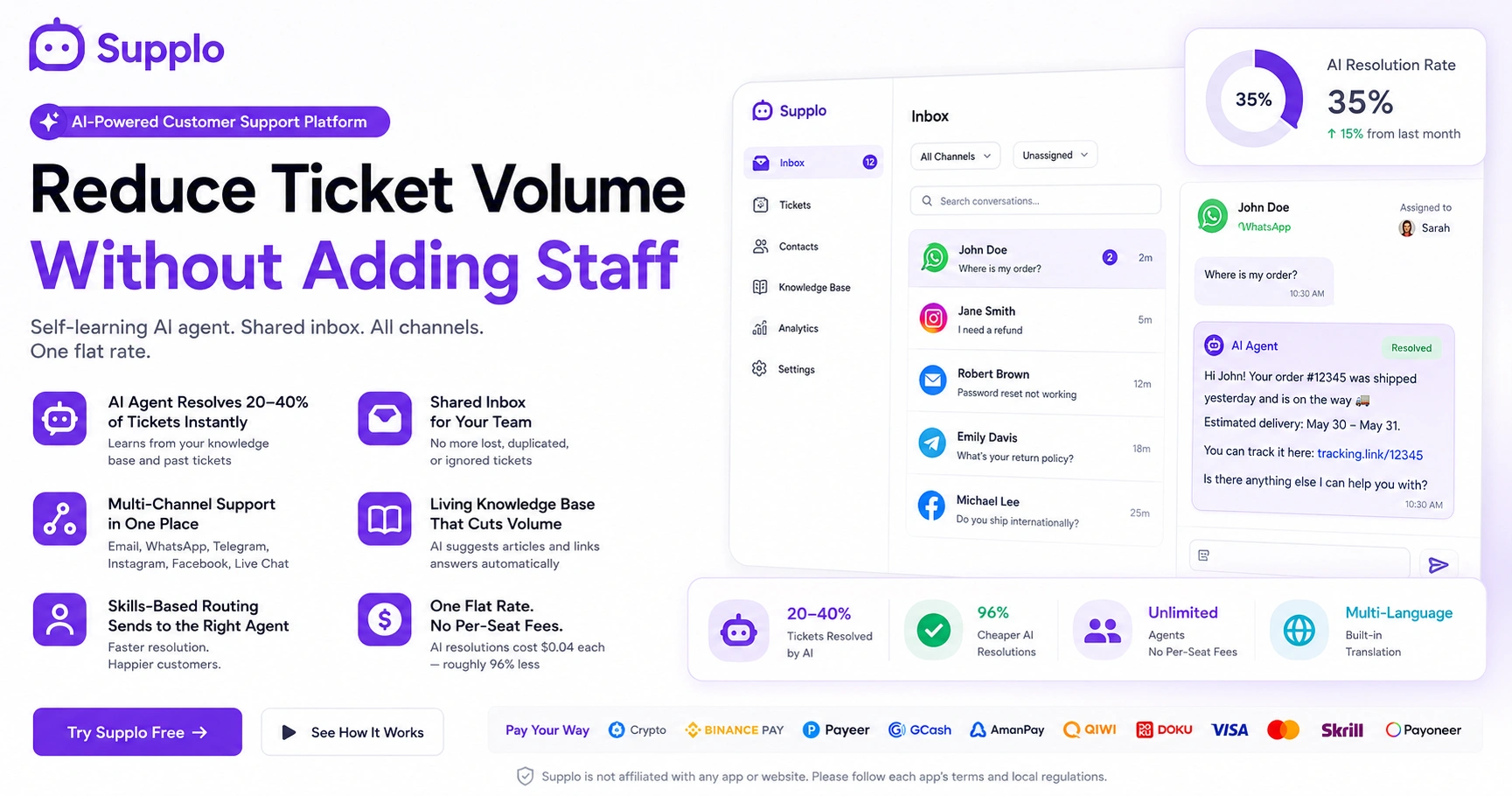
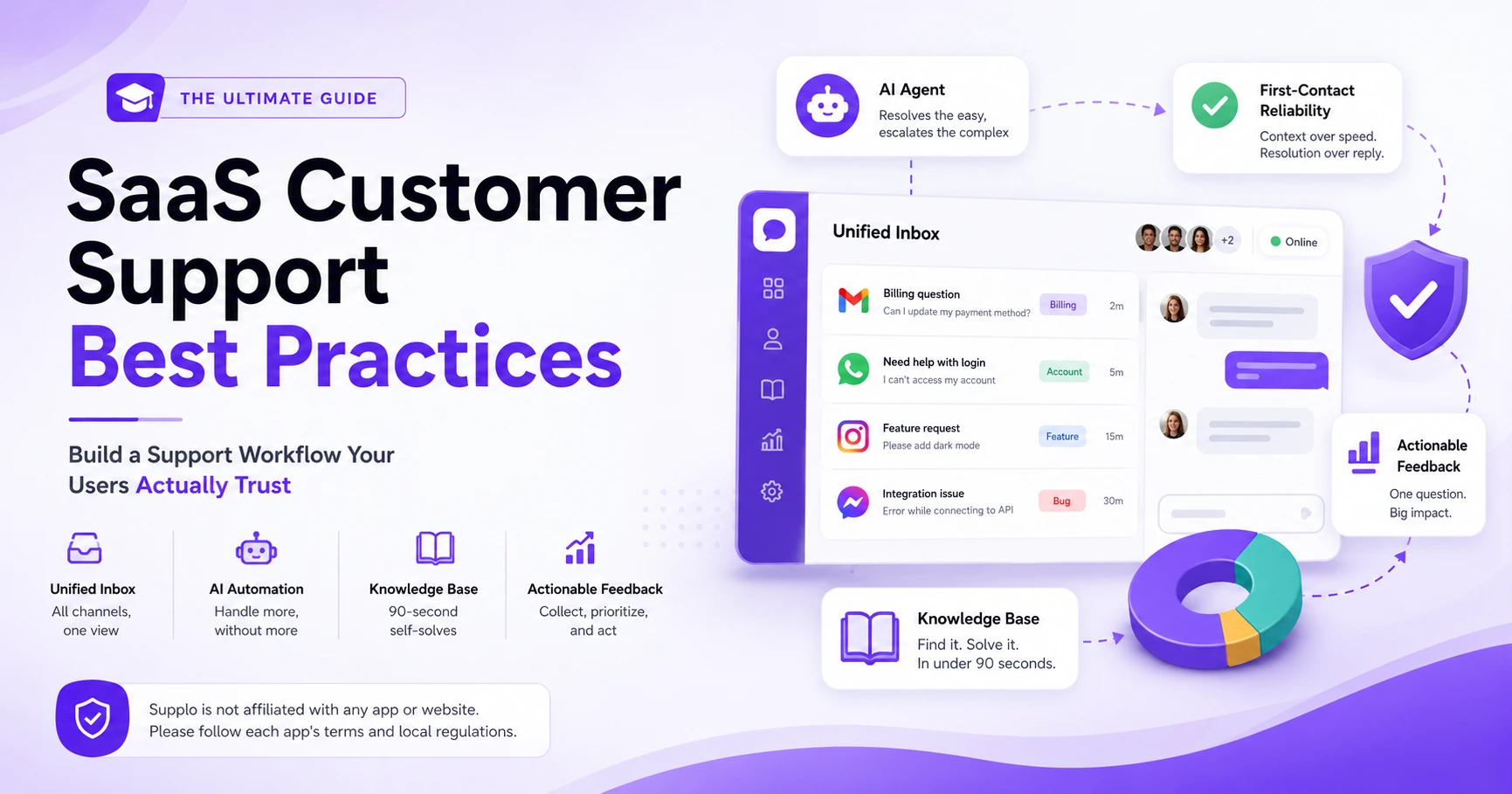
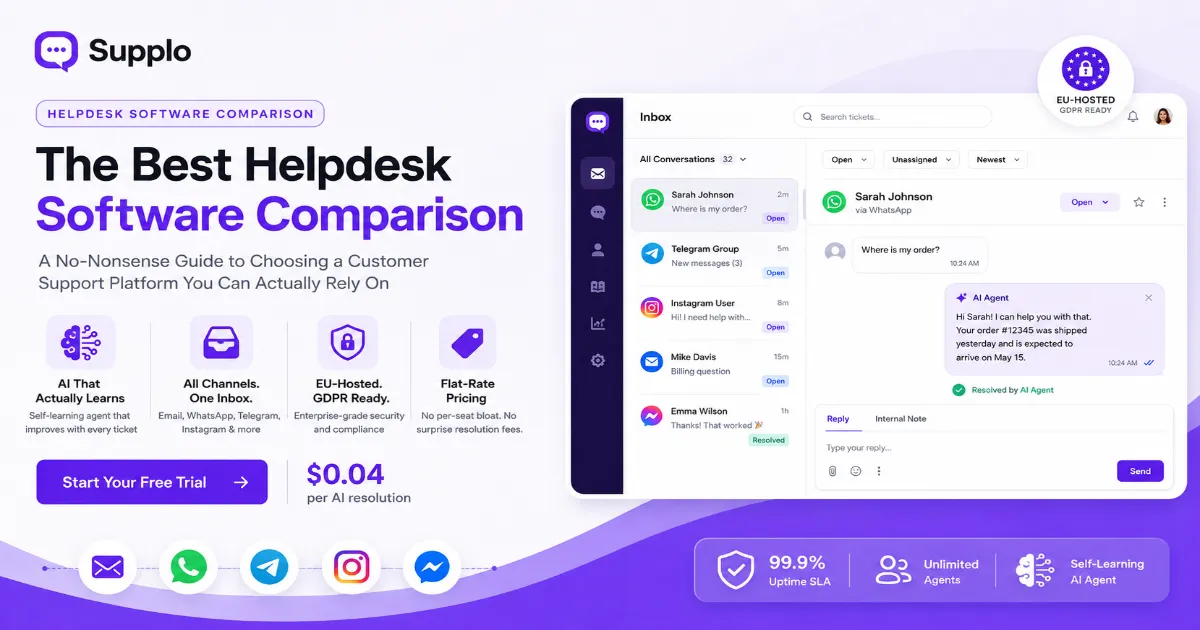
An all-in-one platform that routes email, WhatsApp, Telegram and Instagram into one shared inbox eliminates that failure point. Supplo handles Supplo handles email ticketing, WhatsApp support, Telegram support, Instagram DMs and Facebook Messenger from a single workspace. No toggling between tabs. No lost messages.
- Separate tools mean separate logins, separate SLAs and separate headaches. Your team shouldn't need a map to find customer conversations.
- An all-in-one inbox prevents agents from switching between 5 windows to answer one customer's questions.
- Look for a unified inbox that preserves conversation history regardless of which channel the customer uses.
A stack of three separate tools is not a help desk; it's a support maze for your team.
How We Compare Helpdesk Solutions: The 5 Non-Negotiable Features for a Reliable Support Desk
When you compare helpdesk solutions, most marketers point to flashy features like chatbots with cute avatars or custom colour themes. We look at five things that determine whether your team actually sleeps at night:
- AI resolution accuracy without manual tuning. The AI should learn from your data, not require you to feed it answers every week.
- Channel routing without message loss. Every message, from every channel, lands in the right place.
- Knowledge base integration so the AI doesn't invent answers that embarrass your brand.
- Flat-rate pricing that doesn't penalize you for having a busy month.
- EU data residency for GDPR peace of mind.
Supplo scores high on all five because it was built for operators, not for investors chasing growth metrics. The knowledge base feeds directly into the AI and the platform routes messages without losing threading context.
- AI resolution accuracy requires a knowledge base that is automatically linked to every ticket the agent handles.
- Channel routing must handle message threading correctly: Instagram replies in threads, Telegram group chats as tickets, the works.
- Flat-rate pricing means your budget is predictable, even if support volume spikes during product launches.
- EU hosting ensures compliance without needing a separate data processor agreement.
Compliance Note: Supplo is not affiliated with any app or website. Please follow each app's terms and local regulations.
The Price Trap in the Cheap Helpdesk Software Comparison
A "cheap helpdesk software comparison" typically focuses on monthly subscription fees. $29 per seat, $49 per seat, looks great. But they conveniently ignore per-resolution costs, the fees that quietly eat your budget as ticket volume grows.
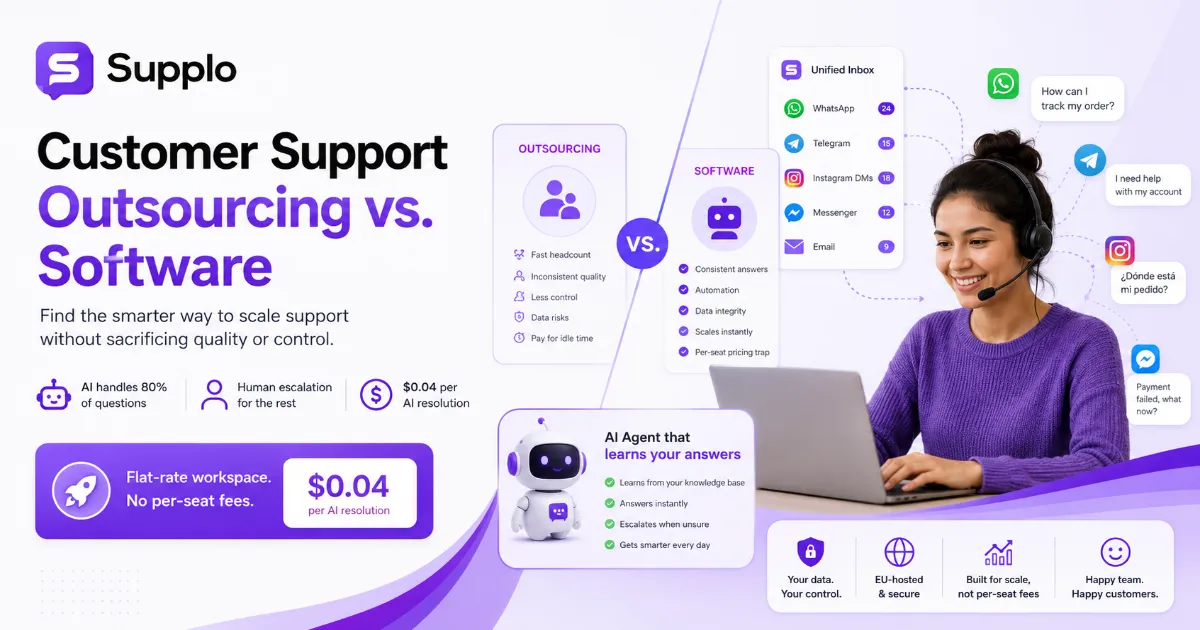
Some platforms charge $ 1.00 or more per AI resolution. Think about that. If your AI handles 1,000 tickets in a month, that's an extra $1,000 on top of your subscription. Supplo charges $0.04 per AI resolution, roughly 96% cheaper than comparable solutions and couples that with a flat monthly rate for human agents.
Cheap software isn't cheap if it costs you $1,000 in surprise AI fees every month.
- Always ask: what is the cost per AI resolution after the free tier? Some platforms give you 100 free resolutions, then hit you with $1 each.
- Check if the AI is metered by conversations or resolutions; there's a big difference and conversations are usually more expensive.
- Flat-rate billing (no per-seat fees) means you can add agents without renegotiating your contract.
- Supplo's pricing page is transparent: no hidden per-resolution escalators, no surprises.
A cheap monthly subscription becomes expensive fast if it charges $1 per AI answer. Always look at the total cost of ownership.
Ready to stop worrying about surprise fees? Switch to a flat-rate model that treats your team size like an asset. See Transparent Pricing.
The Real Cost of Leading Helpdesk Software – Are You Paying for Per-Seat Bloat?
Let's talk about the elephant in the room: per-seat pricing.
The big-name helpdesk software brands are famous for it. A team of 10 agents might pay $1,000+ per month just for the privilege of logging in. That's before any AI resolution costs. You're paying for every chair, not every problem solved. If you have 15 agents, you pay for 15 seats, even if half are part-time.
That's per-seat bloat and it's one of the highest hidden costs in customer support.
Supplo bills a flat monthly rate regardless of how many agents you add. This makes it a viable alternative to established players, especially for teams that scale support seasonally. Add 5 agents during the holiday rush? No price change. Scale back to 3 in the slow months? Same flat rate.
- Per-seat pricing punishes teams that have part-time or seasonal agents. Why pay for seats you don't use?
- Compare the cost of a 15-agent team on leading software vs. flat-rate billing. The difference is often thousands per year.
- The #1 reason support teams switch platforms is unexpected price increases tied to seat counts. Don't get trapped.
Budget Helpdesk Software Comparison: Getting Enterprise-Grade Reliability Without the Enterprise Invoice
A budget helpdesk software comparison doesn't mean you have to trade reliability for cost. Modern AI-native platforms can deliver enterprise-grade ticketing, routing and deflection at a fraction of the cost of legacy systems.
The trick is finding a tool that automates the boring stuff- data collection, ticket categorization and standard answers- so your human agents only handle high-value interactions. Supplo's self-learning AI agent handles the automations and the knowledge base ensures consistency across all channels.
- Look for automatic ticket tagging and prioritization based on urgency, not manual sorting.
- Enterprise-grade means 99.9% uptime and encrypted data storage, not a fancy logo on the homepage.
- Budget tools must still offer multi-channel routing to be viable for modern teams. If it can't handle WhatsApp and email in the same inbox, it's not ready.
- Supplo is built on EU infrastructure with high-availability standards: enterprise reliability and budget-friendly pricing.
Multi-Channel Support: The Single Point of Failure in Most Help Desk Tools
If your customer support software comparison doesn't stress-test multi-channel routing, you're missing the biggest reliability factor in the industry.
Here's the dirty secret: many platforms claim omnichannel support but actually require separate inboxes for email, WhatsApp and Telegram. That defeats the entire purpose of a unified workspace. Your team ends up toggling between three tabs, missing messages and accidentally sending duplicate replies.
A reliable help desk routes every channel into one timeline, preserving context and preventing chaos. Supplo provides native, integrated channels for WhatsApp, Telegram, Instagram DMs, Facebook Messenger and email ticketing, all visible in a single inbox.
- Verify that the platform supports threaded replies on Instagram and Facebook; many don't and that means broken conversations.
- Check if Telegram group chats can be routed as tickets so your team doesn't miss messages in group threads.
- A shared inbox prevents two agents from responding to the same customer with conflicting answers.
How Supplo Re-Defines the Comparison Page: AI That Actually Learns, Not Just a Chatbot
Most AI agents on comparison pages are simple retrieval-augmented chatbots. They search a knowledge base, grab a likely match and hope for the best. If the answer is wrong, they try again. And again. And again.
Supplo's AI agent is different. It's self-learning. It analyzes historical ticket resolutions, updates its confidence scoring and refines its answers over time. When you land on this comparison page, you aren't looking at a static tool; you're looking at a platform that gets better the more you use it.
It also has internal link support, automatically incorporating content from your knowledge base to reduce the risk of hallucinated answers, no more AI inventing processes your company doesn't use.
- Self-learning means less manual maintenance for your support managers. The AI trains itself.
- The AI can be set to auto-resolve certain ticket types (password resets, order status checks) while flagging others for human review.
- Built-in translation support means the AI can serve multilingual customers without extra plugins or integrations.
Supplo's AI isn't a chatbot; it's a self-learning agent that improves with every ticket it handles. Learn more about the self-learning AI agent.
How to Run Your Own Help Desk Tools Comparison
Don't trust a review site's top 10 list. Run your own test. Here's the checklist:
- Add your agents to the trial and test concurrent usage with at least 3 people. Solo demos hide routing problems.
- Send a stress test of 100+ tickets in one hour to check routing and AI handling under pressure.
- Measure AI resolution accuracy vs. human escalation rates and track this over a week, not an hour.
- Check the monthly invoice for hidden fees (per-seat, per-resolution, per-channel). Look for the fine print.
- Verify data residency to ensure GDPR or local compliance for your region.
Supplo passes all five tests because it was built for reliability, not shareholder returns. Use the knowledge base feature to set up consistent answers before you test; it'll save you time.
Ready to stop comparing and start solving? Run your own stress test today with Supplo's full trial. Add your agents, route your emails and WhatsApp and let the AI agent take the load. No per-seat fees, no contract lock-in. Start Your Free Trial
Key Takeaways
- Reliability over features: The best helpdesk software comparison prioritizes uptime, AI accuracy and message delivery over flashy feature lists.
- Watch the hidden costs: Per-resolution fees ($1+) can silently destroy a budget. Compare the total cost of ownership, not just the monthly subscription.
- Multi-channel is binary: A tool either unifies all channels into one inbox or it doesn't. There is no "partial omnichannel."
- Supplo is an exception: It combines an EU-hosted, self-learning AI agent with flat-rate pricing ($0.04 per AI resolution) and a unified inbox for email, WhatsApp, Telegram, Instagram and Facebook.
FAQ
What is the most important factor in a helpdesk software comparison? Reliability. Not features, not price reliability. This includes uptime, AI resolution accuracy and message delivery integrity across channels. A feature-rich platform that loses messages is worse than a simple one that always works.
Why do some help desk tools fail at multi-channel support? They advertise "omnichannel" but use separate inboxes per channel, or they break threading on platforms like Instagram and Telegram. A truly reliable tool routes every channel into a single timeline with the full conversation history.
Is cheap helpdesk software actually reliable? It can be if the platform is AI-native and uses a smart architecture. Cheap often means no per-seat bloat or no surprise per-resolution fees. Look for flat-rate billing and a self-learning AI to ensure quality doesn't drop.
How do I compare helpdesk solutions for my specific team size? Test with your actual team. Add 3+ agents to the trial simultaneously. Send a batch of real tickets and check for routing errors, duplicate responses and AI hallucinations. Scalability is proven in the trenches, not in demo videos.
What budget help desk software comparison traps should I avoid? The biggest trap is ignoring the "cost per resolution" line item. A cheap monthly plan can balloon to $1,000+ if the AI is metered per question. Always calculate the total cost of ownership (TCO) for your expected volume.
Does Supplo offer a free trial or demo? Yes. You can test the full platform, including the AI agent, shared inbox and all channel integrations, during the trial. This way, you can run your own comparison of help desk tools before committing.
Is Supplo compliant with data regulations for global teams? Yes. Supplo is EU-hosted to ensure GDPR compliance and is not affiliated with any app or website. Please follow each app's terms and local regulations.
Compliance note: Supplo is not affiliated with any app or website. Please follow each app's terms and local regulations.