On this page
Your customers are the lifeblood of your business. If they aren't happy, they'll leave. Simple as that. The Customer Satisfaction Score (CSAT) is the most direct measure of how well your support team performs, but most teams chase it blindly without a real plan.
This guide walks you through the exact formula, proven strategies, and a 30-day plan to boost your CSAT score without burning out your team. If you run a small-to-mid-size support team, consider this your playbook.
Who is this for? Support team leads and operations managers at SaaS and e-commerce companies with 2-15 agents.
When to use this: Implement these strategies immediately after noticing a dip in your CSAT, or as a proactive quarterly review exercise.
When NOT to use this: If your product has critical bugs or you're in the middle of a major outage, fix those first. No survey strategy can salvage a broken product.
Quick Answer
- Measure accurately: Use the standard CSAT formula (positive responses / total responses) x 100, and only survey immediately after a resolved ticket.
- Go fast: Reducing your chat First Response Time to under 2 minutes can lift your CSAT by 5-10 points.
- Automate the easy stuff: Let an AI agent handle password resets and order statuses so your team can focus on complex issues that need human empathy.
What is CSAT and Why Does It Matter for Your Bottom Line?
CSAT stands for Customer Satisfaction Score. It's a direct metric that measures how happy a customer is with a specific interaction, purchase, or support experience. A high CSAT score reduces churn, generates referrals, and ties directly to lifetime value.
Unlike NPS, which measures brand loyalty over time, CSAT is transaction-based. It's a snapshot of a single moment. If a customer gives you a 1 or 2, that's a signal of immediate friction. Maybe it's your product. Maybe it's your support process. Probably both.
Companies that improve their CSAT by just 5 points often see a corresponding lift in customer retention and monthly recurring revenue. It's a leading indicator, not a lagging one.
If you can't measure it, you can't improve it. CSAT gives you that measurement.
How to Calculate Your CSAT Score: The Simple Formula
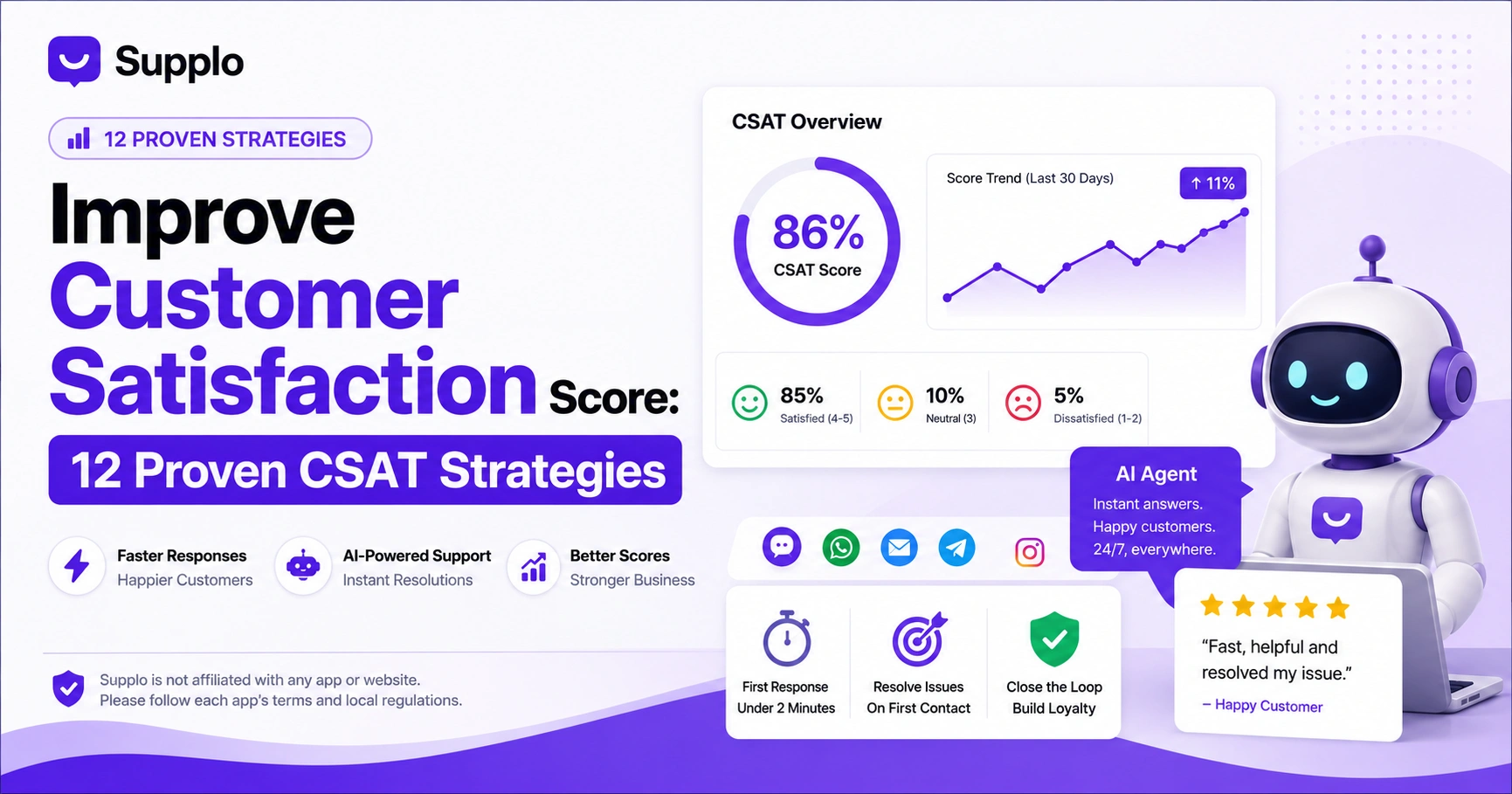
The calculation is brutally simple: Divide the number of positive responses (usually 4 and 5 on a 5-point scale) by the total number of responses, then multiply by 100. The result is your percentage score. Anything above 80% is generally considered great.
The formula: (Number of Satisfied Customers / Number of Survey Responses) x 100 = CSAT %
Most teams use the Top-2-Box scoring method, counting a "4" or "5" as satisfied. Some strict teams use Top-Box scoring, where only a "5" counts. We recommend Top-2-Box for a realistic view.
Warning: Don't ignore the "neutral" 3 scores. They often hide passive dissatisfaction. A 3 is not a win; it's a risk hiding in plain sight.
Example: You sent 100 surveys. 80 customers gave you a 4 or 5. Your CSAT is 80%. That's solid, but there's still room to grow.
Customer Satisfaction Metrics: CSAT vs. NPS vs. CES
CSAT measures happiness with a specific interaction. NPS measures loyalty to your brand over time. CES (Customer Effort Score) measures how easy it was for the customer to solve their problem. You need all three for a complete picture, but CSAT is your best "in-the-moment" health check.
CSAT vs. NPS: NPS asks "Would you recommend us?" (future intent), while CSAT asks "How did we do?" (past interaction). You can't use NPS to evaluate a single support ticket.
CES rising in importance: Research consistently shows that "easy" often trumps "happy" for support. A customer who jumped through hoops but got a friendly agent will still be frustrated. Use CES to measure friction in your processes.
Our recommendation: Use CSAT for every live chat and email interaction. Use NPS for quarterly customer pulse checks. Using NPS for every ticket creates survey fatigue and skews your data.
How to Write Customer Satisfaction Survey Questions That Get Honest Answers
Keep it to one question: "How would you rate the support you received?" with a 1-5 scale. Avoid leading language like "How great was our service?" Ask immediately after a ticket is resolved; timing is everything.
The golden rules:
- Use a 5-point Likert scale. Don't use stars or smiley faces if you want clean data.
- Don't require a comment. Optional text fields yield 5x higher response rates.
- Send the survey within 5 minutes of the chat or email closing. Any longer and you lose context.
Bad example: "Was your experience excellent today?" (Leading, no insight)
Good example: "Was your issue resolved today? Rate your experience on a scale of 1 to 5." (Binary resolution + satisfaction)
Keep it simple. A low barrier to respond equals more data.
Speed is a Satisfaction Metric: Why Response Time is Everything
Nothing kills a CSAT score like a long wait. Customers expect near-instant responses, especially on chat. Shortening your first response time from 10 minutes to 2 minutes can lift your CSAT significantly, often more than script quality ever could.
Key metrics to track:
- First Response Time (FRT): The time between the customer sending a message and an agent responding.
- Time to Resolution (TTR): The total time it takes to close the ticket.
The industry benchmark for live chat FRT is under 30 seconds. For email, aim for under 1 hour. If you're above these thresholds, your CSAT will suffer.
But speed without accuracy is a problem. A fast wrong answer is worse than a slow correct answer. The goal is 80% resolution on first contact, combined with speed.
The average customer defines 'good service' as fast service. Every minute you delay costs you a fraction of your CSAT.
Stop Chasing Tickets: How an AI Agent Can Boost CSAT While You Sleep
An AI agent can handle Tier-1 questions instantly, password resets, order status, and business hours, so your human team can focus on complex issues. This dramatically reduces wait times and keeps your CSAT high without hiring an army of agents.
Imagine a world where customers get an instant answer to their simplest query at 2 AM. That's exactly what a dedicated AI agent delivers. It resolves issues with zero hold time, which users love.
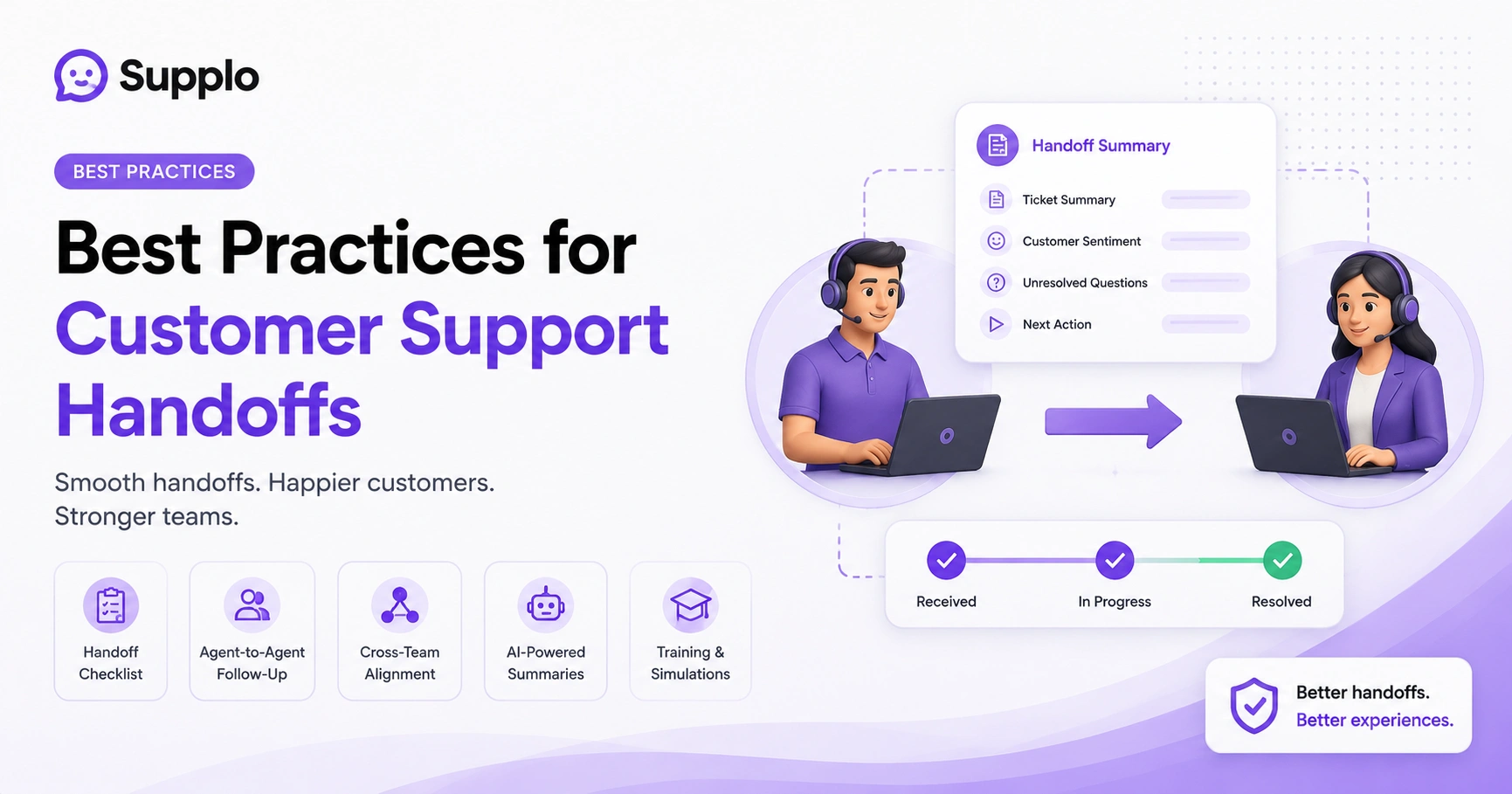
The escalation handoff pattern: The AI agent tries to solve the problem first. If it can't, it gracefully hands the conversation to a human agent with full context. The customer never repeats themselves.
At a cost of around $0.04 per resolution, this is roughly 96% cheaper than traditional enterprise bots. It makes 24/7 support financially viable for any team.
Quick, correct answers from a bot often yield a higher CSAT than a slow answer from a human.
You don't need to build a bot from scratch. Test Supplo's AI agent for free right now. It resolves common questions for $0.04 each, with no per-seat fees. Head here to see how an AI agent works.
The Second Touch Strategy: Closing the Loop on Negative Feedback
If a customer leaves a 1 or 2 on your CSAT survey, don't ignore it. The "Second Touch" strategy means proactively reaching out to that specific customer within 24 hours to apologize, fix the root cause, and sometimes offer a small credit. This can salvage the relationship and improve future scores.
The workflow:
- Flag any negative CSAT responses in your unified shared inbox.
- Assign a senior agent to reach out via email or phone personally.
- Be specific about what went wrong. Don't use a generic apology.
- Ask the customer what they would have wanted instead.
This acts as a risk management function. One good "second touch" can turn a detractor into a promoter. It also provides direct feedback on which processes are failing.
Customer Satisfaction Best Practices: Precision vs. Speed
The age-old debate: do you answer fast but generic, or slow but perfect? The best practice is to aim for 80% resolution speed on first contact. For complex issues, acknowledge the ticket immediately ("We see you"), set an expectation for a detailed reply, then deliver on that timeline.
Actionable best practices:
- Use saved replies for common questions to speed up responses. Don't type the same answer twice.
- "I don't know, but I'll find out" is better than a wrong, fast answer.
- Invest in a knowledge base so customers can help themselves. This boosts CSAT for users who prefer self-service.
- Tone matters more than word count. A short, empathetic message beats a long, generic one.
A good knowledge base is the unsung hero of customer satisfaction. It gives the customer control, which they love.
How to Measure Customer Satisfaction Without Annoying Your Users
Survey fatigue is real. Measure CSAT selectively: after a ticket is closed, but only once per customer per 48-hour window. Never pop up a survey mid-conversation. Use a small widget in the corner, not a full-page redirect.
Implementation tips:
- Use a post-interaction survey via your chat widget. It's non-intrusive and contextual.
- Segment your CSAT by channel. Is your chat team scoring 90%, but your email team scoring 60%? That tells you where to focus training.
- Don't survey during onboarding. New users are often confused, and the learning curve will skew their feedback.
A 5-10% survey response rate is standard for a well-implemented widget. If you're getting 0%, your survey timing or placement is wrong.
Common Pitfalls That Tank Your CSAT Score And How to Fix Them
Three big pitfalls: (1) Responding too slowly, (2) forcing customers to repeat themselves across channels, and (3) not having a self-service option. Fix these by unifying your inbox, using an AI agent to set expectations, and building a simple FAQ page.
The channel hop problem: A customer opens a chat, then sends an email. If those are in different systems, your agent has no context for them. The customer has to repeat their whole story. That's a guaranteed low CSAT.
The fix: Use a unified shared inbox that routes email, Telegram, WhatsApp, Instagram, and Facebook to a single place, no context switching.
Supplo is not affiliated with any app or website. Please follow each app's terms and local regulations.
Another common pitfall: Multilingual teams sending confused translations. Tools like the translate feature can prevent miscommunication that kills scores.
Forcing a customer to repeat their problem is the fastest way to a 1-star rating.
Fix your inbox: If your team is drowning in channels, Supplo's unified shared inbox handles email, Telegram, WhatsApp, and more in one place, with no context switching. Start your free trial today.
The 30-Day Improvement Plan
Here's a quick plan: Week 1 - Audit your response time. Week 2 - Implement an AI agent for after-hours. Week 3 - Review your top 3 most complained-about processes. Week 4 - Send "Second Touch" emails to negative feedback. Follow this plan, and you'll see a 5-10 point shift in your CSAT within a month.
The weekly checklist:
- Week 1: Audit your First Response Time and Time to Resolution. Set a baseline. If FRT exceeds 2 minutes in chat, make it your #1 priority.
- Week 2: Deploy an AI agent for after-hours and Tier-1 questions. Measure the reduction in wait times.
- Week 3: Review your top 3 most hated processes. Fix the one that generates the most negative feedback.
- Week 4: Implement the "Second Touch" workflow for all negative scores. Track if those customers return or churn.
We've seen teams achieve this exact improvement. Check out case studies from teams like yours to see real results.
Consistency beats perfect execution. Do something every week, even if it's small.
Key Takeaways
- CSAT is a transaction-based metric that measures satisfaction with a specific interaction. 80%+ is the target.
- Speed is the #1 driver. Reduce your chat First Response Time to under 2 minutes.
- Use an AI agent to handle Tier-1 questions instantly, cutting wait times to zero.
- Always close the loop on negative feedback within 24 hours using the "Second Touch" strategy.
- Avoid forcing customers to repeat themselves. Use a unified inbox for all channels.
- Measure CSAT selectively, only after resolved interactions, and only once per 48 hours.
FAQ
What is a good CSAT score?
Generally, a score of 80% or higher is considered excellent. Scores between 60% and 80% indicate room for improvement, and anything below 60% signals serious issues with your support process or product.
How is the CSAT score calculated?
You calculate it by dividing the number of satisfied customers (those who gave a 4 or 5) by the total number of survey responses, then multiplying by 100 to get a percentage.
What is the difference between CSAT and NPS?
CSAT measures satisfaction with a specific interaction or purchase. NPS (Net Promoter Score) measures overall brand loyalty and the likelihood that a customer will recommend you to others.
How often should I send a CSAT survey?
Send it immediately after a support interaction is resolved. To avoid survey fatigue, limit it to once per customer per 48-hour window. Don't embed it in your general app experience.
Why is my CSAT score low even though I respond quickly?
Speed matters, but resolution accuracy matters more. If you're answering fast but incorrectly, or forcing the customer to repeat their problem, your speed is actually harming your score.
Can AI really improve my CSAT?
Yes, primarily by eliminating wait times. An AI agent can handle Tier-1 questions instantly. A quick, correct answer from a bot often yields a higher CSAT than a slow answer from a human.
What is the best survey question to measure satisfaction? The most effective question is binary: "Was your issue resolved today?" (Yes/No) combined with a 1-5 scale rating. This gives you a concrete resolution metric plus a satisfaction metric.
Compliance line: Supplo is not affiliated with any app or website. Please follow each app's terms and local regulations.