On this page
Nobody enjoys being put on hold. And repeating your story three times? That's a special kind of frustration. What customers actually want is fast, human help right now, without the runaround. This guide walks through live chat best practices that actually work for modern support teams. You'll learn how to set up your chat workflow, train agents who don't sound like robots, and pick tools that work for you, not the other way around.
Who should read this? Small to mid-size support teams who want to level up without hiring consultants or buying software that does way too much.
When to use this: Setting up a new chat system, running a retraining session, or fixing a workflow that's starting to feel clunky.
When to skip: If your CSAT is already above 90% and everything runs smoothly, you might want the H2 on iteration tips.
Quick Answer
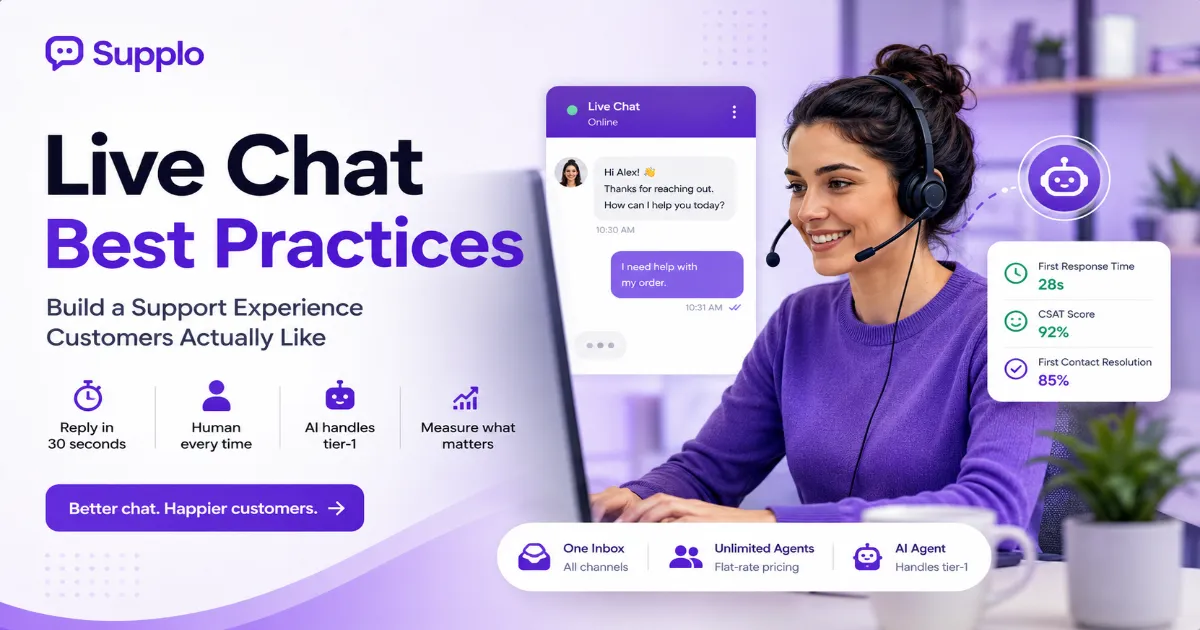
- Speed plus the human touch: Reply within 30 seconds, personalize every message, and let an AI agent catch the easy tier-1 questions before they hit your team.
- Train on real transcripts: Ditch the textbook scenarios—Role-play actual customer conversations. Agents improve fastest when they review their own chats with a coach.
- Measure what matters: First-response time, CSAT, and first-contact resolution. Chat volume is a vanity metric. These three tell you the real story.
- Pick a platform that scales without penalties: Unlimited agents, flat monthly billing, and built-in omnichannel routing. Avoid anything with per-seat or per-resolution fees like you'd avoid a root canal.
- Quit asking for info twice: Keep chat transcripts and customer history accessible. The conversation should flow smoothly, not restart.
What Are Live Chat Best Practices?
Live chat best practices are the proven techniques and workflows that help support teams deliver fast, human, effective help through chat. They span everything from response time targets and tone to tool configuration and agent training. Following them isn't optional if you want happy customers and a sane team.
- Speed matters, but accuracy matters more. Aim for first-response time under 30 seconds, but never rush a wrong answer.
- Use saved replies and macros for common questions. But personalize before you hit send every time.
- Track metrics like CSAT, first-contact resolution, and average handle time. That's where you'll spot bottlenecks.
- A well-configured AI agent can handle repetitive tier-1 questions. Let it. Your team will thank you for the breathing room.
- Keep chat transcripts accessible across your team. Context shouldn't get lost when a chat gets transferred.
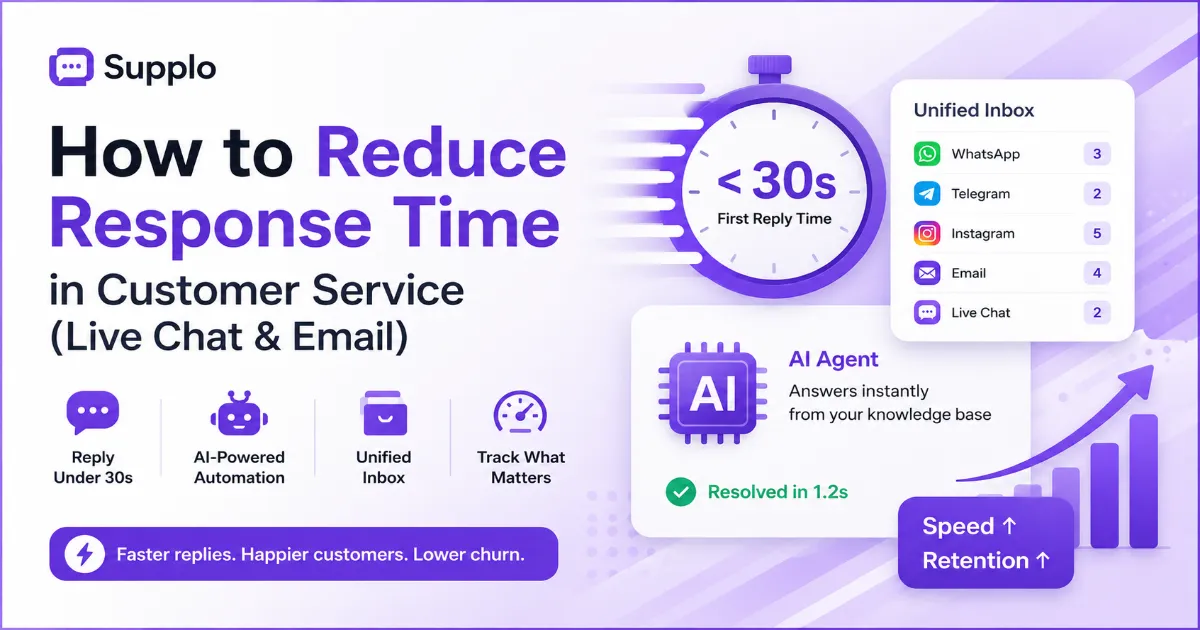
A first‑response time under 30 seconds is the industry gold standard. Hitting it consistently requires smart routing, not just throwing more agents at the problem.
Live Chat Customer Service Best Practices for Modern Teams
Modern customer service teams need live chat practices that match how people actually communicate today, fast, casual, and multi-channel. Greet customers by name, use a conversational tone, and be ready to switch from chat to video or voice when things get complex. And let customers reach you on the channels they already use, like WhatsApp or Instagram DMs.
- Start with a friendly opener: "Hi [Name], thanks for reaching out. How can I help?" It's simple, but it works.
- Avoid scripted answers. Customers can smell copy-paste from a mile away.
- Integrate live chat with your other support channels. The conversation should follow the customer, not the other way around.
- Set clear expectations. If you need to escalate, say so upfront and give a timeline.
- Follow up after the chat closes. A quick "everything still good?" costs nothing and builds trust.
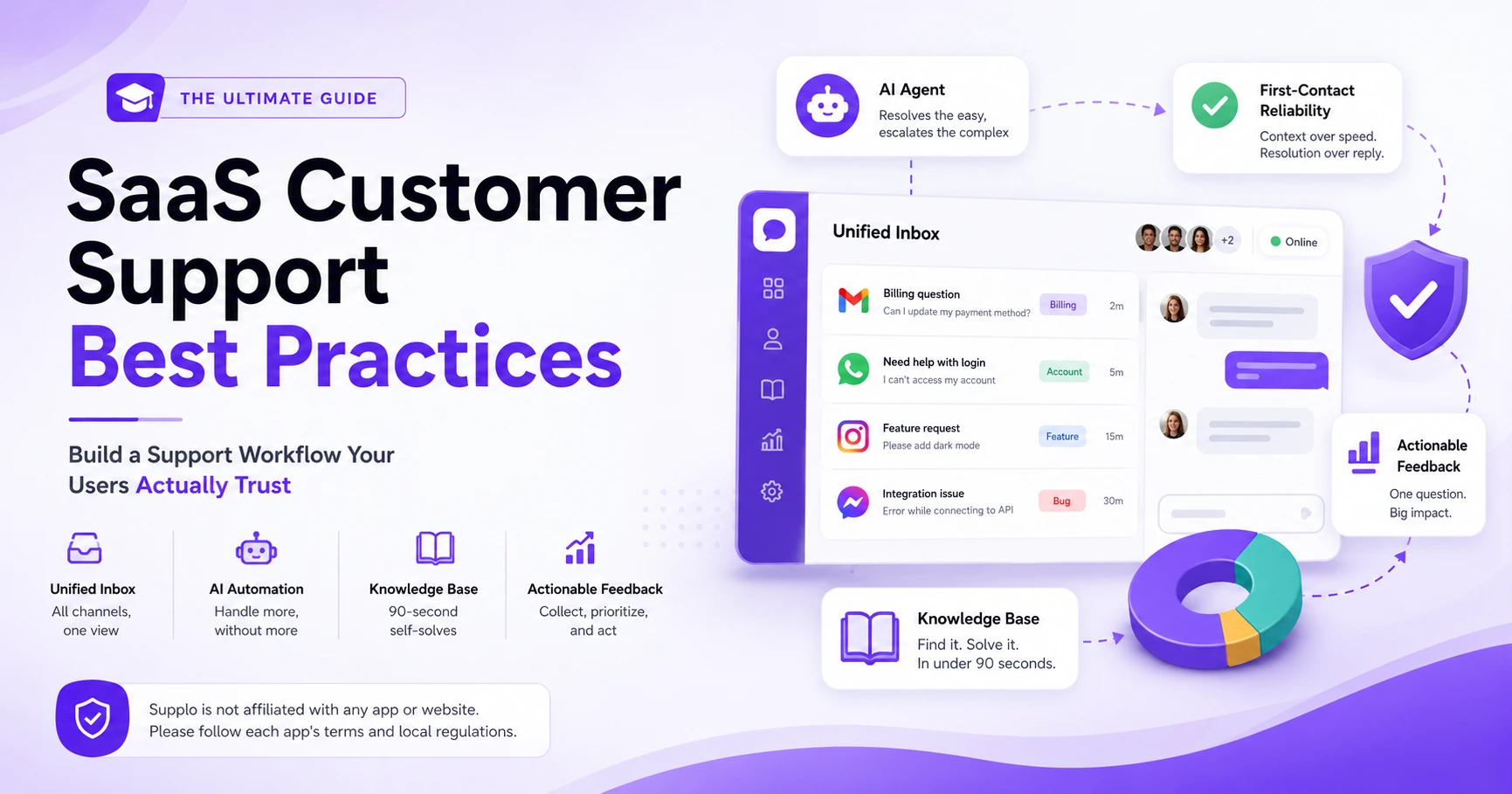
Teams juggling email, Telegram, and social DMs alongside chat should check out a shared inbox to manage multi‑channel chats. Everything in one place changes the game.
How to Optimize Live Chat for Support Efficiency
Optimizing live chat isn't about making agents faster. It's about removing friction so they can focus on solving problems. Use automation for the boring stuff: routing, greetings, and canned responses. Give agents a clean UI that shows customer history. Measure what actually matters. When your tool becomes invisible, efficiency follows naturally.
- Use smart routing to send chats to the right agent based on skill, language, or past interactions.
- Enable co-browsing or screen sharing for complex issues. One shared screen beats a hundred messages.
- Set up a shared inbox so nothing slips through the cracks, especially with remote teams.
- Automate post-chat surveys to collect feedback without interrupting the flow.
- Audit your trigger words and macros quarterly. Stale templates hurt both speed and quality.
The best teams pair human agents with an AI agent that handles tier‑1 questions, such as password resets and order status checks. It creates a first line of defence that never sleeps.
Building an Effective Live Chat Strategy
An effective live chat strategy aligns your support goals with your business metrics. It defines whether you'll offer a chat 24/7 or just during business hours. which channels you'll cover, and how your AI agent handles off-hours. The best strategies are built on data, not guesswork, and evolve as your customer base grows.
- Start simple: chat should reduce friction, not add it. If a self-service answer is faster, serve that before routing to a live agent.
- Decide if you need round-the-clock coverage or can rely on an AI agent for after-hours triage.
- Map your customer journey and place chat prompts at high-intent moments, pricing pages, checkout, and error pages.
- Measure deflection rate. You want the AI to handle simple queries so humans can tackle the tough stuff.
- Review your strategy monthly. Customer expectations change faster than your software updates.
If your customers reach you via messaging apps, consider adding a WhatsApp customer support channel to meet them where they already hang out.
Improving the Live Chat Experience for Customers
Improving the live chat experience means making every interaction feel effortless. Short wait times, personalized responses, and smooth channel transitions are table stakes. The real magic happens when you anticipate what the customer needs before they type it.
- Reduce wait times with a chatbot for initial triage or a queue message that sets expectations.
- Always show the agent's name and profile picture. It humanizes the interaction instantly.
- Let customers see chat transcripts in their account portal so they can pick up where they left off.
- Don't ask for information they've already provided on your website or in a previous chat.
- Test your chat widget on mobile. Most live chats happen on phones, and a tiny text box kills the experience.
70% of customers expect a consistent experience across all channels. A fragmented toolset makes that impossible; a unified inbox solves it.
Want a simpler way to manage all your chats? Supplo combines live chat, email, and social messaging into one workspace with flat-rate pricing. Explore the features →
Live Chat Agent Best Practices: Skills That Matter
The best live chat agents combine typing speed with emotional intelligence. They read between the lines, de-escalate frustrated customers, and explain complex answers in plain language. These skills aren't innate; they're developed through training, practice, and the right tooling.
- Teach agents to mirror the customer's tone, formal for a B2B client, casual for a SaaS user.
- Empathy statements like "I can see how that would be frustrating" work better than robotic apologies.
- Use open-ended questions to clarify. Closed questions stall conversations.
- Encourage agents to take ownership. "Let me handle this for you" beats "I'll pass you to a colleague."
- Provide a knowledge base that they can search quickly. Guessing wastes everyone's time.
Teams that invest in agent skills see higher CSAT and lower turnover. Check out case studies of teams that improved chat performance after implementing structured training.
How to Train Live Chat Agents for Success
Training live chat agents should go beyond product knowledge. Teach conversational flow, multi-tasking, and how to use your specific chat platform efficiently. Role-play real scenarios, review past chat transcripts, and create a playbook for common escalations. Training is never one-and-done; ongoing coaching keeps skills sharp.
- Simulate high-volume scenarios so agents practice staying calm while juggling multiple chats.
- Share anonymized "wins" and "learning moments" weekly. Peer feedback is surprisingly powerful.
- Train agents on your knowledge base tools so they can find answers fast without breaking the flow.
- Include a module on data privacy. Agents should never ask for passwords or share sensitive info in chat.
- Use your platform's analytics to identify which agents need extra help with handle time or CSAT.
Agents who use an integrated knowledge base resolve tickets 35% faster on average. Training without tooling is wasted effort.
Essential Live Chat Operator Skills
Live chat operator skills fall into three buckets: communication, technical navigation, and emotional regulation. Operators must type clearly, switch between apps quickly, and keep their cool when a customer is upset. The best ones also know when to ask for help; nobody expects them to know everything.
- Typing speed of 50+ WPM is helpful, but accuracy and clarity matter more.
- Operators should feel comfortable reading a knowledge base while typing. Split focus is a core skill.
- They need to recognize "hot" words that signal frustration and defuse them before they escalate.
- Knowing how to transfer a chat without losing context is surprisingly rare and incredibly valuable.
- Empathy and patience can't be taught in a one-day workshop. Reinforce them through culture.
Customer Service Chat Etiquette You Can't Ignore
Chat etiquette is the unspoken rulebook that makes digital conversations feel human. Use proper grammar without stiff formality. Avoid jargon. Never type in ALL CAPS. A simple "thanks for your patience" goes a long way. And please never use chat as a spam channel or start with "How can I help you today?" if the customer already typed their question.
- Greet the customer by name and acknowledge their issue in the first sentence.
- Use bullet points or short paragraphs in long answers. Walls of text kill readability.
- Don't overuse emojis. One smiley face is fine. Twenty looks unprofessional.
- Never interrupt a customer mid-sentence. If they're still typing, wait.
- Always confirm the solution before closing: "Does that answer your question?"
Speed up your replies without sacrificing quality by setting up a knowledge base integration to enable agents to search for answers mid-conversation.
Implementing Live Chat Best Practices in Your Workflow
Implementing live chat best practices isn't a one-time project. It's a continuous cycle of setup, training, measurement, and iteration. Start by choosing a platform that doesn't nickel-and-dime you per agent or per resolution. Then configure your routing, build your knowledge base, and train your team. Finally, watch the metrics and adjust.
- Prioritize a tool with unlimited agents and a flat monthly rate. Surprise bills are never fun.
- Integrate your chat with your CRM or help desk so customer history is one click away.
- Create a short cheat sheet for agents with the most common macros and escalation paths.
- Run A/B tests on your chat widget placement. Sometimes moving it from the bottom right to the bottom left boosts engagement.
- Schedule monthly reviews of chat transcripts to catch slipping quality before it impacts CSAT.
Compliance: Supplo is not affiliated with any app or website. Please follow each app's terms and local regulations.
Best practices are only as good as the platform that enables them. Supplo's AI agent answers questions for roughly $0.04 each, about 96% cheaper than the big guys. And our unlimited agent plan means you can scale support without surprises.
Start your free trial → (no credit card required)
Or read case studies from teams who already made the switch.
Key Takeaways
- Respond within 30 seconds with a personalized, human tone. Speed without quality frustrates. Quality without speed loses customers.
- Train agents on real transcripts, not hypothetical scenarios. Use role-play and share weekly wins and learning moments.
- Track CSAT, first-response time, and first-contact resolution. These three metrics tell you more than chat volume ever will.
- Use a shared inbox and AI agent to manage multi-channel chats without losing context or blowing your budget.
- Pick a flat-rate platform with unlimited agents so you can scale support without cost surprises.
FAQ
What is the most important live chat best practice?
Responding within 30 seconds while keeping a helpful, human tone. Speed without quality frustrates customers; quality without speed loses them. You need both.
How many chats should an agent handle at once?
Most agents can comfortably manage 2–3 concurrent chats. Beyond that, quality drops. Let your AI agent handle tier-1 questions so your team stays focused.
Should I use a chatbot or live agents?
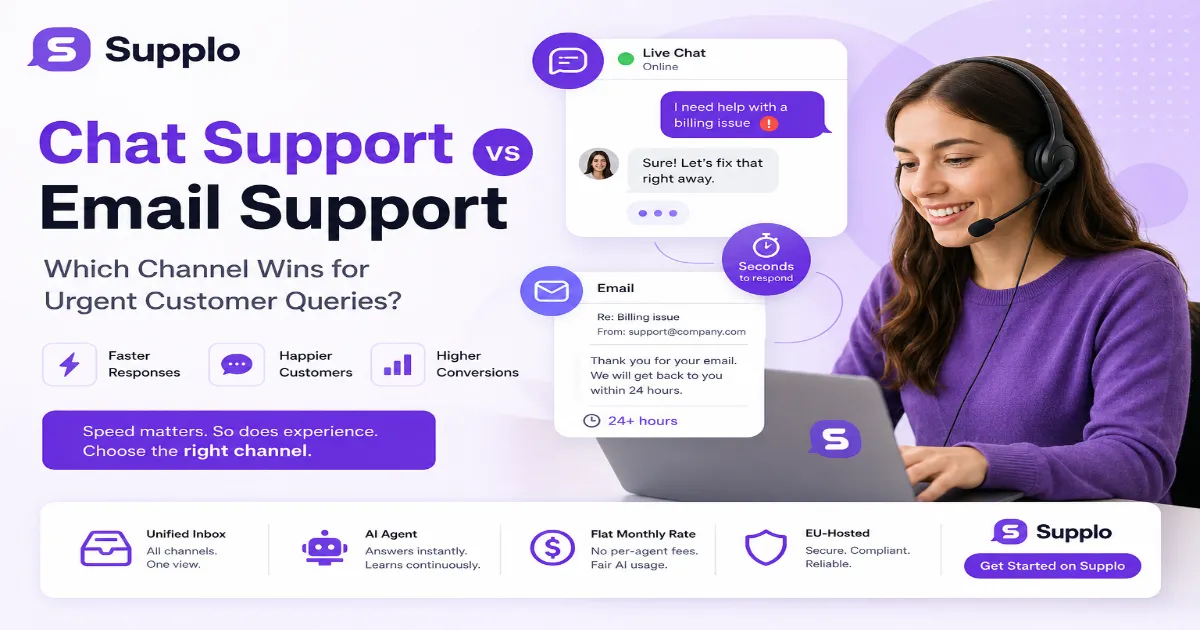
Both. A self-learning AI agent can resolve common queries instantly, while live agents handle complex or sensitive issues. The key is seamless handoff without making the customer repeat themselves.
How do I measure live chat success?
Track first-response time, average handle time, CSAT score, and first-contact resolution. If deflection rate improves without hurting CSAT, your AI is doing its job.
What chat etiquette mistakes hurt customer trust?
Typing in all caps, ignoring the customer's name, copy-pasting canned responses that don't fit, and closing a chat without confirming resolution. Also, asking for info they've already provided.
How can I improve agent training fast?
Record and review actual chat transcripts, not hypothetical scenarios. Use role-play for de-escalation, and create a short playbook of your top 10 recurring issues with ideal responses.
What's the biggest mistake teams make when implementing live chat?
Treating chat as just another channel instead of redesigning the support workflow around it. Without proper routing, a shared inbox, and an AI triage layer, chat becomes a source of noise.
Compliance note: Supplo is not affiliated with any app or website. Please follow each app's terms and local regulations.