On this page
Open-source helpdesk software means the code is public, free to download, and yours to host. You own everything, the data, the infrastructure, the whole thing. Sounds like a dream, right? Until you're the one patching security holes at 2 AM.
Quick Answer
The appeal is cost control and customization. The reality? You're trading a license fee for a hidden tax on your team's time.
- Core benefit: Zero upfront licensing costs. But holy smokes, the infrastructure bill sneaks up on you.
- Customization freedom: Fork the code, add plugins, build exactly what you want, assuming you've got a developer who can pull it off.
- Data sovereignty: Your tickets, your customers, your server. No third-party cloud is involved.
- The catch: There's no support hotline. You're the IT department, the security team, and the help desk manager rolled into one.
- Popular examples: Zammad, osTicket, UVdesk, Faveo, MantisBT; these are where most folks start.
If you've got an in-house developer and strict data rules, open source can work. But "can work" isn't the same as "won't give you headaches."
The Real Cost of "Free" Open Source Helpdesk: Server, Setup, and Stress
Most people hunting for "no cost helpdesk software" don't see the real price tag. It's not the license, it's the labour. A basic self-hosted setup needs a VPS (roughly $10–50/month), a domain, SSL certs, SMTP configuration for email, and weekly security updates. And that's before you train your team or build any automations. That "free" tool? It can quietly cost you a junior sysadmin's salary in maintenance hours.
- Server costs: DigitalOcean or AWS droplets start around $10, but they scale fast as your ticket volume grows.
- Maintenance overhead: Security patches, database backups, plugin updates, call it 5–10 hours per month, easy.
- Scalability limits: Open source databases like MySQL start wheezing with thousands of concurrent users unless you've optimized the heck out of them.
- Hidden IT debt: When the person who set it up leaves, all that tribal knowledge walks out the door with them.
- ROI comparison: With a flat-rate SaaS like Supplo, your costs are predictable, zero tech maintenance required.
Ready to see how much faster a real support platform is? Start with Supplo's free trial today. No credit card required, no server setup, just a working inbox in 30 minutes.
Top Open Source Helpdesk Solutions Compared
If you're dead set on self-hosting, these five are your most reliable bets. Each has a distinct personality: Zammad's modern with a RESTful API, osTicket is old-school but rock solid, UVdesk plays nice with eCommerce, Faveo caters to managed service providers, and MantisBT is strictly for bug tracking. All are free to download. None includes AI or multi-channel inboxes out of the box.
- Zammad: React-based UI, great for IT teams comfortable with Docker. Supports email and chat only.
- osTicket: PHP/MySQL, solid ticket system with a learning curve on the admin side.
- UVdesk: Built on Symfony, hooks into WooCommerce and Magento, best for retail support.
- Faveo: Billing and SLA-focused, popular with managed service providers.
- MantisBT: Not really a helpdesk, it's for bug tracking. Weak for customer-facing stuff.
Here's the kicker: none of these gives you a unified inbox for email, WhatsApp, Instagram, Telegram, and Facebook. You'd need custom development to bridge that gap.
Open Source Ticketing System Free vs. A Modern Flat-Rate SaaS
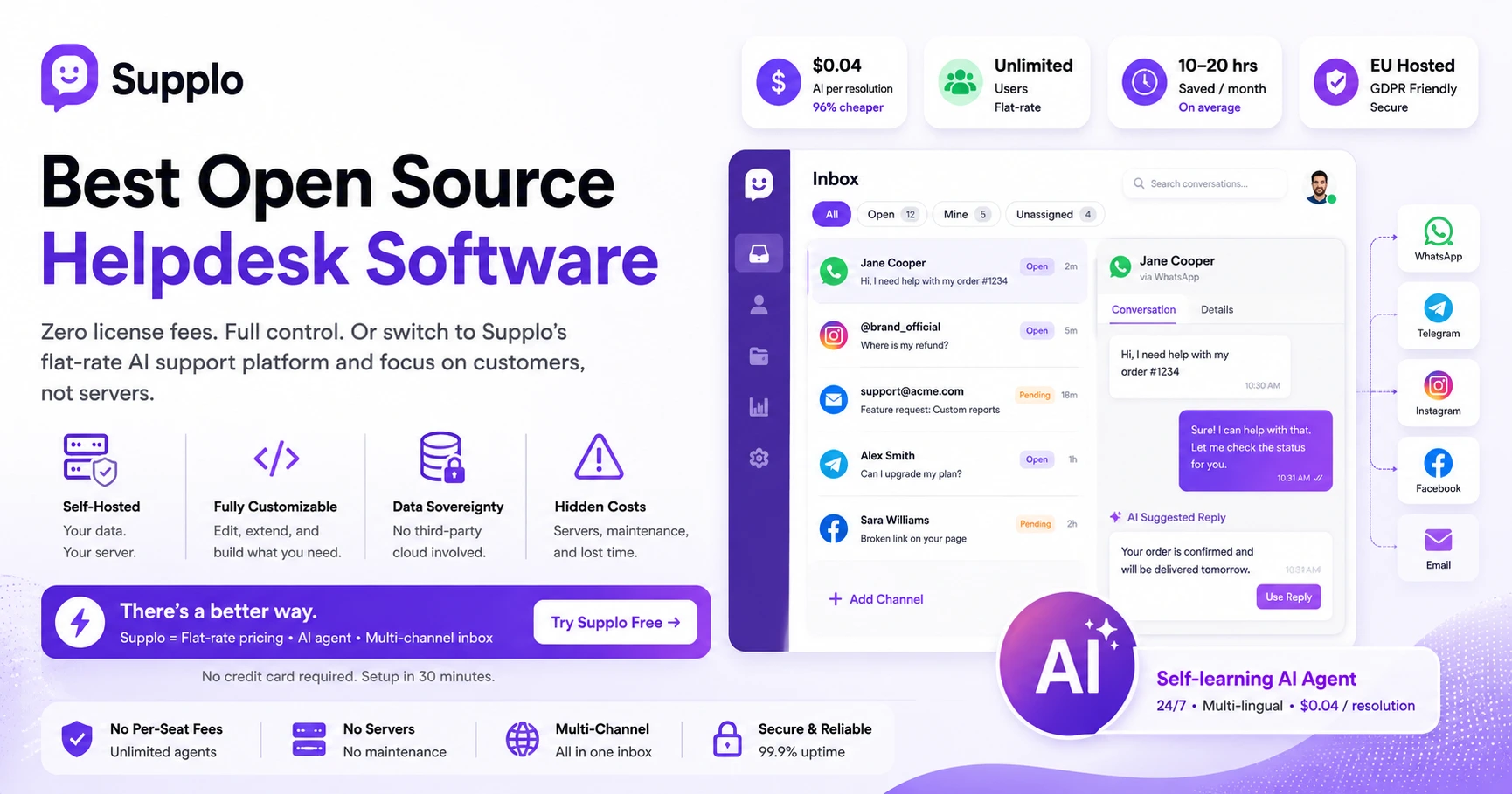
The numbers shift dramatically when you stack an "open source ticketing system free" against a flat-rate SaaS like Supplo. Self-hosted means paying for servers, SMTP gateways, developer hours, and plugin costs. Supply? One flat monthly fee for unlimited users, live chat, a shared inbox, WhatsApp/Telegram/Instagram routing, and a self-learning AI agent. The AI runs $0.04 per resolution, roughly 96% cheaper than comparable AI services from proprietary platforms.
- Self-hosted hidden costs: VPS ($20/mo), SMTP through SendGrid ($15/mo), developer maintenance ($50–200/mo in time).
- SaaS flat-rate advantage: No per-seat fees, no surprise overage charges, zero setup time.
- AI cost comparison: Competing AI agents charge $0.20–$1.00 per resolution; Supplo charges $0.04 per resolution.
- Multi-channel built-in: Email, live chat, WhatsApp, Telegram, Instagram, Facebook, all in one inbox without plugins.
- Payment flexibility: Supplo accepts crypto (Binance Pay), Payeer, GCash, Skrill, Payoneer, and global cards.
Check Supplo's flat-rate pricing against your current server bill. Want hard numbers? See real case studies of teams that made the switch.
Must-Have Open Source Helpdesk Software Features Your Team Will Actually Use
The best features aren't about having the most; they're about the ones your team touches every single day. Look for a unified inbox, automation rules (tags, assignment, escalation), a knowledge base, and multi-language support. Most open-source help desks provide a ticketing backbone, but few offer real-time collaboration features such as internal notes, collision detection, or SLA dashboards. Need AI-powered triage or self-service? You're probably building that yourself.
- Unified inbox: Merge email, chat, and social DMs into one view.
- Automation: Conditional routing, auto-replies, trigger-based workflows.
- Knowledge base: Separate public and private articles; markdown or WYSIWYG editors.
- Multi-language detection: CRITICAL. Suplo's Translate feature automatically detects and translates tickets into the agent's language.
- Real-time agent collaboration: Collision warnings, internal notes, conversation assignments.
Supplo offers a unified multi-channel inbox that ties everything together without extra plugins, no additional tools to install.
Why Self-Hosted Open Source Ticketing Often Fails
Reliability is the silent killer of self-hosted helpdesks. When your server goes down, there's nobody to call. Email queues stall because of misconfigured SPF or DKIM records. Database corruption from a failed migration can erase months of tickets. And security vulnerabilities? The Equifax breach started with an unpatched open-source framework. If uptime and support matter, self-hosting starts looking like a liability, not a benefit.
- No uptime SLA: Self-hosted means 100% your problem, no refunds, no escalation.
- Email deliverability nightmares: SMTP configuration errors cause tickets to disappear silently.
- Security patching lag: Open-source vulnerabilities are published publicly before fixes are available.
- Database backup discipline: Most teams realize they haven't tested a restore until it's too late.
If your current approach keeps failing, it's time to stop troubleshooting and start fixing. Supplo handles servers, email deliverability, and security patches so you can focus on your customers. → Switch to Supplo.
Compliance line: Supplo is not affiliated with any app or website. Please follow each app's terms and local regulations.
How to Migrate Out of Open Source Helpdesk Without Losing Your Data (or Your Mind)
Moving from an open-source platform to a cloud service takes more than an SQL dump. You need to export tickets, user data, canned responses, and attachments, then map everything to your new system's format. Most open-source help desks can export to CSV or JSON, but attachments often require manual linking. Supplo accepts structured imports during onboarding; the hardest part is cleaning up duplicates and orphaned conversations. Plan for a weekend of data cleaning, not a single day.
- Export all ticket tables from MySQL/PostgreSQL as CSV with headers.
- Extract attachment files from the file system (usually in /uploads or /attachments folders).
- Match user accounts, de-duplicate email addresses across your old system.
- Test import with a sample of 100 tickets before full migration.
- Run both systems in parallel for one week to catch missing data.
A careful migration means you don't lose history. Supplo's onboarding team can help map your data format.
No Cost Helpdesk Software: Comparing On-Premise vs. Cloud AI Agents
"No cost" helpdesk software really means "no license fee." But when you compare on-premise self-service to a cloud AI agent, the cloud option often costs less. An open source knowledge base requires manual article writing and search indexing. A modern AI agent, like Supplo's self-learning AI agent, learns automatically from your FAQ and past tickets, answers customers 24/7, and runs $0.04 per resolved conversation. For most teams, the flat-rate SaaS price is lower than the labour cost of maintaining a self-hosted FAQ.
- Self-hosted FAQ: Expensive to build, static, no learning curve for the bot.
- Supplo AI Agent: Self-learning, multi-lingual, integrated with live chat for handoffs.
- Cost per resolution: $0.04 vs. $1+ for AI competitors (96% cheaper).
- Zero maintenance: No server, no SMTP, no plugin updates, just results.
- Instant setup: Deploy the widget or API in under 30 minutes.
When Open Source Helpdesk Makes Sense (and When It's a Trap)
An open-source helpdesk is genuinely better when you have a full-time DevOps engineer, strict data residency requirements (like on-premises for government), or deep customization needs. But it's a trap for small-to-mid teams who want to answer tickets and move on. If you don't have a budget for a sysadmin or patience for weekend server crashes, you're better off with a flat-rate service. Your customers don't care about your stack; they care about fast, accurate answers.
- Good for: Startups with in-house DevOps, regulated industries requiring on-prem data, and teams with custom permission models.
- Bad for: Small support teams, non-technical founders, fast-scaling companies, anyone who values sleep over server uptime.
- The trap: You think you're saving money, but every hour of debugging downtime is an hour you could have spent on customers or product.
- Supplo's alternative: AI-first customer support with no per-seat fees, no server management, and multi-channel routing.
Open Source vs. Supplo's AI-First Customer Support
If you have a developer on staff and data sovereignty requirements, go with open source. If you want to allocate your budget to customer outcomes rather than server maintenance, choose Supplo. Supplo combines live chat, a shared inbox, a self-learning AI agent, and multi-channel routing (email, Telegram, WhatsApp, Instagram, Facebook) in one workspace, billed at a flat monthly rate: no per-seat fees, no per-resolution meter. The AI costs $0.04 each, roughly 96% cheaper than comparable services. Built for small-to-mid support teams who want category-leader features without the category-leader invoice.
- Open source wins on: Customization, data control, and no recurring license fee.
- Supplo wins on: Reliability (EU-hosted, managed infrastructure), ease of use, AI-powered automation, global payment options (crypto, Binance Pay, Skrill, Payoneer, etc.), and 24/7 support.
- Final recommendation: Use Supplo if you have 3–20 agents and want to stop managing a server. Use open source if you have a dedicated ops team and deep customizations.
- Next step: Start with Supplo's free trial or flat-rate plan, migrate your data, and see the difference in week one.
See how Supplo compares to tools like vs. Intercom or check out WhatsApp customer support built directly into the platform.
Don't let another ticket slip through the cracks. Supplo gives you reliable, flat-rate customer support with built-in AI, live chat, and multi-channel routing. Sign up now and get your first month on a flat-rate plan, no hidden fees, no per-seat billing. → Get Started with Supplo.
Key Takeaways
- Open-source helpdesk software is free to download, but costly to run; server, maintenance, and DevOps time add up fast.
- Top tools like Zammad and osTicket lack built-in AI and multi-channel inboxes.
- Supplo offers a flat-rate, EU-hosted alternative with a self-learning AI agent, unlimited users, and no server management.
- AI resolutions cost $0.04 each, 96% cheaper than proprietary AI services.
- Most teams save 10–20 hours/month by switching from self-hosted to flat-rate SaaS.
FAQ
Is open source helpdesk software really free?
The software license is free, but you pay for hosting, server maintenance, email infrastructure, and developer time. Most teams end up spending more on these hidden costs than on a flat-rate SaaS platform.
Can I use open source helpdesk software for a large team?
Yes, but you'll need robust server infrastructure and possibly load balancing. Open-source tools like Zammad and UVdesk can scale but require dedicated DevOps support; they're not a set-and-forget solution for growing teams.
What's the biggest risk of self-hosting an open source ticketing system?
Reliability. You have no uptime SLA, no one to call during a server crash, and security patches are your responsibility. A single missed update can expose customer data.
Can I migrate from an open source helpdesk to Supplo later?
Yes. Supplo supports structured imports from common open source formats. Plan for data cleaning and a one-week parallel run to ensure a smooth transition.
Does open source helpdesk software include an AI agent?
Rarely. Most open-source help desks lack built-in AI. You'd need to integrate third-party NLP tools or build a custom bot. Supplo's AI agent is integrated out of the box and costs just $0.04 per resolution.
What payment options does Supplo accept?
Supplo accepts cryptocurrency (Binance Pay), Payeer, GCash, AmanPay, QIWI Wallet, DOKU, Nigeria and South Africa cards, Skrill, and Payoneer, plus standard global credit cards.
Is Supplo compliant with data regulations?
Supplo is not affiliated with any app or website. Please follow each app's terms and local regulations. Supplo is EU-hosted and designed for GDPR-friendly data handling.
Compliance line: Supplo is not affiliated with any app or website. Please follow each app's terms and local regulations.