On this page
Every business knows the math: keeping a customer costs 5–7x less than finding a new one. The problem is, most teams treat support as a cost center, not a retention engine. This guide is for support leaders, founders, and operations managers who want to stop fighting fires and start preventing them. You'll learn how to reduce customer churn with better support, using proactive outreach, smart automation, and simple team changes.
When to use these strategies: If you are losing customers due to waiting long times, repetitive answers, or a lack of personal connection.
When NOT to use them: If your core product is fundamentally broken or your pricing is way above market value. Support can't fix a bad product.
Quick Answer
- Proactive outreach catches problems before they become churn triggers. Reach out to customers who are stuck, not just those who complain.
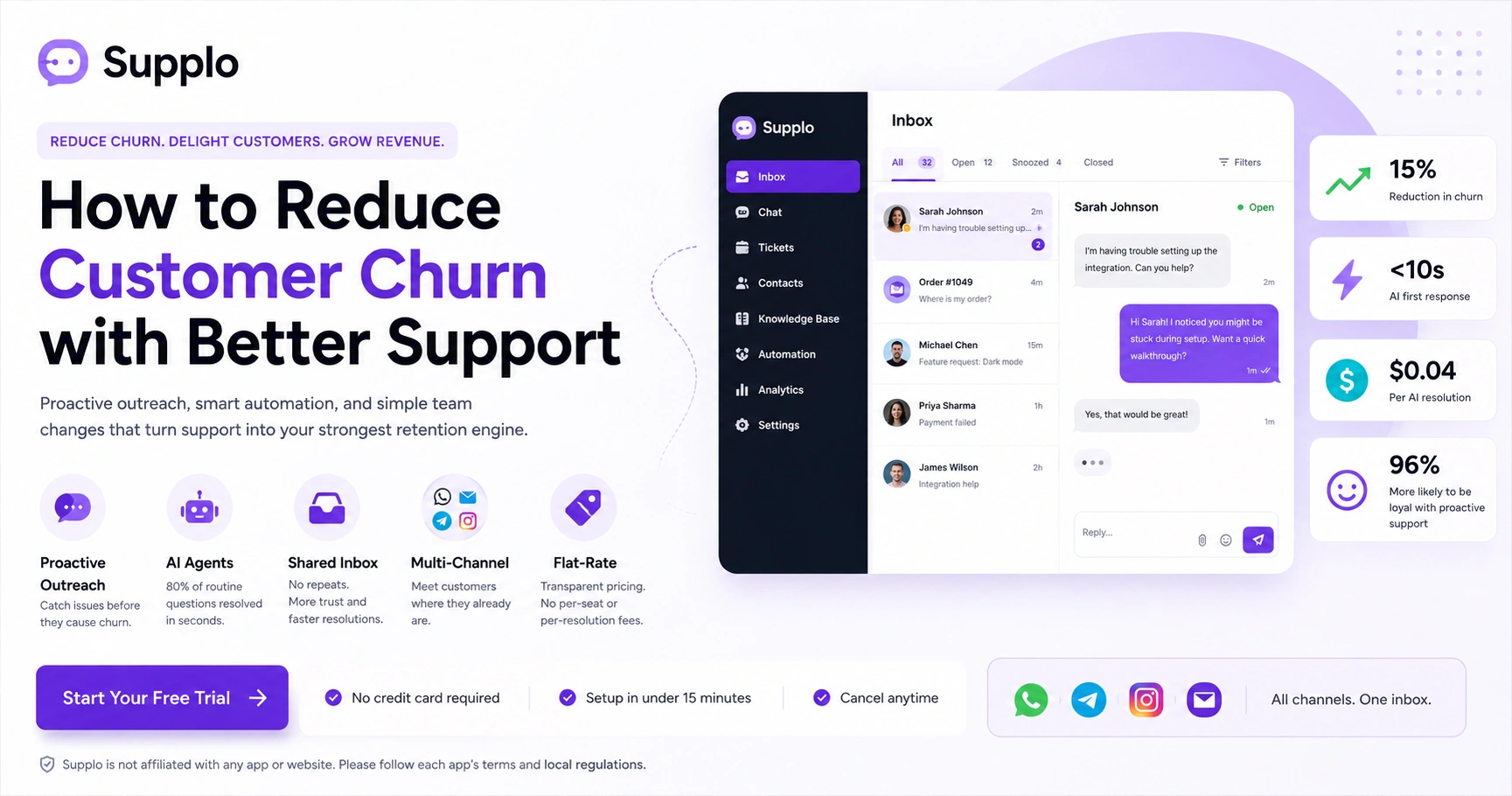
- AI agents handle routine questions in seconds for roughly $0.04 per resolution, freeing humans for complex issues.
- A shared inbox prevents agents from asking for the same information twice, building trust and speed.
- Multi-channel routing (email, WhatsApp, Telegram, Instagram DMs) meets customers where they already are.
- Flat-rate pricing removes the fear of being penalized for helping more customers.
Why Better Customer Support Is Your Most Powerful Churn Reduction Strategy
The math is simple: keeping a customer costs 5–7x less than acquiring a new one. But not just any support works. Customers churn when they feel unheard, wait too long, or get bounced between agents. Fixing those friction points directly decreases churn rates because you're solving the root cause of defection: a bad experience. This is the foundation behind every other strategy in this guide.
- Poor support is the #1 cited reason customers leave after price increases.
- Speed matters: 60% of customers define "good service" as a fast first reply.
- Consistency builds trust; a shared inbox prevents agents from having to ask for the same info twice.
- Flat-rate support pricing removes the fear of being penalized for helping more.
A fact to remember: Reducing churn by just 5% can increase profits by 25% to 95%.
Proactive Customer Support: The Best Strategy to Prevent Churn Before It Starts
Reactive support waits for a customer to break. Proactive support catches the crack before it spreads. This means monitoring behavior (like failed login attempts or stalled onboarding) and reaching out first. Proactive customer support churn prevention works because it turns a potential frustration into a moment of delight; the customer realizes you're paying attention.
- Set triggers for common drop-off points: incomplete setup, feature not used, ticket reopened.
- Send a short, human message: "Noticed you hit a snag, want a quick walkthrough?"
- Proactive outreach can reduce churn by up to 15% in early customer cohorts.
- Use a shared inbox for proactive outreach to log all proactive touches so nothing falls through the cracks.
Steps to implement proactive support today:
- Identify the top 3 points where customers get stuck (e.g., onboarding, feature adoption, payment issues).
- Set automated triggers in your support platform for those events.
- Draft 3 short, helpful messages for each trigger.
- Log every outreach in a shared inbox to track follow-ups.
Proactive Engagement to Reduce Churn: How to Reach Customers Before They Reach You
Proactive engagement to reduce churn isn't about spamming customers with offers. It's about timing helpful interventions when they're most likely to get stuck. For example, a SaaS user who hasn't logged in for 14 days is at risk. A quick, non-salesy check-in via live chat or WhatsApp can instantly re-engage them. The goal is to make the customer feel seen, not sold to.
- Use behavioral triggers based on in-app actions (or inaction).
- Engage through the channels they already use, like multi-channel routing on Telegram and WhatsApp.
- A single proactive chat message can recover a churning customer in under 2 minutes.
- Avoid generic automation, personalize the outreach with specific context.
A fact to remember: 96% of customers are more likely to be loyal to a company that proactively addresses issues.
Customer Success Proactive Outreach: Building Retention Through Timely Communication
Proactive customer success outreach bridges the gap between support and sales. It's a structured process: identify customers with declining engagement, assign an owner, and reach out with a value-add (like a feature tutorial or a usage report). This isn't a one-off tactic; it's a retention rhythm. Teams using proactive outreach see a measurable decrease in churn rates.
- Segment customers by engagement level: high, medium, low, dormant.
- Schedule monthly or quarterly check-ins for medium-engagement accounts.
- Use a knowledge base for self-service to proactively send relevant help articles, not just reactively.
- Track outreach in a shared inbox to ensure timely follow-ups.
Using AI for Customer Churn Reduction: Automating Prevention at Scale
Using AI to reduce customer churn means letting a trained model spot patterns that humans miss. An AI agent can analyze ticket sentiment, response times, and resolution rates to flag at-risk accounts. It can then trigger an automated message or alert a human agent. The best part? Each AI resolution costs roughly $0.04, making it viable for small teams to deploy high-touch prevention without a high-touch budget.
- AI detects negative sentiment in customer replies and escalates instantly.
- Automate first-touch follow-ups for unresolved tickets.
- The AI learns from your flat-rate AI agent, so answers improve over time.
- No per-seat fees mean you can have the AI handle unlimited concurrent conversations.
How an AI Agent Can Spot At-Risk Customers in Real Time
An AI agent doesn't just answer questions; it monitors for signals. It can flag a ticket where the customer uses words like "frustrated" or "unhappy." It can detect when a customer has asked the same question three times without resolution. It can even track if a VIP customer suddenly stops engaging. When the AI spots these patterns, it can send an alert to your team or trigger a proactive automated message.
AI Customer Support for Churn: Practical Ways to Deploy Automated Agents
AI customer support for churn isn't about replacing humans; it's about triaging faster. Deploy an AI agent on your widget or WhatsApp channel to handle password resets, order status, or refund requests instantly. If the AI can't resolve it, it surfaces the full transcript to a human agent. This cuts resolution time from hours to seconds, which is a direct lever for reducing churn.
- The AI agent should have access to your full knowledge base and ticket history.
- It can handle up to 80% of routine queries without human intervention.
- Human agents step in only for nuanced issues, keeping them where they add the most value.
- The AI logs every interaction, providing your team with a complete audit trail. See a case study of AI-driven support in action.
AI agents that can resolve simple tickets in under 10 seconds dramatically reduce the likelihood of customer churn due to frustration.
The $0.04 Resolution: Why AI Support Doesn't Have to Break the Bank
Many teams avoid AI because they assume it's expensive. But the math flips when you move away from per-seat or per-resolution metered pricing. With a flat-rate workspace and a low cost per AI resolution (roughly $0.04), you can afford to let the AI handle thousands of conversations without worrying about the bill. This makes AI-driven retention accessible to small and mid-sized support teams.
Worried about getting automation wrong? Don't guess. Supplo's AI learns from your knowledge base and human agents, so automated responses get smarter over time. And if a resolution fails, it escalates seamlessly to a human. Try it risk-free.
Automating Support to Reduce Churn: What to Automate and What to Never Automate
Automating support to reduce churn works brilliantly for predictable, low-stakes questions. Automate password resets, FAQ lookups, order tracking, and account updates. Never automate sensitive escalations (such as refund disputes, account security issues, or emotional complaints). The line is simple: if a wrong automated answer would make the customer more frustrated, keep it human.
- Good targets: "Where's my order?" "How do I reset my password?" "What are your hours?"
- Bad targets: "I'm unhappy with the service", "I think my account was hacked."
- Let the AI escalate to a human with full context, so the customer doesn't have to repeat themselves.
- Multi-channel routing (email, Telegram, Instagram) should all funnel into a single inbox.
Checklist for automating support:
- Is the question predictable (fewer than 3 variations)?
- Is the answer factual and non-judgmental (e.g., tracking numbers, store hours)?
- Would a wrong answer cause serious harm (e.g., locking an account or approving a refund)?
- If the answer to the last question is "yes," keep it human.
AI-Driven Customer Retention: Turning Reactive Support into a Retention Engine
AI-driven customer retention means your support system doesn't just answer tickets, it actively works to keep customers. This looks like automated "how-to" video suggestions sent after a common question, or a check-in message, 30 days after a feature was released. The AI acts as a retention engine by identifying opportunities for re-engagement and surfacing them to your team.
- Use the AI to track feature adoption and send tips when usage drops.
- Automatically tag and route VIP customers to senior agents.
- The AI can generate a daily "at-risk" list for your team to review.
- No per-resolution pricing means you can afford to run these automations 24/7.
Customer Retention Strategies Support Teams Can Implement Today
Not all customer retention strategies require a massive budget. Start with a single change: reduce first response time to under 60 seconds. Then add a shared inbox so agents don't lose context. Finally, enable a single channel your customers already use, like WhatsApp or Telegram, so they don't have to switch apps. These three moves alone can significantly decrease churn rates.
- Use a widget on your site for instant chat, no login required.
- Enable email-to-ticket so no message goes unanswered.
- Add a knowledge base for self-service; customers who find their own answer churn less.
- Translate support into their language using auto-translate features.
Want to test these strategies live? Start a free trial and deploy a shared inbox and AI agent in under 15 minutes. See Supplo pricing.
How to Measure Your Churn Reduction Efforts: Key Metrics That Matter
You can't improve what you don't measure. Track monthly churn rate, first response time, resolution time, and customer satisfaction score (CSAT). More importantly, look at the trend: is churn decreasing month over month? Pair this with ticket volume and sentiment trends. A decreasing churn rate alongside rising CSAT is the clearest signal that your support changes are working.
- Healthy churn varies by industry, but a monthly churn rate under 5% is a solid target.
- Track the churn rate for customers who used live chat vs. those who used email only.
- Measure repeat contact rate; if it's high, your resolutions aren't sticking.
- Use your support platform's analytics to automate these reports.
What a Healthy Churn Rate Looks Like (and What It Hides)
A "healthy" monthly churn rate for a SaaS company is typically between 3% and 5%. But the average hides a dangerous truth: high-value customers might churn at a lower rate than low-value customers, masking revenue loss. Always measure churn by revenue, not just by customer count. A 3% customer churn rate that costs you 10% of your monthly recurring revenue means you have a problem with your largest accounts.
Key Takeaways
- Proactive outreach is more effective than reactive support for preventing churn.
- AI agents can automate 80% of routine questions for pennies per resolution.
- Flat-rate pricing removes financial barriers to scaling support.
- Measure churn by revenue, not just customer count, to see the real picture.
- Start with faster first replies and a shared inbox for immediate impact.
Important Note
Supplo is not affiliated with any app or website. Please follow each app's terms and local regulations.
You've got the strategies. Now you need the platform that makes them painless. Supplo combines live chat, a shared inbox, AI automation, and routing to WhatsApp/Telegram/Instagram into one flat-rate workspace. No per-seat fees, no surprise charges. Start your free trial today.
FAQ
Can better customer support really reduce churn?
Yes. Poor support is one of the top reasons customers leave. Faster, more personalized, and proactive support directly addresses that pain point, making customers less likely to switch.
What's the fastest way to use AI for churn reduction?
Deploy an AI agent in your live chat to instantly handle common questions. This cuts first-response time to under 10 seconds, dramatically reducing churn driven by frustration.
How much does AI-powered support cost?
It can be surprisingly affordable. Some platforms charge around $0.04 per AI resolution, making it cheaper than hiring additional human agents to handle routine questions. Avoid per-seat or per-resolution metered plans.
What channels should I use for proactive customer outreach?
Use the channels your customers already prefer: WhatsApp, Telegram, Instagram DMs, or email. Forcing them onto a new channel often backfires.
How do I know if my churn reduction strategy is working?
Track monthly churn rate, first response time, CSAT scores, and ticket sentiment. A drop in churn coinciding with faster response times is a strong indicator of success.
Should I automate all support to reduce churn?
No. Automate routine, predictable tasks (password resets, FAQs). Keep emotional or complex issues (such as refund disputes or security concerns) with human agents. The best approach is AI + human, not AI only.
Compliance line: Supplo is not affiliated with any app or website. Please follow each app's terms and local regulations.