On this page
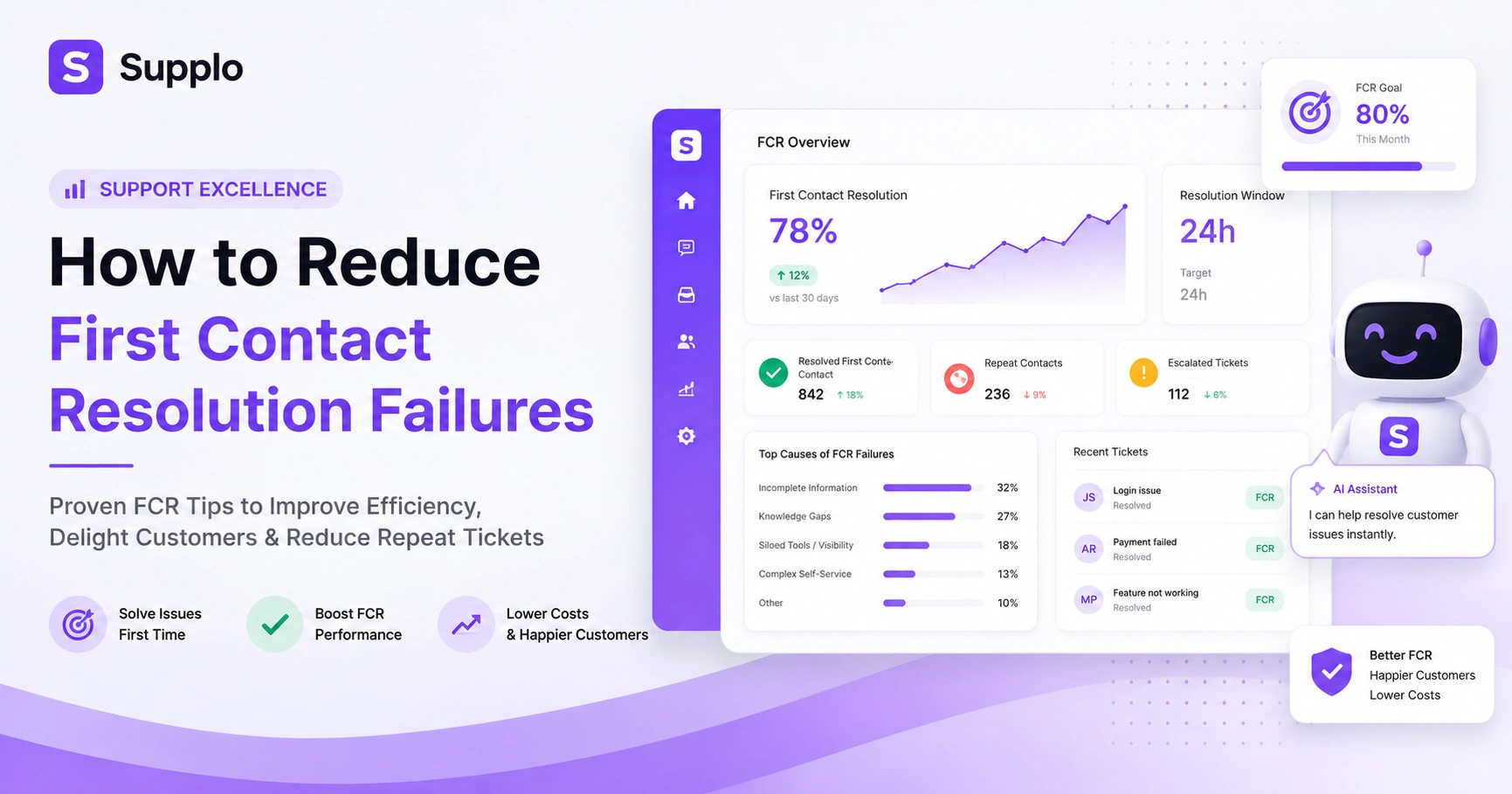
First Contact Resolution (FCR) is one of those metrics that tells you everything about your support team’s efficiency. It’s the percentage of customer issues that get solved in that very first interaction. When FCR fails, customers get frustrated, agents drown in repeat tickets, and your support costs balloon. This guide is for anyone running a support team who wants to reduce first contact resolution failures and build a smoother, faster experience.
Supplo is not affiliated with any app or website. Please follow each app's terms and local regulations.
Quick Answer
- Audit your knowledge base: Ensure agents have up-to-date, searchable information right at their fingertips.
- Empower agents: Give them the tools and authority to solve common issues without needing a manager’s nod.
- Use self-learning AI: Automate up to 80% of routine tickets while keeping a clean handoff to humans.
- Track repeat contacts: Focus on customers who come back within 24–48 hours; that’s your real FCR signal.
- Break down FCR by segment: Look at agent, channel, and ticket type to find exactly where things break.
Why First Contact Resolution Fails: The 7 Most Common Causes
First contact resolution fails when agents don’t have the right information, tools, or authority on that first interaction. The most common culprits? An incomplete knowledge base, agents who can’t see past conversation history, poorly designed self-service options, and missing cross-functional escalation paths. Fixing these root causes directly reduces first contact resolution failures.
- Incomplete or outdated knowledge base – Agents guess or escalate, which slows everything down.
- Siloed tools – Agents can’t see the full customer history across channels, so they end up asking the same questions again.
- Lack of agent empowerment – No permission to resolve common issues without a manager? That’s a delay.
- Overly complex self-service – An IVR or chatbot that misroutes customers from the start pushes them toward a second contact.
- Vague customer input – Poor intake forms make it hard for customers to explain their issues clearly.
- Ineffective training – Agents may lack the product knowledge or soft skills needed to resolve issues the first time.
- No cross-functional support – Issues that span departments can’t be resolved in one interaction if agents can’t quickly connect with the right internal teams.
How to Measure First Contact Resolution: The Only FCR Calculation You Need
FCR is simple math: divide the number of tickets resolved on the first contact by the total number of tickets handled, then multiply by 100. The trick is defining what first contact means across your channels; email threads, chat sessions, and phone calls all count differently. Use this formula to set a baseline before you try to improve things.
- FCR formula (Tickets resolved on first contact ÷ Total tickets) × 100.
- Consistent definition: Define first contact the same way across email, chat, phone, and social DMs.
- Exclusions: Don’t count follow-ups initiated by the customer for clarification; those aren’t FCR failures if the initial issue was actually solved.
- Channel-specific tracking: Track FCR by channel to identify your biggest pain points.
- Define a resolution window: 24 hours is a good default, but adjust based on your industry. A chat resolution might be immediate, while an email could take longer.
- Crucial insight: FCR isn’t just about closing tickets; it’s about resolving the customer’s issue so they don’t need to come back.
How to Analyze First Contact Resolution Failures with Data, Not Gut Feel
To analyze first contact resolution failures, you need to segment your FCR data by agent, channel, ticket category, and time of day. Look for patterns: are certain teams consistently nailing it? Are specific ticket types, like billing or technical support, the biggest sources of repeat requests? Use this structured approach to find the real problems.
- Segment by agent: See if training gaps or knowledge differences among agents are causing repeat contacts.
- Filter by ticket category: Identify if product bugs, policy gaps, or documentation issues are driving FCR failures for specific topics.
- Compare across channels: Analyze first contact resolution data across channels, like website chat versus WhatsApp, to understand unique challenges.
- Analyze the why: Use exit surveys or follow-up tags to understand the real reasons behind repeat contacts.
- Create dashboards: Build a weekly FCR dashboard that surfaces the top 3 causes of failure so you can act quickly.
Try measuring your FCR for free today.
Start with Supplo’s 14-day free trial, no credit card required. You’ll get a shared inbox, an AI agent, and real-time FCR tracking so you can see exactly where your first-contact resolution failures are.
First Contact Resolution Best Practices: Agent Training and Knowledge Access
The fastest way to improve first contact resolution is to give every agent immediate access to a searchable, curated knowledge base that includes past resolutions. Train agents to recognize when a customer’s issue spans multiple departments, and give them the authority to triage cross-functionally on the first call. These best practices cut the back-and-forth that kills FCR.
- Searchable knowledge base: Build one that agents can search in under ten seconds for any common issue.
- Active listening training: Teach agents to capture the real request on the first try, reducing misinterpretations.
- Empowerment thresholds: Let agents resolve billing, shipping, or technical issues up to a defined limit without needing manager approval.
- Role-play scenarios: Practice first-contact resolution scenarios in which the customer’s issue is vague.
- Shared team inbox: Use a shared inbox so agents can see the full conversation history before responding.
First Contact Resolution Strategies: Automation That Boosts FCR Instead of Breaking It
Bad automation, like chatbots that can’t hand off or email autoresponders that don’t confirm the issue, actually increases first contact resolution failures. Good automation pre-qualifies the customer, routes them to the right agent, and resolves known issues entirely on the first message. When you use automation to assist (not replace) human judgment, FCR improves dramatically.
- Self-learning AI agent: Use an AI agent that resolves up to 80% of common tickets automatically, handling routine queries instantly.
- Automated triage: Set up routing based on intent detection to minimize misrouting.
- Seamless handoff: Avoid dead-end chatbots that force customers to repeat themselves; ensure clean handoffs with summarized context.
- Selective automation: Automate post-resolution follow-ups only when the customer hasn’t responded in 48 hours, not as a blanket solution.
- AI-assisted responses: Use AI to draft responses that agents can approve with a single click, significantly reducing resolution time.
How to Track First Contact Resolution in Real-Time: KPIs That Actually Matter
First contact resolution KPIs should be tracked alongside CSAT, average handle time, and repeat contact rate, not in isolation. The most useful FCR metric is the repeat contact rate within 7 days, because it captures customers whose issues were technically resolved but weren’t actually satisfied. Track FCR at the agent and team level weekly to spot trends before they become problems.
- Combine FCR with CSAT: Catch false positives- tickets resolved, but customers are still unhappy.
- Monitor resolution stickiness: Track resolved on first contact versus resolved and closed to see if resolutions truly stick.
- Observe shift performance: Monitor FCR by shift to see if night or weekend coverage is causing more failures.
- Real-time dashboards: Use a real-time inbox dashboard that shows FCR per agent as they work.
- Realistic targets: Set FCR targets that make sense for your industry; 70–80% is strong; 90%+ is exceptional.
How to Identify FCR Failures Before They Hit Your CSAT Scores
You can identify first-contact resolution failures early by monitoring reopened tickets and follow-up tags within 24 hours of the first resolution. Customers who re-contact with a related issue are a clear sign that the original resolution was incomplete. Use this data to fix the root cause before the customer posts a negative review.
- Automated alerts: Set up alerts when a ticket is reopened within 24 hours of being closed.
- Proactive tagging: Tag tickets as likely FCR failure if the second contact mentions the same product or issue.
- Simple surveys: Survey customers after first-contact resolution with a straightforward question: "Did this solve your issue?"
- Channel-specific monitoring: Monitor channel-specific FCR; social DMs and Telegram often have higher failure rates than email.
- FCR reviews: Hold weekly 15-minute FCR reviews where agents share what went wrong in specific cases.
The Hidden Cost of Low First Contact Resolution And Why Your Support Budget Is Bleeding
Every first contact resolution failure costs you more than just a second ticket. It increases agent workload by 40–60% per repeat case, drives up average handle time, and erodes customer loyalty. When you reduce first-contact resolution failures, you’re not just improving a metric; you’re directly lowering your cost per contact and freeing up agents to handle more complex issues. The math is brutally simple: better FCR equals lower support costs.
- Cost of repeat contact: Calculate the hidden cost, often double the original handle time.
- Increased ticket volume: Low FCR can increase overall ticket volume by 30–50% as customers try different channels.
- Customer churn link: Customers who don’t receive first-contact resolution are 4x more likely to churn, which impacts long-term revenue.
- Legacy pricing structures: Per-seat pricing tools make FCR failures even more expensive.
- Flat-rate advantage: Flat-rate pricing, like Supplo’s $0.04 per AI resolution, removes the cost penalty for extra contacts generated by unresolved issues.
If your FCR is stuck below 60%, you’re bleeding money.
Stop paying per-seat for tools that don’t fix the root cause. Supplo’s AI agent resolves common issues at $0.04 per resolution, and our flat workspace pricing means your support bill doesn’t explode as your team grows.
How to Increase First Contact Resolution with a Self-Learning AI Agent
A self-learning AI agent that draws on your knowledge base and past resolved conversations can handle the most common first-contact resolution failures entirely on autopilot. It resolves known issues in seconds, learns from new ones, and hands off to a human with full context when it can’t. This is the most practical way to increase first contact resolution without adding headcount or burning out your team.
- Automated issue resolution: The AI agent resolves common repeat issues (password resets, order status, and refund policies) instantly.
- Continuous learning: It learns from every conversation, so its FCR capabilities improve over time.
- Multilingual support: Inline translation lets you support customers in any language from the first message, great for global teams.
- Unified multichannel support: AI handles requests across email, WhatsApp, Telegram, Instagram DMs, and Facebook Messenger within a single widget.
- Clean human handoff: The AI provides a summary of what was already tried, so the human agent can jump in without repeating questions.
First Contact Resolution Data: What to Audit Weekly, Monthly, and Quarterly
To sustain high first-contact resolution, audit your FCR data at three cadences. Weekly: check which ticket categories are driving repeat contacts and which agents need coaching. Monthly: review your FCR calculation against CSAT scores to spot false positives. Quarterly: refresh your knowledge base and AI training data to cover new products or policies that caused failures.
- Weekly Audit: Focus on the top 5 ticket types with the lowest FCR and individual agent-level FCR trends to address immediate issues.
- Monthly Review: Conduct FCR by channel comparisons and analyze the correlation between FCR and CSAT/NPS to understand customer sentiment.
- Quarterly Deep Dive: Perform a full knowledge base audit, refresh AI agent training data, and review escalation paths to adapt to business changes.
- Training Effectiveness: Track FCR for new hires versus experienced agents to measure the effectiveness of your training programs.
- Investment Justification: Use first contact resolution data to justify investments in self-service tools or AI automation projects.
Get ongoing access to FCR improvements that actually work.
Join thousands of support teams using Supplo to reduce first contact resolution failures, boost CSAT, and cut support costs. Start your 14-day free trial today- no tricks, no hidden fees, just better support.
FAQ
What is the standard FCR calculation formula?
FCR = (Tickets resolved on first contact ÷ Total tickets handled) × 100. A resolved ticket means the customer didn’t re-contact about the same issue within 24 hours (or whatever window you define).
What is a good first contact resolution rate?
Industry benchmarks range from 60% to 80%. For most B2B SaaS companies, 70–75% is a solid range. Anything above 80% is exceptional and usually requires a mix of strong agent training, a good knowledge base, and AI automation.
Why does my FCR rate keep dropping even though agents are working faster?
Speed often kills FCR. If agents rush to close tickets without fully understanding the issue, customers will come back. Focus on accuracy over speed, and use AI to handle simple tickets so agents can take time on complex ones.
Which channels have the lowest first contact resolution rates?
Social media DMs (Instagram, Facebook Messenger) and chat tend to have lower FCR because customers often give incomplete information. Email and phone typically have higher FCR because customers are more descriptive in their responses.
How can I identify first-contact resolution failures without a dedicated tool?
Manually tag tickets as reopened or follow-up, and check the percentage of tickets with multiple conversations within 7 days. It’s rough but effective.
Can AI improve first contact resolution, or does it make it worse?
AI improves FCR when it’s well-trained and hands off cleanly to humans. It worsens FCR when it’s a dead-end chatbot that forces customers to repeat themselves. A self-learning AI agent that resolves common issues and summarizes context for handoffs is the best approach.
What’s the fastest way to increase first contact resolution in 30 days?
Audit your knowledge base for gaps, train agents on the top 5 reasons for repeat contacts, and implement an AI agent that learns from these common issues to handle them automatically. Most teams see a 10–15 point FCR improvement in the first month.
Compliance line: Supplo is not affiliated with any app or website. Please follow each app's terms and local regulations.