On this page
Picture this, your support process is a relay race. When the baton pass is clean, the team wins, and the customer walks away happy. But a fumbled handoff? That's where delays creep in, frustration builds, and suddenly you're not just losing a race, you're losing a customer. Getting best practices for customer support handoffs right isn't just about efficiency. It's about maintaining trust and keeping your brand's reputation solid.
This guide is for anyone looking to tighten up their support operations, reduce customer friction, and give agents the tools they need to deliver consistent, quality service. We'll dig into strategies, checklists, and tools that turn handoffs from weak spots into powerful moments of connection.
Supplo is not affiliated with any app or website. Please follow each app's terms and local regulations.
Quick Answer
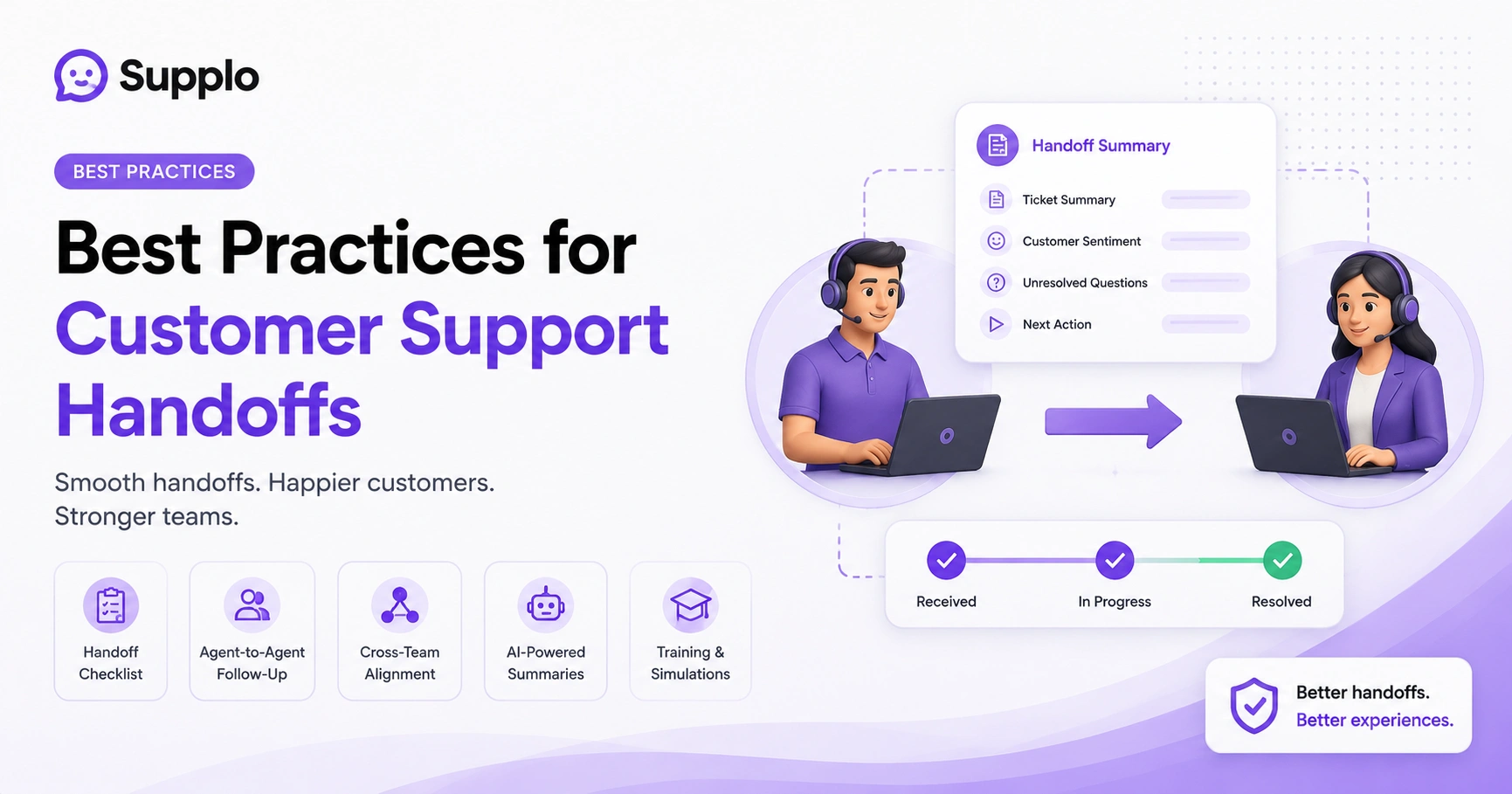
- Use a mandatory handoff checklist so critical context (summary, sentiment, next action) never gets lost.
- Set up agent-to-agent follow-up protocols, think 5-minute verbal overlaps or structured internal notes.
- Create a shared ontology for inter-team handoffs (Sales, Support, CS, Tech) so everyone speaks the same language. Let AI handle initial conversations and summarize interactions before escalating to human agents.
- Run regular handoff training and simulations to help agents handle transfers smoothly under pressure.
Why Seamless Support Handoffs Are the New Reliability Benchmark
Here's the thing: customers don't care which team you work for. They want their problem solved. Every time you transfer a ticket without context, you're chipping away at their trust. Seamless handoffs aren't nice-to-have anymore. They're the clearest signal of internal reliability your customers will ever see. Nail the pass, and the customer feels like they're talking to one smart company, not three confused departments.
The cold transfer problem, where customers have to repeat themselves, is hands-down the biggest satisfaction killer. Reliability here means zero information loss. The customer's account history, their intent, their emotional state, all of that should travel with the ticket. Think of handoffs as your brand's trust checkpoint. A smooth one builds confidence. A bumpy one? That's when customers start looking at competitors. According to recent CX trends, 73% of customers will switch after multiple bad experiences.
A unified inbox helps here. It consolidates all customer interactions into a single thread, so context never gets lost during transfers. Supplo's shared inbox ensures that every agent can see the full conversation history, regardless of which channel the customer used.
The Customer Support Handover Checklist: 5 Steps You Can't Skip
You need a repeatable, documented handover checklist. Otherwise, your team is just winging it. Every transfer should include: a ticket summary, customer sentiment, unresolved questions, and the next expected action. Without this, you're gambling on the next agent's memory. Treat it like a pre-flight checklist, boring, sure, but it saves the flight.
Here's what every handover needs:
- Capture the 'why' of the handoff: Be clear about why you're transferring- escalation, shift change, need for specialized expertise.
- Sync the customer's emotional state: Note if they're frustrated, confused, urgent, or calm. This sets the tone for the next agent.
- Attach the last 3 interactions, even the older ones, as they provide crucial context for the new agent.
- Set a clear expectation for the customer: Tell them about the transfer, who's taking over, and roughly when (Sarah will pick this up in 10 minutes)
Confirm the receiving agent has acknowledged: Make sure the new agent has actively taken ownership and that no tickets are falling through the cracks.
AI can automate a lot of this. An AI agent can auto-populate summaries, flag sentiment, and even suggest the next best action. That way, no crucial step gets missed during a handover.
Agent-to-Agent Best Practices: The Follow-Up Protocol That Actually Works
The real test of a handoff isn't the transfer itself. It's the follow-up. Agents should have a mandatory 5-minute overlap to verbally confirm the ticket's state, or use an internal note system that feels like a conversation. The best follow-up protocol is simple: I read the notes, I own the ticket, and I'll check back in 30 minutes.
Avoid the ping-pong handoff. If the ticket comes back to the original agent, that's a failure of the transfer process. Always use internal notes instead of direct messages; that keeps the entire history searchable and accessible. Implement a follow-up timer rule: the new agent has to send a proactive update within 30 minutes of receiving the transfer.
Email ticketing systems that preserve the full thread of communication, including internal notes, are essential here. It keeps everyone accountable and ensures nothing gets lost.
Improving Agent-to-Agent Handoffs: Stop the Pressure Drop Between Teams
The pressure drop happens when an agent spends 20 minutes building rapport, then hands off to someone who starts from zero. To fix this, your CRM or helpdesk needs to pass the conversation's tone and urgency alongside the data. Don't just transfer the ticket, transfer the trust.
Train agents to write handoff notes like they're handing over a live grenade: clear, concise, and urgent. They should convey not just facts but also the customer's emotional context. Use a shared internal glossary for sentiment tags (ANGRY, CONFUSED, VIP) to standardize communication. And keep an eye on the re-answer rate; if customers keep repeating themselves, your handoff process is broken.
A solid knowledge base acts as a single source of truth for agents. It reduces pressure drop by providing everyone with consistent information and a shared understanding across the team.
Efficient Support Ticket Handoffs: The Right Data to Pass Every Time
You don't need to pass the entire conversation history. You need to pass the signal. The minimum viable handoff data set: customer name, problem summary, attempted solutions, and the customer's preferred channel. Everything else is noise. Efficient handoffs are short, structured, and ready for the next agent to act on.
Use a mandatory handoff card template, pre-filled by your tool, to keep things consistent. Make sure to state the next action explicitly, such as "The customer is waiting for a refund." You need to approve it. And include the customer's timezone and preferred communication method (email vs. chat) so follow-ups feel personal.
Our website chat widget captures essential customer data before chat, streamlining the handoff process by giving agents immediate, relevant context.
Best Practices for Inter-Team Support Handoffs: Sales, Support, CS, Tech
Inter-team handoffs are the trickiest because every team speaks a different language. Sales talks about deals. Support talks about tickets. CS talks about retention. The fix? A shared ontology. Define a handoff trigger for each scenario. A customer asking for a demo is a sales handoff. Customer reports a bug during a tech handoff. Document it. Enforce it.
Here's how to manage inter-team handoffs effectively:
- Sales to Support: Handoff when the customer needs post-purchase assistance, not for pre-sale inquiries
- Support to CS: Handoff when a customer shows a high risk of churning or has high lifetime value, requiring proactive engagement
- Tech to Support: Handoff when a technical fix is deployed, so the support agent can communicate the resolution and close the loop.
A unified inbox system, like Supplo, helps break down these silos. It enables seamless communication and context sharing across departments, unlike fragmented legacy systems.
Technical Support to Customer Success Handoffs: A Blueprint for Retention
The tech-support-to-CS handoff is high-stakes. The customer is often frustrated and considering cancellation. The handoff must include the issue's root cause, the fix applied, and a recommendation for proactive outreach. CS should follow up within 24 hours, not to sell, but to make sure the fix worked and rebuild trust.
The technical support's job during this handoff is to document the exact technical resolution clearly. Customer success's role is to reframe that resolution as a value-add: We fixed this, and here's how it's better now. Use a handoff score (1-5) to gauge the customer's likelihood to stay engaged and their retention risk.
Legacy tools often struggle with integrated workflows and transparent pricing. Supplo's per-resolution pricing offers a practical, transparent alternative, making it easier to manage costs associated with high-stakes retention efforts compared to traditional seat-based models.
Sales to Support Handoffs: Don't Lose the Context at the Baton Pass
The sales-to-support handoff is where most companies lose the white-glove feeling. A sales rep promises the world; support has to deliver it. The handoff must include the sales notes, the promised features, and the customer's urgency level. If the support agent doesn't know what was promised, they'll under-deliver, and the customer will feel duped.
Sales teams need to accurately tag the deal stage (won, pending, trial) within the handoff notes. Support agents should review those notes before contacting the customer; no one likes repeating themselves. Create a promise tracker in your CRM: We promised a 24-hour response time; don't break it.
Transparent pricing models from the start help sales teams set accurate expectations, preventing miscommunications that lead to friction during handoffs.
You've got the checklist. Now get the tool that makes it stick. Supplo's unified inbox and AI agent automate the handoff so you never lose context again. Start your 14-day free trial, no credit card required.
→ Start Free Trial at supplo.io
Streamlining Internal Support Processes: The Tools That Make It Stick
You can't streamline handoffs with a manual spreadsheet. You need a shared inbox that automatically surfaces the right context. Use tools that consolidate email, live chat, WhatsApp, Telegram, Instagram, and Facebook Messenger into one thread, so the handoff is just a tag change, not a file transfer. The goal is zero friction.
Choose a tool that supports internal notes and private agents to keep handoff discussions confidential and separate from the customer view. Automate handoff triggers, like Customer mentions 'billing' = route to finance team, to ensure rapid, accurate transfers. And audit your handoff process monthly. Look for tickets that bounced between three or more agents; that's a sign of a systemic issue.
Supplo unifies multiple communication channels, including Instagram DMs and Telegram Support, into a single thread-based inbox. That makes multichannel coordination effortless and handoffs seamless.
Customer Service Transfer Protocols: What Happens When the AI Handles It
AI can own the first 80% of a conversation, but it needs to hand off cleanly to a human when it hits its limit. Your transfer protocol should define exactly when the AI escalates, when sentiment spikes, when repeated questions occur, when sensitive topics arise, and when to pass the full transcript, including the AI's attempted answers. The human shouldn't have to re-ask the question.
Define a clear AI handoff threshold. For example, three failed attempts to answer or a customer sentiment score below 2/5. When AI escalates, it should summarize its efforts: I tried X, Y, and Z. The customer is still frustrated. Always include a customer intent tag, such as "This is a refund request, not a technical question," to guide the human agent.
Supplo's AI agent is built to resolve up to 80% of tickets automatically, then hand off cleanly to your team with complete context when human intervention is needed.
Smoother Team-to-Team Support Transfer: Training Your Agents for the Pass
The smoothest transfer protocol fails if your agents aren't trained to use it. Run handoff drills. Simulate a ticket that needs to pass from support to tech to CS. Train agents to write handoff-ready notes that assume the next person has zero context. The goal is to make the transfer feel like a handoff, not a handover.
Implement a handoff simulation during agent onboarding. Give new hires a ticket and ask them to pass it within three minutes. Train agents to avoid saying I don't know and instead guide the customer with phrases like Let me connect you with Sarah, who can help with that. Establish a handoff feedback loop in which the receiving agent rates the handoff quality (1-5) to encourage continuous improvement.
Internal Ticket Escalation Process: When To Move Up, Not Out
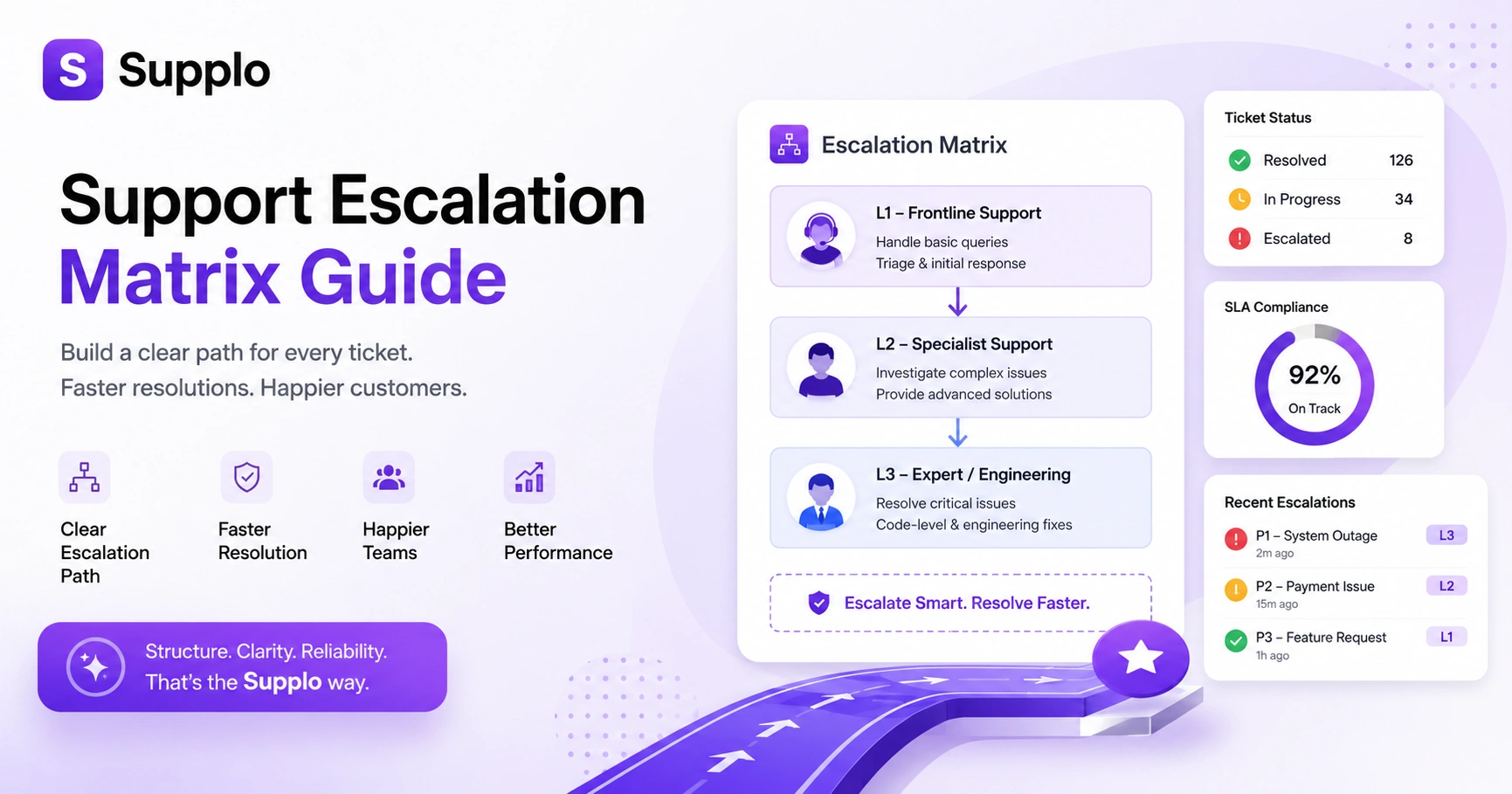
Escalation isn't a failure; it's a protocol. Define clear escalation tiers: Tier 1 (agent), Tier 2 (team lead), Tier 3 (product expert). The rule: escalate when the agent can't resolve within 15 minutes, or when the customer explicitly asks for a manager. Document the escalation path so the customer knows who's next and why.
Don't escalate to a manager unless the current agent has attempted at least two resolution paths. The escalation note must include three critical pieces of information: What the agent tried, what the customer asked for, and the desired outcome. Monitor your time-to-escalate metric. If it consistently takes longer than 20 minutes, your process needs to be re-evaluated.
WhatsApp customer support threads can be seamlessly escalated within a unified inbox, preserving the entire conversation history and ensuring no context is lost during the transfer.
If Your Handoff Keeps Failing, It's the Tool. Manual handoffs are error-prone. Supplo's AI handles the first 80% of tickets, summarizes the conversation, and hands it off to a human with full context, at a flat $0.04 per resolution. Try it risk-free for 14 days.
Reliable Handoffs Start Here. You can't afford to lose customers to a bad transfer. Supplo gives you the AI, the inbox, and the multichannel support you need to make every handoff seamless. Pricing is flat per workspace, not per seat, so your bill doesn't balloon. Plus, you can pay via Crypto, Binance Pay, Payeer, GCash, and more. Try it free today.
Key Takeaways
- Handoffs are reliability benchmarks: They're visible indicators of internal process health and directly impact customer trust.
- Context is critical: Never transfer a ticket without the customer's history, sentiment, and clear next steps. Use checklists and mandatory fields.
- Inter-team alignment is essential: define shared vocabulary and handoff triggers across departments to prevent confusion.
- AI augments, not replaces: Leverage AI for automated summaries, routing, and handling initial inquiries, ensuring human agents receive full context for complex cases.
- Continuous training and tools matter: Regularly train agents on handoff protocols and use tools that centralize communication channels for seamless transitions.
FAQ
What is a customer support handoff, and why does it matter?
A support handoff happens when a ticket is transferred from one agent or team to another. It matters because a bad handoff forces the customer to repeat themselves, which damages trust and satisfaction. A good handoff preserves context and speed.
How do I create a customer support handover checklist?
Start with five fields: ticket summary, customer sentiment, attempted solutions, next action, and customer's preferred channel. Document it as a template in your helpdesk, and enforce it with a mandatory field rule. Every agent must fill it before they can transfer.
What is the best protocol for inter-team support handoffs?
Use a shared ontology: define what triggers a handoff (e.g., billing question = finance, bug report = tech). Then, pass the ticket with the customer's intent tag and a summary of what's been tried so far. The receiving team should acknowledge the transfer within 5 minutes.
How do I improve agent-to-agent handoffs during shift changes?
Implement a 5-minute overlap where the outgoing agent can verbally brief the incoming agent. Alternatively, use a handoff note that includes the customer's emotional state and a next action field. Avoid leaving a ticket mid-conversation; wrap it up or flag it.
What data should be included in an efficient support ticket handoff?
The minimum dataset includes: customer name, problem summary, attempted solutions, customer sentiment, and the next expected action. Include the customer's time zone and preferred channel, if available. Don't dump the entire history, just the signal.
How do I handle technical support handoffs to customer success?
Tech support should document the root cause and the fix. Customer success should then follow up within 24 hours to confirm the fix worked and rebuild the relationship. The handoff note should include a retention risk score (1-5).
Can AI help with customer support handoffs?
Yes. AI can automate the handoff by summarizing the conversation, tagging the customer's intent, and routing the ticket to the right team. It can also handle the first 80% of a conversation and hand it off to a human only when necessary. Supplo does this with a flat $0.04 per AI resolution.
Compliance line: Supplo is not affiliated with any app or website. Please follow each app's terms and local regulations.