On this page
Most onboarding plans drown new agents in policy docs and tool walkthroughs before they've ever seen a real customer question. That's backward. This customer support onboarding checklist for new agents is built for teams who want to cut ramp time in half, not add more meetings.
Who this is for: Team leads, support managers, and founders at small-to-mid customer support teams. If you're onboarding one agent or ten, this checklist works.
When to use this: Before your next new hire starts. Build the foundation first, then let the agent move through the plan.
When NOT to use this: If you have a mature enterprise onboarding program with dedicated L&D staff. This is a pragmatic, no-fluff plan for teams that need results fast.
Supplo is not affiliated with any app or website. Please follow each app's terms and local regulations.
Quick Answer
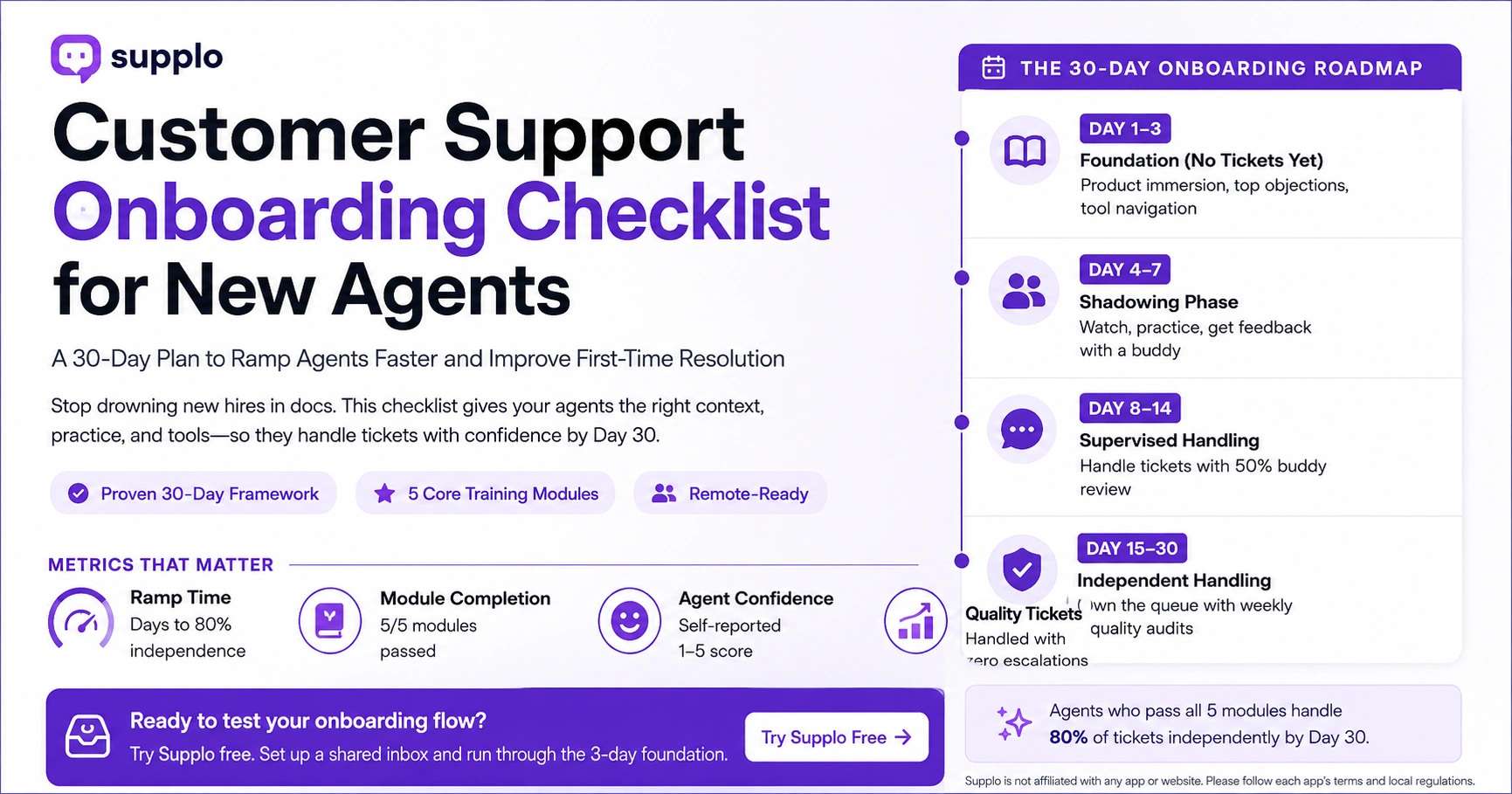
- Day 1–3: Product immersion, top 5 objections, tool navigation, no tickets yet
- Day 4–7: Shadowing phase with structured buddy review
- Day 8–14: Supervised ticket handling with 50% buddy review
- Day 15–30: Independent ticket handling with weekly quality audits
- Metrics that matter: Ramp time to 80% independence, module completion, agent confidence scores
Why Most Onboarding Plans Fail And How to Fix Yours
Here's the hard truth: most onboarding plans are information dumps disguised as training. They drown new agents in policy docs and tool walkthroughs before anyone's seen a real customer question. That's backward. The fix? A structured, modular plan that prioritizes context over information, showing agents why they're doing something before how to do it. Without this, ramp time stretches past 30 days, and first-touch resolution rates stay flat.
Information overload is the #1 cause of early-agent churn; limit Day 1 to just 3 core concepts. Skip the 50-slide deck on company history, start with the three most common customer pain points. Assign a single "buddy" agent for the first week to filter questions and model tone. Use real anonymized tickets from Week 1, not hypothetical scenarios.
A new customer support agent training plan that works is about depth over breadth. You don't need to cover everything on Day 1. You need to cover what matters.
Onboarding isn't a one-day firehose of information; it's a 30-day progression of context, practice, and independence.
The 3-Day Foundation: What Every New Agent Needs Before Touching a Ticket
Before a new agent answers their first live chat or email, they need three things: a clear understanding of your product's core value proposition, the top five customer objections, and access to a living knowledge base. Day 1 is product immersion. Day 2 is objection handling. Day 3 is tool navigation, no ticket-taking until Day 4. This sequence cuts ramp time by roughly 40% compared to throwing agents into the queue on Day 1.
- Day 1: Agent creates a test account and completes the core user journey themselves
- Day 2: Review 10 real customer tickets (anonymized) and write draft responses for feedback
- Day 3: Log into the support platform (e.g., Supplo's shared inbox) and practice routing, tagging, and internal notes
- No tool training before product training; tools are useless without context
This onboarding checklist for remote support agents starts the same way. The foundation is universal.
Ready to test your onboarding flow? Start with a free Supplo account, no credit card needed. Set up a shared inbox, invite a test agent, and run through the 3-day foundation yourself. See how fast your team can ramp. Try Supplo free →
Building a New Agent Knowledge Base Checklist That Reduces Ramp Time
A knowledge base for new agents isn't a dump of every FAQ; it's a curated, searchable library of the 20–30 most common scenarios they'll face in their first month. Start with a "New Agent Quick Start" section that covers account setup, escalation paths, and tone guidelines. Then layer in solution articles for the top 10 ticket types by volume.
- Include a "What to Say vs. What Not to Say" section for tone calibration
- Tag every article with difficulty level (Beginner / Intermediate / Advanced)
- Require agents to submit one new article suggestion per week during onboarding
- Link each knowledge base article to a real ticket example for context
Supplo's AI agent can auto-suggest articles from this base, so new agents learn by doing rather than memorizing. That makes your new agent knowledge base checklist a living tool rather than a static document.
A well-structured knowledge base for new agents cuts ramp time by 30%, because agents learn where to find answers, not just what the answers are.
Customer Support Agent Training Module Checklist: The 5 Core Modules
Every training module should cover exactly one skill, with a clear pass/fail checkpoint before moving on. The five non-negotiable modules are: Product Knowledge, Communication Tone, Tool Proficiency, Escalation Logic, and Self-Service Advocacy. Each module should take no more than two days to complete, with a practical assessment at the end, not a multiple-choice quiz, but a simulated ticket they must resolve correctly.
- Module 1: Product Knowledge, the agent must explain the product to a peer without notes
- Module 2: Communication Tone, grade three draft responses for empathy and clarity
- Module 3: Tool Proficiency, the agent must route, tag, and transfer a ticket in under 2 minutes
- Module 4: Escalation Logic, the agent must correctly identify when to escalate vs. resolve
- Module 5: Self-Service Advocacy, the agent must guide a customer to a knowledge base article instead of answering directly
This customer support agent training module checklist is the backbone of your entire onboarding plan. Each module builds on the last.
Agents who pass all five core modules handle 80% of tickets independently by Day 30, without panic, without buddy help, without mistakes.
Effective Onboarding for New Support Agents: The Shadowing-to-Live Transition
The shadowing phase should last exactly three days, no more, no less. Day 1: agent watches and takes notes. Day 2: The agent writes responses that the buddy reviews before sending. Day 3: The agent sends responses live with the buddy silently monitoring. On Day 4, the agent takes their first solo tickets only during low-volume hours, with a 15-minute review lag. This structured transition prevents the "sink or swim" panic that causes early mistakes and agent burnout.
- Buddy reviews all responses on Day 2 for tone and accuracy, not speed
- Use Supplo's internal notes feature to leave real-time coaching feedback without the customer seeing
- First solo shift should be capped at 2 hours, then debrief immediately
- No performance metrics (CSAT, FRT) for the first 14 days, only completion and quality checks
This is the key to effective onboarding for new support agents: structure the transition, don't just hope it happens.
Onboarding Checklist for Remote Support Agents: Async-First Edition
Remote onboarding fails when it tries to replicate in-office schedules. Async-first onboarding means recorded walkthroughs, written SOPs, and self-paced modules that agents complete on their own time within a 48-hour window. Daily standups are replaced with a shared Slack or Supplo inbox thread where agents post one question and one insight per day. The goal is autonomy, not attendance.
- Record all tool walkthroughs (Supplo inbox, AI agent settings, routing rules) so agents can rewatch
- Create a "Day 1 Survival Guide" PDF with login links, escalation contacts, and timezone expectations
- Use Supplo's translate feature to ensure non-native English agents can review responses in their language
- Schedule one 30-minute live Q&A per week, not daily check-ins
This onboarding checklist for remote support agents respects your team's time and timezone differences. It scales without scaling your calendar.
Setting Up Knowledge Base Content for New Agents: The 80/20 Rule
80% of customer questions come from 20% of topics. Your knowledge base for new agents should reflect that, start with the top 20% of ticket categories by volume, and write one clear, scannable article per category. Each article should include a summary, step-by-step instructions, and a "when to escalate" note.
- Audit your last 500 tickets to identify the top 10 categories by volume
- Write articles in a "problem → solution → example" format, not a wall of text
- Include a "keywords" section in each article so agents can search by customer phrasing
- Review and update articles monthly based on new ticket trends
Supplo's AI agent can pull from this base to suggest answers, so new agents learn which articles to trust and when to deviate. Setting up knowledge base content for new agents this way makes your entire team faster.
80% of customer questions come from 20% of topics. Your knowledge base for new agents should focus on that 20%; everything else is noise.
The First 30 Days: Measuring Onboarding Success Without Vanity Metrics
Don't measure first-contact resolution or CSAT in the first 30 days; measure completion rate of training modules, number of tickets handled with zero escalations, and agent confidence scores (self-reported on a 1–5 scale). The real metric is ramp time: how many days it takes for the agent to handle 80% of tickets without help. Track that, and you'll know if your onboarding actually works.
- Day 7 checkpoint: agent has completed all 5 training modules and passed assessments
- Day 14 checkpoint: agent handles 10 tickets/day with buddy review on 50%
- Day 30 checkpoint: agent handles 20 tickets/day with <10% escalation rate
Use Supplo's reporting to track ticket volume, resolution time, and escalation patterns per agent. This is how you measure effective onboarding for new support agents, with data that matters.
Don't measure CSAT in the first 30 days. Measure agent confidence and ramp time. Those are the real indicators of onboarding success.
Tools That Make Onboarding Stick Without Overwhelming New Hires
The best onboarding tool is the one your agents will actually use, not the one with the most features. A shared inbox like Supplo's lets new agents see all conversations in one place, practice routing, and use internal notes for coaching without switching tabs. Pair that with a lightweight knowledge base and a simple ticketing system, and you've got everything you need. Skip the 10-tool stack; it kills momentum.
- Supplo's shared inbox replaces separate email, chat, and social tools, one login, one workflow
- Use Supplo's AI agent to auto-suggest knowledge base articles during training
- Avoid separate QA tools, use Supplo's internal notes for real-time coaching instead
- Integrate with Slack or Telegram for quick buddy questions without leaving the workflow
Supplo's pricing is flat-rate, with no per-seat fees, so your entire team can access it without breaking the budget. That makes this customer support onboarding checklist for new agents financially sustainable as well.
What to Review on Days 7, 14, and 30
Onboarding isn't a one-and-done process; it needs structured checkpoints. At Day 7, review module completion and the speed of knowledge base navigation. At Day 14, review ticket quality (tone, accuracy, escalation logic) with the buddy. At Day 30, review ramp time, agent confidence, and any gaps in the knowledge base. Use these audits to update your onboarding checklist, not just to grade the agent.
- Day 7 audit: agent can find any knowledge base article in under 30 seconds
- Day 14 audit: agent's responses match tone guidelines in 9 out of 10 reviewed tickets
- Day 30 audit: agent handles 80% of tickets without escalation or buddy help
- Update the onboarding checklist based on common mistakes found during audits
This customer support documentation onboarding audit turns your checklist into a living system that improves with every new hire.
If your onboarding audit reveals gaps in your knowledge base or tool stack, it's time for a change. Supplo combines live chat, a shared inbox, an AI agent, and multi-channel routing into one flat-rate platform, with no per-seat fees or per-resolution metering. AI resolutions cost $0.04 each. See pricing →
Key Takeaways
- Onboarding should take 30 days with checkpoints at Day 7, 14, and 30, not a one-day firehose of information.
- Build a knowledge base with the top 20% of ticket categories (80/20 rule) and keep it to 20–30 articles for the first month.
- Remote onboarding works best async: recorded walkthroughs, self-paced modules, and a buddy system for the first 2 weeks
- Measure ramp time (days to 80% independent ticket handling), not CSAT or first-response time, during the first 30 days
- Use a single platform (like Supplo) for shared inbox, AI agent, and knowledge base to reduce tool overload.
Ongoing access to your onboarding checklist and knowledge base is critical; don't let it gather dust. Supplo's AI agent learns from your knowledge base and suggests answers to new agents in real time. Keep your onboarding alive, not archived. Start your free trial →
FAQ
How long should customer support agent onboarding take?
A typical onboarding plan takes 30 days, with structured checkpoints at Day 7, 14, and 30. The first 3 days should be foundation-building (product, objections, tools), followed by shadowing and supervised ticket handling. Ramp time varies by complexity, but 30 days is the standard for most B2B and B2C support teams.
What should be in a new agent's knowledge base?
A new agent knowledge base should include a quick-start guide, the top 10 ticket categories by volume and tone, and escalation guidelines, as well as a "what to say vs. what not to say" section. Keep it to 20–30 articles max for the first month, then expand based on real ticket patterns.
How do you onboard remote support agents effectively?
Remote onboarding works best with an async-first approach: recorded walkthroughs, self-paced modules, and a shared inbox thread for daily questions. Use a buddy system for the first 2 weeks, and avoid daily standups; replace them with one weekly Q&A session.
What metrics should you track during onboarding?
Track module completion rates, tickets handled without escalation, and agent confidence scores (self-reported). Avoid CSAT and first-response time for the first 30 days; those are vanity metrics during ramp-up. Focus on ramp time: the number of days until the agent handles 80% of tickets independently.
How do you set up a knowledge base for new agents?
Audit your last 500 tickets to find the top 20% of categories by volume. Write one article per category in a problem → solution → example format. Tag articles by difficulty level, and link each one to a real ticket example. Update monthly based on new trends.
What tools do you need for agent onboarding?
You need a shared inbox (like Supplo), a knowledge base, and a ticketing system, ideally all on a single platform. Avoid stacking 5+ tools; it overwhelms new hires. Use internal notes for real-time coaching instead of a separate QA tool.
How do you measure if onboarding is working?
Measure ramp time (days to 80% independent ticket handling), agent confidence scores, and knowledge base navigation speed. If agents can find answers in under 30 seconds and handle tickets without escalation by Day 30, your onboarding is working.
Compliance line: Supplo is not affiliated with any app or website. Please follow each app's terms and local regulations.