On this page
Intent detection in customer support AI is the ability of artificial intelligence to automatically understand a customer's underlying goal or need from their message. It's designed for businesses aiming to automate and streamline their customer service operations, providing quicker, more accurate responses.
You should use intent detection in customer support AI for high-volume, repetitive customer inquiries that can be automated, allowing your human agents to focus on complex issues. It may not be suitable for businesses with extremely low ticket volumes or highly specialized, non-repetitive customer interactions.
Quick Answer
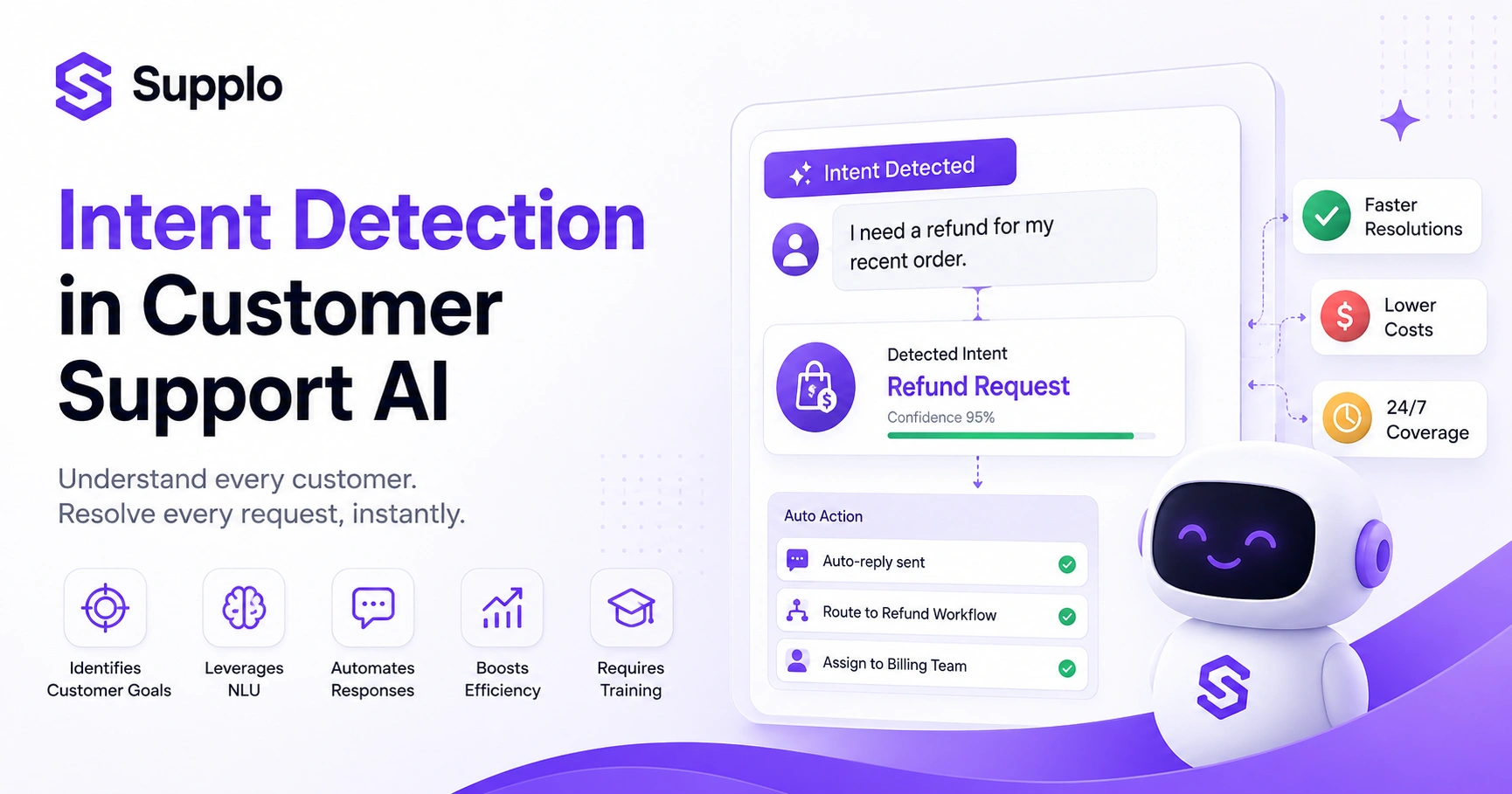
- Identifies Customer Goals: Automatically understands what a customer wants from their message (e.g., a refund or a password reset).
- Leverages NLU: Uses Natural Language Understanding to process language, context and sentiment.
- Automates Responses: Routes requests to the correct workflow, auto-replies, or assigns to the appropriate agent.
- Boosts Efficiency: Reduces response times, improves resolution rates and lowers support costs.
- Requires Training: Effectiveness improves with training on your specific support conversation data.
What is Intent Detection in Customer Support AI?
Let's get straight to it. Intent detection is the AI's ability to automatically determine what a customer wants as soon as they type a message. Instead of a human scanning every word, the AI analyzes language, context and sentiment to classify requests such as a refund request, a password reset, or a shipping question. It's the mechanism that moves support from a reactive queue to a proactive, self-solving system.
Think about it this way. A customer types "I can't log in," and the AI instantly routes them to a password reset flow. That's intent detection in action. This process relies on Natural Language Understanding (NLU) and machine learning models trained on thousands of support conversations. It allows you to automate repetitive tickets without forcing customers to navigate clunky IVR menus. The AI learns from your existing knowledge base and past interactions to enhance its accuracy.
How Does Customer Support AI Detect Intent?
The process is surprisingly straightforward. First, the AI tokenizes the customer's message, breaking it into individual words and phrases. Second, it runs those tokens through a trained model that compares them against known intents and their associated keywords (e.g., cancel, refund, charge). Finally, the AI agent scores the most likely intent and routes the ticket to the correct workflow or agent, often in under a second.
Here's a breakdown
- Input & Tokenization: The customer's message is cleaned and split into analyzable parts. This initial processing is crucial for the AI's understanding.
- Model Matching: The AI matches the tokens against a predefined intent library. This often involves assigning a confidence score (e.g., 95% sure this is a billing issue) using machine learning models.
- Action & Routing: Based on the identified intent, the AI can then auto-reply, trigger an automated workflow, or assign the ticket to the right human agent.
The 5 Core Benefits of Intent Detection AI Customer Support
The advantages are practical and measurable. First, it slashes first response time from minutes to milliseconds. Second, it reduces the workload of human agents by handling up to 80% of simple, repetitive questions. Third, it supercharges your existing knowledge base by guiding customers to the exact article they need. Fourth, it improves customer satisfaction by eliminating the frustration of having to repeat yourself. And fifth, it provides a clear, data-driven roadmap for your team's training and resource allocation.
Here are the core benefits in detail:
- Faster Resolutions: The AI answers common questions before a human even reads the ticket, delivering instant customer satisfaction.
- Lower Costs: Automation handles a significant portion of inquiries, meaning you pay for AI resolutions, not human hours spent on basic tasks like password resets.
- 24/7 Coverage: Intent detection works around the clock, providing uninterrupted support regardless of time zones or holidays.
- Consistent Language: The AI applies the same logic and brand voice to every ticket, ensuring uniform responses.
- Actionable Data: You gain insights into exactly what customers are asking for most, helping you refine your products and services.
Why Use AI for Customer Intent? The Business Value of AI Intent Analysis
The business value comes down to three things: cost, speed and scalability. An AI that can detect intent doesn't just answer questions; it prevents your inbox from overflowing during peak hours. It turns your support team from a reactive cost center into a proactive growth engine that can handle 10x the volume without hiring 10x the people. When competitors are making customers wait, you're providing instant answers.
Key aspects of its business value include:
- Scalability: Effortlessly handle sudden surges in customer inquiries, like during holiday sales, without needing to hire seasonal staff.
- Cost Control: With tools like Supplo, you pay a flat $0.04 per resolution, not a per-seat fee that balloons as your team grows, helping you manage your pricing effectively.
- Operational Efficiency: Human agents only see complex, high-value tickets, making them more productive and engaged.
- Competitive Advantage: Instant support is a modern customer expectation, setting you apart from businesses that still rely solely on manual processes.
How to Implement AI Intent Recognition for Your Support Team
Implementation is simpler than you think. Start by analyzing your last 100 ticket types to identify your top 5-10 most common intents. Next, feed those intents into your AI platform (like Supplo) along with your existing knowledge base articles. Then, test the AI in a suggest-only mode to see its accuracy without affecting customers. Finally, turn it on for real and monitor the confidence scores to fine-tune your model.
Follow these steps for successful implementation:
- Audit Your Tickets: Identify the low-hanging fruit intents such as password resets, order status inquiries and shipping questions.
- Build Your Intent Library: Define the exact phrases and keywords for each intent. This forms the foundation of your AI's understanding.
- Connect Your Knowledge Base: Link each intent to a specific answer or workflow, ensuring the AI has the right information to provide.
- Use Shadow Mode: Run the AI in the background to see how it would have responded without actually sending replies. This allows for rigorous testing.
- Go Live & Monitor: Review the missed intent reports weekly to continuously improve the accuracy of your AI in your shared team inbox.
Common Pitfalls in AI Intent Analysis for Customer Service And How to Avoid Them
The biggest mistake is overpromising, assuming your AI can handle every complex, nuanced request from day one. Another common pitfall is cold start failure, where the AI has no training data and starts guessing. The solution is to start small, focus on high-volume, low-complexity intents and always have a clear human handoff path. A reliable AI (like Supplo) is transparent about what it knows and what it doesn't.
Be aware of these common pitfalls:
- Pitfall 1: Ambiguous Language: A phrase like I need help is too vague. Train the AI to ask clarifying questions in such instances.
- Pitfall 2: Sarcasm & Negation: Detecting nuances like Your app is great, it just deleted my work which requires advanced sentiment analysis capabilities.
- Pitfall 3: False Positives: When the AI routes a billing ticket to the shipping team, it causes frustration and delays.
- How to Avoid: Use a confidence threshold (e.g., 85%+). Below that, always ask a human or a clarifying question.
- Compliance Note: Supplo is not affiliated with any app or website. Please follow each app's terms and local regulations.
Tired of AI that can't handle the simple stuff? If your current AI is misrouting tickets or faking it, it's time for a reliable alternative. With Supplo, you get a flat $0.04 per resolution and a transparent confidence score. See how Supplo compares to the legacy tools.
Identifying Customer Needs with AI in Action: Real-World Examples
Imagine a customer types Where's my stuff? in a chat widget. An AI with intent detection immediately knows this is a Track Order request. It pulls the customer's latest order information from your database and returns the tracking link in seconds. Another example: a customer types I'm getting charged double. The AI classifies this as a Billing Error and routes it to your highest-tier agent with a note about transaction duplication.
Here are a few more scenarios:
- SaaS: A user types I can't log in to my dashboard. The AI identifies the intent as Account Access and automatically sends a magic link or password reset instructions.
- E-commerce: A customer on WhatsApp says, I want to return my shoes. The AI recognizes this as a Return Request and instantly provides a return label and instructions.
- Fintech: A user states, My card was declined. The AI classifies this as a Payment Issue, checks for common fraud flags and explains the most likely reason for the decline.
How to Measure the Success of Your AI Intent Detection System
You don't just guess; you track cold, hard data. The key metric is Intent Resolution Rate, the percentage of tickets the AI correctly identifies and resolves without human help. You should also track Deflection Rate (the number of tickets the AI stops from reaching a human) and Average Handle Time (AHT) for the tickets that are escalated. If your AI is routing tickets to the wrong place, these metrics will tell you immediately.
Metrics to consider for your email ticketing system:
- Intent Resolution Rate: Aim for 70-80% for your most common questions. This indicates the AI's effectiveness in fully automating certain tasks.
- Customer Satisfaction Score (CSAT): Compare CSAT for AI-resolved versus human-resolved tickets to ensure quality isn't sacrificed for speed.
- First Contact Resolution (FCR): An effective AI should resolve issues directly on the first interaction, reducing customer effort.
- Sentiment Analysis: Monitor if the customer's mood is improving or worsening during the AI interaction, providing insights into emotional context.
How Natural Language Understanding (NLU) Powers Customer Service AI
NLU is the brain behind the bot. While intent detection is the what, NLU is the how. It allows the AI to understand not just the words, but the meaning and context behind them. For example, the sentence My account is broken is classified differently from My phone is broken because NLU understands the grammar and relationship between the words. This is what makes the AI feel human, not like a keyword scanner.
NLU capabilities in customer service AI:
- Context is King: NLU remembers previous messages, ensuring that follow-up questions like I need a refund are not treated as new, isolated problems.
- Entity Recognition: It effectively extracts critical, specific data, such as order numbers, email addresses and dates, from unstructured text.
- Sentiment Analysis: NLU can detect the emotional tone of a message, identifying if a customer is angry, confused, or happy, which guides the AI's response strategy.
- Language Agnostic: Advanced NLU systems work across multiple languages, translating intent and meaning rather than performing literal, word-for-word translation.
Why Reliability Matters More Than Speed in AI Intent Detection
A fast AI that gives the wrong answer is worse than a slow human who gets it right. Reliability means your AI is confident enough to answer and humble enough to hand off when it's unsure. If a customer asks about a refund and the AI sends them a shipping status, you've broken trust. A reliable system uses strict confidence thresholds and a clean handoff to a human agent, ensuring the customer's problem doesn't get lost in translation.
Factors that emphasize reliability:
- The Cost of Being Wrong: A misrouted ticket not only wastes time but also doubles resolution efforts and severely frustrates the customer.
- Transparency is Key: Reliable AI communicates clearly, for example, stating, I'm not sure about this, but I'm connecting you to a human when it reaches its detection limits.
- Human Handoff: The handoff process must seamlessly transfer the entire conversation context to the human agent, preventing the customer from needing to repeat themselves.
- Supplo's Approach: We prioritize a clean, accurate resolution over a fake instant answer, building long-term customer trust.
Don't let your support costs control you. Supplo is built for the long haul. We offer flexible pricing that works with your team, not against it. And yes, we accept Crypto, Binance Pay, Payeer, GCash, AmanPay, QIWI Wallet, DOKU, Nigeria and South Africa cards, Skrill and Payoneer for your convenience. Get started now.
Key Takeaways
- Intent detection is crucial: It allows AI to understand customer needs, not just keywords.
- NLU is the foundation: Natural Language Understanding enables the AI to grasp context, sentiment and meaning.
- Benefits are significant: Faster resolutions, lower costs and 24/7 service are direct results.
- Implementation requires planning: Start with common intents, train your AI and monitor its performance.
- Reliability over speed: An accurate human handoff is preferable to a swift, incorrect AI response.
FAQ
What is the difference between intent detection and keyword matching?
Keyword matching looks for specific words (e.g., refund). Intent detection understands the meaning (e.g., "I want my money back" is still a refund request, even without the word "refund").
Can AI intent detection handle sarcasm or negative language?
Yes, advanced systems use sentiment analysis to detect sarcasm (e.g., Great, my order is late again). However, most AI will flag negative sentiment and escalate to a human for safety.
How accurate is AI intent detection in customer support?
Accuracy depends on training data, but a well-trained system can achieve 80-90% accuracy on common, high-volume intents. Uncommon or complex requests should always have a human fallback.
Do I need to be a data scientist to set up intent detection?
No. Modern tools like Supplo allow you to define intents using plain English rules and sample conversations. The AI learns from your existing knowledge base and past tickets.
Will AI intent detection replace my human support agents?
No. It replaces repetitive work, not the people. It handles 80% of simple questions (password resets, tracking), freeing your agents to handle complex, high-empathy issues.
What happens if the AI detects the wrong intent?
A reliable system will have a confidence threshold. If the AI is unsure (e.g., only 60% confident), it should ask a clarifying question or hand it off to a human agent immediately.
Is the AI translation feature accurate?
Yes, but it translates the intent, not just the literal words. This ensures that a customer requesting a refund (French for "refund") is still routed to the refund workflow, even if your team speaks English.
Compliance line: Supplo is not affiliated with any app or website. Please follow each app's terms and local regulations.