On this page
Choosing the right customer support platform is a big deal for any growing business, but honestly, the options can feel overwhelming. Help Scout and Intercom usually top the comparison lists, each promising to clean up your customer service mess. But here's the thing: for many small to mid-sized businesses, neither one actually fits how modern support works anymore.
This guide digs into Help Scout vs Intercom, their pricing, features and the blind spots that surface when you start scaling across multiple channels. We'll also look at why a middle-ground alternative might be your best bet for predictable costs and actually unified conversations.
Quick Answer
- Help Scout works well for email-only teams with fewer than 3 agents. It's simple. It's clean. But it lacks native multichannel support and advanced AI.
- Intercom offers powerful automation and chatbots, but it has a steep learning curve and per-seat pricing that gets ugly fast. Often overkill for smaller teams.
- Both struggle with native integration with WhatsApp, Instagram and Telegram. And their pricing models? They punish you for growing your team.
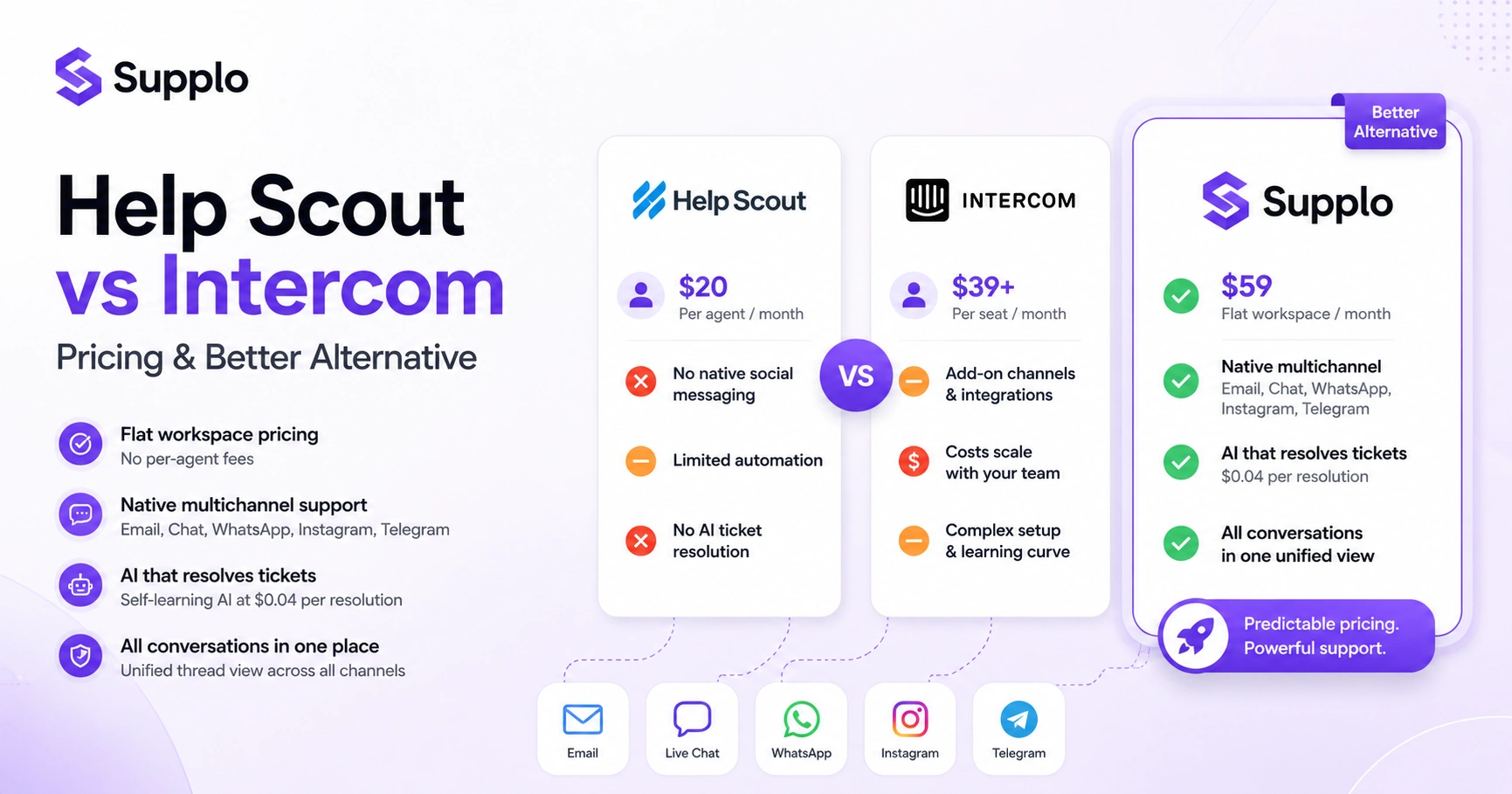
- A better alternative offers flat workspace pricing, native multichannel support (email, chat, social DMs) and self-learning AI that resolves tickets at a transparent, low cost per resolution.
Supplo is not affiliated with Help Scout, Intercom or any other platform mentioned. Please review each platform's terms and local regulations before choosing a help desk solution.
Help Scout vs Intercom: Which Help Desk Actually Serves Small Business?
Here's the truth: both Help Scout and Intercom say they're built for small business, but they define small very differently. Help Scout leans into email-first simplicity with a clean interface that works for teams of 10 or fewer. Intercom goes all-in on automation and chatbots, but its pricing escalates the moment you add users or turn on features. The real question isn't which one is better. It's which one matches how you actually work and what happens when you grow past their ideal fit.
Help Scout's per-agent pricing ($20/agent/month) seems affordable at first. Then your team adds a third or fourth person and suddenly it's doubled, with no volume discounts for small teams. Intercom's Essential plan starts around $39/seat/month, but most small businesses end up on Advanced ($99/seat) to get in-app chat and chatbots.
Both platforms charge per agent. That means scaling your team scales your software cost linearly, a painful reality for bootstrapped startups. Plus, neither tool integrates Instagram DMs, Telegram or WhatsApp natively, requiring third-party connectors that add latency and monthly fees. Small business owners often discover too late that unlimited doesn't mean free. Help Scout caps workflows. Intercom caps email sends, even on paid plans.
Help Scout for growing businesses vs Intercom for SMBs
Help Scout is ideal for businesses that primarily handle support via email and need a straightforward, uncluttered interface. Its strength is its ease of use for traditional help desk tasks. But its capabilities quickly become limited when a growing business needs advanced automation or the ability to manage diverse communication channels.
Intercom targets businesses seeking robust customer engagement, sales and support, especially those with a significant in-app presence. It's powerful for larger SMBs with dedicated teams for setup and management. But its complexity and tiered pricing can be prohibitive for smaller, rapidly growing businesses with limited resources. If you're focused on a predictable budget and unified support, Intercom can quickly become more than you need.
Help Scout vs Intercom Alternatives Pricing, Where Your Budget Goes Further
When comparing Help Scout vs Intercom pricing, the most important number isn't the starting price; it's what you pay after adding three agents, a chatbot, email and Instagram support. Help Scout's $20/agent quickly becomes $80+/month for a small team with no AI automation. Intercom's $39/seat balloons to $200+ before you've added a second channel. Modern alternatives like Supplo charge a flat workspace fee and $0.04 per AI resolution, making the budget predictable regardless of team size or ticket volume.
Help Scout's free tier basically doesn't exist; the 15-day trial forces a credit card upfront, unlike tools that offer real free plans. Intercom's pricing page hides essential features, such as multilingual support and phone integrations, behind custom quotes. The per-resolution pricing model, popularised by legacy tools at $0.99/resolution, penalises high-volume teams. You pay more when support gets busier, which is the opposite of what you want.
Flat workspace pricing eliminates the math problem: adding a new hire doesn't trigger a new software invoice. Most unlimited chat plans still limit the number of active conversations per month, hitting small teams during product launches or viral moments. With transparent per-workspace pricing, your bill doesn't balloon as your team grows.
Try Supplo Free for 14 Days
No credit card required. See how flat workspace pricing and $0.04 per AI resolution works for your team. Test Instagram, WhatsApp, Telegram and email support in one thread view, completely free for 14 days. Start at supplo.io.
Intercom vs Help Scout budget breakdown for startups
For startups, budget predictability isn't just nice, it's essential. Help Scout's entry-level monthly cost is lower, but it quickly adds up with each new agent and key features like AI are absent. Intercom's per-seat costs, especially for plans that include chatbots and in-app messaging, can quickly strain a startup's finances. And the true cost of Intercom? It often includes hidden fees for add-ons and significant time investment for setup.
A startup's budget goes further with solutions that offer flat pricing based on the workspace, not the number of agents. This model lets you expand your team without proportional increases in software costs. Plus, solutions that provide AI-driven ticket resolution at a low, transparent cost per resolution can significantly reduce overall support expenses as you scale.
Intercom vs Help Scout for Startups: What Changes When You Scale?
Startups often choose Intercom for its automation or Help Scout for its simplicity. But both make assumptions about how fast you'll grow. Intercom assumes you'll hire dedicated support ops early. Help Scout assumes you'll never need more than email and a basic knowledge base. The gap shows up around month 6 or 7, when ticket volume spikes but the budget doesn't. That's where flexible pricing and channel unification matter more than feature checklists.
Startup-stage costs for Help Scout (3 agents) are around $60/month. Intercom at 3 seats? A minimum of $117/month. But Intercom's real cost lands near $300 once you add chatbots and in-app messaging. Neither platform offers native support for WhatsApp, Telegram or Instagram. Startups managing those channels need Zapier or third-party tools that break thread continuity.
Help Scout's reporting is basic at the startup tier, making it hard to prove ROI when the board asks about support efficiency. Intercom's onboarding takes 2-4 weeks to implement properly, a time cost most pre-revenue startups can't afford. Both platforms lock AI automation behind premium tiers ($60-$99+ per seat), meaning startups pay more to automate more.
Best Help Desk for Small Business vs Intercom, What the Reviews Miss
Most comparison reviews focus on feature lists and UI screenshots. But they skip the operational reality: how hard is it to switch when your needs change? Help Scout lacks native social channel support and basic AI deflection unless you pay extra per agent. Intercom requires heavy setup and punishes you with seat-based pricing as you grow. The best help desks for small business conversations often ignore the fact that small businesses need channel flexibility and predictable costs more than they need advanced bots or A/B testing.
Reviews rarely mention that Help Scout doesn't support Instagram DMs or Telegram natively, two channels growing fast in e-commerce and SaaS. Ease-of-use comparisons miss that Intercom's power creates a steep learning curve that slows down non-technical support teams. Best help desk comparisons often benchmark against outdated versions of tools, ignoring features like thread-based multichannel inboxes.
Small business owners report spending 30-45 minutes per day just switching between Help Scout and their WhatsApp/Instagram tabs. The ideal alternative should auto-translate messages, merge channels into a single thread view and offer AI that learns from your past conversations, without a separate setup fee.
When Help Scout's Simplicity Becomes a Limitation
Help Scout is a beautiful email ticketing tool. But it was built in an era when support meant answering emails and maybe a chat widget. Modern support teams manage 4-6 channels, including WhatsApp, Instagram, Telegram and SMS. Help Scout doesn't natively support any of these. You end up duct-taping integrations together, breaking the single-thread view that makes support manageable. If your customers message you outside email, Help Scout's simplicity becomes a workflow tax. For multi-language customer bases, this is a significant bottleneck.
Help Scout's email-only focus means social channel conversations live in separate tabs, killing context and increasing response time by 40-60%. The knowledge base feature is basic. There's no AI training from past conversations and no auto-suggest from customer queries. Workflow automation in Help Scout triggers on simple conditions (subject line, tag, mailbox) but can't act on sentiment, intent or conversation history. Adding Instagram or WhatsApp support requires third-party forwarding tools that introduce 30-60 minute refresh delays. Help Scout lacks native translation, forcing multilingual teams to manually translate or add DeepL/Grammarly plugins when handling email ticketing.
When Intercom's Power Becomes Overkill
Intercom is built for mid-market and enterprise teams, with dedicated revenue ops and support engineering teams. For a small business with 3-5 support staff, the feature set is overwhelming and underutilised. You'll pay for chatbots you don't need, automation workflows that require a learning curve and seat-based pricing that punishes your first hire. Intercom's power is real, but most small teams use only 20% while paying for 100%.
Intercom's chatbot builder requires serious time investment. Small teams spend 10-15 hours to launch a basic FAQ bot, time better spent on customers. The reporting dashboard assumes you understand LTV, CSAT scoring and custom funnel reporting, which is overkill for teams under 10 people. Intercom charges extra for outbound features (email campaigns, product tours) that many small teams don't use but still see in the interface.
Adding WhatsApp costs extra and requires Twilio configuration, adding $50-200/month before you've handled a single conversation. Intercom's AI features are included in the $99/seat Advanced plan, making it cost-prohibitive for smaller teams to automate simple ticket deflection. A unified shared inbox for all channels, integrated with AI, offers a more practical solution.
Help Scout vs Intercom Alternatives: The Middle-Ground Nobody Talks About
Most alternatives to Help Scout and Intercom fall into two camps: cheap multichannel tools that lack AI or expensive enterprise platforms that require a dedicated admin. The middle ground, a tool that unifies email, WhatsApp, Instagram, Telegram and chat into one thread view, with AI that learns from your conversations, is surprisingly rare. Platforms like Supplo fill this gap by combining multichannel support, self-learning AI and flat pricing without per-seat penalties.
True multichannel inboxes combine email, chat widget, WhatsApp, Telegram, Instagram DMs and Facebook Messenger into a single chronological thread per customer. AI should train on both your knowledge base AND past conversations, not just static FAQ rules that miss 50% of queries. Per-resolution pricing at $0.04 (instead of $0.99) makes AI automation affordable for high-volume teams without limiting ticket count.
Flat workspace pricing means adding new team members costs nothing beyond their salary, with no software license escalation. Auto-translation should be built-in, not an add-on, so global teams support customers in any language without manual effort. This type of AI conversational support helps small businesses scale their customer service efficiently.
Three Real World Scenarios That Expose the Gap
Spreadsheet comparisons don't show what happens when real support teams hit budget constraints, team expansions or channel overload. Scenario one: Your team grows from 2 to 5 agents, Help Scout goes from $40 to $100/month, Intercom from $78 to $495. Neither includes Instagram or Telegram. Scenario two: A product launch spikes ticket volume; Help Scout has no AI to deflect and Intercom charges $99/seat for its bot. Scenario three: Customers flood in from WhatsApp and Instagram; neither platform can handle them without expensive workarounds.
Budget blowup scenario
- Help Scout at 2 agents: $40/month, at 5 agents: $100/month, no volume discount, no AI included at any tier.
- Intercom at 2 seats: $78+, at 5 seats: $195+ on Essential, $495+ on Advanced and that's before add-ons.
- Flat-priced alternatives keep the same invoice price for 2, 10 or 20 agents.
Support team growth scenario
- Hiring a third support agent at Help Scout adds $20/month, affordable but adds no automation or deflection capacity.
- Intercom's per-seat pricing means every new hire adds $39-$99/month to your software bill, before tools.
- An AI agent that resolves tickets automatically reduces the need to hire additional agents, shifting costs from labour to software.
Multi-channel chaos scenario
- Managing Instagram DMs and WhatsApp customer support separately from email adds 3+ browser tabs and 30+ minutes of context-switching time daily.
- Thread-based inboxes (one view per customer across all channels) eliminate channel silos.
- Help Scout and Intercom both lack native Instagram, Telegram and WhatsApp support, requiring third-party tools.
Don't Let Pricing Surprises Derail Your Support Team
If your budget is tight but ticket volume is growing, Supplo's flat workspace model keeps your software cost predictable. No per-seat escalation. No surprise invoices. Start your free trial at supplo.io.
What to Look for in Help Scout vs Intercom Alternatives
When evaluating Help Scout vs Intercom alternatives, prioritise three things: channel coverage, pricing structure and AI that actually learns. Channel coverage means native support for email, live chat, WhatsApp, Instagram, Telegram and Facebook Messenger without third-party tools. The pricing structure is flat per-workspace rates, not per-seat escalation. AI quality means self-learning from your knowledge base and past conversations, not just static FAQ matching. Everything else is a nice-to-have that grows with you, not against you.
Checklist for evaluating alternatives:
- Multi-channel nativity: Does it offer native WhatsApp, Instagram DMs, Telegram and Messenger support in a single thread view, without forwarding through Zapier or paid connectors?
- AI that learns: Does it feature self-learning AI that trains on your help centre articles AND past ticket resolutions, automatically updating as new issues emerge?
- Transparent pricing: Is there a flat workspace fee regardless of team size, plus clear per-resolution AI costs ($0.04 vs $0.99)? Are there no surprise invoices?
- Auto-translation: Is built-in translation included, not an add-on, so your team can respond to customers in any language without leaving the inbox?
- Free trial without credit card: Can you test the tool fully for 14 days before committing, with no billing surprise on day 30?
Intercom vs Help Scout or Something Better?
If you're a pure email shop with a stable team under 3 people and zero plans to use other channels, Help Scout works fine. If you have a dedicated ops person and a budget that grows with seat count, Intercom delivers powerful automation. But most growing teams fall into the gap: they need multichannel support, predictable costs and AI that scales without admin overhead. Modern alternatives like Supplo combine unified messaging, self-learning AI and flat workspace pricing that doesn't punish you for hiring. The best support tool isn't the flashiest or the cheapest; it's the one that fits how you actually work today and stays affordable as you succeed.
Consider your needs:
- Choose Help Scout if: you only need email support, have fewer than 3 agents and don't plan to add Instagram, WhatsApp or Telegram support.
- Choose Intercom if you have a dedicated revenue ops person and a budget that can absorb per-seat growth at $39- $99/seat/month.
- Choose a modern alternative if: you manage 2+ channels, want AI that learns automatically and need pricing that doesn't escalate with every new hire.
The best tool changes as you grow. Choose one that supports your next 18 months, not just your current size. Test any alternative for 14 days before committing; the trial period reveals workflow fit faster than any comparison chart.
Key Takeaways
- Both Help Scout and Intercom use per-seat pricing models, which can quickly become expensive as your team scales.
- Neither platform offers robust, native multichannel support for popular social messaging apps like WhatsApp, Instagram or Telegram.
- AI capabilities in both platforms are either basic (Help Scout) or expensive and complex to implement (Intercom).
- Modern alternatives like Supplo provide flat workspace pricing, comprehensive multichannel integration and self-learning AI at a predictable cost.
- Prioritise solutions that align with your actual customer communication channels and allow your team to grow without budget penalties.
Built for Teams That Straddle Help Scout and Intercom
Supplo unifies email, chat widget, WhatsApp, Telegram, Instagram DMs and Facebook Messenger into one thread-based inbox, without per-seat pricing or expensive AI add-ons. Our self-learning AI resolves up to 80% of tickets automatically at $0.04 per resolution. Start your 14-day free trial at supplo.io.
FAQ
What's the main difference between Help Scout and Intercom for small businesses?
Help Scout focuses on email-first support with a simple interface starting at $20/agent/month. Intercom offers powerful automation and chatbots, but starts at $39/seat and escalates quickly with per-user pricing and feature-tier costs. The key difference is between simplicity and power, but neither natively supports WhatsApp, Instagram or Telegram without expensive workarounds.
Which is more affordable: Help Scout or Intercom for a 3-person team?
Help Scout is cheaper at $60/month (3 agents) vs Intercom at $117-297/month (3 seats on Essential or Advanced). However, neither includes AI automation at their base tier. Both charge per person, meaning a team of 10 costs $200/month on Help Scout and $390-990/month on Intercom, before any add-ons or extra channels.
Does Help Scout support customer inquiries via WhatsApp or Instagram?
No. Help Scout is built only for email and its own chat widget. To manage WhatsApp, Instagram DMs or Telegram through Help Scout, you need third-party forwarding tools that break thread continuity and add 30-60 minute delays. Modern alternatives offer native multichannel support in a single inbox.
Can Intercom's AI replace a human support agent?
Intercom's AI can deflect basic FAQ questions, but its advanced automation is available only in the $99/seat Advanced plan. It's best used for initial triage, not full ticket resolution. Alternatives with per-resolution pricing ($0.04/resolution) make AI more accessible for small teams that want to automate without paying enterprise rates.
What happens when my support team grows from 3 to 10 people?
With Help Scout, your bill goes from $60 to $200/month, manageable but with no added features. With Intercom, your bill jumps from $117 to $390/month (Essential) or $297 to $990/month (Advanced), a significant increase. Flat workspace pricing models keep your software cost stable regardless of team size.
Can I combine email, WhatsApp and Instagram in one conversation thread?
Help Scout and Intercom don't offer this natively. You'd need separate integrations or switching between platforms. Modern multichannel help desks merge all channels into a single thread per customer, showing the full conversation history regardless of how the customer reached you.
Is there a free trial for Help Scout or any of its alternatives?
Yes. Alternatives like Supplo offer a 14-day free trial without requiring a credit card upfront. Help Scout requires a credit card for its 15-day trial and Intercom offers a limited free trial that often requires follow-up sales calls before full access.
Compliance Line: Supplo is not affiliated with any app or website. Please follow each app's terms and local regulations.