On this page
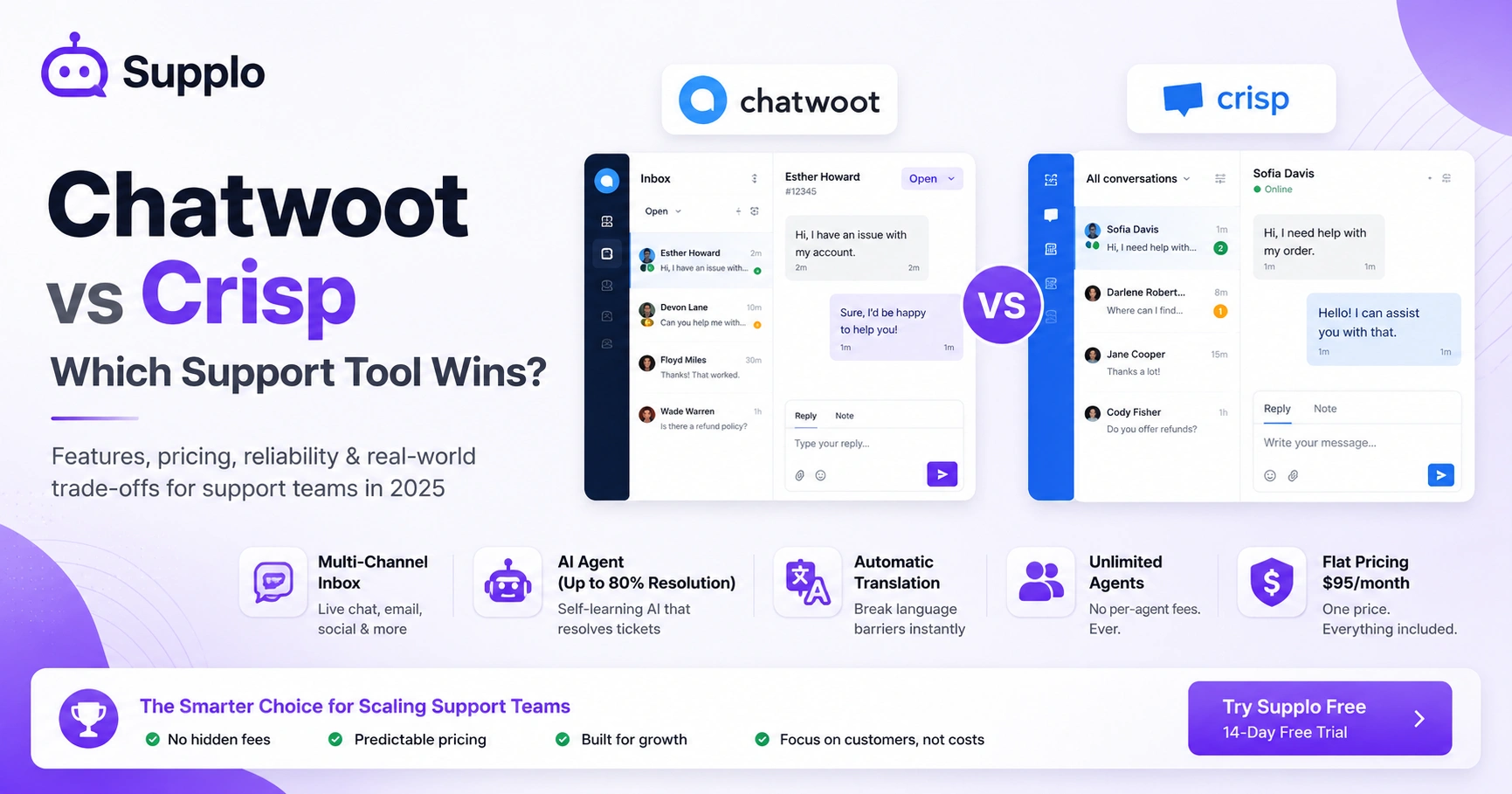
Look, picking a customer support platform shouldn't feel like a high-stakes gamble. But between Chatwoot and Crisp, two of the more talked-about options out there, it's easy to get lost in feature lists and pricing pages that hide the real costs.
This comparison is for anyone running support operations: founders, support managers, technical leads. We're going to dig into what each tool actually delivers, where they fall short and whether either one is truly built for the way teams work in 2025.
Let's cut through the noise.
Quick Answer
- Chatwoot: Open-source, free to self-host (if you manage servers), high customisation, developer-friendly. Cloud plan starts at $29/agent/month.
- Crisp: Cloud-based SaaS, polished UI, easy setup, includes live chat, CRM and basic bots. Starts at €18/agent/month (billed annually).
- Pricing Pitfall: Both rely on per-agent pricing models, which can quickly inflate costs as teams grow.
- AI Gap: Neither offers a self-learning AI agent capable of fully resolving tickets without human intervention.
- Reliability: Chatwoot's reliability depends on your self-hosting expertise; Crisp offers SaaS stability, but with feature and pricing changes.
Chatwoot vs Crisp: Feature-by-Feature Breakdown
Here's the thing: you can get both tools to do roughly the same things on paper. But the how, the experience, the headaches, the hidden trade-offs, is wildly different.
Chatwoot is open-source. That means you can literally tweak everything. Want a custom widget that matches your brand exactly? Go for it. But you're also responsible for making sure the thing actually stays running. Setup takes time. Maintenance takes more time. And unless you're comfortable with DevOps, you're going to hit walls.
Crisp, on the other hand, is plug-and-play. Their UI is clean, polished and ready out of the box. Live chat, email ticketing, CRM basics, a knowledge base- it's all there. But you don't own the infrastructure. You pay per agent and those costs climb faster than you'd expect as your team grows.
Both tools support multi-channel support: email, live chat, social media. But here's where things get interesting. Chatwoot's real strength is permissionless customisation; you can build whatever integration you need. Crisp's strength is that you don't need to build anything. It just works.
The big gap? AI. Chatwoot has basically zero native AI automation. You'd need to bolt something on yourself. Crisp offers basic chatbot flows, but they're rules-based and limited, plus you'll pay extra for the advanced stuff. Neither tool offers a self-learning AI agent that actually resolves tickets on its own. That's a real gap for any team dealing with volume.
Chatwoot vs Crisp Pricing: Which One Costs Less Over Time?
Let's be real: both of these tools look affordable on a pricing page. But pricing is rarely where the real costs live.
Chatwoot's open-source version is free in the sense that the software license costs nothing. But you're paying for servers; expect $10–30/month for a decent VPS. You're paying for developer time to set it up and maintain it. You're paying for backups, SSL certificates and security patches. That free tool can easily cost $200–500/month in hidden engineering time once you factor in a few hours of DevOps work each month.
Chatwoot's Cloud plan starts at $29/agent/month, with a minimum of 2 agents. So that's $58/month before you've done anything. Scale to 10 agents and you're at $290/month.
Crisp's Pro plan is €18/agent/month billed annually or €25/agent/month billed monthly. A 10-agent team costs €180–€250/month. But then you want chatbot automation? That's an extra €30/month. Advanced reports? More. CRM features? Also more. The base price is a decoy.
Here's the truth: per-seat pricing is a trap. Every time you hire someone new, your bill goes up. Every contractor, every part-timer, every seasonal hire- they all cost you. For growing teams, that unpredictability is brutal.
Supplo flips the model entirely. $95/month flat for your entire workspace. Unlimited agents. Unlimited contacts. No surprise bills when you onboard three new support reps next month. That's it.
Chatwoot vs Crisp features: When you actually line up what you get per dollar spent, the flat-rate model wins for any team planning to grow.
Chatwoot Crisp Plans Compared: What You Actually Get vs What You Pay
Let's go plan by plan, because the differences matter more than you'd think.
Chatwoot Free Cloud: 2 agents, 1,000 contacts. You get a team inbox and basic reports—no API access. No webhooks. No advanced automations. It's usable for a tiny team testing the waters, but you'll hit the ceiling fast.
Chatwoot Paid Cloud ($29/agent/month): Unlimited contacts. API and webhook access. Automation rules. Advanced reports. This is where Chatwoot starts to feel like a real tool. But at 10 agents, that's $290/month.
Crisp Free: Honestly? Nearly unusable for any real operation. 2 agents. 10 conversations per month. One dashboard seat. That's not a free plan; that's a demo with extra steps.
Crisp Pro (€18/agent/month yearly): Unlimited conversations, up to 3 dashboards, basic chatbot. But want a good chatbot? That's an add-on. Automation rules? Add-on. Advanced analytics? Add-on. You're piecing together a tool one module at a time.
Both lock basic functionality behind paywalls that feel reasonable until you actually need them. Neither includes multi-language translation natively. Neither has a self-learning AI agent.
Supplo's single plan, $95/month, includes unlimited agents, unlimited conversations, an AI agent, a multi-channel inbox, automatic translation and everything else. No tiers. No which plan do I need? anxiety.
Chatwoot vs Crisp Cost: Hidden Fees, Seat Limits and Scaling Gotchas
The surface-level pricing looks clean. But dig deeper and the gotchas start appearing.
Crisp gotchas:
- Chatbot automation add-on: €30/month extra
- CRM features: locked behind higher tiers
- Enterprise pricing: completely opaque, requires a sales call
- Each new agent adds to your monthly bill with no volume discounts unless you negotiate custom pricing.
Chatwoot gotchas:
- Self-hosting: $20–50/month for VPS, plus 2–5 hours of developer time monthly for updates and patches
- Cloud plan: $29/agent/month scales linearly, no built-in discounts until you negotiate Enterprise
- No native backup or disaster recovery on self-hosted, you build that yourself
- Premium support costs extra
The real cost isn't the subscription line item. It's the time, the complexity and the unpredictability. Every time your team grows, your bill grows. Every time you need a feature that should be standard, you're paying more or building it yourself.
Supplo eliminates this. $0.04 per AI resolution when the AI handles a ticket. Unlimited agents for the flat workspace price. No hidden fees. No oops, that feature costs extra. Just predictable, transparent pricing that doesn't punish you for growing.
Chatwoot Crisp Affordability: Which Tool Helps Small Teams Save More?
For a tiny team of 2 to 5 agents, Chatwoot's free, self-hosted setup looks like the cheapest option. If you have the engineering time to maintain it, you can keep costs around $15/month for a basic VPS.
Crisp's free tier is, honestly, a non-starter. Ten conversations per month? That's not running a business, that's testing a feature. Their Pro plan at €36/month for 2 agents is more realistic, but still barebones until you add on features.
Here's how the numbers shake out for a 10-agent team:
- Chatwoot Cloud: $290/month
- Crisp Pro (yearly): €180/month before add-ons
- Supplo: $95/month, flat, unlimited
The math gets clearer as your team grows. At 20 agents, Chatwoot Cloud is $580/month. Crisp is €360/month plus add-ons. Supplo is still $95/month.
Chatwoot vs Crisp features comparisons often ignore the most important feature: affordability at scale. A tool that forces you to cut team members because the pricing model punishes growth isn't really a solution; it's a constraint.
How Reliable Is Chatwoot for Customer Support Workflows?
Chatwoot can be reliable. Key word: can.
If you self-host, reliability is entirely on you. Your VPS provider, your database configuration, your Redis caching setup, your backup strategy- you own all of it. That's powerful if you have a dedicated DevOps person. It's terrifying if you're a founder who wants the tool to work.
Chatwoot Cloud (their SaaS offering) is more reliable for non-technical teams. But their uptime SLA of 99.9% applies only to the Business and Enterprise plans, not the Free or Paid tiers. So most users have no guarantee.
There's no native backup or disaster recovery for self-hosted deployments. You set that up yourself or risk losing everything.
And critically: Chatwoot has no AI-powered ticket deflection or auto-resolution. Every single conversation needs a human. Under high volume, that's a reliability bottleneck; your team can only handle so many chats before response times tank.
For teams that want guaranteed uptime without infrastructure headaches, a cloud-native platform like Supplo offers a much better trade-off.
How Reliable Is Crisp for Daily Customer Support Operations?
Crisp is generally stable. Their SaaS backend is polished and you don't have to think about servers. That's a real advantage for non-technical teams.
But reliability is about more than uptime. It's about predictability.
Crisp has changed their pricing model and feature bundling over the years. Features included when you signed up sometimes migrate to higher-priced tiers. That kind of unpredictability can disrupt workflows and force budget conversations you didn't plan for.
Their free tier's 10-conversation cap makes it unreliable for anything beyond testing. Their paid plans offer 99.9% uptime, but webhook and API reliability can vary under heavy load.
And their chatbot automation is limited to rules-based flows. No self-learning. No confidence-based handoff. If the flow doesn't match exactly what a customer types, the bot fails. That's not reliable automation; that's fragile automation.
Teams that need true scale should look for flat-rate workspace pricing with AI that actually learns and improves over time, not just executes predefined rules.
Should You Self-Host Chatwoot or Go Cloud with Crisp?
This is the core question for anyone evaluating these tools and the answer depends on what you're optimising for.
Self-host Chatwoot if:
- You have dedicated DevOps time
- You need full data sovereignty
- You can tolerate occasional outages
- You want maximum customisation
Use Crisp cloud if:
- You want zero setup
- You don't mind per-seat pricing
- You're okay with feature add-ons
- You want a polished UI out of the box
But here's the reality of self-hosting: updates break things. Backups fail. Scaling requires Redis, Sidekiq and database tuning, which most teams don't have expertise in. The free option often costs more in time and stress than it saves in money.
And the reality of Crisp: no server access, limited customisation and no ability to audit security or modify backend logic. You're renting their infrastructure and their rules.
Supplo offers a third path: cloud reliability with per-workspace pricing and full control over your support workflows, without the DevOps overhead. You get the best of both approaches.
Not sure which path fits your team?
Whether you're leaning toward self-hosting Chatwoot or going with Crisp in the cloud, you can test either approach risk-free. Or skip the guesswork and start a free 14-day trial of Supplo, no server setup, no per-agent limits, no hidden fees. Sign up free.
Which Tool Handles Multi-Channel Support Better?
Both tools support the basics: email, live chat, social channels. But the details matter.
Chatwoot supports email, live chat, Facebook, Twitter, WhatsApp (via API) and Instagram (via API). That's flexible, but every integration requires setup. You're managing API keys, webhooks and authentication yourself.
Crisp supports live chat, email, WhatsApp (native integration), Facebook and Instagram (native on Pro+ plans). The native integrations are smoother, but social channel support requires the Pro plan; that's another cost driver.
Neither tool includes Telegram support natively. Neither supports Binance Pay or regional payment gateways. If your audience uses these platforms, you're out of luck without custom development.
Crisp does offer message translation, but charges per translation. Chatwoot has no built-in translation engine.
Supplo unifies everything: email, its website chat widget, WhatsApp customer support integration, Telegram, Instagram DMs and Facebook Messenger, all in a single unified thread-based inbox. With automatic translation included. No per-translation fees. No separate integrations to manage.
The Bottom Line: Chatwoot vs Crisp – Which One Should You Choose?
Let's be honest about what each tool actually delivers.
Chatwoot wins if you're an open-source enthusiast with DevOps time and a desire for total control. You can build anything, customise everything and avoid per-agent fees by self-hosting. But you'll pay for that flexibility in maintenance time and operational risk.
Crisp wins if you want a polished, cloud-hosted chat tool and are okay with per-seat pricing. Setup is fast, the UI is clean and you don't need technical skills to get started. But you'll pay more as you scale and features you expect to be included often aren't.
Neither tool offers a self-learning AI agent that automatically resolves tickets. Neither offers flat-rate unlimited agent pricing. Neither makes it easy to scale without your costs scaling along with it.
That's where Supplo comes in. $95/month flat for your entire team. AI agent that learns from your knowledge base and past conversations. Multi-channel inbox with automatic translation. No per-agent penalties, no feature add-on costs, no surprises.
Chatwoot vs Crisp features comparisons often miss this point: the best tool isn't the one with the most features, it's the one that works for your team without creating new problems. Supplo is built to be that tool.
Key Takeaways
- Self-Hosting Dilemma: Chatwoot's free, open-source model requires significant technical investment and ongoing maintenance, making it costly in terms of developer time.
- Per-Agent Penalty: Both Chatwoot's cloud and Crisp's SaaS models penalise team growth through per-agent pricing, leading to unpredictable, escalating costs.
- AI Automation Gap: Neither platform inherently offers self-learning AI agents for automated ticket resolution, relying instead on rule-based chatbots or human agents.
- Feature Bundling: Core features such as advanced reporting, API access and social media integrations often reside behind higher-priced tiers or require add-ons.
- Reliability vs Control: Chatwoot offers control at the cost of your team's operational reliability; Crisp delivers SaaS reliability but with less control and evolving feature access.
- Cost-Effectiveness: For scaling teams seeking predictable budgets, flat-rate, per-workspace pricing with AI automation offers a more reliable and affordable solution.
FAQ
Is Chatwoot really free to use?
Chatwoot is free to self-host, but you pay for server infrastructure, maintenance and developer time. Their Cloud plan starts at $29/agent/month.
Does Crisp offer a free plan?
Yes, but it's extremely limited, only 2 agents and 10 conversations per month. It's more of a trial than a usable free plan.
Can I use Chatwoot or Crisp for telemarketing or mass messaging?
Supplo is not affiliated with any app or website. Please follow each app's terms and local regulations. Using support tools for unsolicited mass messaging violates the policies of WhatsApp and Telegram and can result in your account being banned.
Which tool is cheaper for a 10-agent team?
Chatwoot Cloud would cost $290/month, Crisp about €180/month (Pro, yearly). But both charge extra for automation and advanced features. Supplo covers unlimited agents for $95/month flat.
Do Chatwoot or Crisp support WhatsApp Business API?
Yes, both integrate with the WhatsApp Business API, but each requires your own API approval and setup. Supplo includes WhatsApp support natively in its unified inbox.
Which tool has better AI automation?
Neither Chatwoot nor Crisp includes a self-learning AI agent that automatically resolves tickets. Supplo's AI resolves up to 80% of tickets at $0.04 per resolution, built-in, not an add-on.
Can I easily migrate from Chatwoot or Crisp to another tool?
Chatwoot allows data export via API; Crisp locks conversation history behind higher-tier plans. Both require manual migration to a new platform. Supplo offers smooth onboarding and data import support.
Compliance Line: Supplo is not affiliated with any app or website. Please follow each app's terms and local regulations.