On this page
Managing a remote customer support team requires a strategic approach that prioritizes clear systems, the right technology and consistent communication over micromanagement. This guide is for customer support leaders and operations managers scaling their remote teams, from startups to established businesses. If you're struggling with team silos, inconsistent service, or agent burnout, this article offers practical strategies to build a reliable, scalable and sane remote support operation.
Let's be real, managing a team you can't physically see isn't easy. But the good news? It's actually simpler than most people make it out to be. The secret isn't more meetings or surveillance software. It's better systems, smarter tools and a whole lot of trust.
Quick Answer
Here's the nutshell version so you can get moving:
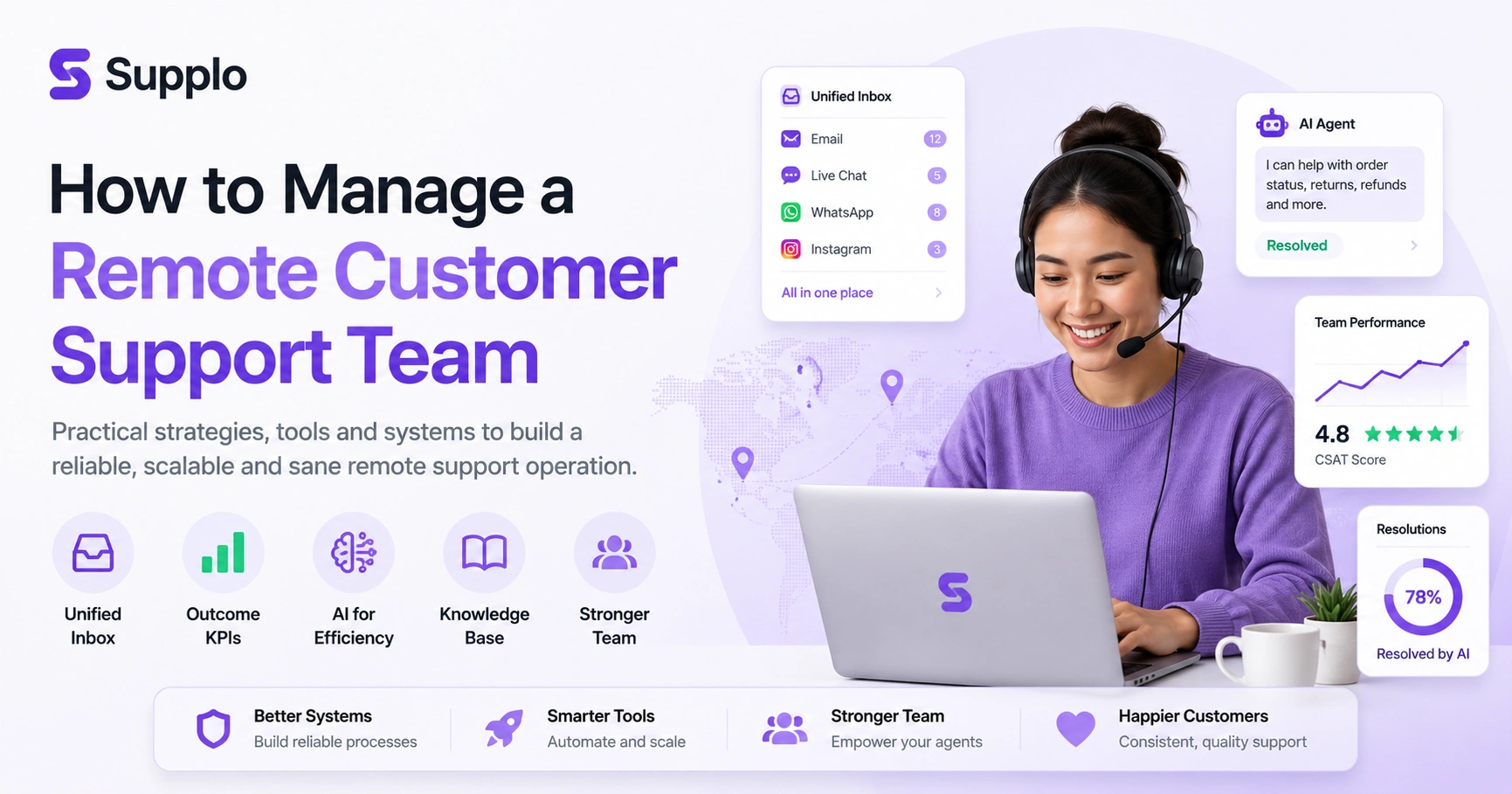
- Unified Inbox is Key: Consolidate all communication channels (email, chat, social media DMs) into one thread-based inbox to prevent agents from juggling tabs and losing context.
- Focus on Outcome KPIs: Track Customer Satisfaction (CSAT), first-response time, resolution rate and escalation percentage. Ignore vanity metrics like daily chat count.
- Structured Onboarding: Implement a rapid, structured 5-day onboarding plan to get new remote agents productive quickly.
- AI for Efficiency: Leverage an AI agent to resolve 60-80% of routine tickets, freeing human agents for complex, high-value customer interactions.
- Asynchronous Communication: Favor daily asynchronous standups and knowledge base updates over constant meetings and check-ins.
Why Remote Support Teams Fail And How to Build Reliability From Day One
Most remote support teams stumble not because of bad agents, but because of bad systems. Without a unified inbox, agents juggle tabs, miss messages and lose context. The fix isn't more oversight, it's better infrastructure that makes the right answer easy to find and the right handoff automatic.
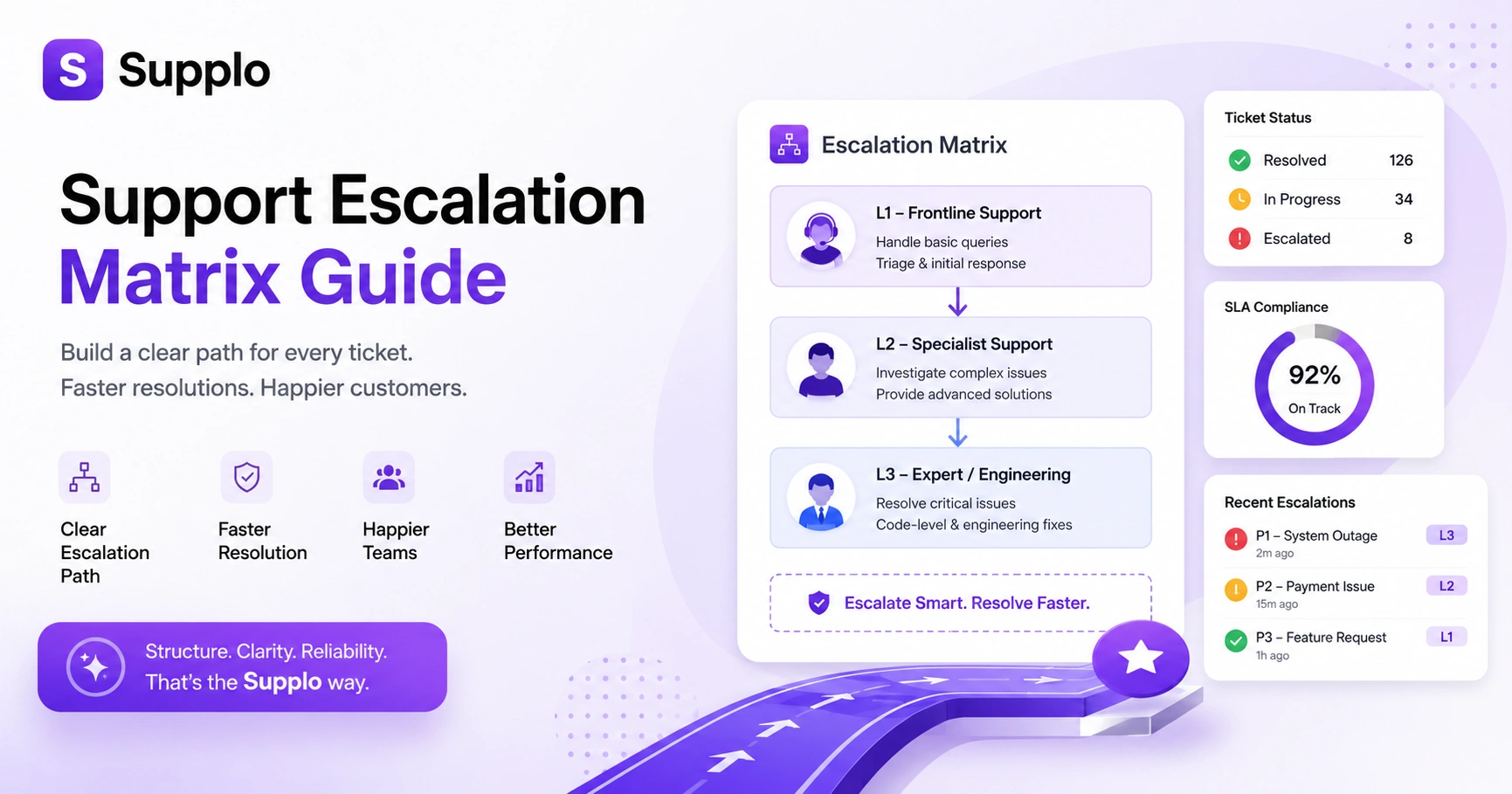
A common failure point is siloed communication, where customer interactions are scattered across email, live chat and social media DMs. Without a single source of truth for answers, agents waste time searching or provide inconsistent information. Unclear escalation paths further complicate matters when an AI or Tier 1 agent can't resolve an issue.
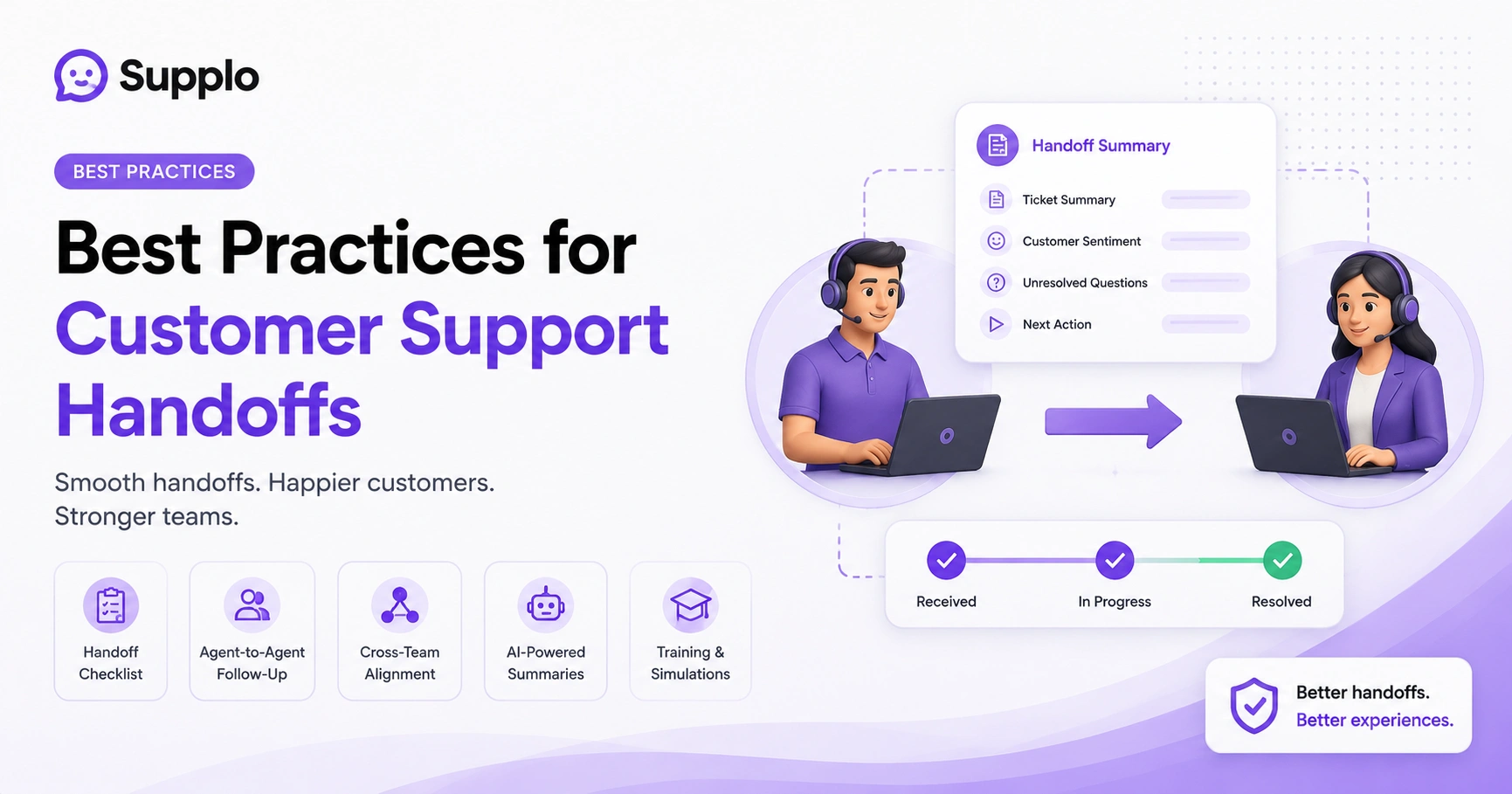
A shared inbox combined with a self-learning AI agent prevents these issues before they even arise. The AI can resolve tickets automatically, and the system ensures a clean handoff to human agents when needed.
The biggest failure I see? Leaders are trying to solve cultural problems with more meetings and system problems with... also more meetings. Your tools should do the heavy lifting.
Remote Customer Service Agent Tech Stack
Your agents need three things to work reliably from anywhere: a unified inbox that pulls in email, chat, WhatsApp, Telegram, Instagram DMs, and Facebook Messenger into one thread-based view; a knowledge base that auto-suggests answers; and an AI agent that resolves repetitive tasks so humans only handle what matters. Skip the tool sprawl, one workspace beats five disconnected apps every time.
Must-haves for your tech stack:
- Shared inbox: Provides a unified customer view with complete conversation history and internal notes. No more wondering which tab the customer was on again?
- Knowledge base: A central repository of information that improves over time by learning from resolved tickets. Think of it as your team's collective brain.
- AI agent: An intelligent assistant that learns from past conversations to provide accurate, instant answers. It handles the Where is my order? stuff so your team doesn't have to.
- Multichannel support: Capabilities for WhatsApp customer support, Telegram support, Instagram DMs, email, and website chat widget integration are crucial. Customers don't care about your internal channel strategy; they want to reach you.
- Security baseline: Role-based access, audit logs, and encrypted data protect customer information. Non-negotiable.
Onboarding Remote Support Staff Without the Chaos
Onboarding remote support agents isn't about swag boxes and Zoom happy hours. It's about getting them productive before they get frustrated. A structured 5-day plan: Day 1, tool setup and permissions; Day 2, knowledge base deep dive; Day 3, shadowing with AI-assisted tickets; Day 4, handling live chats with a senior buddy; Day 5, solo queue with real-time feedback. Anything slower burns time and morale.
Quick tip: Day 1 is the hardest. Make sure every tool login works before they start. Nothing kills momentum like a password reset loop.
Pre-onboarding checklist:
- Ensure agents have reliable hardware, a stable internet connection, a functional workspace, and a secure VPN.
- Verify all software access and permissions are pre-configured
- Prepare a welcome document with team communication norms.
5-day onboarding sequence:
- Day 1: Grant software access, set up roles, and provide a tour of the shared inbox. Keep it hands-on.
- Day 2: Conduct a thorough walkthrough of the knowledge base and establish expectations for AI agent behavior. Let them break things in a sandbox.
- Day 3–4: Engage in simulated tickets and live shadowing, followed by transcript reviews. Pair them with your best agent.
- Day 5: Transition to independent work, supported by daily huddle check-ins. They'll mess up, that's fine. What matters is how fast they learn.
Training Remote Support Agents for Consistency and Confidence
Ongoing training for remote agents should be asynchronous, searchable, and tied directly to real tickets. Record common edge cases, update your knowledge base weekly based on escalations, and run weekly mystery ticket exercises where agents solve a tricky scenario with no prep. The goal isn't memorization, it's knowing where to find the answer fast.
Effective training strategies:
- Implement weekly knowledge base updates derived from actual escalated tickets. If an agent needs help, the KB needs to be updated.
- Conduct mystery ticket exercises to assess and develop judgment and resourcefulness: no prep, no warnings, just a tough case and a timer.
- Utilize asynchronous training modules that are recorded, searchable, and bite-sized. Your team works across time zones; train accordingly.
- Role-play difficult conversations, such as refund requests or interactions with angry customers. It feels awkward, but it works.
- Analyze AI agent logs to identify common agent struggles and areas needing improvement. The AI learns from your team; your team should learn from the AI.
Effective Remote Customer Service Management
Managing a remote team doesn't mean constant Slack pings. It means creating rhythms that build trust and clarity. Start each day with a 10-minute async standup in your shared inbox (not a separate app). Mid-day, review the AI agent's auto-resolved tickets to catch drift. End with a 5-minute one thing learned post. That's it, no endless meetings. No surveillance.
Daily rituals for remote teams:
- Morning: Conduct an asynchronous standup within the inbox to discuss blockers and trending issues. Keep it tight, bullet points, not novels.
- Mid-day: Dedicate 10 minutes to review AI-resolved tickets for quality assurance and identify any drift. The AI gets better when you catch its mistakes.
- Afternoon: Facilitate a one-thing-learned thread for team knowledge sharing and continuous improvement. Celebrate the small wins.
- Weekly: Hold a recorded 20-minute walkthrough of the top escalations to share insights. Record it; someone always needs to catch up later.
- What NOT to do: Avoid screen recording, keystroke logging, or incessant check-in calls. Trust your team or find a new team.
Monitoring Remote Customer Support Team Performance Without Micromanaging
Monitoring performance remotely is about measuring outcomes, not activity. Instead of tracking minutes online, track resolution rate, customer satisfaction (CSAT), and escalation frequency. Use your shared inbox's analytics to spot who's overloaded and who's drifting, then have a coaching conversation, not a surveillance one. Real-time dashboards beat random check-ins every time.
Performance monitoring essentials:
- Outcome metrics: Focus on CSAT, resolution rate, first-response time, and escalation rate. These tell you what matters.
- Process metrics: Track ticket volume per agent, average handle time, and reply cadence. Useful for staffing, not for policing.
- Red flags: Watch for sudden spikes in escalations, drops in CSAT, or long periods of inactivity. Context matters; ask before assuming.
- Coaching approach: Share data transparently, ask open-ended questions, and collaboratively develop improvement plans. Your agents want to do well; help them figure out how.
- Tools: Rely on built-in analytics within your customer support platform instead of third-party monitoring software, one less login to manage.
Need to unify your channels into one inbox?
Start your 14-day free trial at supplo.io. Sync email, live chat, WhatsApp, Telegram Support, Instagram, and Facebook Messenger in minutes, no credit card required.
KPIs for Remote Support Agents: What to Track And What to Ignore
Track KPIs that reflect real customer impact: CSAT, first-response time, resolution rate, and escalation percentage. Ignore vanity metrics like the number of chats handled per day or average handle time; they punish quality and reward speed. A remote agent who solves 20 complex tickets well is worth more than one who closes 80 by rushing customers.
Key Performance Indicators to Track:
- CSAT (Customer Satisfaction Score): Directly measures customer happiness. The gold standard for a reason.
- First-Response Time (FRT): Time taken to respond during business hours. Speed matters, but accuracy matters more.
- Resolution Rate: Percentage of issues solved without escalation. High resolution rate = well-trained agents.
- Escalation Rate: Frequency and reasons for ticket escalations. Watch for patterns, not individual spikes.
Metrics to Ignore:
- Number of chats handled per day. (Congratulations, your agent is fast and sloppy.)
- Average handle time. (Unless you want your agents rushing customers off the line.)
- Login hours. (It's 2026. Judge output, not butt-in-seat time.)
Remote Support Team Productivity Metrics That Actually Tell You Something
Productivity in remote support isn't about speed; it's about throughput of quality resolutions. Track tickets resolved per agent per week, but weigh them by complexity (easy vs. escalations). Also track knowledge base contribution: agents who submit improvements to your KB are compounding productivity across the whole team. A single FAQ update can save 50 future tickets.
Meaningful productivity metrics:
- Tickets resolved per agent per week: Weighted by complexity to reflect actual effort: a complex refund case ≠ , a password reset.
- Knowledge base contributions per agent: Measures proactive knowledge sharing. Your best agents improve the system for everyone.
- Time-to-resolution vs. time-to-first-response: Evaluates problem-solving efficiency versus just showing up quickly.
- Customer re-contact rate: Indicates the completeness of resolutions. If customers keep coming back, your agents aren't closing properly.
- Agent satisfaction and burnout signals: Sudden drops in output can signal underlying issues. A quiet agent isn't always a productive one.
Measuring Remote Customer Service Success With Real Data
Customer service success isn't a feeling, it's a trend. Look at CSAT over time, deflection rate (how many tickets your AI agent resolved without human touch), and average resolution time. Benchmarks: top-performing remote teams see CSAT above 90%, deflection above 50%, and resolution time under 6 hours for non-critical issues. If your numbers are drifting, adjust your knowledge base and agent training before you hire more people.
Data points for measuring success:
- CSAT trend: Monitor weekly and monthly changes over 90 days. One bad week is a blip; three bad weeks are a problem.
- Deflection rate: Percentage of tickets fully resolved by the AI agent. Higher deflection = your team works on harder problems.
- Average resolution time: Track by priority level to highlight bottlenecks. Critical issues should be addressed quickly; non-urgent issues can wait.
- Re-contact rate within 7 days: A key indicator of incomplete resolutions. If customers come back within a week, your first fix didn't stick.
- Benchmark ranges: Understand typical performance for B2B and B2C mid-market support teams. Know where you stand.
- Transparent pricing without seat-based fees allows you to scale cost-effectively. Your budget shouldn't punish growth.
If you're building a remote support team for a growing business, check out Supplo's pricing. Flat per-workspace billing means your bill doesn't balloon as your team scales. No per-seat surprises. Supports crypto, Binance Pay, Payeer, GCash, AmanPay, QIWI Wallet, DOKU, Nigeria, and South Africa cards, Skrill, and Payoneer.
Leading a Remote Support Team Through Change and Growth
Leading remotely means earning trust through transparency, not authority. When you scale from 5 to 15 agents, your biggest risk is losing culture and consistency. Keep a public record of why we changed this log in your inbox. Run monthly 1-on-1s that are conversations, not performance reviews. And let your team co-author the knowledge base; they know the real edge cases better than you do.
Strategies for leading through change:
- Maintain a public change log for all process and policy updates. We changed X because Y prevents gossip and confusion.
- Conduct monthly 1-on-1s focused on growth, career paths, and addressing blockers. Skip the performance scorecard format.
- Empower agents to submit and edit entries in the team knowledge base directly. They're on the front lines, and trust their insights.
- Recognize and celebrate high-quality resolutions, not just speed. A well-handled angry customer is worth celebrating.
- Plan for scalability by promoting from within or hiring experienced leads as appropriate. Your first agents should become your future managers.
Ready to move from managing chaos to building a reliable remote team?
See how Supplo's shared inbox and self-learning AI agent can handle the repetitive tickets so your team can focus on what matters. Start free at supplo.io.
Key Takeaways
- Implement a unified shared inbox for all customer communications to improve agent efficiency and customer context.
- Prioritize outcome-based KPIs, such as CSAT and resolution rate, to measure true team performance and avoid micromanagement.
- Establish a structured 5-day onboarding process to integrate new remote agents into your workflow quickly.
- Utilize a self-learning AI agent to automate routine tickets, allowing human agents to focus on complex issues.
- Cultivate a culture of transparency and trust through asynchronous communication and collaborative knowledge sharing.
FAQ
Is it legal to monitor remote customer support agents without telling them?
No. In most jurisdictions, you must disclose monitoring practices. Focus on outcome-based metrics (CSAT, resolution rate) instead of surveillance. Transparency builds trust and reduces turnover. Supplo is not affiliated with any app or website. Please follow each app's terms and local regulations.
How is my remote support team actually working?
Look at their output quality, not their online status. Track resolution rate, CSAT, and first-response time. If numbers are solid, trust is earned. If they're drifting, have a coaching conversation, don't install spyware.
What's the biggest mistake companies make when managing remote support agents?
Over-communicating and under-systemizing. They add more meetings instead of improving the shared inbox, knowledge base, and automation, the best remote teams run on good tools and clear processes, not constant check-ins.
How many remote support agents do I need?
It depends on ticket volume. A good starting ratio is one agent per 100–150 tickets per week for Tier 1 support. If your AI agent handles 60–80% of tickets, you may need fewer humans. Scale slowly and measure deflection rate first.
What tools do remote customer service teams absolutely need?
A unified shared inbox, a knowledge base, and an AI agent for automation and analytics. One platform that does all four is better than stitching together five apps. Supplo combines all of these in one workspace.
How do I train a remote support agent who has never worked from home?
Start with a structured 5-day onboarding plan: tool setup, a deep dive into the knowledge base, shadowing with AI assistance, live chats with a buddy, then solo with feedback. Asynchronous training modules and a shared inbox make the transition smooth.
Can remote support teams handle multi-language customers?
Yes, if your platform has built-in translation. Many customer support tools can now translate messages in real-time and translate your knowledge base content. Supplo supports multi-language inbox and AI responses.
Compliance line: Supplo is not affiliated with any app or website. Please follow each app's terms and local regulations.