On this page
Quick Answer
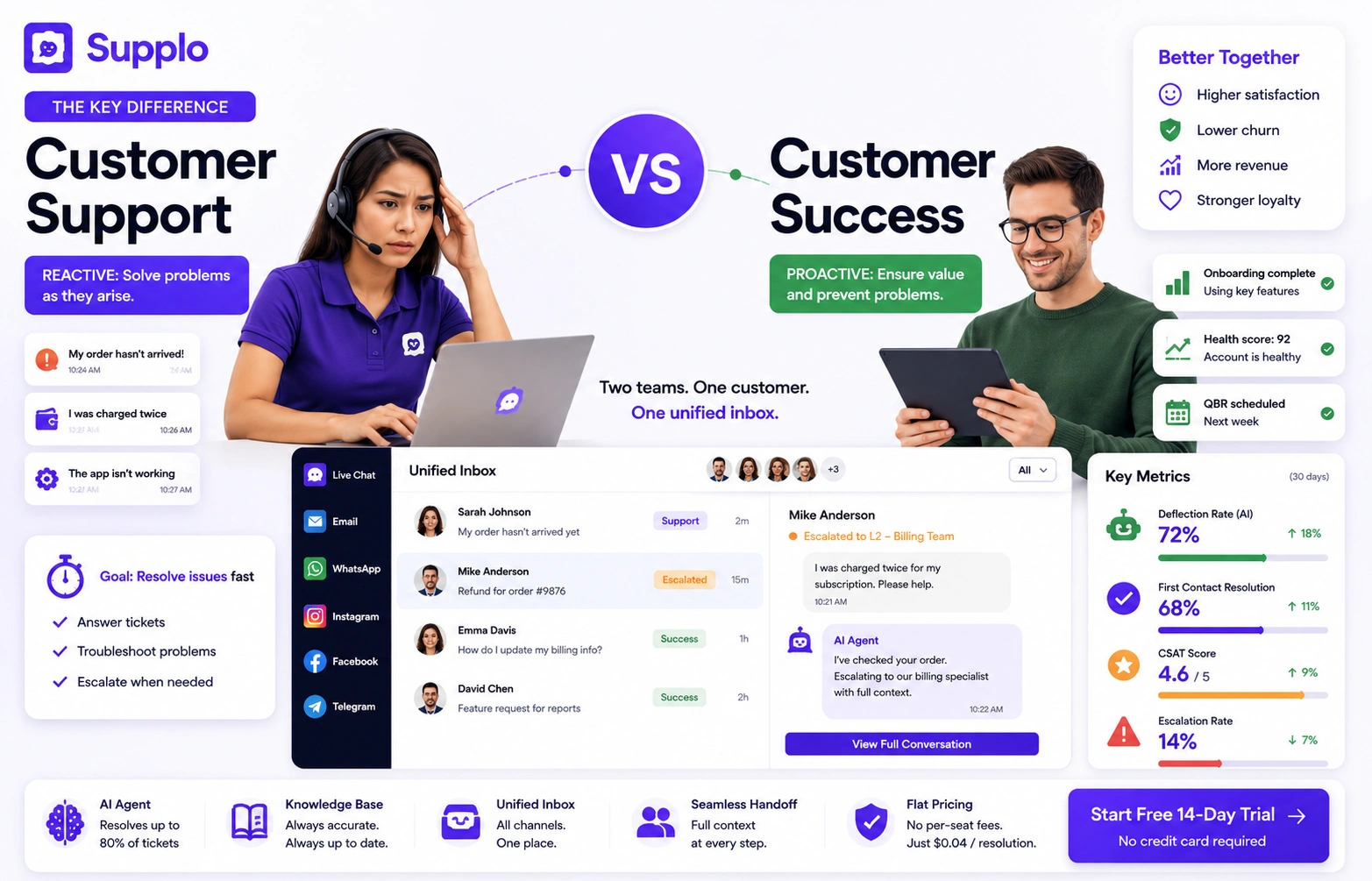
- Customer support is reactive, solving problems as they arise.
- Customer success is proactive, preventing issues and ensuring value.
- Both roles are essential for customer retention and business growth.
- Use a unified platform to ensure seamless collaboration between teams.
Let's be honest: if you're running a business, especially a growing one, you've probably used the terms "customer support" and "customer success" interchangeably. They're not. They're two sides of the same coin, but they face opposite directions. Understanding the difference between customer support and customer success isn't just a semantic exercise; it's key to keeping your customers happy and your churn rate low. Here's the real breakdown.
What Is Customer Support? The Role, Responsibilities, and Daily Reality
Customer support is the reactive arm of your service operation. When a customer has a problem, a billing error, a broken feature, or a login issue, they reach out to support. The job is to resolve that specific issue as quickly and accurately as possible. Support teams live in the ticketing system, triaging requests, answering questions, and escalating issues beyond their scope. It is tactical, immediate, and measurable using metrics such as response time and first-contact resolution.
Think of support as the front-line defense. They're the ones who catch the ball when it drops. Their day is a constant stream of "how do I?" "it's not working," and "can you fix this?" It's fast-paced, often stressful, and incredibly valuable.
- The primary goal is issue resolution, not long-term relationship building.
- Support agents handle inbound requests from email, live chat, social DM, and phone.
- A well-run support team reduces friction and keeps customers from leaving in frustration.
- It's often the first human interaction a customer has after self-service fails.
- It is a cost center when done poorly; a retention engine when done right.
What Is Customer Success? A Broader, Proactive Mandate
Customer success is the strategic, proactive counterpart to support. Instead of waiting for problems, success teams reach out to ensure customers are getting value from the product. They monitor usage patterns, check in on onboarding progress, and intervene before a customer considers canceling. Success is about outcomes, helping the customer achieve their goals with your product. It is less about tickets and more about relationships, retention, and expansion.
Here's the thing: support asks, "How can I help you right now?" Success asks, "How can I help you succeed long-term?" It's a mindset shift. The success team is like a personal trainer for your customer's account; they're checking form, adjusting the plan, and celebrating wins.
- Success teams track health scores and usage data to flag at-risk accounts.
- They conduct business reviews, share best practices, and identify upsell opportunities.
- Success is not a single department; it is a mindset that touches sales, product, and support.
- The role requires empathy, data literacy, and the ability to influence without authority.
- Metrics include net revenue retention, expansion revenue, and time-to-value.
The Core Difference: Reactive vs. Proactive Engagement
The fundamental difference between customer support and success is the trigger. Support is reactive; it exists to answer the phone when something breaks. Success is proactive; it schedules the call to prevent the break. Think of support as the fire department and success as the fire inspector. Both are essential, but they operate on entirely different timelines. Support solves the now; success protects the future.
This is the heart of the customer support vs success difference. One waits for the bell to ring; the other is already in the building checking the wiring. You need both to keep the house standing.
- Support responds to direct customer requests; success initiates contact based on data.
- Support focuses on one transaction; success focuses on the customer lifecycle.
- Support is measured by speed and resolution rate; success by renewal rate and expansion.
- A company that invests only in support will see customers quietly leave over time.
- A company that only invests in success will miss urgent fires.
Customer Support vs. Customer Success Responsibilities
The responsibilities overlap at the edges, but generally live in different lanes. A support agent's day is filled with ticket queues, password resets, and bug reports. A success manager's day involves account reviews, QBRs, and check-in calls. Below is a clear breakdown of who owns what so you can staff and structure accordingly.
- Support: Resolving technical issues, handling billing disputes, managing returns, answering product questions, escalating defects.
- Success: Onboarding new users, monitoring product adoption, identifying health risks, conducting business reviews, driving upsells and renewals.
- Shared: Communicating customer feedback to product teams, maintaining a knowledge base (though support owns more of the "how-to" content).
- Support works ticket-by-ticket; success works account-by-account.
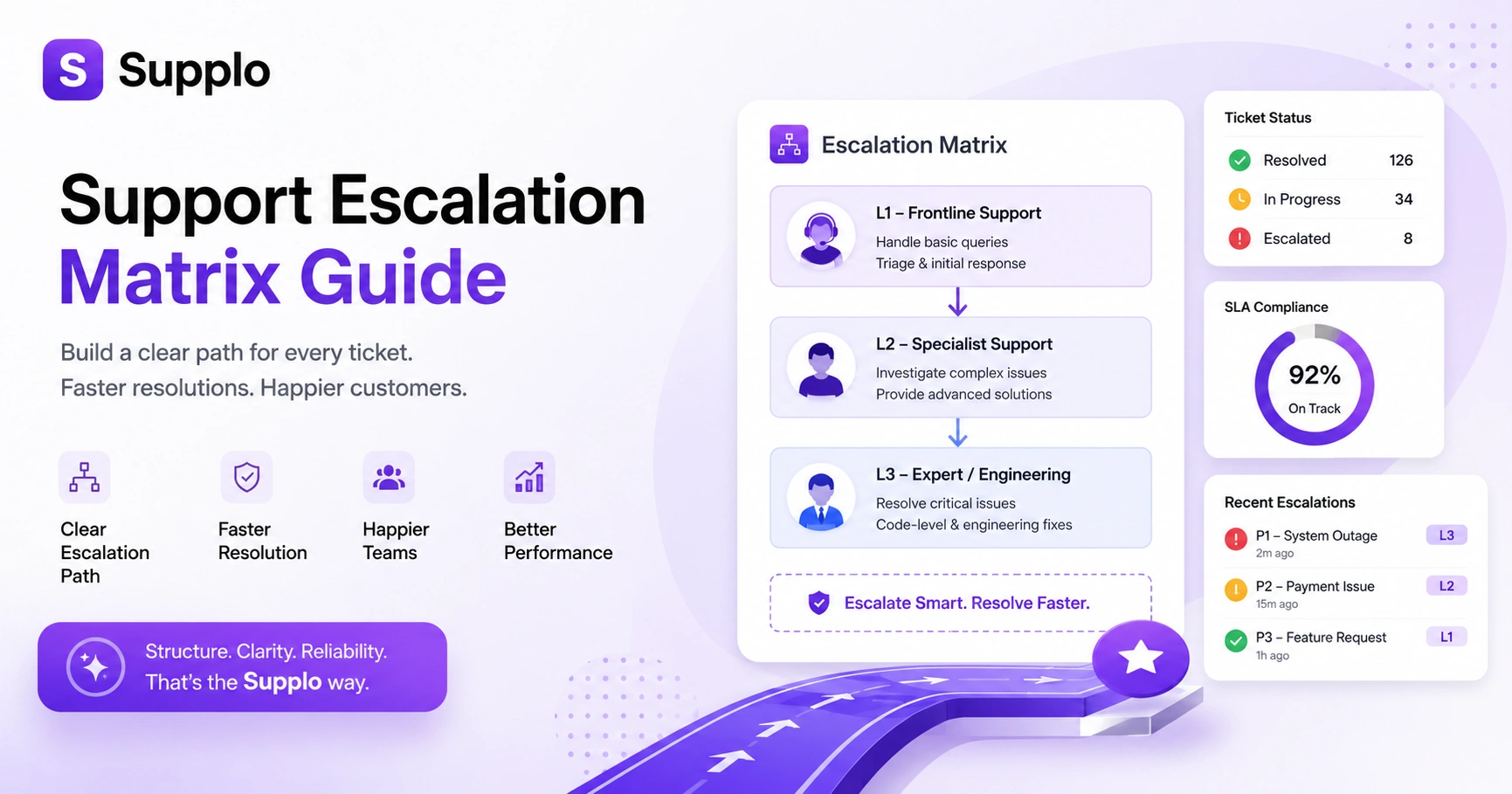
- Support is often tiered (L1, L2, L3); success is typically segmented by customer size or value.
Common Questions About Customer Support vs. Customer Success
People new to customer operations often mix up these two roles. Here are answers to the most frequent questions:
- "Is customer success the same as account management?" Not exactly; success focuses on value delivery; account management is more about the commercial relationship.
- "Can AI automate support but not success?" AI handles high-volume support tickets well, but success requires human relationship skills.
- "Which function reduces churn more?" Both; support stops immediate cancellations; success prevents long-term drift.
- "Should success report to sales or support?" Most high-functioning teams give success its own leadership.
- "How do I transition from support to success?" Build data skills, learn product strategy, and develop client-facing communication.
- "Can one person do both?" Yes, in very small teams, but it's hard to scale.
What a Customer Support Job Description Actually Looks Like
A modern customer support job description goes beyond "answer phones and reply to emails." Top companies look for agents who are technically curious, emotionally intelligent, and comfortable using automation tools. The best descriptions emphasize problem-solving over scripts and autonomy over micromanagement. Below is what a real support job description includes, and what you should look for when hiring.
- Key responsibilities: Triage inbound tickets via email, chat, and social channels; troubleshoot product issues; document bugs for engineering; update the knowledge base.
- Required skills: Clear written communication, basic technical proficiency, patience under pressure, ability to learn new tools quickly.
- Nice-to-have: Experience with a shared inbox or ticketing platform, familiarity with AI chatbots, multilingual ability.
- Metrics: Average handle time, first-response time, CSAT score, resolution rate.
- Growth path: Senior support specialist → team lead → customer success manager.
How Customer Support and Customer Success Should Work Together
When support and success work in separate silos, customers fall through the cracks. A support agent resolves a ticket but doesn't flag the account as at risk. A success manager plans a check-in but doesn't know the customer just logged a major complaint. The fix is a shared data layer, one system where both teams can see the full customer journey. That way, a support interaction becomes a handoff opportunity rather than a dead end.
Imagine this: A support agent resolves a billing issue, then pings the success team saying, "Hey, this account is frustrated. Might need a check-in." That simple handoff can save a relationship. That's the power of breaking down silos.
- Support passes escalation summaries to success so they can follow up.
- Success provides context on high-value accounts to deliver faster, personalized help.
- Both teams contribute to the same knowledge base; support writes solutions, success writes best practices.
- Use a platform like Supplo that unifies inbox, AI, and knowledge base so both teams are on the same page.
- The goal is a single view of the customer, not two separate versions of the truth.
Why Your Business Needs Both Functions to Reduce Churn
If you only have support, you are putting out fires but never fireproofing the house. If you only have success, you are building relationships but missing the daily pain points that drive customers away. Churn is almost always a combination of unresolved issues (support failure) and unmet expectations (success failure). Together, they form a closed loop: success identifies risk, support resolves blockers, and success re-engages the customer with renewed confidence.
It's a simple equation: support handles the "owies," and success ensures the patient gets healthy. Neglect one, and you'll bleed customers.
- Support data is early-warning intelligence; a spike in tickets from one account signals trouble.
- Success data is preventative: a drop in logins or feature usage flags a disengaged user.
- Companies with mature support and success functions report higher net revenue retention.
- A shared tool like Supplo's AI agent can automatically surface insights for both teams.
- The cost of acquiring a new customer is 5–7x higher than retaining one; both teams are retention levers.
The Tools That Power Modern Customer Support And Where Success Fits In
The right tooling can make the difference between a chaotic support operation and a well-oiled machine. Modern support requires a unified inbox that pulls email, live chat, WhatsApp, Instagram, and other channels into a single thread. AI agents handle common questions without human involvement, and a shared knowledge base serves both customers and agents. For success, the same tools can surface account health data and automate check-in reminders. The best setup is one platform that covers both, not five separate tools that never talk to each other.
You don't need a Swiss Army knife of different apps. You need one good knife that does everything well.
- A shared inbox prevents teams from working in the dark; everyone sees the full conversation history.
- AI agent can resolve up to 80% of inbound tickets, freeing humans for complex cases and success outreach.
- The knowledge base is the connective tissue between support and success; both teams build and use it.
- Success teams benefit from triggers that alert them when a customer opens multiple support tickets.
- Shared inbox eliminates the "he said, she said" handoff problem.
- Supplo's flat per-workspace pricing means you can add success team members without per-seat cost blowup.
The Cost of Getting It Wrong: When Support and Success Operate in Silos
The most expensive mistake a company can make is treating support and success as unrelated departments. When they operate in silos, critical information gets lost. A support agent spends 20 minutes solving a problem that the success team already documented. A success manager calls a client who is furious because their ticket from three days ago has not been answered. The result is duplicated effort, frustrated customers, and higher churn. The fix is simple but requires intentionality: shared data, shared tools, and shared goals.
It's like having two different doctors for the same patient who never talk to each other. One prescribes a medication the other already knows the patient is allergic to. It's inefficient and dangerous.
- Silo-driven churn is hard to quantify but shows up in "lost for unknown reasons" data.
- Customers notice when teams don't talk to each other; it erodes trust.
- Duplicate work is a hidden cost that drags down team morale and efficiency.
- A unified platform eliminates the "he said, she said" handoff problem.
- Supplo's thread-based inbox ensures every interaction is visible to both teams.
Getting Started: Building a Customer-First Strategy That Covers Support and Success
If you are a founder or operations leader, the question isn't "support or success?", it's "how do I sequence both?" Start with support. You need to handle inbound issues reliably before you can be proactive. Once you have a stable support operation (and the data from those tickets), hire or designate a success person. Give them access to the same tool and customer history, and a mandate to prevent problems, not just react to them. The goal is a continuous loop: support fixes what's broken, success strengthens what's working.
- Phase 1: Hire a support team, set up a shared inbox, and build a knowledge base.
- Phase 2: Introduce an AI agent to handle high-volume, low-complexity tickets.
- Phase 3: Assign a success owner, even if it's part-time, to review account health weekly.
- Phase 4: Integrate feedback loops so support tickets trigger success actions.
- The entire strategy works best on a platform that doesn't punish you for growing your team, like Supplo's pricing.
Key Takeaways
- Customer support is reactive, solving problems as they arise.
- Customer success is proactive, preventing issues and ensuring value.
- Both roles are essential for customer retention and business growth.
- Use a unified platform to ensure seamless collaboration between teams.
- Avoid silos by sharing customer data and using the same tools.
- Start with support and add success as you grow.
- The cost of churn is high; invest in both functions for better retention and growth.
Ready to Unify Your Support and Success Teams?
Ready to unify your support and success teams under one roof? Start with Supplo's 14-day free trial, see how an AI agent, shared inbox, and knowledge base can work together without per-seat pricing.
Supplo is not affiliated with any app or website. Please follow each app's terms and local regulations.
Don't Let Silos Cost You Customers
Don't let silos cost you customers. Supplo gives both teams the same customer view, so nothing slips through the cracks. Try it free, no credit card required.
FAQ
What is the main difference between customer support and customer success?
Customer support is reactive; it solves problems when customers ask for help. Customer success is proactive; it ensures customers get value before problems arise. Support fixes issues; success prevents them.
Can one person do both customer support and customer success?
Yes, in very small teams it is common for one person to handle both. However, as you grow, the reactive nature of support will crowd out the proactive work of success. Plan to separate them once you have the headcount.
Which function is more important for a startup?
Start with customer support. You cannot be proactive about success if your basic support is unreliable. Once support is stable, add success to reduce churn and drive growth.
What metrics should I use for customer support vs. customer success?
Support: first-response time, average handle time, CSAT, resolution rate. Success: net revenue retention, time-to-value, product adoption rate, expansion revenue.
Do support agents need different skills than success managers?
Yes. Support requires speed, patience, and technical troubleshooting. Success requires data literacy, relationship building, and strategic thinking. Both need empathy, but they apply it differently.
How do I prevent my support and success teams from working in silos?
Put them on the same platform. Use a unified inbox where both teams can see the full customer history. Hold joint weekly reviews to discuss at-risk accounts and share feedback from the front line.
Can AI handle both support and success tasks?
AI is best suited for support tasks, such as handling repetitive questions, triaging tickets, and suggesting answers. Success requires human judgment and relationship building. Use AI to free up your support team so they can focus on the complex work success demands.
Compliance line: Supplo is not affiliated with any app or website. Please follow each app's terms and local regulations.