On this page
Ever wished your support team had a super-smart assistant that never sleeps, never forgets a thing and costs a fraction of a full-time hire? That's exactly what an AI copilot for customer support does.
An AI copilot for customer support is a machine-learning tool that works alongside your human agents or resolves tickets on its own. It pulls answers from your knowledge base and past conversations, so every reply is accurate, consistent and fast. The result? 24/7 support without hiring a night shift and a team that's freed up to tackle the tough stuff.
Use an AI copilot when your team's drowning in repetitive questions, you need to scale without blowing your budget, or you want your best agents focused on high-value conversations. It might not be the right fit if you handle maybe three tickets a month, or if every single interaction requires deep, personal empathy, but for most growing businesses, it's a game-changer.
Quick Answer
- An AI copilot for customer support uses machine learning to assist agents or resolve tickets automatically.
- It learns from your knowledge base and conversation history for context-aware, accurate responses.
- Handles repetitive tasks so your human team can focus on complex, high-value issues.
- Unifies email, chat and messaging apps into one clean inbox.
- Can dramatically cut costs by automating a big chunk of incoming tickets at a predictable rate.
What Does AI Copilot for Customer Support Actually Mean?
Here's the simple version: an AI copilot is like having the smartest junior agent you've ever trained, one that never sleeps, never takes a sick day and remembers every single customer interaction.
It's a machine-learning tool that sits alongside your human agents or works autonomously. It can draft replies, suggest next steps and resolve tickets based on your knowledge base and past conversations. Unlike those clunky old chatbots, a real copilot learns from your specific context. It only escalates to a human when it's not confident it can nail the answer.
The key is natural language understanding. Customers don't need to use weird bot keywords or rigid commands. They type naturally and the copilot figures it out. It pulls from your knowledge base, email history and chat transcripts to build comprehensive, helpful responses.
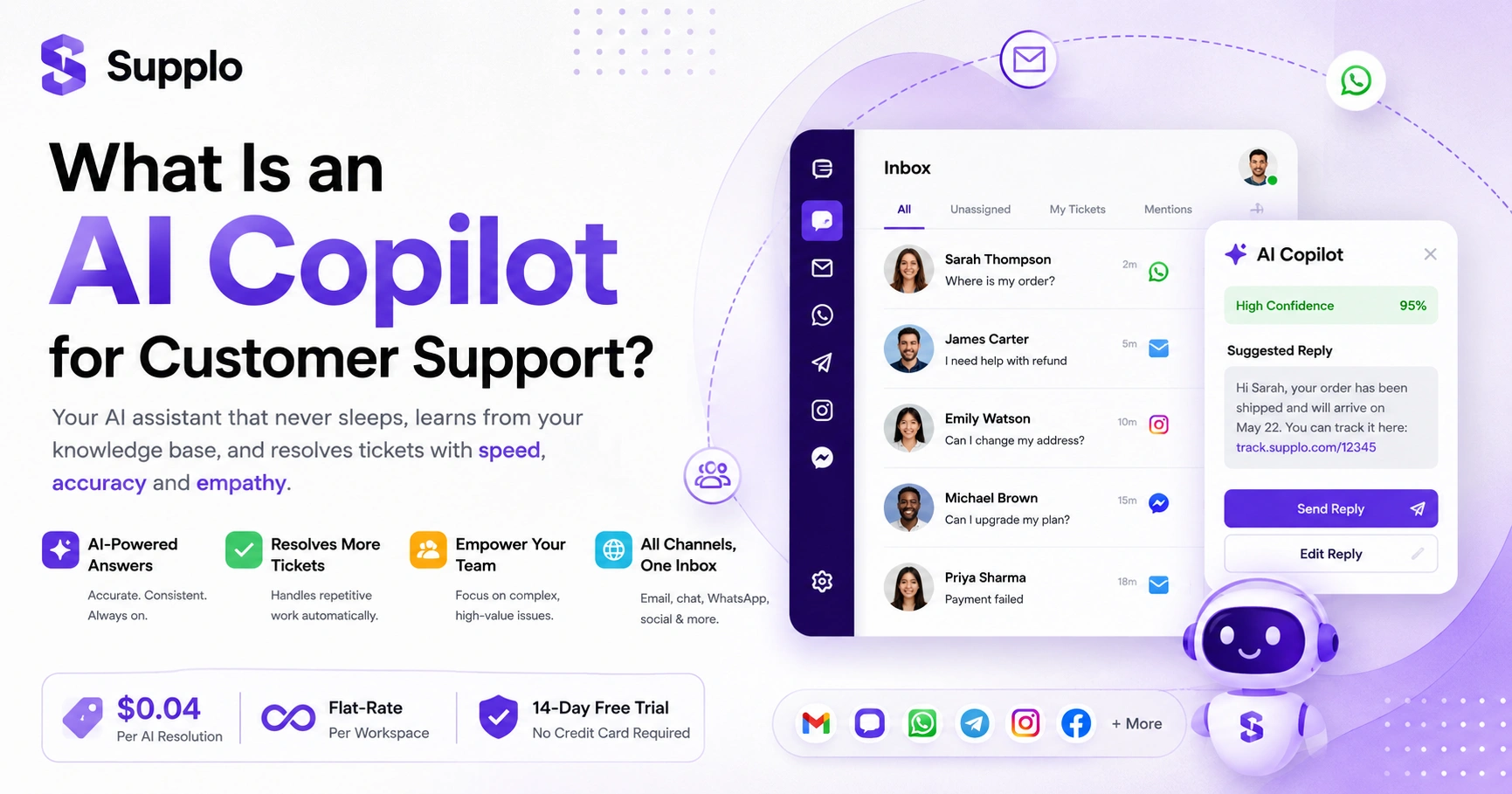
So what does that look like day-to-day? It handles FAQs, order lookups, password resets, all the stuff that eats up your team's time. It can even flag when a customer sounds frustrated and automatically route that conversation to a human. And it works across email, live chat, WhatsApp, Telegram, Instagram DMs and Facebook Messenger, all from one unified inbox.
The Real Benefits of an AI Copilot for Support Teams
Let's cut through the marketing fluff. The real advantages come down to three things: speed, consistency and cost control.
Customers get near-instant replies, even at 3 AM on a Sunday. Your agents never have to answer the same refund question 12 times in a single shift. And unlike legacy tools that charge per-seat and lock you into contracts, a modern copilot handles a huge portion of your volume at a predictable flat rate. No surprises, no bill creep.
First-response time drops dramatically. Often from hours to seconds. Every answer stays consistent with your latest policy updates, no more outdated info slipping through. Your support team can finally focus on complex tickets that actually need human judgment and empathy.
The training burden shrinks, too. The copilot learns from your documentation, not from your team's vacation schedule. And as your volume grows, the total cost of support stays manageable. No per-agent price hikes. No, oh wait, we hired two more people, now our software costs double.
How an AI Copilot Helps Customer Support Agents Every Day
Picture this: a ticket comes in. Before your agent types a single word, the AI has already surfaced the most relevant knowledge base article. It drafted a response. It's even flagged whether the customer sounds frustrated or satisfied.
That's the daily reality with an AI copilot.
If the AI is confident, it resolves the ticket on its own. Your agent never even sees it. If it's not sure, it prep everything the human needs: context, a suggested reply and related articles so that they can close the conversation in seconds instead of minutes.
Your agents stop suffering from reply fatigue because the AI auto-generates drafts for common queries. It identifies when a customer truly needs a human and routes them cleanly, no dead ends, no frustration. Messages are automatically translated, removing language barriers across channels. And here's the smart part: the AI learns from corrections. If an agent rewrites a response, the AI notes the change for future interactions.
Everything happens inside a single-thread inbox. No conversation gets lost. No channel gets ignored.
AI Copilot for Customer Support vs. Live Chat: What's the Difference?
Traditional live chat needs a human at the keyboard, waiting for someone to type. That means it only works during business hours, unless you want to pay for a night shift.
An AI copilot runs 24/7. Customers get answers instantly, even when your whole team is offline.
But here's the smarter play: combine them. Let the AI handle the first response. If a live agent is needed, the conversation transfers with full context. Your team never has to ask Can you repeat your problem? The customer gets fast answers and a warm handoff when things get complex.
Live chat alone is reactive. A human has to start or respond to every conversation. An AI copilot, on the other hand, can handle proactive and reactive support. It manages multiple chats simultaneously without queue build-up. It learns and improves over time, reducing the manual training you'd need for human agents.
The best approach? AI copilot plus human handoff. High-touch service at a lower cost.
AI Copilot vs. Chatbots: Why They're Not the Same Thing
A traditional chatbot is like a vending machine that only accepts exact change. Ask something it wasn't programmed for and it breaks.
An AI copilot understands context. It learns from your knowledge base. It can handle open-ended questions by reasoning through the content.
The difference is reliability. A chatbot fails when the customer asks something unexpected. A copilot figures it out, or knows when to hand off.
Chatbots rely on rigid, predefined rules. AI copilots use advanced machine learning and a continuous learning loop. Chatbots choke on synonyms and typos; copilots roll with them. A copilot integrates with your real data, tickets, knowledge bases and conversation history to provide informed responses. Most basic chatbots can't do that.
And crucially? A copilot escalates with full context. Customers don't have to repeat themselves. Chatbots often reset the conversation, forcing customers to start over. That's frustrating and it wastes everyone's time.
You don't need to rebuild your bot every month. The copilot adapts and improves with each interaction.
Core Features of an AI Copilot for Customer Service
Not every tool calling itself an AI copilot actually qualifies. Here's what to look for:
- A shared team inbox that unifies all your channels
- Self-learning AI that trains on your actual conversations
- Real-time sentiment analysis
- Smooth human handoff with full context
- A built-in knowledge base so you control what the AI knows
That last one matters. If you can't control the AI's knowledge, you can't guarantee its accuracy. And if a copilot can't explain why it gave a particular answer, it's not a copilot, it's a black box.
A true AI copilot, like Supplo, gives you a multi-channel inbox that integrates email, live chat widgets, WhatsApp, Telegram, Instagram DMs and Facebook Messenger. The self-learning AI continually improves through agent corrections, becoming more accurate over time. Unified conversation history means no duplicate tickets and no lost context. Advanced sentiment detection and automated escalation triggers ensure that urgent issues reach a human quickly. And the built-in knowledge base is your safety net for maintaining a consistent brand voice.
Which Support Channels Can an AI Copilot Handle? And Why It Matters
A modern AI copilot should unify all the channels your customers actually use. Email, website, live chat, WhatsApp, Telegram, Instagram DMs, Facebook Messenger, all in one place. With automatic translation across languages.
If your copilot only works on one channel, you're essentially running two support systems. That defeats the purpose.
A unified inbox means no dropped threads. No customers re-explaining their issue because it got routed to the wrong place. One single source of truth for every conversation.
A robust setup handles email ticketing smoothly, turning inbound emails into trackable tickets. It provides native support for WhatsApp and Telegram, complete with media sharing. Social channels like Instagram DMs and Facebook Messenger stay organized and searchable. A smart website widget can even trigger proactive chats based on what a visitor is doing on your site.
And the language translation? That's huge. You can support customers in any language without hiring a dedicated translation team. Your global support becomes seamless.
Compliance line: Supplo is not affiliated with any app or website. Please follow each app's terms and local regulations.
The Hidden Advantage: Reliable, Flat-Rate Pricing Over Per-Seat Models
Here's where most support tools quietly punish you, the price per agent. So as your team grows, your bill inflates at the same rate. Want to hire more people? Great, your software cost goes up, too. It's like being penalized for growing.
Smarter alternative: flat-rate pricing per workspace. Add as many agents as you want; the software cost stays the same.
Supplo charges a flat workspace fee (free to start), plus just $0.04 per AI resolution. Compare that to the $0.99 many legacy tools charge. The savings add up fast.
And yes, you can pay with crypto. Binance Pay, Payeer, GCash, AmanPay, QIWI Wallet, DOKU, Nigeria and South Africa cards, Skrill, Payoneer, no weird restrictions.
Flat-rate pricing means no per-seat charges and a single consistent workspace cost, regardless of team size. AI resolutions at $0.04 each keep billing predictable, even during high-volume months. There's a free 14-day trial with no credit card required. For global teams, the crypto and diverse payment options make it easy to get started.
How to Get Started with an AI Copilot for Customer Support
Getting started doesn't have to mean weeks of configuration. With a modern copilot, you connect your email and chat widget, upload your knowledge base and the AI starts learning from your existing conversations within hours.
You keep your current workflows intact. The copilot sits alongside your team and takes over only when it's confident. No disruption, no complicated migration.
Steps to Get Started:
- Connect Your Channels: Link your email, website widget, WhatsApp, Telegram, Instagram and Messenger accounts in a matter of minutes.
- Upload Your Knowledge Base: Import your existing knowledge base or let the AI learn directly from your past tickets and customer interactions.
- Define Escalation Rules: Set clear rules for when a human agent should take over to ensure seamless handoffs.
- Test Live: Start testing with real customers immediately. No complex staging environments needed.
- Monitor & Adjust: Use the analytics dashboard to track performance and tweak AI thresholds as needed.
See How Much Your Team Could Save, No Commitment Needed
Connect your first channel, upload a knowledge base and let the AI handle real customer conversations during your free 14-day trial. No credit card required, no time limit on your trial.
Common Misconceptions About AI Copilots And Why They're Wrong
Some teams worry that AI copilots will replace human agents. Others think they're too complex to set up. Neither is true in a well-designed system.
A copilot makes your agents better, not redundant. It handles the drudgery so humans can focus on empathy. And modern pilots don't require a data science degree. If you can upload a knowledge base, you can train one.
The real risk? Ignoring the technology while competitors build faster, cheaper and more reliable support operations.
Common Misconceptions & Realities:
- Myth: AI will replace my support team. Reality: AI offloads repetitive, low-value tasks. Human agents focus on complex, empathetic, strategic conversations.
- Myth: It's too hard to set up. Reality: Modern solutions like Supplo connect in under 30 minutes, no extensive technical expertise required.
- Myth: It can't handle complex questions. Reality: A well-trained AI copilot recognizes complexity and escalates with full context. It knows what it doesn't know.
- Myth: Customers hate talking to AI. Reality: Most customers prioritize fast, accurate answers. When an AI copilot delivers quick resolutions, satisfaction often goes up.
If Your Current Tool Overcharges or Underdelivers, Try the Alternative
If resolution fees, per-seat pricing, or multi-channel chaos are costing you more than they should, Supplo is the practical alternative. Flat workspace pricing, transparent AI and real human support behind the scenes.
Build Reliable Support That Grows With You, Not Against You
Your support team deserves a tool that scales without surprise price increases. Start with a free trial and see why teams switch from legacy tools to a copilot that actually works.
FAQ
What exactly is an AI copilot for customer support?
An AI copilot is software that uses machine learning to understand customer questions, pull answers from your knowledge base and either resolve tickets automatically or prepare drafts for human agents. It works 24/7 across email, live chat and messaging apps.
How is an AI copilot different from a regular chatbot?
A chatbot follows rigid, pre-programmed decision trees and fails when customers ask unexpected questions. An AI copilot uses natural language understanding and learns from your actual conversations, so it can handle open-ended queries and escalate with full context.
Will an AI copilot replace my human support agents?
No. It handles repetitive, low-complexity tickets, freeing your agents to focus on nuanced, emotional, or high-value conversations. The copilot makes your team faster and less burned out, not redundant.
What channels does an AI copilot support?
A modern copilot supports email, website live chat, WhatsApp, Telegram, Instagram DMs and Facebook Messenger, all in one unified inbox. It also automatically translates messages across languages.
How much does an AI copilot typically cost?
Pricing varies widely. Legacy tools often charge $0.99 per AI resolution or per-seat fees that balloon as your team grows. Supplo charges a flat workspace fee plus $0.04 per AI resolution, with a free 14-day trial.
How long does it take to set up an AI copilot?
Most teams can connect their channels and upload a knowledge base in under 30 minutes. The AI begins learning immediately from your existing conversations and knowledge base content.
Does the AI Copilot work if I already use another support tool?
Yes. Connect your existing email and add the Supplo widget alongside your current systems. The copilot unifies conversations across all channels into a single thread-based inbox, allowing you to migrate gradually.
Supplo is not affiliated with any app or website. Please follow each app's terms and local regulations.
Compliance line: Supplo is not affiliated with any app or website. Please follow each app's terms and local regulations.