On this page
If your support inbox is flooded daily with Where's my code? And my OTP expired again, you know the drill. It's exhausting, repetitive and frankly, a waste of your team's talent. This guide is for customer support managers, product owners and operations leads at SaaS companies and ecommerce stores who want to automate customer support for OTP and SMS verification services with AI. Use this when your ticket volume is climbing and your agents are stuck in an endless loop of resend code requests. Don't use this if you're hoping to replace your entire security team. AI handles the busywork, not the compliance layer.
Quick Answer:
- OTP support is painfully repetitive (5 common queries: not received, expired, resend, wrong number, blocked).
- AI chatbots can check delivery logs, resend codes and switch to voice/email fallbacks instantly.
- Setup requires API integration to your SMS gateway (think webhooks for real-time status)
- Always set a max resend limit (2-3 attempts) to prevent loops.
- Escalate persistent failures to human agents with full context (delivery log, carrier, resend attempts).
Why OTP and SMS Verification Support Is the Perfect Use Case for AI Automation
Here's the thing about OTP and SMS verification support: it's almost too perfect for AI. The interactions are highly repetitive and transactional. Users almost always ask the same five questions: Didn't get the code, Code expired, Can you resend it, Wrong number, or Blocked. An AI support agent or AI customer support chatbot can handle these queries instantly, 24/7, without tying up human agents. This reduces resolution time from minutes to seconds and dramatically lowers support costs for businesses relying on SMS verification.
The common pain points in manual OTP support
Manual OTP support creates long wait times for users who need a simple resend, which harms user trust and verification completion rates. Agents end up copy-pasting the same instructions over and over, leading to burnout. And let's not forget the error-prone handoffs like when an agent accidentally resends a code to the wrong number, introducing security risks.
How AI transforms a reactive process into a proactive one
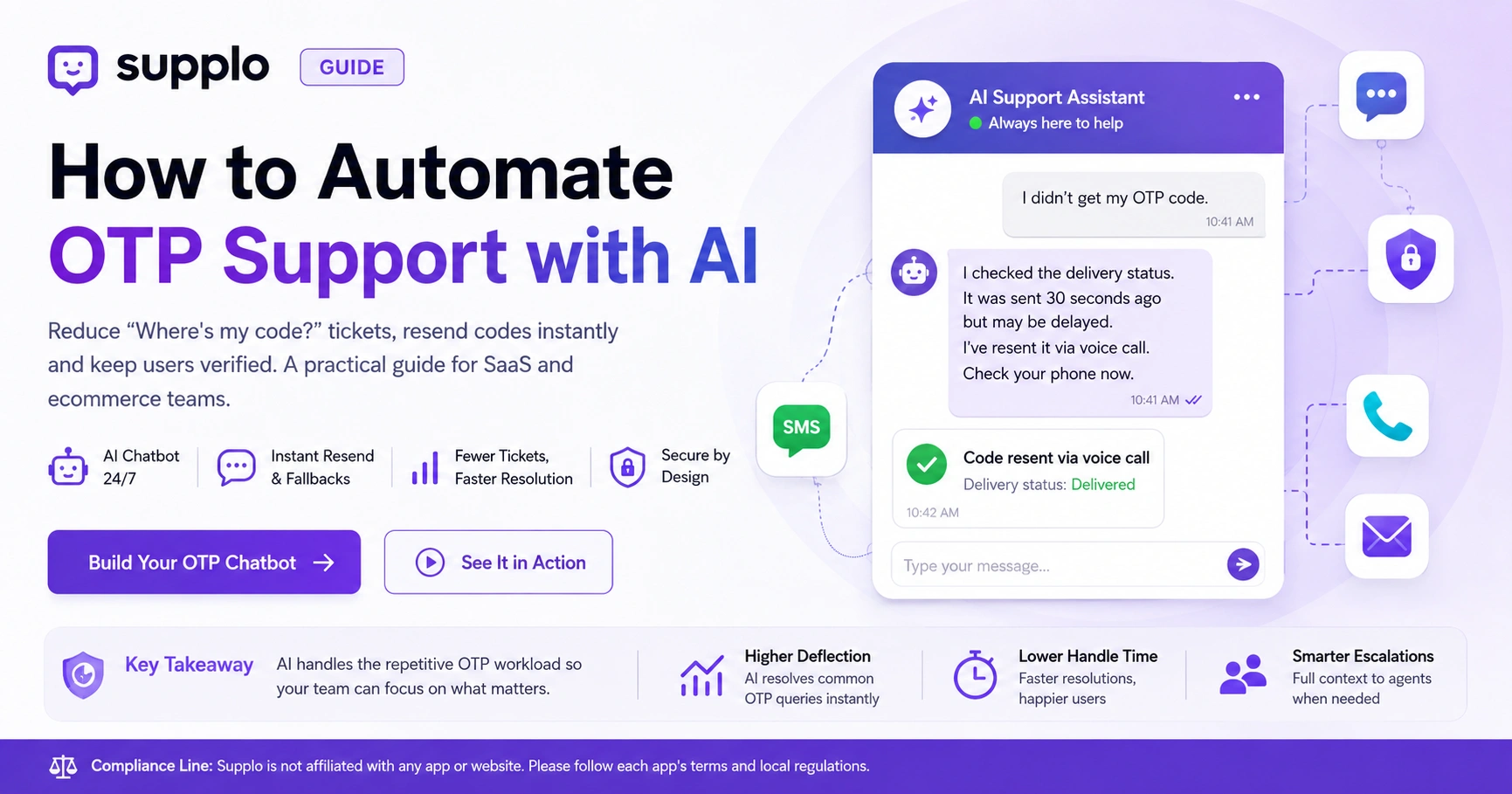
An AI chatbot for OTP verification can check the real-time delivery log the moment a user types didn't get code. Instead of saying please wait, it says Your code was sent 30 seconds ago. Let me check my carrier status. I see a delay. I resent it via voice call. Check your phone now. That's the difference between reactive waiting and proactive resolution.
What You Need to Know About OTP Verification Automation Before You Start
OTP verification automation isn't just about plugging in a chatbot and calling it a day. It requires a clear understanding of your verification flow, SMS gateway and security boundaries. A modern AI customer service chatbot for OTP verification differs from a basic autoresponder because it can understand context, handle side conversations (like Why did I get blocked?) and escalate intelligently. Before you start, map out every step your users take during verification and identify where they commonly get stuck.
The difference between AI chatbots and traditional autoresponders
A traditional autoresponder sends a canned We'll get back to you message. An AI SMS support bot? It queries your delivery API, checks rate limiting, verifies the user's identity via partial data (e.g., last 4 digits of phone number) and then executes a resend or fallback all within the same chat session. It learns from each interaction to improve accuracy over time.
Key components of a reliable AI support stack
You need three components: an SMS gateway with delivery-receipt webhooks, an AI support platform (like Supplo) that can receive and act on those webhooks and a clear escalation path to human agents. Without real-time delivery logs, the AI can't accurately answer Did the code send? and that erodes user trust fast.
Identify Your Most Common OTP and SMS Verification Support Issues
The first step to reliable automation is understanding exactly why your users contact support about OTPs. Most issues fall into three categories: code never delivered, code expired before use, or carrier/network failures. By analyzing your existing support tickets, you can build a knowledge base and an AI training set that covers 90% of those scenarios. This ensures your AI for customer service can immediately provide the right solution like a resend, a format change, or a voice call fallback.
Tracking delivery failures and timeouts
Review your SMS gateway's logs to find carriers with high failure rates or consistent 5+ second delivery times. For example, some international carriers filter SMS from unknown short codes. The AI can then ask the user to switch to a voice OTP, bypassing the carrier filter entirely.
Understanding user confusion around rate limits and expiry
Users often try to request a new code repeatedly, hitting your rate limit and locking themselves out. The AI should explain the limit clearly: You've requested a code three times in 5 minutes. Please wait 2 minutes before trying again, or I can escalate to a human agent who can help manually.
Configure Your AI Chatbot for OTP Verification
Configuring an AI chatbot for phone verification involves connecting your support platform to your SMS delivery infrastructure. You'll need to give the AI visibility into delivery statuses so it can answer Did the SMS send? without human intervention. Set up a secure verification flow where the AI can verify a user's identity using partial data (e.g., the last 4 digits of a phone number or a masked email) before executing sensitive actions like a resend. Supplo's platform simplifies this with native API integration.
Connecting your SMS gateway and delivery API
Integrate your SMS provider's webhooks with your AI support platform. This streams real-time status updates (sent, delivered, failed, or pending) directly into the chatbot's context. Ensure the AI can distinguish between a true delivery failure and a carrier queue delay.
Training the AI on your verification flow and security policies
Feed your AI examples of common identity verification questions. For example, before I resend that code, can you confirm the last 4 digits of the phone number on file? The AI must never share raw OTP values over chat; they should always be masked. This protects against account takeover attempts via chat interception.
Ready to see it in action? Create a free Supplo account and test our AI chatbot with your own test phone number. No credit card is required.
Build Automated OTP Response Workflows for Code Not Received
The code not received query is the most common support ticket for verification services. An automated OTP response workflow should first check the delivery log, then offer a resend (if the original was sent but delayed), or switch to an alternate channel (if the original failed). The AI should also check rate limits to prevent abuse. If the issue persists, the workflow escalates to a human agent with the full delivery history attached, so they don't have to ask the user to repeat the problem.
Triggering automatic resend requests
Workflow 1: If the delivery log shows pending, ask the user to wait 60 seconds, then resend. Workflow 2: If the log shows failed, offer to switch to voice OTP or email. Always verify identity before resending. Set a maximum of 2-3 resend attempts per session to prevent abuse.
Escalating persistent failures to human agents with full context
If the delivery log shows sent but the user insists they didn't get it flag for human review. The AI should attach the delivery log, carrier ID and resend history to the escalation ticket. This eliminates the please describe your problem again loop that frustrates users.
How to Optimize OTP Delivery Using AI for Faster Verification
Optimizing OTP delivery with AI customer support isn't just about faster responses in chat, it's about making the real-world delivery of the SMS itself more reliable. AI can analyze delivery failure patterns by carrier, time of day, or region and proactively route future messages through a more reliable provider. It can also detect when a user's phone is on a VoIP or non-SMS-capable line and automatically route verification through an alternative method before the user even asks.
Real-time carrier status checks and intelligent routing
Program the AI to monitor time-to-delivery metrics. If a carrier consistently takes >10 seconds or shows a high failure rate, the AI can automatically reroute the next OTP through a secondary provider or switch to a voice call via the user's carrier network. This reduces the code never arriving scenario significantly.
Reducing false positives and improving SMS verification reliability
False positives occur when the AI marks a sent code as delivered, but the user insists otherwise. Train the AI to trust the delivery log, but also prompt the user: I see the code was marked as sent. Carriers occasionally delay. Would you like me to try a voice call instead? This acknowledges the user's experience while avoiding incorrect denials.
Troubleshooting Common AI SMS Reliability Issues
Even the best AI SMS reliability setup can hit snags. Common problems include the chatbot getting stuck in a resend loop because it doesn't recognize a successful delivery, API keys expiring without alerting the team, or the AI misunderstanding a user's issue (e.g., my phone is off vs. carrier blocked). To avoid this, build health checks into your workflow and always give users a quick Talk to a human escape hatch. Supplo is not affiliated with any app or website. Please follow each app's terms and local regulations.
Handling API downtime and partial failures
Your SMS gateway may go down or return partial errors. The AI should recognize a gateway error (e.g., HTTP 503) and immediately inform the user: Our SMS system is temporarily unavailable. I've escalated this to our team. You'll hear back within 5 minutes. Do not let the AI pretend everything is fine.
Avoiding loop errors and over-automation
Set a strict max resend limit per session (2-3 attempts) and force a human escalation after that limit is reached. Also, program the AI to wait at least 30 seconds between resends to account for network latency. Test the bot regularly by simulating real user traffic (e.g., using test numbers and carriers). If the AI frequently escalates sent codes, increase its trust in the delivery log by cross-referencing multiple webhook events.
If your OTP codes are still failing after troubleshooting, your support logic might need a professional review. Talk to our team at Supplo where we'll help you build a workflow with higher acceptance rates and fewer false escalations.
Measuring the Success of Your AI Customer Support for OTP Delivery
To know if your AI-powered OTP solution is working, track metrics like first-contact resolution rate for OTP queries, average handle time reduction and escalation rate to human agents. Avoid marketing claims about unverifiable success percentages; instead, focus on trend direction. A well-optimized system should see a steady decrease in repeat tickets about the same code and an increase in user satisfaction scores for OTP-related interactions.
Key metrics to track (without unverifiable claims)
Deflection rate: % of OTP queries resolved by AI without human intervention.
Re-contact rate: % of users who chat the bot, get a resend, then chat again within 5 minutes (signals failure).
Average handle time (AHT): Compare before vs. after AI implementation.
Escalation rate: % of OTP chats escalated to human agents; a healthy rate is 10-20%.
How to use feedback to refine the AI's escalation logic
Review session transcripts weekly to identify new OTP issues the AI wasn't trained on. For example, a sudden spike in code received but didn't work may indicate a system-side bug. Adjust the AI's escalation trigger: if the user types tried it but is still blocked, the AI should immediately escalate with a screenshot of the user's failed attempt. For more insights, explore on support metrics.
The Future of AI-Powered OTP Solutions and Customer Verification
While SMS OTPs aren't going away tomorrow, the landscape is shifting toward passkeys, biometrics and silent network authentication (SIM-based). However, AI will remain critical as the unified support layer for all these methods. When a passkey fails or a biometric scan is rejected, users will still need real-time, empathetic help and that's where an AI customer support automation shines. The smartest businesses are building AI support systems now that can adapt to any verification method.
Trends in passkeys, biometrics and hybrid verification
Expect AI to preemptively detect verification failures before the user does. For instance, if a user's device doesn't support biometrics, the AI can proactively offer an SMS fallback. Hybrid support models (AI + Human) will become the standard for security-critical flows, where the AI handles the first 80% of the interaction and seamlessly hands off to a human for the remaining 20%.
Why AI remains the backbone of reliable delivery support
Even with advanced methods, delivery failures happen. Network issues, device incompatibility and user error persist. AI automates the immediate fix of fallback channels, identity verification prompts and intelligent escalation so human agents only intervene when the situation demands a deeper investigation.
Conclusion:
Build a Reliable, Scalable OTP Support System with Supplo.
Automating customer support for OTP and SMS verification services with AI isn't just about saving money, it's about earning trust. Every second a user waits for a code they need, their confidence in your service drops. With Supplo, you get a unified workspace that combines an AI chatbot, a shared team inbox and a self-learning knowledge base. It's built for SaaS companies and ecommerce stores that need to scale support without scaling headcount and it supports website chat, email and WhatsApp out of the box. Supplo's AI learns from every interaction to get smarter about your verification flows and its seamless handoff from AI to human agents provides full conversation context. Check our Supplo's pricing for flexible plans that scale. Ready to build your OTP verification chatbot? Sign up for Supplo today and start with a free trial with no credit card required.
Key Takeaways:
OTP support is uniquely suited for AI because of its repetitive, transactional nature.
Configure your AI to check real-time delivery logs before offering a resend.
Always verify identity before executing sensitive actions like code resends.
Set a max resend limit (2-3 attempts) to prevent abuse and loops.
Use metrics like deflection rate and re-contact rate to measure success.
FAQ
Is it legal for a business to use an AI chatbot for OTP verification?
Yes, it's perfectly legal to use an AI chatbot for OTP verification support, as long as the AI follows security best practices (like verifying identity before resending codes) and doesn't store or share unencrypted OTPs. Always make sure your setup complies with local data protection regulations like GDPR or CCPA.
Why does my OTP code fail to deliver, even when the phone number is correct?
OTP delivery failures often happen because of carrier filtering (treating the SMS as spam), network congestion, temporary roaming issues, or the recipient's phone being on Do Not Disturb mode. An AI chatbot can check the delivery log and offer an alternative like a voice OTP to bypass these issues.
Can an AI chatbot resend an OTP automatically?
Yes, an AI chatbot for OTP verification can resend a code automatically. Still, it must first verify the user's identity (e.g., by asking for the last 4 digits of their registered phone number or a backup email). This prevents bad actors from requesting resend storms against a targeted account.
How do I stop an AI chatbot from getting stuck in a resend loop?
Set a strict max resend limit per session (typically 2-3 attempts) and force an escalation to a human agent after that limit is reached. Also, program the AI to wait at least 30 seconds between resends to account for network latency.
What should I NOT use an AI chatbot for in SMS verification?
You should not use an AI chatbot to bypass security protocols, share raw OTP values over chat (they should be masked), or act as the sole verification method for high-value transactions without human oversight. AI is a support layer, not a replacement for secure authentication logic.
How can I troubleshoot a Code Not Received issue with my AI system?
First, check the real-time delivery log in your SMS gateway. If the delivery status shows Sent, the issue is likely on the carrier or user device side. Instruct your AI to offer a resend via a different channel (voice call or email) and escalate to a human agent if the problem persists after two attempts.
Will using an AI chatbot for OTP support improve my verification success rates?
Yes, indirectly. While the AI doesn't control carrier infrastructure, it drastically reduces the time a user waits for help. By immediately offering resends, alternate channels and contextual troubleshooting, the AI prevents user frustration and abandonment, effectively improving the perceived and actual completion rate of the verification flow.
Compliance Line: Supplo is not affiliated with any app or website. Please follow each app's terms and local regulations.