On this page
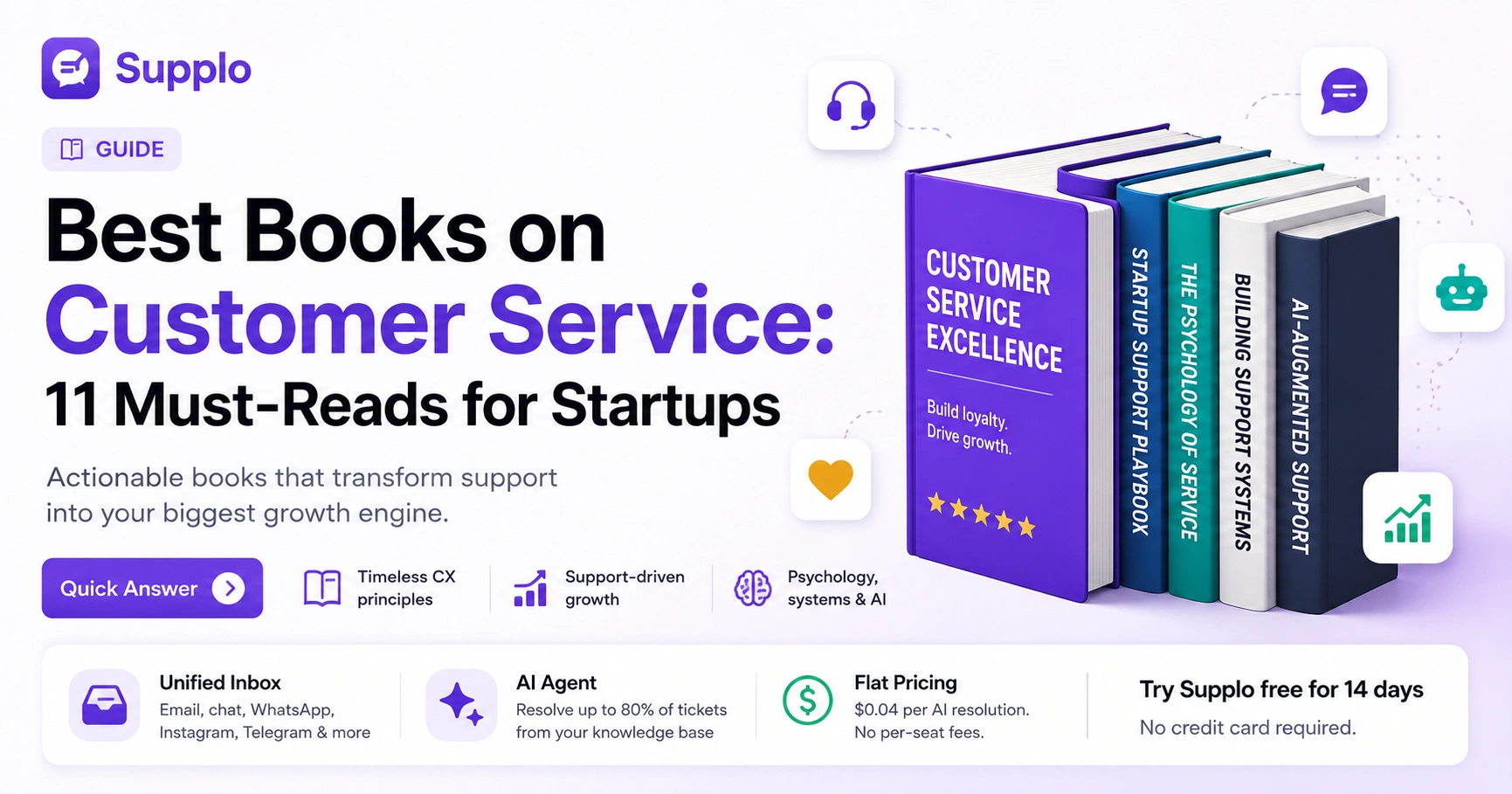
Look, you already know that support isn't just about fixing broken stuff. It's about actually keeping customers around, building relationships, driving loyalty, making people feel heard. But with a million books out there, where do you even start? The best books on customer service cut through the noise and give you frameworks that actually work, whether you're a solo founder drowning in tickets or a team lead trying to build something scalable.
Quick Answer
- Start with foundational classics for timeless CX principles.
- Focus on support-driven growth for startups.
- Understand the psychology of service to handle customer emotions.
- Build robust systems for operational excellence.
- Embrace AI-augmented support for efficiency.
- Turn lessons into action with a unified support tool like Supplo.
Why Reading the Right Customer Service Books Changes How You Build Support
Most teams treat customer support like a cost center, a necessary evil. But the right books flip that script; they show you that support is actually a retention engine and a feedback loop that shapes your product. Reading the best books on customer service early (especially when you're bootstrapping) saves you from expensive mistakes like scaling a broken process instead of a good one.
- Frameworks over tactics: Books give you frameworks, not just tactics; frameworks survive team turnover, tactics don't.
- Support vs. experience: The difference between "support" and "experience" is the difference between fixing a bug and preventing the frustration that caused it.
- Real-world insights: Most top customer service books were written by founders or operators who actually handled tickets; they're tested, not theoretical.
Ready to put these principles into practice? Start with a free 14-day trial of Supplo and see how a unified inbox + AI agent can handle your first-line support while you read the books.
The Foundational Classic: Start Here for Timeless CX Principles
If you read one book, make it the one that practically invented modern customer service thinking. It teaches that service isn't a department; it's the entire company's job. Every interaction is either a brand-building moment or a brand-damaging one. Books like this are must-read customer service books because their principles predate the internet and still hold up.
- Moment of truth: Covers the moment of truth concept, those seconds where a customer decides if you care.
- Recovery matters: Teaches why recovery (handling a complaint well) often creates more loyalty than a smooth transaction.
- Culture is everything: Warning: don't skip the sections on culture; culture eats process for breakfast in support.
The Modern Playbook for Startup Customer Support
Startups can't afford the enterprise playbook of hiring armies of agents. The best customer service books for new businesses focus on support-driven growth, using every ticket to learn what's broken in the product. This book in particular argues that your first support hire shouldn't be a support person but a product-minded generalist.
- Ticket debt: Introduces the concept of ticket debt, ignored issues that pile up and destroy retention.
- Prioritize effectively: Shows how to prioritize which customers get your personal attention vs. which ones need automation.
- Hiring strategy: A practical framework for deciding when to hire your second support person (hint: it's earlier than you think).
Best Books on Customer Experience for Leaders Who Want to Drive Retention
This is less about answering tickets and more about designing the entire journey a customer takes, from finding you to churning. CX books for leaders often map the ladder of loyalty and show exactly where most companies lose people. It's not about making customers happy; it's about making their goal easier to achieve.
- Jobs-to-be-done: Introduces the jobs-to-be-done framework for supporting interactions.
- Measure what matters: Teaches why measuring CSAT alone is misleading; you need effort score and churn prediction.
- Map pain points: Leaders learn to map pain points before they become support tickets.
The Psychology of Service: Understanding What Your Customers Actually Feel
Most service failures aren't about the product; they're about the customer's emotional state. Top customer service books in this category teach you to recognize anger, frustration and confusion before they escalate. It also covers the neuroscience of why people remember the end of an interaction more than the middle (the "peak-end rule").
- Ladder of inference: The ladder of inference shows how customers jump from a small bug to: this company doesn't care.
- De-escalation techniques: Techniques for de-escalation that work over chat, email and phone.
- Apologize wisely: Why apologizing too early can backfire and what to say instead.
How to Build Support Systems That Don't Break
Even the best team collapses under bad systems. This essential customer service literature focuses on workflows, SLAs and automation that let you sleep at night. It covers how to design a shared inbox, when to escalate and why a knowledge base is your best hire (it works 24/7 for free).
- One-touch resolution: Teaches the one-touch resolution ideal: solve it the first time, or you've failed.
- Tagging and categorizing: Explains why tagging and categorizing tickets isn't admin work; it's the raw data for product decisions.
- First response vs. resolution: How to measure time to first response vs. time to resolution and which one actually matters.
Customer Service for Startups Books: When You Have Zero Budget and a Full Queue
This specific book is written by a founder who grew a company from zero to millions while answering every single email himself in the early days. It gives you permission to use AI, templated replies and triage systems without feeling like you're cheating your customers. It argues that "scaling yourself" is more important than "scaling your team."
- Triage funnel: Introduces the triage funnel: decide in 10 seconds whether a ticket needs you, an AI, or an FAQ link.
- Personal touch: Why a personal touch on 10% of tickets beats a mediocre touch on 100%.
- Know when to say no: Real talk on when to say we can't help you and move on (it's okay to lose the wrong customers).
The Unpopular Book: Why Good Service Means Saying No
Most customer service books tell you always to say yes. This one argues that saying yes to every request dilutes your product and burns out your team. It's a counterintuitive read that shows how setting boundaries (like not supporting old versions or feature requests that don't fit your roadmap) actually builds respect.
- Customer obsession vs. servitude: The difference between customer obsession and customer servitude: the former is healthy; the latter is toxic.
- Graceful exits: How to fire a customer gracefully (without getting a bad review).
- Value clarity: Why some of your best customers are the ones who push back on pricing; they're telling you the value is unclear.
If your current support tool is burning budget with per-seat pricing, it's time to switch to a flat-rate model. Supplo starts at $0.04 per AI resolution and doesn't charge per agent. Test the difference today.
Books That Teach AI-Augmented Support
The best customer service books now include a chapter on AI, but the good ones don't promise magic. They teach you how to train a model on your own knowledge base, how to measure AI resolution rate honestly and when to escalate back to a human. The goal isn't to replace your team; it's to handle the boring, repetitive questions so your team can handle the hard ones.
- Human-in-the-loop: Covers the human-in-the-loop model, AI answers first draft, human reviews before sending.
- Clean knowledge base: Why your knowledge base must be clean before you turn on AI; garbage in, garbage out.
- Real cost savings: Real numbers on cost savings (without fake promises); the author cites industry averages, not vendor hype.
Influential Customer Experience Books That Predict the Future of Service
Some of the most influential customer experience books look 5–10 years ahead and predict that support will shift from reactive (waiting for a ticket) to proactive (predicting problems and fixing them before the customer notices). They also predict that asynchronous communication (chat, email) will fully replace the phone as the primary channel, even for complex issues.
- Conversational commerce: The rise of conversational commerce is driven by support happening where customers already are, such as on WhatsApp, Instagram, and Telegram.
- Invisible support: Why the companies that win will be the ones that make support invisible (embedded in the product, not a separate experience).
- Blurred lines: The prediction that support teams will blend with product teams; the line is already blurring.
How to Turn Book Lessons Into a Real Support Strategy (With Supplo)
Reading is worthless without action. The books above teach you to prioritize speed, empathy and automation, but you need the right tool to execute. Supplo brings those lessons to life with a shared inbox that unifies email, chat, WhatsApp, Instagram DMs and Telegram support into a single thread and an AI agent that learns from your knowledge base to resolve up to 80% of tickets at a flat $0.04 per resolution: no per-seat pricing, no hidden fees.
- One-touch resolution: Apply the one-touch resolution ideal: Supplo's AI handles first-line, humans handle escalations.
- Customer history: Use Supplo's inbox to see full customer history in one thread, exactly what the foundational CX books teach.
- Free trial: Start free with a 14-day trial; no credit card needed to test the principles against real traffic.
- Scalable pricing: Pricing is flat per workspace, so your bill doesn't balloon as your team grows, a lesson from the budget-conscious startup books.
Books give you the theory. Supplo gives you the execution. Unify your email, website chat, WhatsApp, Telegram, Instagram DMs and Facebook Messenger into one thread, with an AI agent that learns from your knowledge base. Start now with a 14-day free trial, no credit card required.
Key Takeaways
- The best customer service books teach frameworks, not just tactics: foundational CX principles, support-driven growth and the psychology of service.
- Startup-focused books emphasize triage, automation and saying no, not just always say yes.
- Modern books cover AI-augmented support, omnichannel inboxes and proactive service, all of which you can test with Supplo's flat-priced platform.
- Actionable takeaway: Read the theory, then apply it with a tool that unifies email, chat and social DMs into one thread.
FAQ
Is it legal to use a temporary phone number for verification?
It depends on the platform's terms of service. Many apps prohibit the use of temporary or virtual numbers for account creation. Always review the app's rules before using one. Supplo is not affiliated with any app or website. Please follow each app's terms and local regulations.
Why do some temporary numbers fail verification codes?
Many apps block known virtual number ranges. If a code fails, try a different provider or a number from a less common prefix. Some apps also rate-limit numbers, so waiting a few minutes before retrying helps.
What's the difference between one-time and rental numbers for SMS verification?
One-time numbers are used for a single code and then discarded; they're cheap but may already be burned. Rental numbers give you longer access (e.g., 30 days) and are less likely to be flagged, making them better for accounts you'll use repeatedly.
What should I NOT use a temporary phone number for?
Avoid using temporary numbers for banking, government services, healthcare portals, or any account that holds sensitive personal data. These services require stable access to perform password resets and receive fraud alerts.
How do I troubleshoot a temporary SMS number that stopped receiving messages?
First, check if the number's rental period expired. Second, confirm the sender supports SMS to virtual numbers (some apps now send only via in-app push). If both are fine, the number may have been flagged; switch to a fresh one.
Can I use the same temporary number for multiple accounts on the same platform?
Usually no. Most platforms detect and block a number already associated with another account. For multiple accounts, you need separate numbers.
Compliance line: Supplo is not affiliated with any app or website. Please follow each app's terms and local regulations.