On this page
Poor customer support is a silent killer of business growth. It's more than just an inconvenience for your customers; it directly drains your revenue, inflates costs, and erodes brand loyalty. For businesses looking to scale efficiently and sustainably, understanding and addressing the financial impact of subpar service is non-negotiable.
This guide delves into the hard numbers and hidden business losses resulting from poor customer support. We'll show you how to quantify these costs, make the business case for improvement, and implement practical solutions to turn your support function into a profit center.
Quick Answer
- Customer churn due to poor support is the biggest financial drain, resulting in lost lifetime value and higher acquisition costs.
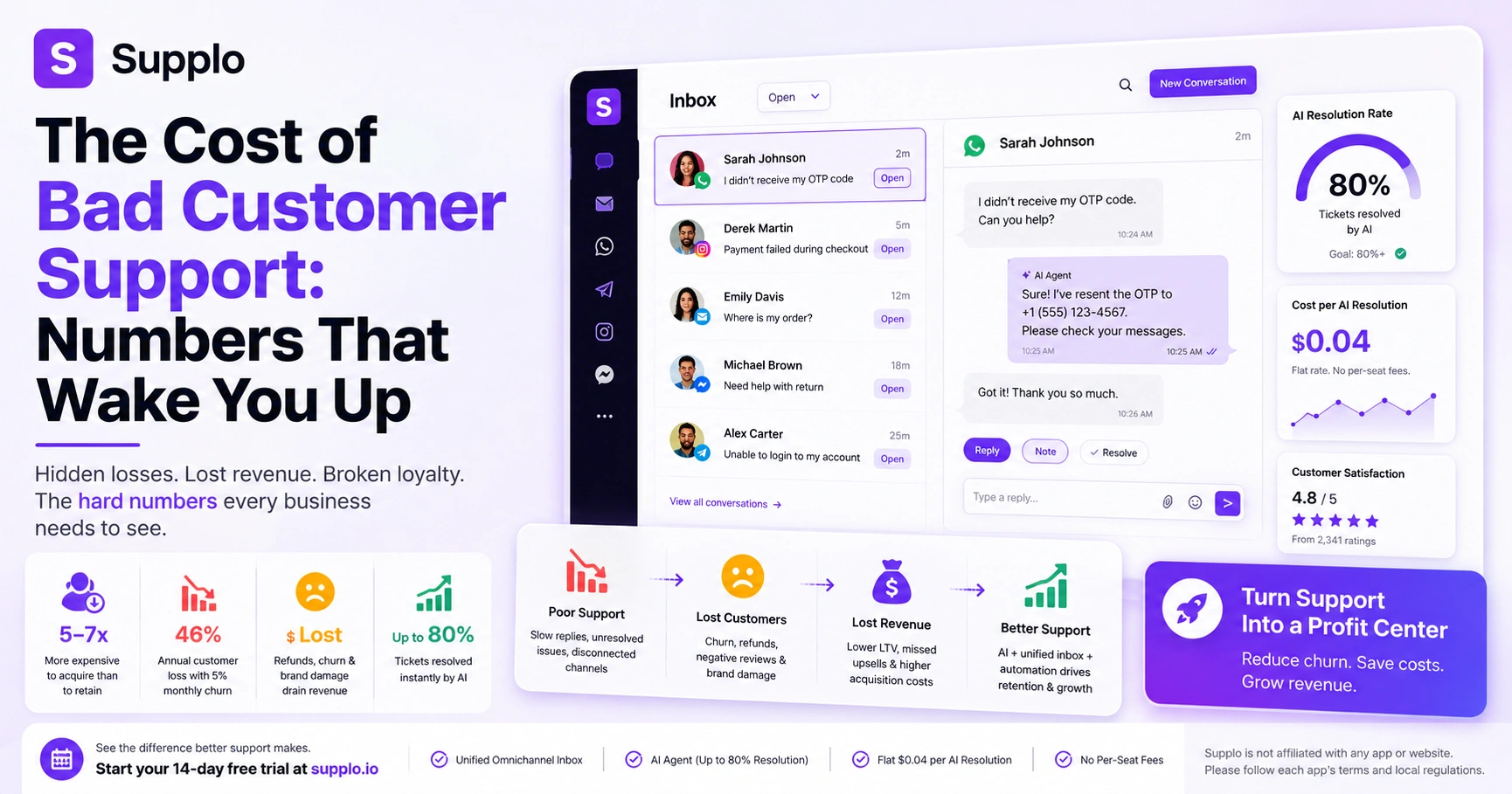
- Acquiring new customers costs 5-7 times as much as retaining existing ones, making retention a more profitable focus.
- Hidden costs, such as brand damage, negative word of mouth, and agent burnout, are often overlooked but significantly impact the bottom line.
- AI customer support can resolve up to 80% of tickets, drastically reducing cost per resolution and improving response times.
- Unified omnichannel support prevents customer frustration and improves agent efficiency by providing full context.
What is the Cost of Bad Customer Support?
The cost of bad customer support isn't just about refunds and chargebacks; it's the aggregate of lost sales, increased churn, and wasted team hours. Every unresolved ticket or slow response directly translates to revenue walking out the door, and many businesses never actually calculate the total. This section lays out the hard numbers so you can see where your money is going.
Tangible financial losses accrue rapidly. Refunds and compensation due to unresolved issues stack up faster than most businesses track. An increased churn rate directly correlates with poor first-response times, as customers leave when their issues aren't handled promptly. Wasted agent time spent re-explaining problems due to disconnected channels adds to operational costs. Direct revenue loss from abandoned carts during checkout when live chat isn't available is another clear indicator. Implementing efficient systems, such as automated email support, can significantly mitigate these direct losses.
The numbers add up fast:
- Refunds and chargebacks: Each unresolved issue costs you the product and the processing fee.
- Lost repeat purchases: A frustrated customer doesn't come back.
- Wasted agent hours: When your team can't see the full conversation history, they start from scratch every time.
- Abandoned carts: Shoppers who hit a wall during checkout? They rarely return.
The Hidden Business Losses Due to Bad Support That Your Spreadsheet Misses
Beyond refunds and lost sales, poor customer support creates costly leakage in areas most teams don't monitor: negative word of mouth, damage to brand equity, and lower customer lifetime value (LTV). A single bad experience can lose not just one customer, but dozens through public complaints and social sharing. These hidden losses often exceed the direct costs.
Reputation damage across review sites and social media deters new acquisitions. Internally, increased employee burnout and turnover in your support team due to constant firefighting are significant, yet often unmeasured costs. Businesses also miss crucial upsell and cross-sell opportunities because customers leave frustrated. Longer sales cycles result as prospects hesitate to buy from a brand with bad support reviews. Higher refund rates from customers who never receive timely answers also eat into margins.
What's hiding in your blind spots:
- Negative word-of-mouth: Unhappy customers tell an average of 9-15 people.
- Brand equity erosion: Bad reviews stick around forever on Google and social platforms.
- Employee turnover: Burned-out agents cost you recruitment and training dollars.
- Missed upsells: A happy support interaction is the perfect moment to suggest an upgrade.
How to Quantify the Cost of Losing a Customer: It's More Than You Think
The cost of losing a customer isn't just their last purchase; it's the entire future revenue they would have generated, plus the referrals they never make. A simple formula: average order value × purchase frequency × average customer lifespan = true loss per customer. When you factor in that acquiring a new customer is often 5-7x more expensive than retaining one, the numbers become undeniable.
To truly understand the impact, calculate customer lifetime value (LTV) to see the real revenue at risk per churned account. Don't forget to include lost referral revenue, customers who would have brought friends but stopped talking about you. Factor in the cost of replacing them, which involves higher acquisition spend and longer onboarding cycles. Add the negative multiplier effect: unhappy customers tell more people than happy ones. The impact of churn on revenue can be catastrophic over time.
Try this quick calculation:
Average order value × purchases per year × customer lifespan = LTV
Then add: Lost referral value × 2 (because unhappy customers talk more)
That's what you lose every time a customer walks away frustrated.
Customer Retention Cost vs. Acquisition Cost: The Math That Changes Everything
Industry benchmarks consistently show that acquiring a new customer costs 5 to 7 times as much as retaining an existing one. Yet many businesses over-invest in flashy acquisition campaigns while under-funding their support infrastructure. Even a small shift in your acquisition budget toward reducing churn through better support directly improves your unit economics.
Customer Acquisition Cost (CAC) includes ad spend, sales team salaries, and onboarding time. In contrast, retention costs are often just a quick interaction or a proactive solution. Research suggests that retention improvements of just 5% can increase profits by 25% to 95%. Better support naturally increases repeat purchase rates and average order value over time. Importantly, retention costs are predictable and controllable, whereas acquisition costs fluctuate with market competition.
Where the money goes:
- Acquisition: Ads, sales team commissions, onboarding materials, free trials- it adds up fast.
- Retention: A quick reply, a proactive check-in, a well-placed knowledge base article- often pennies.
When you put it side by side, the smart money is on keeping the customers you already have happy.
Measuring Customer Support Value: When Support Becomes a Profit Center
Most teams treat support as a cost center, but measuring customer support value correctly shows it can be a bottom-line driver. Track metrics like net promoter score (NPS), first contact resolution (FCR), and customer satisfaction (CSAT) alongside revenue retention data. When support prevents churn or drives a positive review, that has a direct financial impact.
Support-driven revenue includes upsells and renewals driven by excellent service interactions. There's also a direct reduction in refund rates as customers get answers before deciding to return products. A significant increase in LTV comes from customers who feel supported and stay longer. Furthermore, implementing solutions such as an AI agent can lower the cost per contact by automating repetitive tickets at scale.
Metrics that matter:
- First Contact Resolution (FCR), Solved on first touch? That's money saved.
- Customer Satisfaction (CSAT): Happy customers buy more, plain and simple.
- Net Promoter Score (NPS): Promoters bring friends. Detractors drive them away.
- Cost per ticket: Track this against LTV to see if support is paying for itself.
Ready to see the difference better support makes?
Sign up for a free 14-day trial at Supplo. No credit card required. See for yourself how a unified inbox and AI agent can start reducing churn immediately.
Return on Investment Customer Service: How to Build the Business Case for Improvement
Building a business case for customer support improvement means translating soft benefits into hard ROI numbers. Start with your current churn rate, multiply by average LTV, then calculate how much a 10-20% reduction in churn would save. Factor in efficiency gains from automation (like Supplo's flat $0.04 per AI resolution) vs. the cost of manual agent handling. That invests a clear savings line item, not an expense.
To make your case, map your current support cost per ticket with manual agents, considering salary, training, and tooling. Compare this against automated resolution cost with a tool like Supplo's AI agent. Project the revenue saved from reduced churn and increased customer satisfaction. Don't forget to include soft savings, such as reduced agent burnout and faster ramp-up times for new hires. An integrated customer knowledge base can also improve self-service and reduce inbound ticket volume.
Build your business case:
- Calculate current costs: Manual agent salary + tooling ÷ tickets handled = cost per resolution.
- Compare with automation: AI agent at $0.04 per resolution × projected ticket volume.
- Add churn savings: Current churn rate × LTV × projected reduction from better support.
The numbers almost always speak for themselves.
The Impact of Churn on Revenue: Visualizing the Long-Term Leak
Churn doesn't just hurt this month's revenue; it compounds over time as future recurring income disappears. A business with a 5% monthly churn rate loses nearly half its customer base annually, creating an ever-increasing acquisition burden to maintain growth. Visualizing churn as a leaking bucket helps teams prioritize plugging the hole over filling it faster.
Consider your monthly recurring revenue (MRR) loss projections based on your current churn rate. Account for the compounding effect: lost customers mean lost future upgrades and invaluable referrals. It's often more profitable to reduce churn by a small percentage than to achieve a much larger increase in acquisition. Understanding industry-specific churn benchmarks can also help you know where your business stands.
The compounding effect looks scary:
- 5% monthly churn = ~46% annual customer loss
- To grow at 10% monthly despite 5% churn, you need 15% acquisition growth every month
- Reduce churn to 3%, and you only need 13% acquisition growth for the same result
Plugging the leak beats endlessly filling the bucket.
Reducing Customer Churn Financially: Practical Steps That Protect Your Bottom Line
Reducing churn financially starts with fixing the support touchpoints that cause frustration: slow response times, repetitive answers, and disconnected channels. Implementing a unified inbox that surfaces conversation history across email, chat, WhatsApp, Telegram, Instagram, and Facebook Messenger dramatically reduces friction. Adding an AI agent that resolves up to 80% of tickets instantly helps customers get answers before they get annoyed.
A practical approach involves auditing your support channels to identify where customers are waiting the longest. Deploy automation for tier-1 questions so agents can focus on complex issues. Use customer feedback loops to fix root causes, not just symptoms. Proactive outreach to at-risk customers, often triggered by support tickets, can prevent churn. Integrating your knowledge base allows customers to self-serve instantly. For businesses with international customers, adopting solutions like WhatsApp support integration is crucial.
Quick wins to start :
- Audit your slowest channel; where do customers wait the longest?
- Set up an AI agent for tier-1 questions (up to 80% of your tickets)
- Create a unified inbox so agents see the full conversation history
- Build a knowledge base for self-service
Supplo is not affiliated with any app or website. Please follow each app's terms and local regulations.
The Real Cost of Poor Customer Service vs. Investing in the Right Tools
The cost of poor customer service is often invisible until it hits your bottom line hard, but the cost of fixing it is lower than most teams realize. A flat-rate AI support tool like Supplo resolves up to 80% of tickets at a predictable $0.04 per resolution, compared with legacy tools that charge $0.99 or more per resolution. That's not a cost; it's a savings line item that directly offsets the financial impact of bad support.
When evaluating tools, compare per-resolution costs: legacy AI solutions often exceed $0.99, while Supplo offers a flat $0.04. Consider the total cost of ownership: per-seat pricing can quickly balloon, whereas Supplo's per-workspace model keeps costs predictable as your team grows. Efficiency gains are substantial: AI handles tier-1 requests instantly, freeing human agents to manage escalations and complex issues more effectively. A unified inbox eliminates context switching, saving agents hours per day.
Cost comparison at a glance: Manual agent handling typically costs between $2-$5 per ticket, while legacy AI solutions often exceed $0.99 per resolution. In contrast, the Supplo AI agent offers a highly efficient alternative at a flat rate of $0.04 per resolution.
Supplo is not affiliated with any app or website. Please follow each app's terms and local regulations.
To understand the best fit for your budget, it's wise to compare pricing models directly.
Key Takeaways
- Poor customer support leads to significant, measurable revenue loss through churn, refunds, and missed opportunities.
- The hidden costs, including brand damage and agent burnout, can outweigh direct financial losses.
- Retaining existing customers is far more cost-effective than acquiring new ones.
- Investing in efficient customer support tools, particularly AI-powered solutions, delivers strong ROI.
- By unifying channels and automating tier-1 support, businesses can transform their support into a profit center.
FAQ
What is the biggest driver of the cost of bad customer support?
The biggest driver is customer churn due to unresolved or slow responses. Each lost customer means losing their entire lifetime value, plus the additional cost of acquiring a replacement.
How do I calculate the financial impact of poor customer service?
Multiply your average monthly churn rate by your average customer lifetime value (LTV). Then factor in refunds, chargebacks, and lost referral revenue to get a baseline annual loss.
Is it really cheaper to retain customers than acquire new ones?
Yes. Industry data consistently shows acquisition costs are 5-7 times higher than retention costs. Reducing churn by just 5% can increase profits by 25% or more.
What metrics should I track to measure the value of customer support?
Track first contact resolution (FCR), average response time, customer satisfaction (CSAT), and net promoter score (NPS). Also tie these to retention rate and LTV to quantify financial impact.
Can AI customer support really reduce the cost of bad service?
Yes. AI can resolve up to 80% of repetitive tickets instantly, reducing response times and agent workload. This lowers the cost per ticket and significantly reduces churn from slow service.
How can I build a business case for better customer support tools?
Calculate your current cost per ticket with manual agents, then project savings from automating tier-1 questions. Include projected churn reduction and revenue retention to demonstrate clear ROI.
What is a reasonable budget for customer support software?
Look for flat-rate pricing per workspace (not per seat) to avoid bill bloat as your team grows. Tools like Supplo offer a free 14-day trial and charge a predictable $0.04 per AI resolution.
Don't let poor customer support drain your revenue.
Supplo brings live chat, email, WhatsApp, Telegram, Instagram, and Facebook Messenger into a single thread-based inbox, powered by AI that resolves up to 80% of tickets instantly. Flat pricing. No per-seat surprises. Start your 14-day free trial today at https://supplo.io.
Compliance line: Supplo is not affiliated with any app or website. Please follow each app's terms and local regulations.