On this page
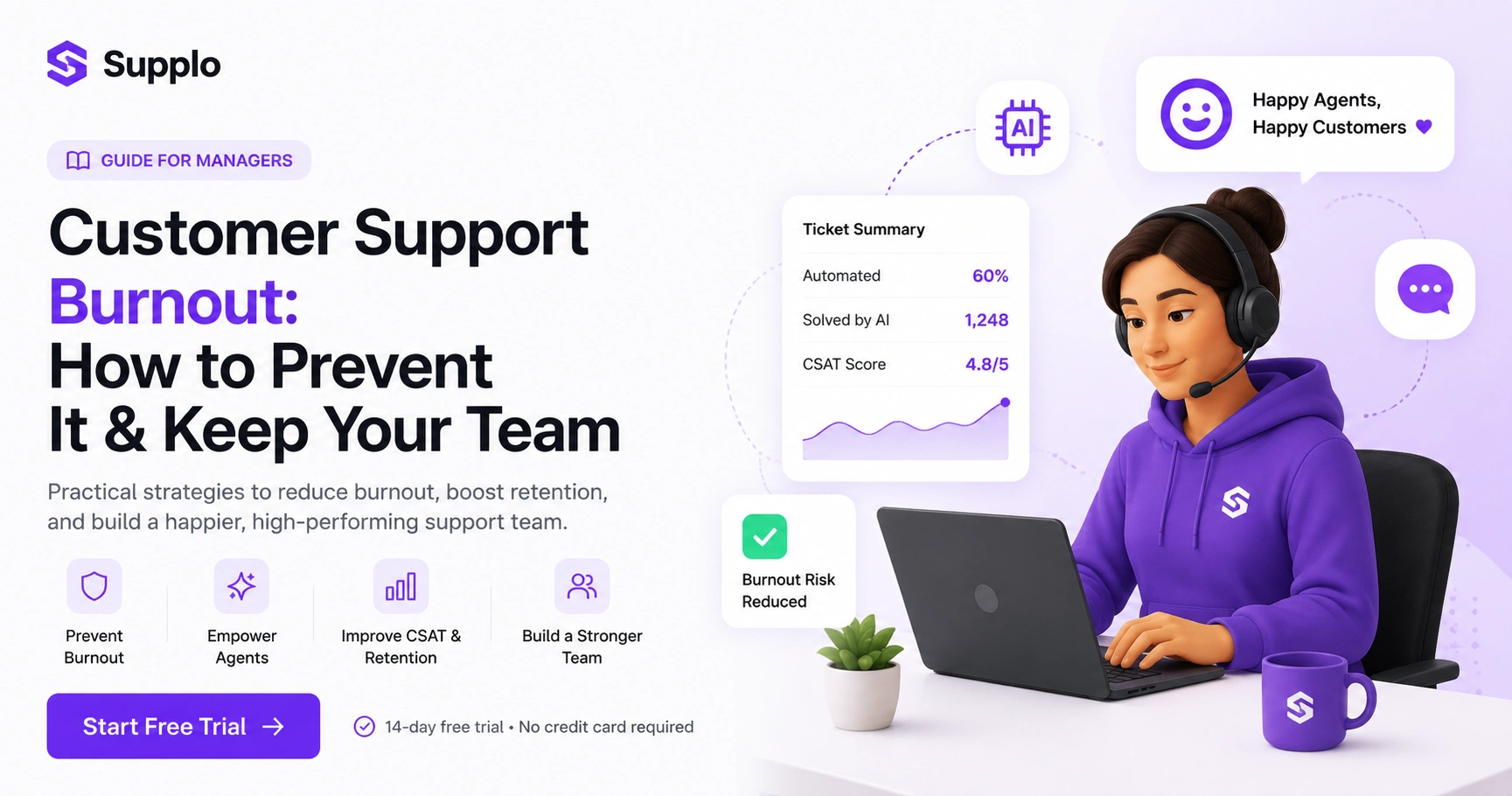
Customer support burnout how to prevent it is probably the most important question you can ask as a manager. It’s not just a buzzword; it’s the silent killer of great teams: high turnover, low morale and service that starts to feel… robotic. If you’ve been losing your best people or noticing that spark fade, you’re in the right place. This guide is for managers and team leads who actually want to fix things. We’ll walk through the early warning signs, practical prevention strategies (the kind that don’t involve pizza parties) and the specific challenges remote teams face. Plus, we’ll look at how smart automation can save your agents from the soul-crushing stuff.
Quick Answer
- Burnout starts with subtle shifts: empathy drops, tickets take longer, callouts increase. Catch it early.
- The no. 1 fix is workload restructuring: automate repetitive queries (FAQs, refunds) so agents can focus on the interesting, human work.
- Remote teams need hard boundaries: a "digital commute" and zero after-hours messaging are non-negotiable.
- Retention isn’t about perks; it’s about mastery, career growth and building a culture where asking for help is safe.
What Are the First Signs of Customer Support Burnout You Can’t Ignore?
You don't wake up one day with a burned-out team. It creeps in. Think of it like a slow leak, easy to miss until the tire is flat. The earliest signs are behavioral shifts: the agent who used to write thoughtful, empathetic replies now wants to close the ticket. The resolution time creeps up. You start seeing more sick days from the same people.
- Emotional exhaustion: Agents stop caring about the outcome. They want the interaction to end.
- Cynicism and detachment: Sarcastic internal notes, visible eye rolls at repeat requests, or that "here we go again" energy.
- Reduced professional efficacy: Missed SLAs become a habit. Simple issues get escalated. Ticket reopen spikes.
- Physical symptoms: Frequent headaches, digestion issues, or comments about dreading the start of a shift. Yes, burnout shows up in the body.
How to Prevent Customer Support Burnout Before It Hits Your Team
If you wait until someone quits, you’ve already lost. Prevention is about being proactive, not just putting out fires. The biggest lever you have is giving agents control. Autonomy is like kryptonite to burnout. Start with a reasonable ticket cap per shift, rotate the "last responder" for tough cases and build in buffers between back-to-back emotional conversations.
- Set no-penalty break tickets: Give each agent a few times a week they can skip the queue for a breather, no questions asked.
- Create a hard rule against after-hours messaging. If your support tool sends notifications, disable them for off-hours. Full stop.
- Use AI to triage and pre-solve the most repetitive questions. Let agents focus on work that actually needs a human.
- Implement a safety net buddy system: Agents can hand off an upset customer to a colleague without feeling judged.
Want to test it for yourself?
You don’t have to guess if these strategies work. Start a free 14-day trial of Supplo and see how automating those boring 60% of tickets frees your agents for work that matters.
Start Free Trial today.
Why Traditional Customer Support Agent Burnout Solutions Fail and What Works
Let’s be honest: pizza parties don’t fix burnout. Neither do mindfulness apps or telling an overwhelmed agent to just breathe. These things fail because they don’t touch the root cause: unsustainable ticket volume, emotional labor overload and hitting a career ceiling. What actually moves the needle is restructuring the work itself. Take away the mind-numbing stuff, add variety and give agents something to grow toward.
- The throw more bodies at it approach fails because it ignores systemic inefficiency. More people means more chaos.
- Weekly therapy sessions or meditation apps are nice perks but useless if an agent faces 80 identical refund requests per shift.
- Solutions that force agents to "manually learn" every new product update waste cognitive load and breed frustration.
- The fix: Audit your ticket volume by category. If 40%+ is simple FAQs, automate that layer and let agents tackle complex problem-solving instead.
How to Fix Support Team Burnout
Fixing burnout isn’t about a single magic bullet. It’s a process. Start with a full audit of your last 90 days of ticket data. Look for patterns: which types of queries happen at the same time as low CSAT? Which agents are handling the most emotional labor? Then, take that data and make structural changes. Reassign the most draining categories to a rotating specialized queue. And for the love of everything, implement a mandatory 4-hour max on "continuous chat" shifts.
- Week 1: Conduct an anonymous burnout pulse survey. Ask the direct question: "What specific task drains you most?"
- Week 2: Identify the top three repetitive ticket types. Build an automated response or a self-service knowledge base article for each.
- Week 3: Implement a "hero day" rotation; one agent handles overflow so others can focus on deep work or training.
- Week 4: Introduce a 10-minute debrief after every difficult interaction. Let them vent, log feedback and reset before the next ticket.
The Hidden Levers of Customer Support Staff Retention
Here’s the truth: money and perks matter less than you think. The number one driver of retention in support is mastery. Agents who feel they’re learning and getting better are significantly less likely to leave. The second is transparency around career paths. If an agent can’t see a future beyond frontline support for the next three years, they’ll check out mentally long before they hand in their notice.
- Create career ladders within support: Level 1, Level 2, escalation specialist, QA analyst, operations manager. Make the path visible.
- Offer skill stipends for certifications in areas such as customer success management, UX writing, or data analytics.
- Give agents ownership of a project outside the queue, like updating the knowledge base, training new hires, or A/B testing response templates.
- Recognize raw effort, not just results: Celebrate the agent who handled 10 angry chats with grace, not just the one with the fastest resolution time.
Reducing Turnover in Customer Service
High turnover is a math problem and the math isn’t pretty. Replacing an agent costs 6-9 months of their salary. To fix the math, focus on two levers: reducing the emotional tax of the job and creating a visible path to growth. Implement "compassion fatigue breaks" (paid 15-minute escapes from the queue) and rotate agents through different channels to break the monotony.
- Use a skip-level meeting structure in which senior leadership speaks with frontline agents without their direct manager present.
- Offer flex-scheduling to accommodate life events. Parents, students, or night owls will stay twice as long when they have control.
- Conduct exit interviews with a focus on what would have made you stay? rather than just "why are you leaving?"
- Implement a happiness index post-shift survey (1-10) to track burnout trends in real time, not quarterly.
Preventing Burnout in Remote Support Teams: The Specific Challenges
Remote support is a whole different beast. There’s a triple threat: isolation from colleagues, blurred work-life boundaries and always feeling on. Without the physical act of leaving the office, agents often work longer hours and feel disconnected from the company culture. The fix? Intentional digital rituals.
- Implement a digital commute: A fixed 5-minute wind-down routine: log out, close the laptop, step away from the desk. This signals the end of the workday.
- Create a virtual water cooler channel in Slack or Teams with zero work talk. Strictly memes, pets and hobbies.
- Use async-first communication: Discourage instant replies outside of scheduled support hours.
- Host weekly coworking video calls where agents work silently alongside each other. It fights loneliness without forcing small talk.
The Role of Automation in Team Burnout Management: Customer Support
Automation isn’t your enemy. It’s your agent’s best friend. When set up right, it acts as a shield, absorbing the boring, repetitive, emotionally draining first wave of questions. When AI handles the first 50-70% of incoming tickets (password resets, order status, return policies), your agents only get the conversations that actually need a human brain and a human heart. That shift alone is a huge burnout reducer.
- Define which ticket categories are high burnout (frequent, low complexity, high emotional intensity). Automate those first.
- Use AI that learns from your knowledge base and past tickets to answer accurately, reducing the cognitive load on agents.
- Ensure the AI hands off cleanly to a human with full context. Nothing frustrates an agent more than having to ask a customer to repeat themselves.
- Measure pre- and post-automation agent satisfaction scores. A 15-20 point increase is common when you do it right.
If your current tool makes you pay per seat or per resolution, your burnout problem is built into your budget.
Supplo charges a flat rate per workspace, so scaling your team doesn't mean scaling your costs. No surprise fees, no seat-counting anxiety.
How to Build a Culture That Prevents Customer Support Team Burnout Solutions
Culture isn’t a ping-pong table. It’s what happens when no one is watching. In support, a great culture is one where asking for help is celebrated rather than penalized. Build a norm where agents can flag a "difficult ticket" to the whole team without shame. When managers visibly step in to take the most abusive customers off the front line, trust skyrockets.
- Institute "weekly wins" where agents share a customer success story, not just a case number.
- Have managers handle a live shift once a month to stay grounded in the real pain points.
- Ban the phrase "just handle it" from internal communication.
- Create a "burnout trigger" system: Agents can flag a specific ticket type if it consistently feels harmful. That ticket type gets immediately reviewed for reassignment or automation.
Measuring Success: Retaining Customer Support Agents Beyond the First Year
You can't fix what you don't measure. Track your first-year turnover rate specifically and set a quarterly target to reduce it by 5-10%. Use a simple "Stay Interview" template at the 6-month mark: ask, "What makes you want to stay?", "What would tempt you to leave?" and "What one change would make your job 20% better today?"
- Measure burnout density: Average agent ticket count per shift vs. CSAT score. A high ticket count with dropping CSAT is the canary in the coal mine.
- Track re-ticket rate (customers reopening the same issue). High re-ticket rate frustrates agents and customers alike.
- Benchmark your turnover against industry averages (30-40% annual is common in support; aim for sub-20%).
- Reward agents who stay and mentor new hires with a tenure bonus or paid time off, not just a small raise.
Keep your best agents for good.
Supplo’s transparent pricing, unified inbox and self-learning AI agent give you the infrastructure to prevent burnout and retain talent. Start your 14-day free trial today and build a support team that lasts.
Start Free Trial
Supplo is not affiliated with any app or website. Please follow each app's terms and local regulations.
Key Takeaways
- Catch burnout early: Look for subtle signs such as a drop in empathy, slower ticket resolution and increased absenteeism.
- Prevent burnout proactively by implementing workload management, clear boundaries and autonomy.
- Audit traditional solutions: Focus on reducing repetitive tasks and fostering career growth.
- Structure a recovery plan by conducting pulse surveys, automating repetitive tasks and creating a safety net.
- Focus on retention: Mastery and career paths are key drivers of agent retention.
- Adapt for remote teams: Create digital rituals to combat isolation and burnout.
- Leverage automation: Use AI to handle mundane tasks, freeing agents to focus on meaningful work.
- Build a supportive culture: Celebrate teamwork and create systems for flagging difficult tickets.
- Measure success: Track metrics such as re-ticket rate and set targets to reduce turnover.
FAQ
How do I know if my support team is burned out or just having a bad week?
Burnout is persistent (weeks or months of exhaustion and cynicism) while a bad week is situational. Track for patterns: if empathy drops for more than 3 consecutive weeks, it’s burnout, not a bad day.
Can automation really reduce burnout, or does it just make agents feel replaceable?
Automation reduces burnout by removing the most monotonous, high-volume queries. It backfires if agents think they’re being replaced. Frame it as "AI handles the boring stuff so you can do the interesting work."
What’s the best metric to track for burnout prevention?
Look at "ticket re-open rate." A high re-open rate often means agents are rushing to meet quotas and not solving the real problem, a classic burnout behavior.
Should we mandate a maximum number of tickets per agent per day?
Yes. Without a cap, the highest performers burn out fastest. Set a sustainable daily maximum based on ticket complexity, not just volume.
How do you prevent burnout when your support team is fully remote?
Enforce a hard end-of-day shutdown ritual, create virtual team bonding unrelated to work and permit agents to ignore messages after hours.
Is it better to rotate agents across channels (email, chat, phone) or keep them in one channel?
Rotate. Monotony is a major burnout driver. Allow agents to choose their preferred mix, but mandate at least a shift change every 90 days to keep engagement high.
What role does compensation play in burnout vs. retention?
Low pay won't cause burnout directly, but it removes the motivation to tolerate it. Pay fairly for the emotional labor involved and invest in career growth paths to keep agents engaged over the long term.
Compliance line: Supplo is not affiliated with any app or website. Please follow each app's terms and local regulations.