On this page
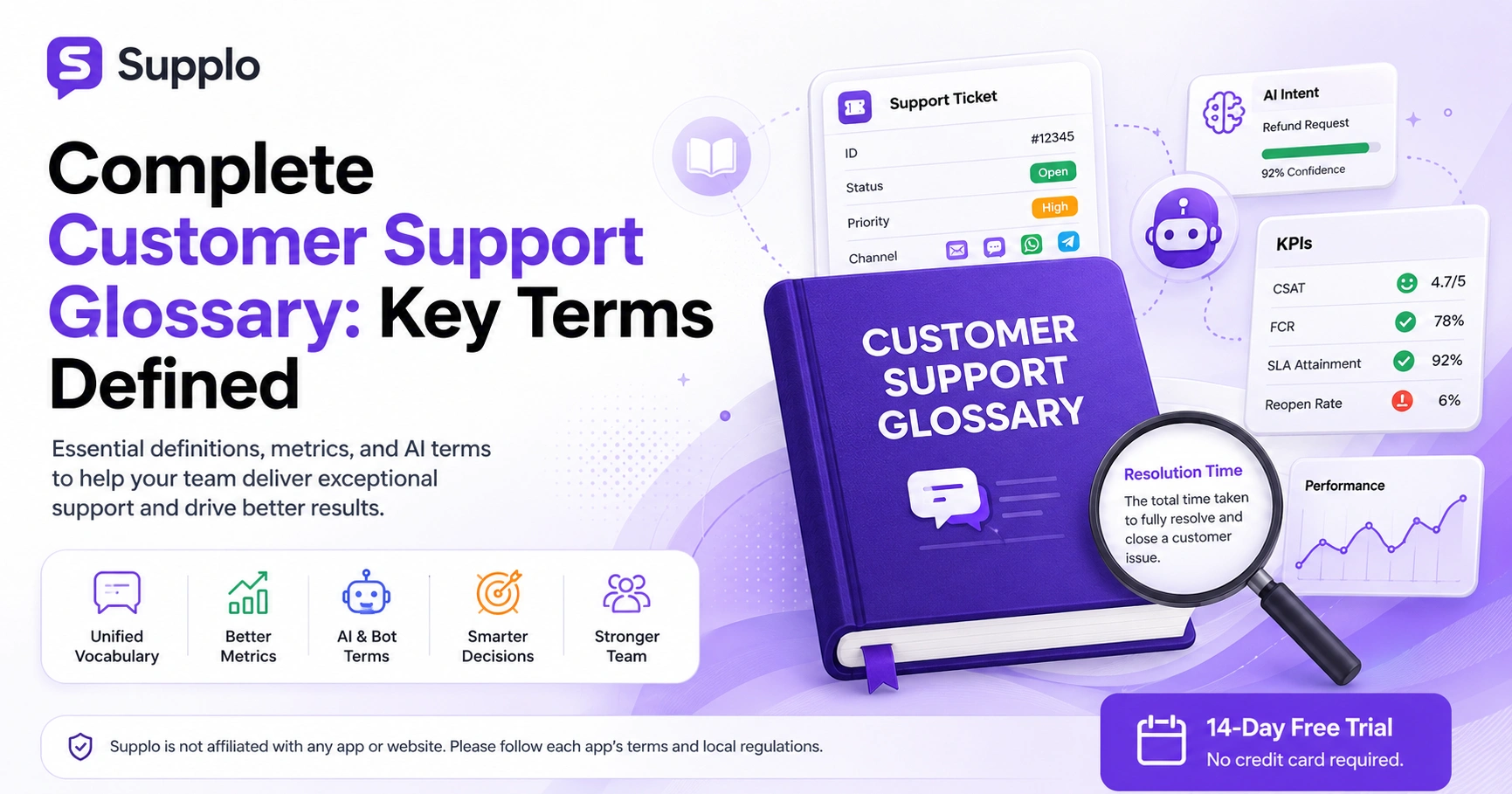
Navigating customer support, whether you're running a traditional call centre or a modern AI-powered help desk, requires a shared vocabulary. This glossary breaks down the essential terms that drive customer satisfaction and operational efficiency. It's built for everyone, from new agents to seasoned managers, who want to understand, measure, and improve their support operations without drowning in jargon.
Quick Answer
- A customer support glossary standardises language across your team, from first response to final resolution.
- It clarifies critical distinctions, like between first response time and resolution time, so your reporting actually makes sense.
- Understanding AI terms like intent recognition and fallback is key to running effective automated support.
- Key Performance Indicators (KPIs) like CSAT and FCR give you real, actionable insights into customer satisfaction and team efficiency.
- A solid glossary helps you evaluate new tools and onboard agents, ensuring everyone speaks the same support language.
What is a Customer Support Glossary of Terms and Why Does It Matter?
A customer support glossary of terms is essentially a centralised cheat sheet. It defines the essential vocabulary used across help desks, call centres, and AI-powered support tools. And honestly? It matters more than you'd think. Teams that speak the same language resolve tickets faster, report metrics more accurately, and avoid the costly confusion that comes from misinterpreting jargon. Whether you're onboarding new agents or evaluating software, this glossary removes the guesswork and sets a reliable standard for communication.
This shared understanding ensures that every team member, from frontline agents to leadership, defines first response time and CSAT consistently. It reduces friction when migrating from legacy tools to modern platforms like Supplo, where terms such as ticket and conversation can overlap. A well-defined glossary also helps non-technical stakeholders understand machine learning support jargon without needing a data science degree. Plus, it supports compliance and safety by clarifying terms like sensitive data handling and resolution ownership across global teams.
Supplo is not affiliated with any app or website. Please follow each app's terms and local regulations.
Core Help Desk and Support Ticket Definitions You Need to Know
Let's start with the basics. Support ticket definitions vary by platform, but the core idea is the same: a formal record of a customer's issue from submission to resolution. A ticket typically includes a unique ID, priority level, status, and history of interactions. Understanding terms such as ticket escalation, SLA breach, and auto-tagging helps teams properly classify work and route requests to the right human (or AI) agent without delay.
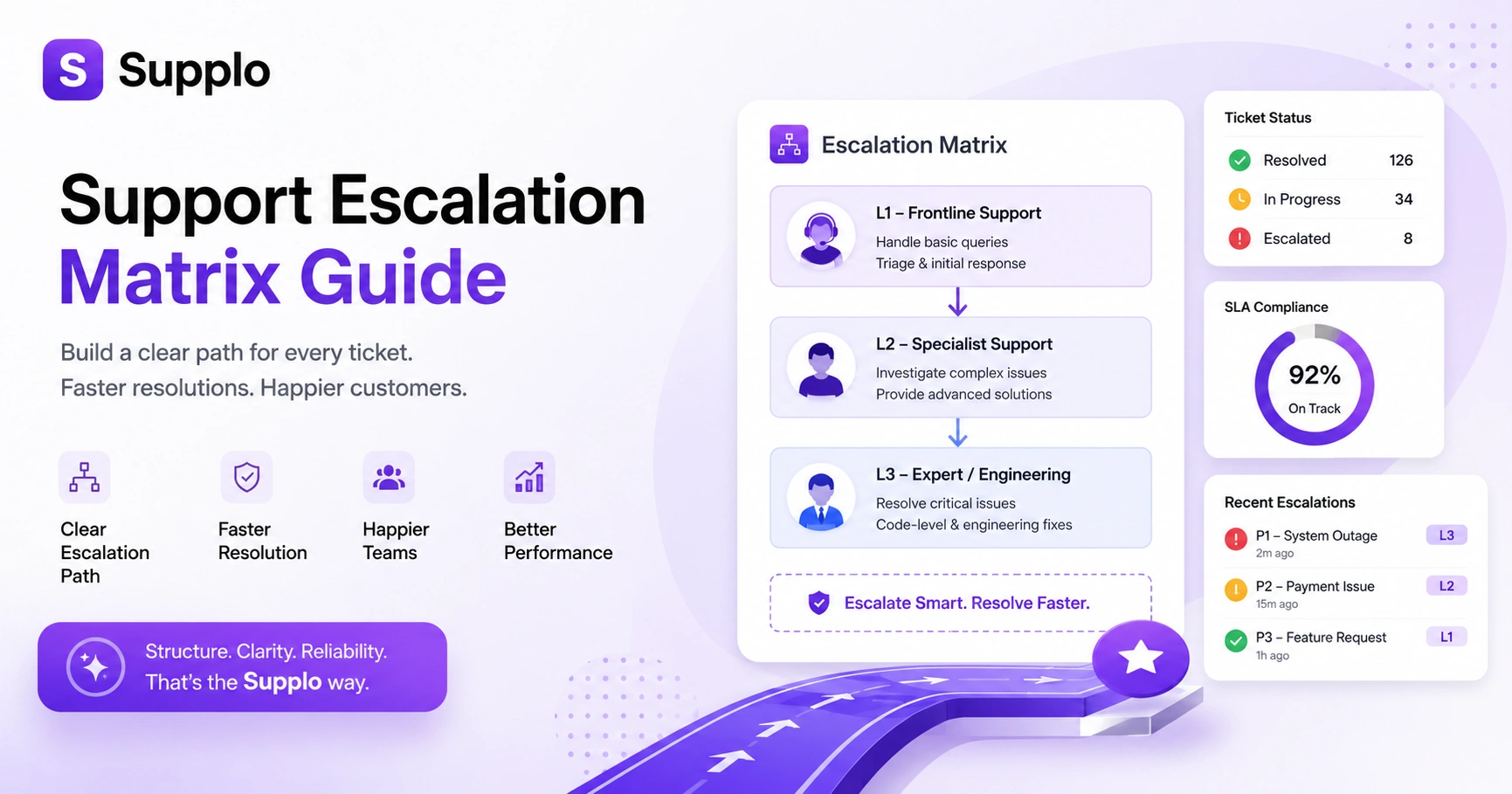
- Ticket escalation: When an issue moves from Tier 1 to Tier 2 or beyond because it exceeds current permissions or knowledge.
- SLA (Service Level Agreement): The contractual window within which a ticket must be acknowledged or resolved.
- Auto-tagging: Using rules or AI to classify incoming requests by topic, urgency, or customer segment.
- Ticket merging: Combining multiple related submissions into one parent record to avoid duplicate work.
- Ticket deflections: When a knowledge base or bot answers a question before it ever becomes a ticket, this often prevents the creation of an email ticketing definition.
Customer Service Terminology for First Response and Resolution Time
First response time glossary terms define how quickly a customer receives an initial acknowledgement. Resolution time, on the other hand, measures how long it takes to close an issue fully. Both are leading indicators of customer satisfaction and agent efficiency. The gap between first response and resolution, often called time to close, is where most support teams optimise for speed without sacrificing quality.
- First Response Time (FRT): The elapsed time between ticket creation and the first human or AI reply.
- Resolution Time: Total duration from submission to final resolution, including any back-and-forth.
- Handle Time: The time an agent actively spends on a ticket, excluding idle or hold periods.
- SLA Clock: A timer that tracks whether resolution aligns with contractual obligations, often paused during customer wait time.
- Escalation Lag: The delay that occurs when a ticket is incorrectly routed to Tier 1 but requires immediate senior attention.
Call Centre Terms Explained: AOV, AHT, and Occupancy Rate
Call centre terms explained: AOV (Average Order Value) tracks revenue per customer interaction; AHT (Average Handle Time) measures total agent time per call or chat; and Occupancy Rate measures the percentage of logged-in time an agent spends handling contacts versus waiting. Modern support teams using Supplo's shared inbox often replace AHT with Time to Competent Resolution, because the first contact that fully closes a ticket is more valuable than a fast partial fix.
- Average Handle Time (AHT): Talk time plus after-call work, typically targeted under 6–8 minutes for phone support.
- Occupancy Rate: Calculated as (handling time / total logged time) x 100; high occupancy can lead to burnout.
- After-Call Work (ACW): Documentation and tagging are done after a customer disconnects.
- Abandonment Rate: The percentage of callers who hang up before reaching an agent.
- Transfer Rate: How often a call moves between departments; high transfer rates often indicate poor routing or insufficient AI triage.
Customer Interaction Terms That Define Good vs. Great Support
Customer interaction terms distinguish between basic acknowledgement and meaningful engagement. Omnichannel means a customer can switch from Instagram DMs to email without having to repeat themselves. Single-session resolution measures whether an issue was resolved in a single continuous interaction. Teams that obsess over these terms, rather than just volume, tend to see higher CSAT and lower overall handling costs.
- Omnichannel: Seamless continuity across email, chat, WhatsApp, Telegram support, and social DMs within a single thread.
- Single-Session Resolution (SSR): The percentage of issues resolved without the customer re-engaging on a new ticket.
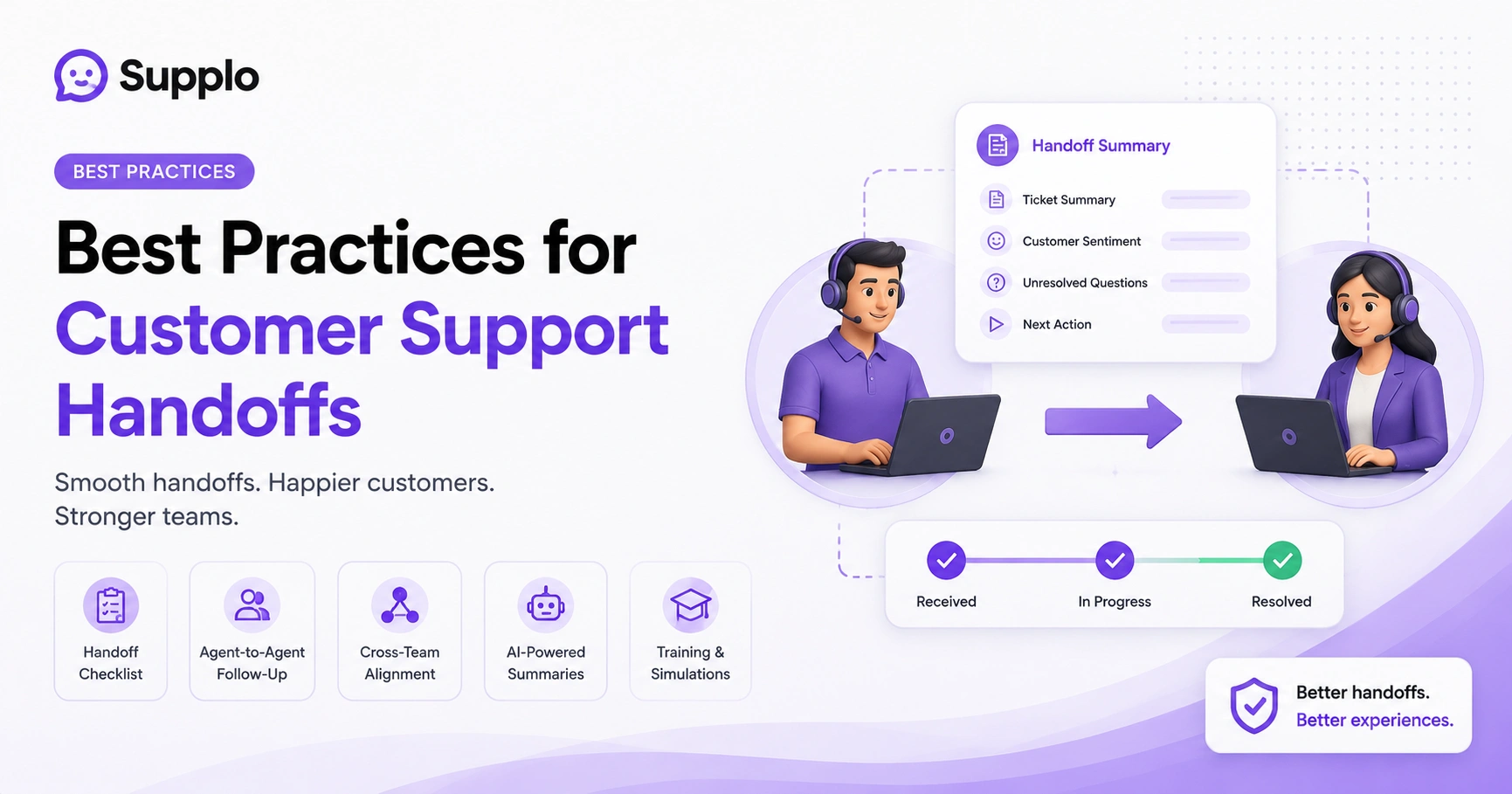
- Agent Handoff: The smooth transfer of context between AI and human agents, ideally with full conversation history intact.
- Sentiment Score: AI-driven analysis of customer tone, used to flag frustration before it escalates.
- Personalisation Depth: Use of CRM history to avoid asking What's your account number? more than once.
Artificial Intelligence Support Glossary: Machine Learning and Intelligent Automation Terms
Artificial intelligence support glossary terms include intent recognition, entity extraction, and confidence threshold, the mechanics behind an AI that actually understands what a customer needs. Machine learning jargon, such as training data and model drift, explains why your virtual agent gets smarter over time or needs recalibration. For teams using Supplo's self-learning AI, terms like resolution confidence clarify exactly when the bot passes a ticket to a human.
- Intent Recognition: The AI's ability to classify a query as a refund request versus a shipping question.
- Entity Extraction: Pulling specific data from a message, like order numbers or shipping addresses.
- Confidence Threshold: The minimum certainty level required for the AI to answer autonomously (Supplo's AI hands off below this line).
- Model Drift: The gradual degradation of accuracy when customer language patterns shift without retraining.
- Reinforcement Learning from Human Feedback (RLHF): Where agents rate the AI's answers to improve future responses.
Conversational AI Glossary and Bot Support Terminology
Bot support terminology covers how conversational AI structures interactions: utterances, fallbacks, and escalation paths define the guardrails for automated conversations. A fallback happens when the AI can't map an incoming message to any known intent. Escalation path is the predetermined route to a human agent. Understanding these terms helps teams set realistic expectations. Your bot won't solve everything, but a well-defined glossary ensures it knows when to step back.
- Utterance: Any phrase a customer types or speaks; the AI learns from millions of utterances.
- Fallback Intent: A catch-all response when the bot doesn't understand; a high fallback rate signals poor training.
- Escalation Path: The automated handoff logic that transfers a session to human support with full context.
- Slot Filling: The sequential collection of required information (e.g., email, issue type, product SKU).
- Small Talk: Pre-built conversational flows for greetings, jokes, or off-topic queries that keep interactions natural.
- Effective knowledge base ingestion is crucial for accurate bot responses.
Customer Support KPIs Glossary: Metrics That Actually Matter
Customer support KPIs glossary entries should clearly distinguish between vanity metrics and actionable ones. CSAT (Customer Satisfaction Score) and CES (Customer Effort Score) measure sentiment, while FCR (First Contact Resolution) and NPS (Net Promoter Score) measure loyalty and efficiency. The catch? A high FCR means nothing if resolution times are fudged by re-categorising reopened tickets as new ones.
- CSAT (Customer Satisfaction Score): Post-interaction survey rating, typically 1–5 or 1–10.
- CES (Customer Effort Score): Measures how easy it was for the customer to resolve their issue.
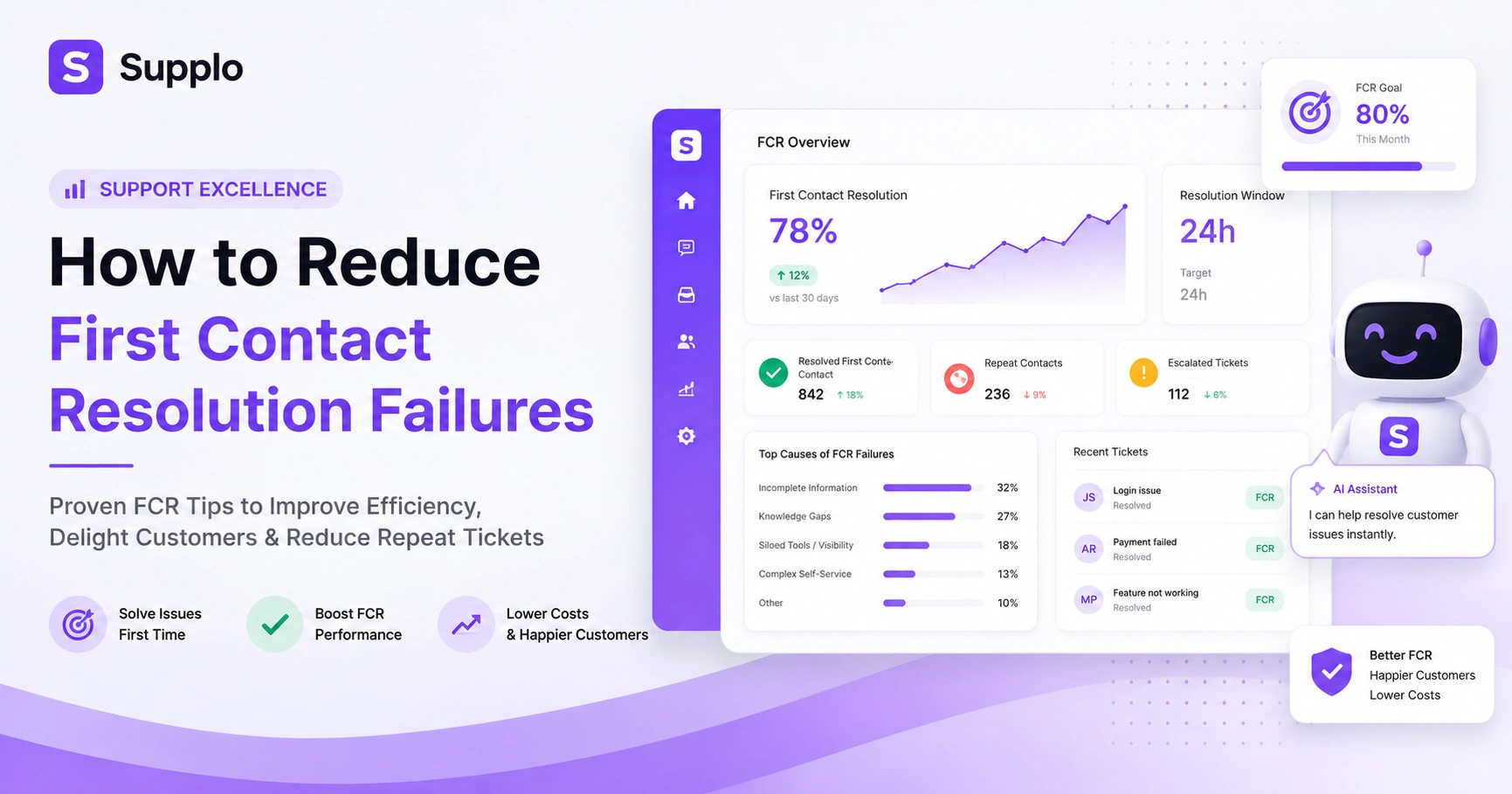
- FCR (First Contact Resolution): Percentage of issues resolved without escalation or follow-up.
- NPS (Net Promoter Score): Likelihood a customer recommends your brand, based on a single 0–10 question.
- Ticket Reopen Rate: The percentage of closed tickets that require reactivation within a set window; low is better.
Help Desk Performance Terms: How to Measure Success
Help desk performance metrics such as Time to Acknowledge, Backlog Age, and SLA Attainment Rate quantify operational health. A healthy help desk sees less than 10% of tickets older than 48 hours, and SLA attainment should exceed 90% for critical issues. With Supplo's unified inbox, performance terms are automatically calculated across channels, so you're not manually reconciling email and chat response times.
- Time to Acknowledge (TTA): How long before a human or AI confirms receipt; distinct from first response.
- Backlog Age: The average age of unresolved tickets; ageing backlogs indicate resource shortages.
- SLA Attainment Rate: Percentage of tickets resolved within the agreed window; the baseline for team accountability.
- Agent Utilisation Rate: The proportion of an agent's shift spent on billable or value-added support work.
- Peak Hour Analysis: Identifying when ticket volume spikes to staff accordingly or activating overflow AI.
Quick Start: How to Use This Glossary to Build a Smarter Support Stack
Start by mapping your current workflow to the support ticket definitions above. Identify where jargon is misaligned, like using resolution time when you're really tracking first response time, and standardise across your team. Then test your AI agent against the conversational AI glossary terms to see if it correctly recognises intents and hands off cleanly. Supplo's 14-day free trial lets you apply these definitions in a real workspace, with the AI resolving common tickets automatically while you audit its confidence scores.
- Print or share the glossary with your whole team before any new tool rollout to ensure a common language.
- Use the bot support terminology section to set expectations for what your AI chatbot can and cannot do.
- Audit your current KPIs against the support metrics definitions to catch metrics that flatter rather than inform.
- Configure Supplo's inbox to tag tickets by the categories in this glossary for cleaner reporting from day one.
- Understand the impact of flat per-workspace pricing on your support KPIs tracking.
Ready to put these definitions to work? Grab a 14-day free trial of Supplo. Your AI agent will start resolving tickets within minutes, and you'll see exactly how your support metrics stack up against the glossary. No credit card required, just a cleaner inbox.
Discover how to integrate Telegram Support AI into your customer service workflow to streamline messaging and improve response times.
Key Takeaways
- A consistent customer support glossary ensures every team member and every tool speaks the same language.
- Differentiate between critical operational metrics, such as First Response Time and Resolution Time, to avoid misleading reports.
- Leverage AI support terms to understand how intelligent automation can accurately diagnose intent and manage interactions.
- Focus on actionable KPIs like CSAT and FCR for real insights into customer satisfaction and team efficiency.
- Regularly review your help desk performance terms to identify bottlenecks and optimise your support workflow.
If your current support tool mislabels first response time or inflates your CSAT, it's time for a transparent alternative. Supplo's flat pricing ($0.04 per AI resolution) and unified inbox give you accurate metrics across email, chat, WhatsApp, and more. Start your free trial here.
FAQ
Is it safe to rely on a customer support glossary of terms from a single source?
Yes, as long as the definitions align broadly with industry standards (e.g., ITIL for help desk terms). Check that key terms like SLA, FRT, and CSAT match how your own tools or compliance requirements define them.
Why do support ticket definitions sometimes differ between platforms like live chat and email?
In live chat, a ticket might be a single session, whereas email ticketing treats an entire thread as a single ticket. Cross-platform tools like Supplo unify these into a single thread-based record so definitions stay consistent.
What is the difference between first response time and resolution time, and which matters more?
First response time measures the speed of acknowledgement; resolution time measures the total time to fix. For most customers, a quick first response builds trust, but a slow resolution will still hurt CSAT.
How do I know if my AI customer service glossary terms are accurate for my specific use case?
Test your AI against the intent recognition and fallback terms. If your bot's fallback rate exceeds 15%, its training data likely needs updating. Supplo's self-learning AI adjusts as it processes new conversations.
Can I optimise support metrics definitions even if my team is small?
Absolutely. Focus on CSAT and first contact resolution rather than complex occupancy rates. A small team benefits most from knowing whether issues are resolved on the first touch.
Are support KPIs, such as NPS and CES, interchangeable?
No. NPS measures loyalty and brand perception, while CES measures effort. A customer may recommend you (high NPS) even if you made them work hard (low CES). Track both.
What is the most common mistake when adopting help desk jargon?
Using resolution time when you really mean first response time. This skews reporting and misleads stakeholders about how quickly issues are truly closed.
Compliance line: Supplo is not affiliated with any app or website. Please follow each app's terms and local regulations.