On this page
Customer support demands more than just answering questions; it requires precision, empathy and efficiency. Many businesses fall into common traps that frustrate customers and drain resources. This guide is for customer service managers, operations leaders and business owners looking to optimize their support strategy. We'll identify the biggest customer support mistakes to avoid and provide practical solutions for building a reliable, AI-powered system that truly serves your customers.
Let’s be real for a second: good support isn't about being fast. It's about being right. It's about not making your customers repeat themselves. It's about having a system that scales with you, not against you. Here’s the short version of what you need to know.
Quick Answer
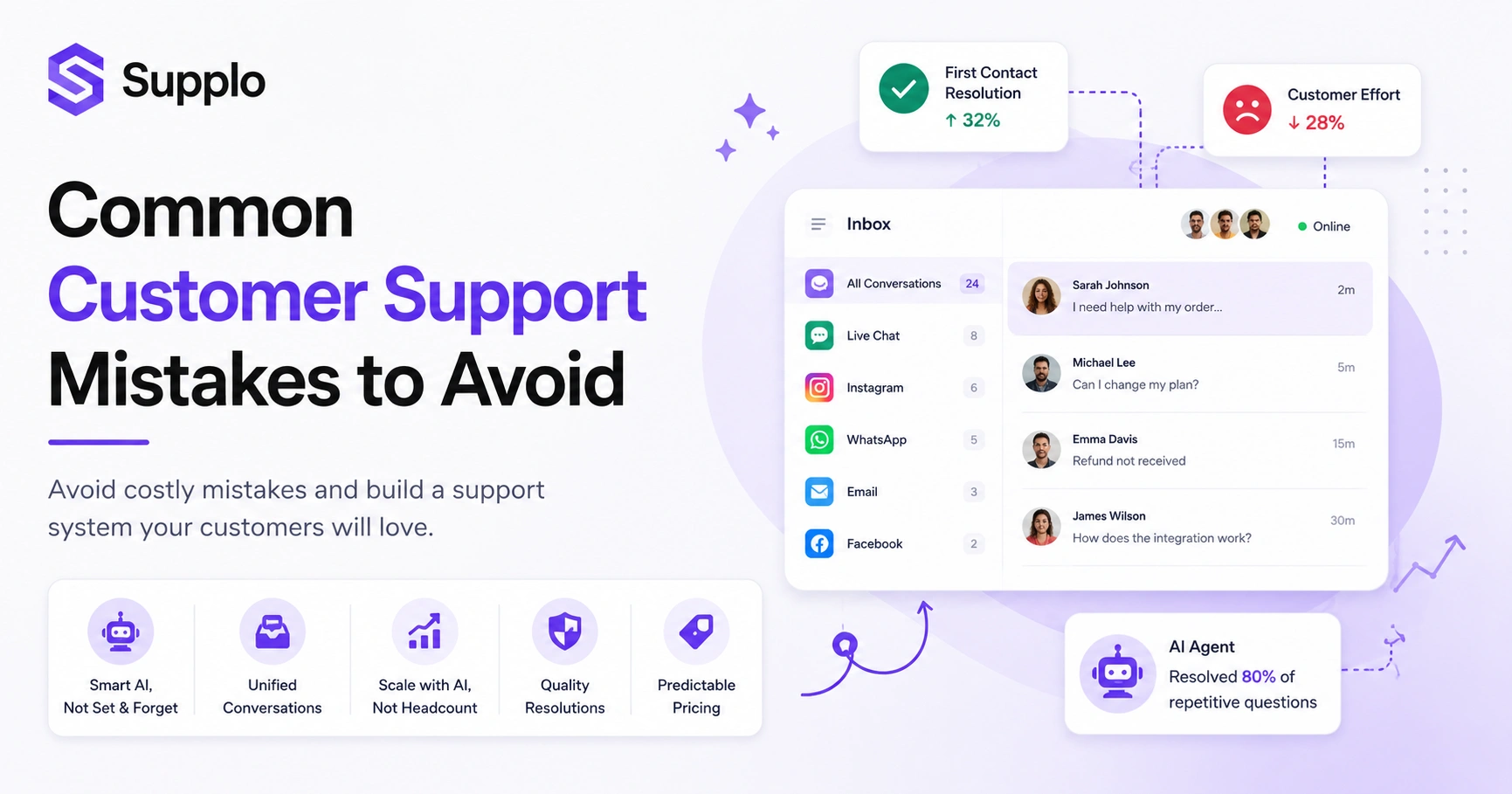
- Avoid the set-it-and-forget-it approach to AI: regularly audit and train your AI to prevent bad answers.
- Unify communication channels: A single inbox stops fragmented, repetitive customer experiences.
- Scale with AI, not just people: Automate routine queries to manage growth efficiently.
- Prioritize resolution quality: Solving issues correctly the first time builds lasting trust.
- Adopt predictable pricing: Flat-rate models offer stability over variable per-seat costs.
Treating AI Support as a Set It and Forget It Tool
The fix is simple: your AI needs a regular check-up, just like your car.
The biggest trap will be deploying an AI agent and assuming it works perfectly forever. Machine learning models drift, customer language evolves and your product changes. You need to regularly audit your AI’s responses, update its knowledge base and ensure it isn’t hallucinating answers to new edge cases. This proactive approach prevents AI customer support mistakes.
Static AI models fail within 90 days. Seriously. Without fresh data and oversight, they become irrelevant fast. The hidden cost of bad AI answers is significant, leading directly to customer churn and reputational damage. To maintain accuracy and relevance, build a monthly review cadence for your AI agent. This includes analyzing unanswered questions and validating the AI's responses against your current policies.
Ignoring the Fragmented Support Experience
Here’s the truth: if a customer has to repeat their story, you’ve already failed them.
Customers expect to switch from Instagram DMs to email to your website chat without having to repeat themselves. When your team uses different tools or separate inboxes for each channel, you create a fragmented support experience that frustrates everyone. The solution is a single shared inbox that threads every conversation together.
The customer frustration of being passed between channels is a major contributor to high customer effort scores (CES). Many businesses claim to be omnichannel but end up offering multichannel chaos when their agents don't have a unified view. A truly unified inbox helps agents spot recurring issues more quickly, improving first-contact resolution (FCR) and reducing agent burnout.
Scaling Support by Just Throwing More People at It
Hiring isn't always the answer. Sometimes, it's just the most expensive one.
As your business grows, hiring more agents is the most expensive and inefficient way to scale. It leads to inconsistent answers, onboarding delays and ballooning payroll costs that eat into your margins. The smarter approach to avoid scaling support issues is to let an AI agent handle 80% of repetitive questions, so your human team can focus on complex, high-value issues.
Consider the math: per-seat costs vs. per-resolution costs. While a seemingly cheap per-seat model might look good initially, it punishes growth. A larger team can paradoxically increase error rates due to inconsistent training and communication breakdowns. Using automation to scale without adding headcount ensures more consistent service quality and predictable expenses.
Letting a Chatbot Ruin the First Interaction
First impressions matter. A bad chatbot can undo years of brand trust in seconds.
A bad chatbot that can’t understand context or routes every question to the wrong department is a classic example of poor customer service. If your AI feels robotic, ignores the user's history, or forces them through a frustrating menu, you lose trust in seconds. Your first interaction needs to feel helpful, not like a barrier.
The dead-end bot is a significant problem: when the AI can’t answer a query and doesn't hand it off gracefully to a human, it creates immense frustration. A generic greeting can feel like a red flag to returning users who expect personalized service. Designing for empathy means training your bot to recognize its limits and, when necessary, to say I don't know, let me get a human instead of offering confident but incorrect information via your website chat widget.
Supplo is not affiliated with any app or website. Please follow each app's terms and local regulations.
Failing to Unify Customer Communication Channels
If your agents are juggling five different apps, your system is broken.
One of the most common multichannel customer support mistakes to avoid is treating WhatsApp, email and live chat as separate silos. This leads to missed messages, slow response times and a disjointed customer journey. Unifying communications means every agent sees the full history, no matter where the customer is messaging from.
A multichannel strategy fails without a single source of truth, creating data silos. The operational nightmare of juggling five dashboards significantly reduces agent efficiency and increases response-time SLAs. Implementing channel unification boosts agent efficiency by 30% or more, allowing for more proactive support and better queue management. For instance, managing WhatsApp support through a unified inbox streamlines operations significantly.
Underestimating AI Agent Onboarding and Training
Garbage in, garbage out. Your AI is only as smart as the data you feed it.
AI agent onboarding issues are a silent killer of support quality. If you feed your AI a messy knowledge base or skip the testing phase, it will give wrong or incomplete answers. Proper onboarding means curating your documentation, testing edge cases and setting clear boundaries on what the AI can handle autonomously.
The risk of the hallucinating AI – giving confident but wrong answers – is high if training data is unrefined. Training data from your top agents often matters more than a manual, as it reflects real-world customer interactions and nuanced problem-solving.
A three-step checklist for onboarding your new AI agent:
- Curate your knowledge base: Ensure all articles are up to date, accurate and clearly written. Remove outdated information.
- Define scope and boundaries: Clearly establish what types of queries the AI is responsible for and when it must escalate to a human.
- Test thoroughly with edge cases: Don't just test common questions. Simulate complex, ambiguous and unusual customer queries to identify gaps.
Prioritizing Speed Over Resolution Quality
A fast we'll look into it with no follow-through is worse than a slow, complete answer.
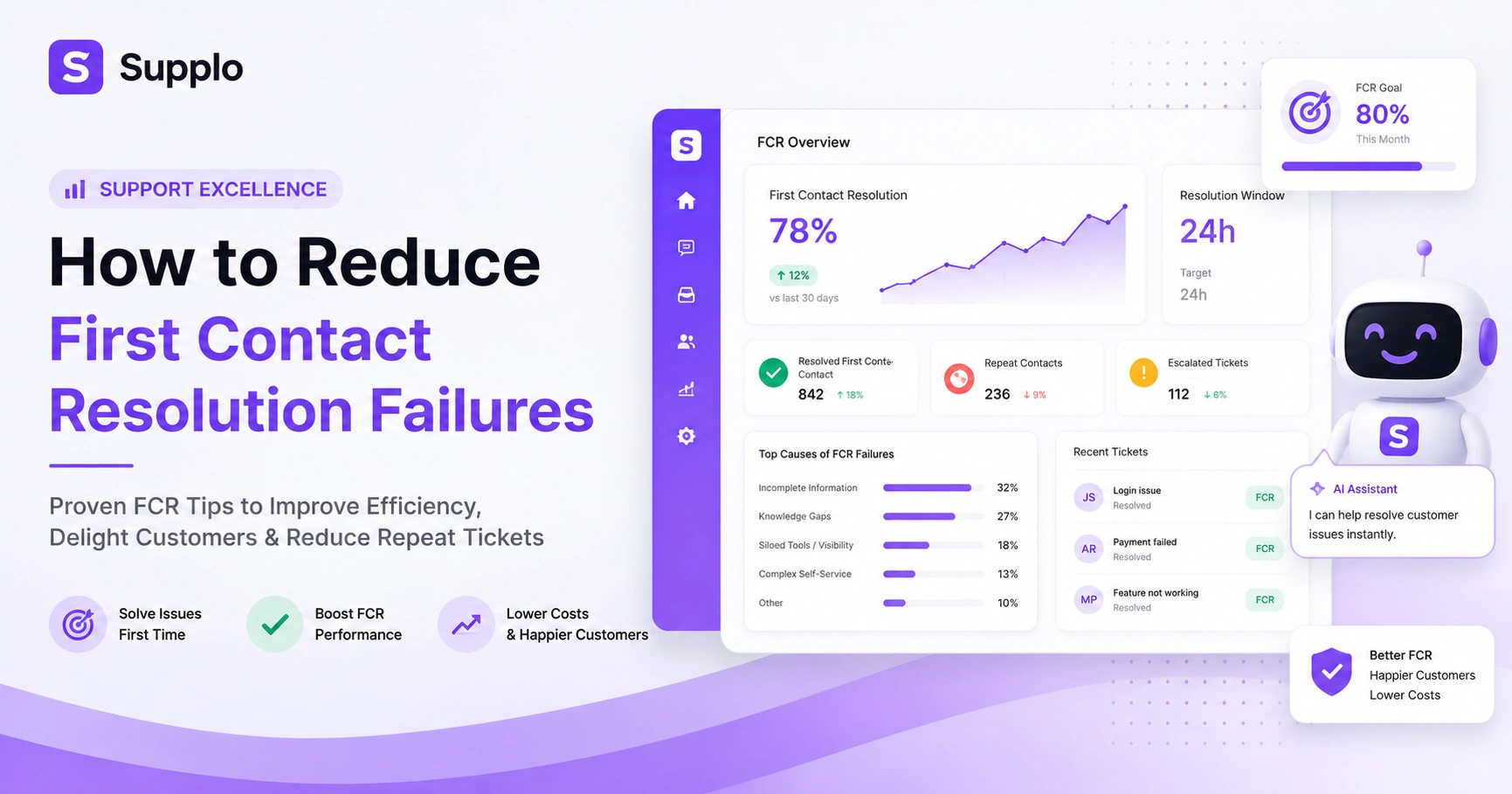
A fast, unhelpful reply is still a support team error. Many teams obsess over first response time while ignoring whether the issue was actually resolved. Reliability means solving the problem right the first time, even if it takes an extra minute. Measure first contact resolution (FCR) and resolution rate, not just reply time, to avoid common customer service blunders.
The ticket ping-pong problem, in which customers are passed back and forth between agents or departments, significantly increases customer effort. A quick look into it without a concrete plan isn't helpful; it just buys time. The right AI can answer fully and accurately, not just quickly, by drawing directly from a well-maintained knowledge base.
Keeping a Rigid: Legacy Pricing Model
If your bill goes up every time you hire someone, your pricing model is working against you.
Per-seat pricing is a relic that actively punishes you for scaling your team. As you add agents to handle volume, your bill skyrockets. The modern, reliable alternative is a flat, per-workspace model that lets you add unlimited team members without surprise invoices. Your support budget should be predictable and transparently priced.
Per-seat pricing creates a tax on growth, forcing businesses to choose between hiring needed staff and controlling costs. The hidden costs of cheap per-agent tools often manifest as subpar automation that requires more human intervention. A flat rate allows you to experiment with automation fearlessly, enabling better planning for conversation routing and queue management.
Want to See a Reliable AI Handle Your Support Now?
See how Supplo’s AI agent can start resolving tickets from your website, email and social media in minutes. No rigid onboarding, just smart automation.
Assuming Your Customers All Speak the Same Language
If you're only supporting one language, you're leaving money on the table.
In a global market, failing to offer multilingual support is a major missed opportunity. If a customer messages you in Spanish and gets a reply in English, that's a fragmented experience. Your support tool should automatically detect and translate messages, letting your team reply in their own language while the customer sees their native language. This helps avoid unifying customer communication errors.
A language barrier creates a significant trust gap, making customers feel misunderstood. Real-time translation can open new international markets by making support accessible to a wider audience. The risk of using external translators for every message, compared with integrated AI translation, lies in delays and potential inconsistencies. Integrated AI translation ensures a seamless and efficient experience.
Neglecting Self-Service and Your Knowledge Base
Your knowledge base is the brain of your support operation. Don't let it go brain-dead.
If you aren't maintaining your knowledge base, you are forcing your AI agent and your human team to repeat themselves. A stale KB leads to bad answers from your AI and slower agents, contributing to scaling support issues. A reliable support stack is built on a constantly updated, searchable library that the AI uses as its source of truth.
A good knowledge base can reduce ticket volume by 40% or more by empowering customers to find answers independently. There's a direct link between KB quality and AI agent accuracy; the AI's efficacy is only as good as the information it learns from.
Simple steps to keep your FAQ and articles current:
- Schedule regular audits: Designate a team member to review and update articles quarterly.
- Monitor common questions: Update articles frequently asked through human support or those that the AI struggles with.
- Cross-reference with product updates: Ensure your KB reflects the latest product features and changes.
Not Defining a Clear Human Handoff Protocol
A bad handoff is a silent trigger of customer churn. Make it seamless.
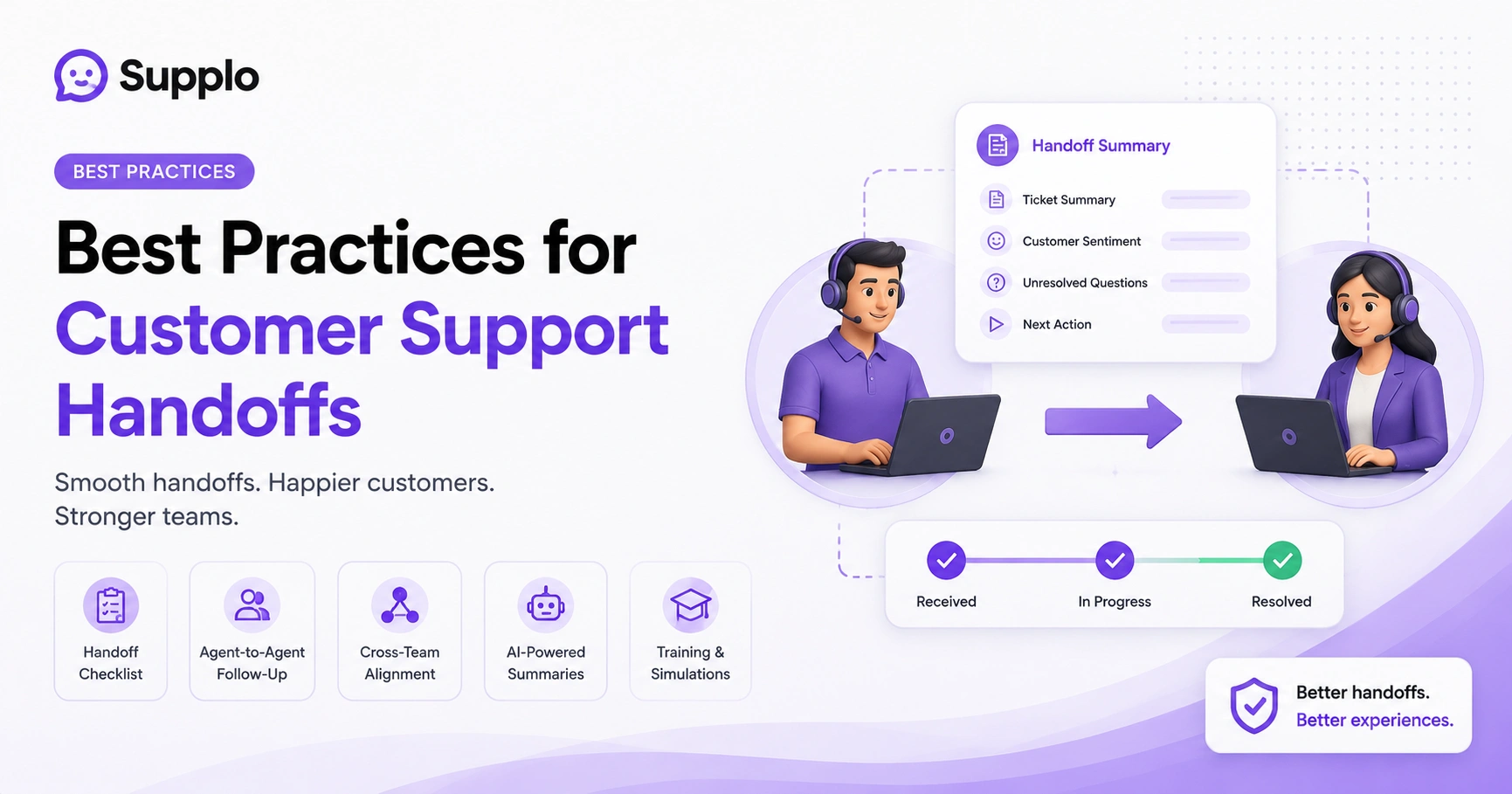
When an AI can't solve a problem, the handoff to a human agent is a make-or-break moment. If the transfer is clunky, the human lacks context, or the customer has to repeat themselves, you've just turned a simple issue into a churn risk. A reliable system automatically provides the human agent with the full conversation history, preventing AI customer support mistakes.
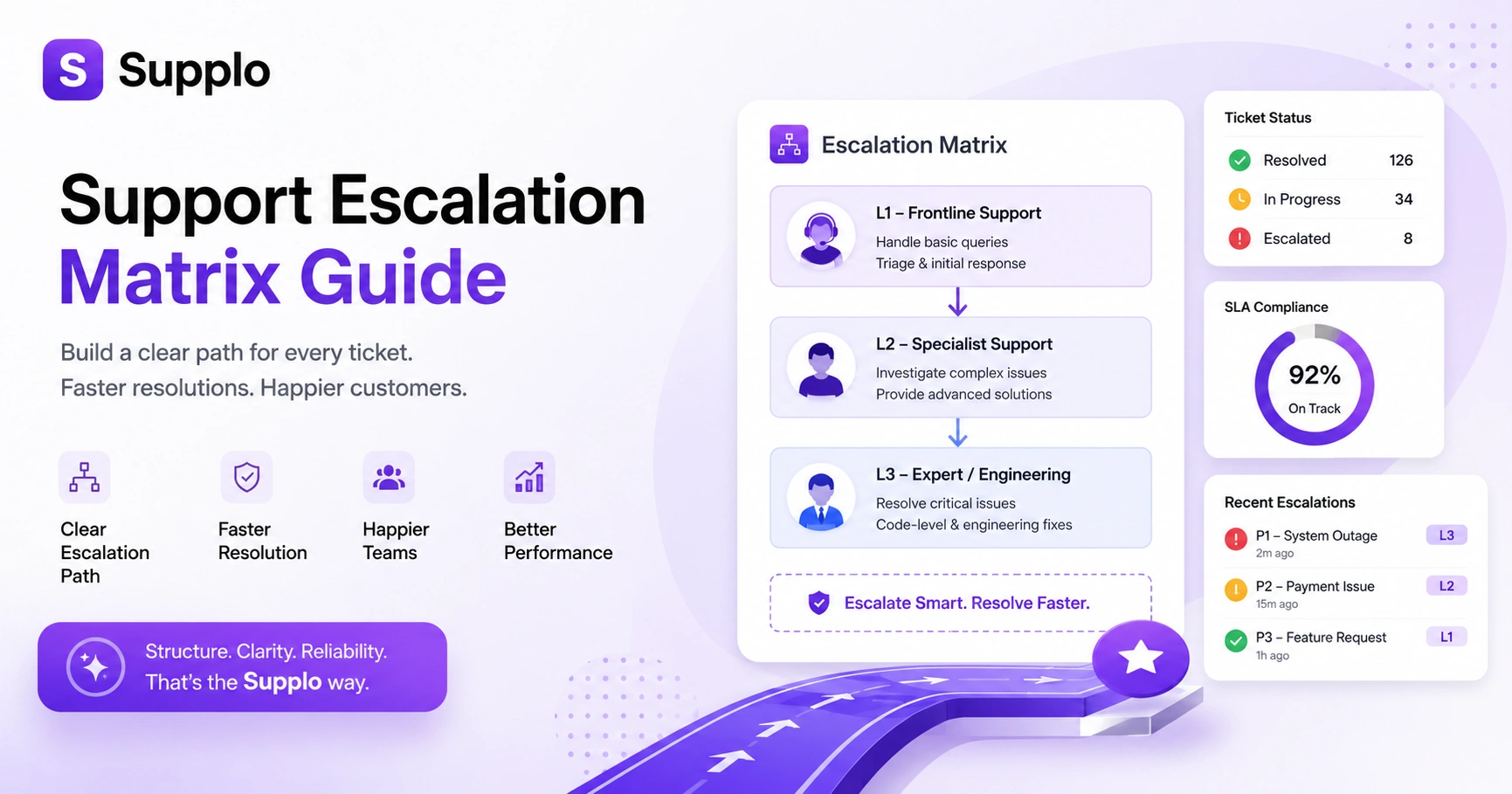
Why cold handoffs feel like a customer service snub: they signal to the customer that their time and previous interaction were not valued. The technical requirements for a seamless transfer include complete conversation history, intent recognition and the passing along of any relevant customer data. Training the AI to recognize when it's out of its depth, usually through low confidence scores or complex intent, is crucial for a smooth escalation protocol.
Tired of Bad AI Handoffs or a Fragmented Inbox?
If your current tool feels like it’s fighting your team instead of helping, it’s time to switch. Supplo unifies everything into one workspace with transparent pricing.
[Fix Your Support Stack]
How to Build a Reliable AI-Powered Support Stack
Stop patching together a Frankenstein system. Build one that works.
The most reliable support stacks will combine a self-learning AI with a unified inbox, a strong knowledge base and transparent pricing. You need a partner that handles multichannel communication without the complexity of legacy tools. The goal is to automate the routine, empower your humans and keep your costs predictable, addressing common customer support mistakes to avoid.
The three pillars of Reliability for your support stack are a smart AI agent, a truly unified inbox and a clear and fair pricing model. Building this stack requires careful consideration of data integration, workflow automation and your team's operating model. Transparency from your vendor is a competitive advantage, ensuring you know exactly what you're getting and how it will perform.
A checklist for evaluating your support stack:
- Does it offer a self-learning AI agent that can resolve up to 80% of tickets?
- Does it unify all communication channels (email, chat, WhatsApp, Telegram Support, Instagram DMs, etc.) into one thread-based inbox?
- Is your knowledge base deeply integrated and used as the AI's primary source of truth?
- Does it offer transparent, flat-rate pricing instead of variable per-seat costs?
- Can it seamlessly hand off conversations from AI to human agents with full context?
- Does it support multilingual communication with automatic translation?
Build Your Support Stack for the Future, Reliably.
Stop making the same mistakes. With flat pricing, unlimited team members and a self-learning AI, Supplo is built to scale with you. Plans include support for payments via Crypto, Binance Pay, Payeer, GCash, AmanPay, QIWI Wallet, DOKU, Nigeria and South Africa cards, Skrill and Payoneer.
Key Takeaways
- Proactive AI Management: Your AI agent needs continuous training and auditing to avoid becoming outdated.
- Unified Customer View: Integrate all communication channels into a single inbox for a seamless customer experience.
- Smart Scaling: Leverage AI to automate routine tasks, allowing human agents to focus on complex, high-value interactions.
- Quality over Speed: Prioritize delivering complete, accurate resolutions to build trust, rather than just fast, unhelpful replies.
- Predictable Costs: Opt for pricing models that support growth without penalizing you for expanding your team.
- Empower Self-Service: A well-maintained knowledge base is crucial for both AI accuracy and customer self-help.
FAQ
What is the most common customer support mistake businesses make?
The most common mistake is treating AI as a set-it-and-forget-it tool. Without ongoing training, monitoring and updates, AI models quickly become outdated and start providing incorrect answers, damaging customer trust.
How do I avoid a fragmented support experience for my customers?
You avoid fragmentation by adopting a unified, omnichannel support inbox. This ensures every conversation, whether from WhatsApp, Instagram, email, or live chat, is visible in one place with a complete history, so customers never have to repeat themselves.
What is the biggest mistake when scaling a customer support team?
The biggest mistake is scaling only by hiring more people. This approach is expensive and leads to inconsistency. A smarter strategy is to use an AI agent to automatically handle up to 80% of routine questions, allowing your human team to focus on complex issues.
Why do AI chatbots sometimes give wrong answers?
AI chatbots give wrong answers due to poor onboarding or model drift. If you feed the AI an outdated knowledge base or fail to train it on your latest product changes, it can hallucinate (invent) answers that sound confident but are completely wrong.
What are the signs of bad customer service examples to watch for in my own company?
Key signs include: customers having to repeat their issue across channels, slow first response times, robotic chatbot interactions that don't understand context and a confusing handoff process from AI to a human agent.
How can I fix AI agent onboarding issues?
Fix AI onboarding by carefully curating your knowledge base and documentation before training the agent. Test the AI with real, edge-case customer scenarios and set clear rules for when it should escalate a conversation to a human agent.
Is it safe to let AI handle all my customer support?
A reliable approach is to let AI handle routine requests, while always having a clear protocol for handing off complex, sensitive, or high-emotion issues to a human team member.
Compliance line: Supplo is not affiliated with any app or website. Please follow each app's terms and local regulations.