On this page
Let's be honest, choosing between outsourced and in-house support isn't simple. It's really a trade-off between flexibility and control. Outsourcing lets you scale fast by handing tickets to an external team. In-house keeps every conversation inside your culture, for better or worse. The real split isn't just about cost. It's about how much oversight you're willing to trade for speed.
- Outsourced support teams are usually third-party agencies handling tickets for multiple brands at once. They're efficient, but they're not your team.
- In-house support means you hire, train and manage agents directly on your own payroll and using your own tools. Slower to build, but fully yours.
- Both models can deliver high satisfaction, but the path to getting there looks completely different.
Pros of Outsourcing Customer Support: When It Makes Sense
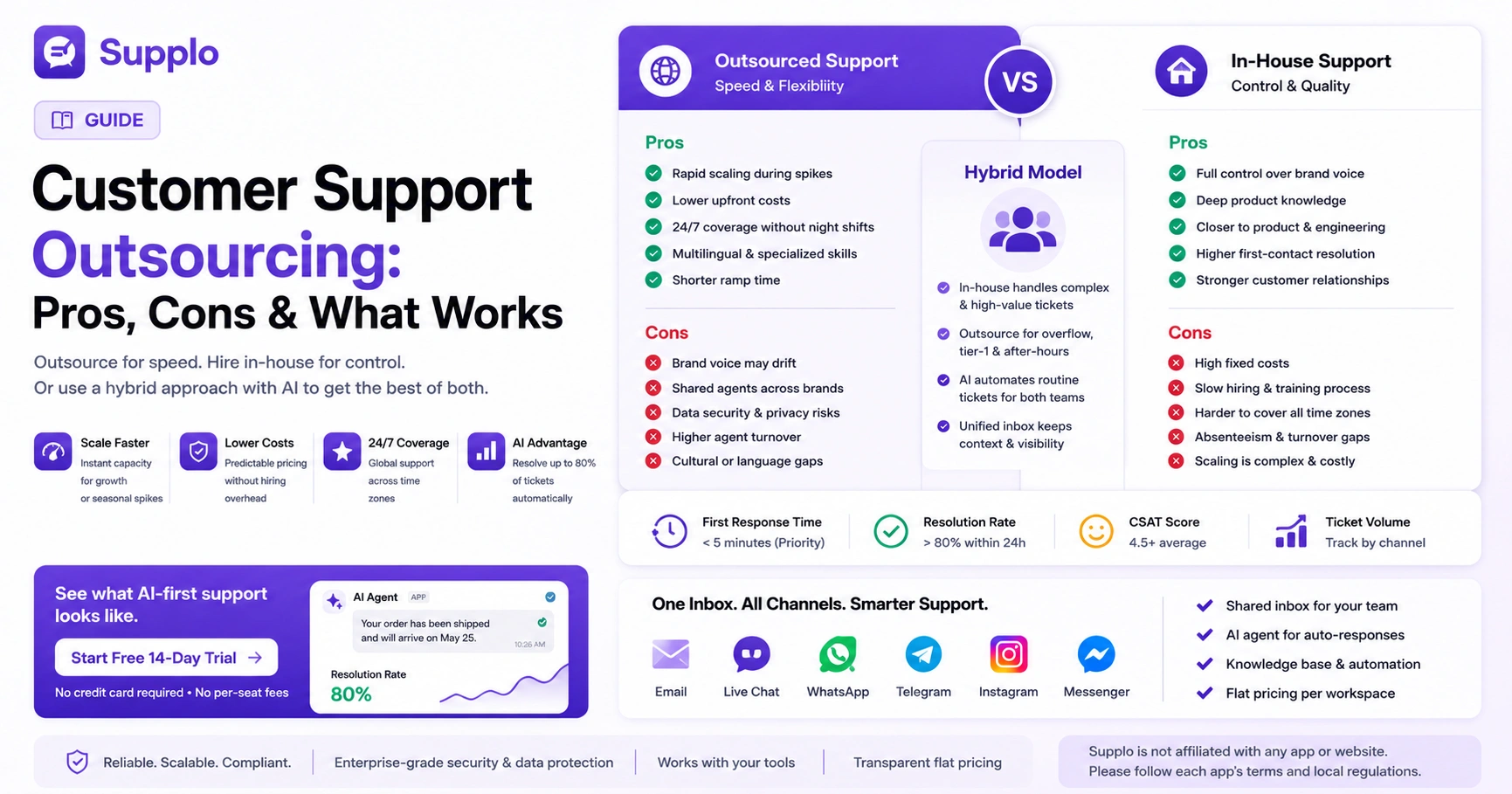
The biggest advantages? Rapid scaling, lower upfront costs and 24/7 coverage without hiring night shifts. You skip the overhead of recruiting, training and infrastructure. That's huge for seasonal spikes or early-stage startups. And if you need multilingual support? Outsourced agencies often offer language coverage that would take months to build in-house.
- Instant capacity during product launches or holiday rushes, no long hiring cycles.
- Fixed per-ticket or per-agent pricing makes budgeting predictable.
- Pre-trained agents on common tools significantly reduce ramp time.
- Access to specialized skills (technical support, billing) without in-house specialization.
Cons and Risks of Outsourcing Customer Support
Here's where it gets tricky. The disadvantages of outsourcing customer support often center around loss of brand voice, data security concerns and inconsistent quality. Agents juggling multiple brands may lack deep product knowledge. And high turnover in call centers? Your support consistency can swing week to week. You also face real risks around data privacy compliance, especially when sensitive customer information crosses borders.
- Brand tone drifts when agents haven't lived your product culture.
- Shared agents may prioritize easier tickets from other clients over yours. Yes, that happens.
- Data privacy risks increase if the outsourcing provider lacks strong security certifications.
- Language or cultural gaps can lead to miscommunication, especially in nuanced conversations.
Compliance Line: Supplo is not affiliated with any app or website. Please follow each app's terms and local regulations.
Pros of In-House Customer Support
In-house support gives you total control over brand voice, escalation paths and product knowledge. Agents sit closer to your engineering and product teams. That means faster bug reports and better feedback loops. For high-stakes accounts or complex B2B products, in-house teams often deliver higher first-contact resolution and stronger customer relationships.
- Agents develop deep expertise in your specific product over time.
- A direct feedback channel between the support and product teams shortens issue resolution time.
- Full control over hiring standards, training and quality assurance processes.
- Higher alignment with company culture and long-term customer relationship goals.
Cons of In-House Customer Support: The Scale Problem
In-house support doesn't scale easily. Every new hire means recruiting, training, hardware, software licenses and management overhead that adds up fast. Covering weekends, holidays, or after-hours spikes? That often means hiring multiple shifts or paying heavy overtime. For fast-growing companies, the lag between hiring and productivity can create frustrating backlogs.
- High fixed costs regardless of ticket volume. You pay even during slow periods.
- Recruiting specialized support talent is slower and more expensive per hire.
- Single-location teams struggle to cover global time zones without shift differentials.
- Absenteeism or turnover creates immediate gaps that are hard to backfill quickly.
Key Factors: Cost, Control and Consistency
When comparing customer support outsourcing vs in-house, three pillars matter: cost, control and consistency. Outsourcing wins on variable cost and speed, but often loses on consistency and control. In-house wins on quality and brand alignment, but struggles with cost predictability and rapid scaling.
- Cost: Outsourcing is pay-per-use; in-house is pay-per-head plus benefits.
- Control: In-house gives full process authority; outsourced teams follow their own playbooks.
- Consistency: In-house teams are easier to standardize; outsourced teams depend on the provider's QA.
- Trade-off: No perfect model exists. The right choice depends on your priority: growth speed or brand fidelity.
The Hybrid Model: Blending In-House & Outsourced Support
Many mature companies use a hybrid approach. An in-house core team handles complex or high-value tickets. An outsourced partner handles overflow, tier-1, or after-hours volume. This balances cost control with quality, as long as the handoff process is clean. The challenge? Tooling. Keeping both teams on the same platform with unified visibility.
- The in-house team manages escalations, product feedback and VIP accounts.
- Outsourced team handles repetitive requests, off-hours volume and seasonal spikes.
- A unified ticketing system is critical. Fragmented tools create silos and duplicated work.
- Clear SOPs for handoffs reduce customer friction when switching between teams.
See what AI-first support looks like.
Start your free 14-day trial and let the AI agent of Supplo handle up to 80% of your routine tickets automatically, no per-seat fees, no contracts, no onboarding hassle.
Start Free Trial →
How AI Customer Support Changes the Math for Both Models
AI customer support software is completely shifting the outsourcing vs. in-house decision. A self-learning AI agent can resolve a large percentage of routine tickets automatically. That reduces the volume both outsourced and in-house teams need to touch. And it changes the cost comparison drastically; AI costs a fraction of either a human model, especially if priced per resolution rather than per seat. Teams keep the human layer for complex cases while AI handles the repetitive load.
- AI resolves common questions without adding headcount or outsourced seat costs.
- Human agents only handle escalations, making each touchpoint more impactful.
- Modern AI tools learn from your knowledge base and past conversations, improving over time.
- AI operates 24/7 without shift scheduling, eliminating a key reason companies outsource for coverage.
Keep your human team focused on what matters.
Supplo unifies email, live chat, Whatsapp, Telegram, Instagram DMs and Facebook Messenger into one shared inbox. Your in-house team handles escalations; the AI handles the rest.
Use Cases: When to Outsource vs When to Hire
Outsource support when you face rapid growth, seasonal volume spikes, or need multilingual coverage quickly. Hire in-house when your product is complex, your customers expect deep expertise, or your brand voice is a competitive differentiator. If your ticket volume is predictable and your team can train efficiently, in-house often wins. If volume is unpredictable, outsourcing provides safer flexibility.
- Outsource: E-commerce during Q4, SaaS product launches, multilingual startups.
- Hire in-house: B2B enterprise support, regulated industries, high-touch concierge services.
- Hybrid: Fast-growing startups that need immediate coverage but plan to bring more in-house over time.
- Test: Try outsourcing for a small channel or specific time zone before committing fully.
The Real Reliability Test: What Breaks and What Works
Reliability in customer support isn't just uptime; it's consistency across agents, channels and time zones. Outsourcing can deliver reliable coverage if the provider has strong QA and low agent churn. In-house teams can be highly reliable but are fragile when key people are out. The most reliable setup? Often a consistent AI layer combined with a smaller, well-trained human team. Not a bloated outsourced army or an understaffed in-house crew.
- Outsourcing breaks when the provider's agent turnover spikes and knowledge resets.
- In-house breaks when you can't fill a shift or backfill a departure quickly.
- AI reliability improves with effective knowledge base management and regular updates to training data.
- Real reliability means predictable response times, consistent resolution quality and smooth escalation paths.
Stop guessing which model works. Test both risk-free.
Try Supplo for 14 days. Our flat per-workspace pricing includes AI resolution, a multichannel inbox and a knowledge base, so you can compare outsourcing vs. in-house without committing to either.
Key Takeaways
- Outsourcing gives you speed and scalability but carries risks of brand drift, data security breaches and inconsistent quality.
- In-house support offers deeper control and product knowledge but struggles with cost predictability and rapid scaling.
- AI support tools can resolve a large percentage of routine tickets automatically, reducing the need for headcount in either model.
- The most reliable setup often combines a consistent AI layer with a smaller, well-trained human team for escalations.
FAQ
Is outsourcing customer support cheaper than in-house?
It can be cheaper for variable volume, but fixed per-seat pricing may cost more than AI-automated or in-house teams at scale. Outsource for spikes; consider AI for baseline automation.
How do I maintain brand voice with an outsourced team?
Provide detailed brand guidelines, regular QA sessions and limit the number of brands each agent supports. Some companies record mock calls or use script libraries.
What are the biggest risks of outsourcing customer support?
Data security, loss of quality control and agent churn in the outsourcing provider. Ensure contracts include SLAs for training, turnover and data protection.
Can AI completely replace outsourced or in-house support?
Not entirely. AI handles routine tickets well, but complex emotional or product-specific issues still need human judgment. The best setup combines AI + human escalation.
How long does it take to switch from outsourced to in-house?
Typically 3–6 months, including hiring, training and parallel-running both teams. AI tools can accelerate the transition by automating routine ticket processing from day one.
What's the best tool for managing hybrid support teams?
Look for shared inboxes with multichannel support, internal notes and role-based permissions. Avoid tools that limit visibility to in-house agents only.
How do I measure the quality of an outsourced support partner?
Use CSAT scores, first-response time, resolution rate and quality assurance audits. Require monthly performance reports tied to your SLAs.
Compliance line: Supplo is not affiliated with any app or website. Please follow each app's terms and local regulations.