On this page
Look, we've all been on the receiving end of a cold, robotic support reply. It stings, right? Empathetic customer support isn't just about being polite; it's become a strategic must-have for brands that want real relationships, not just one-off transactions. This guide breaks down a practical framework for crafting empathetic replies across every channel, whether you're on email, live chat, or handling social media firestorms.
Here's the thing: empathetic replies matter most when customers are frustrated, confused, or looking for reassurance. For straightforward transactional stuff? Keep it direct and clear. Save the warmth for when it counts.
Quick Answer
- Lead with emotion: Always acknowledge how the customer feels before diving into the fix.
- Validate, don't just sympathize: Show you get why they're upset, not just that you feel bad.
- Be specific: Mirror their language and describe their exact problem, not generic corporate speak.
- Actionable solutions: Spell out next steps clearly so there's no guesswork.
- Public then private: On social media, respond with empathy publicly, then move to DMs for resolution.
Why Empathy in Customer Support Is Non-Negotiable for Modern Brands
Here's the blunt truth: empathy is what separates a customer who walks away from one who becomes your biggest cheerleader. When people feel genuinely heard, they're way more likely to forgive a mistake, stick around, and even pay a premium over time. Without empathy? Even the fastest fix feels hollow.
Empathy cuts down churn by tackling emotional friction head-on, not just the technical glitch. It builds trust because customers remember how you made them feel, not just the solution you handed them. In an age where chatbots handle the basics, genuine human empathy is your competitive edge. Plus, empathetic replies tend to reduce escalations: when someone feels respected early on, they're less likely to escalate to a manager.
The Science of Empathetic Communication Skills: What Actually Works
Let's get one thing straight: empathy isn't just being nice. It's a structured skill that involves validation, active listening, and mirroring the customer's feelings. The most effective empathetic replies follow a simple three-part structure: acknowledge the feeling, validate the frustration, then lay out a clear path forward. Research suggests that using the customer's own words back to them can boost satisfaction scores by a solid margin.
Key tactics that actually move the needle:
- Mirror their language: I understand the inconvenience is weak sauce. I hear how frustrating that delay was.
- Validate, not sympathize: Say, "That makes sense why you're upset," instead of "I'm sorry you're upset." Big difference.
- Ditch the empty platitudes: We value your feedback sounds like a robot wrote it. Be real.
- Match their tone: If they're direct, be direct. If they're emotional, meet that with calm understanding.
- The feel, felt, found framework works, but only if you adapt it to sound human, not like you're reading a script.
How to Write Empathetic Customer Support Replies
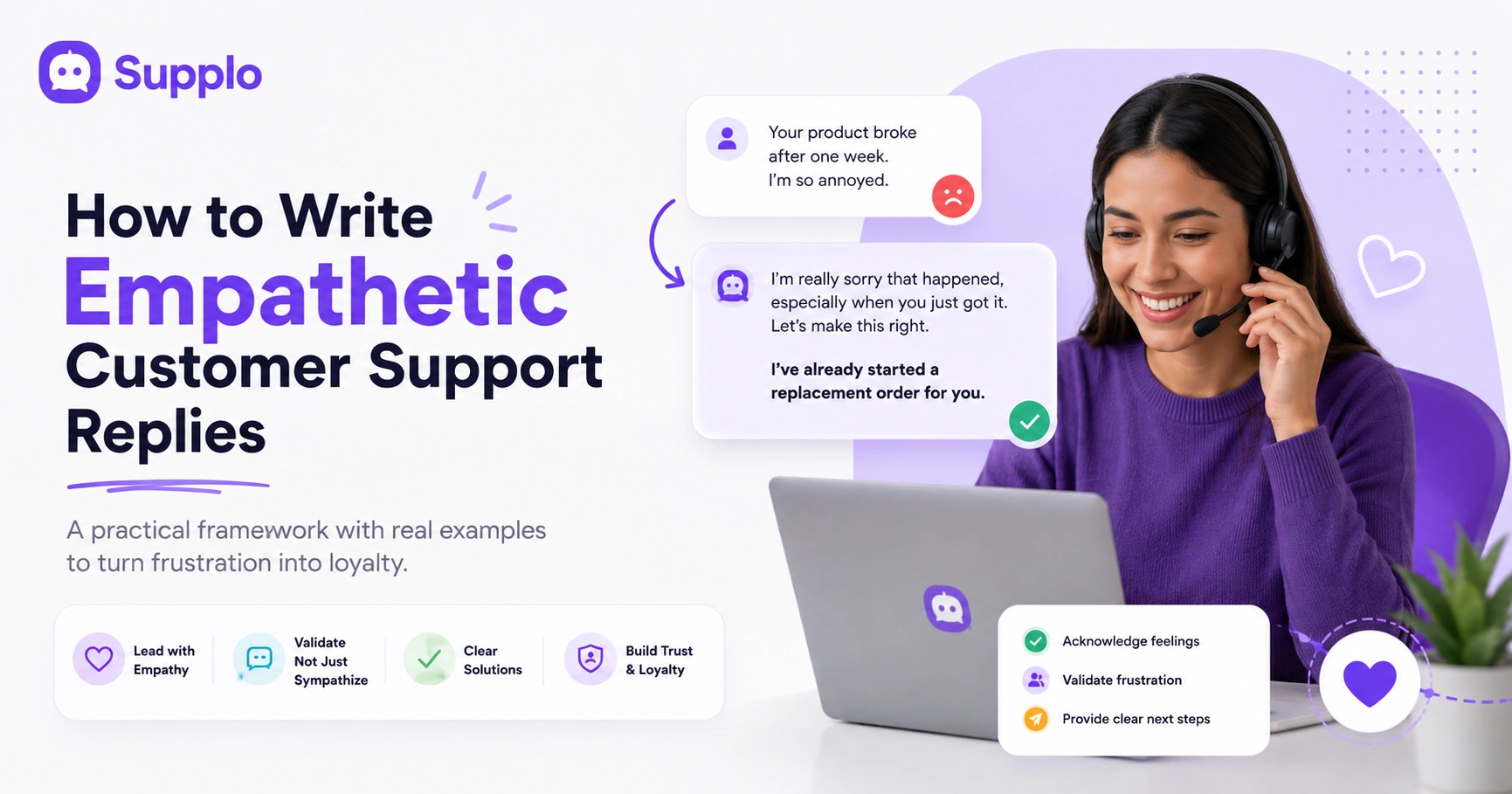
Here's the golden rule: start with the customer's emotion, not the problem itself. Open by acknowledging what they're feeling (I can see why that would be stressful), then validate the inconvenience (That's not the experience we want you to have), and finally present the solution clearly (I've already refunded the shipping; here's your tracking for the replacement). This works across email, live chat, and social media.
Process your team can follow:
- Read the whole message. Don't skim for keywords. Get the full picture.
- Identify the dominant emotion. Are they frustrated? Confused? Disappointed? Urgent?
- Lead with a feeling of acknowledgement. Address the emotion before you even mention the fix.
- Offer two solution pathways (when possible). This gives the customer a sense of control back.
- Close with a forward-looking statement. Something like: "You'll see the update in your shared inbox within two hours."
Following this framework helps your team handle even complex issues with genuine care. And if you want to automate the heavy lifting, an AI agent can draft empathetic first responses for your team to personalize.
Try Empathy-First AI for Free
Can empathetic replies scale without losing the human touch? Start a 14-day free trial at Supplo.io. No credit card needed. The AI suggests empathetic drafts; your team adds warmth.
Customer Empathy Examples That Turn Frustration into Loyalty
Let's look at a real scenario. A customer writes: Your product broke after one week. I'm so annoyed.
- Non-empathetic reply: Please submit a warranty claim. (Feels like a wall.)
- Empathetic reply: I'm really sorry that happened, especially when you just got it. Let's make this right. I've already started a replacement order for you. (Feels like a partner.)
More examples to learn from:
- Bad: We apologize for any inconvenience caused. → Generic, forgettable, corporate-speak.
- Good: I can see why that's frustrating, especially when you need it for your trip. Let me fix this now. When you handle complaints via email ticketing without losing empathy, specificity is everything.
- Great: You're right to be upset. That shouldn't have happened. I've personally escalated this, and you'll hear from me within an hour. → Shows ownership and urgency.
Replace 'issue' with the exact problem (the login error, the delayed delivery). Use 'I' instead of 'we' when possible; it feels more human and accountable.
How to Write Empathetic Customer Support Replies on Social Media
Social media is the wild west: public, permanent, and fast. Every reply becomes a brand statement. Start by acknowledging the customer publicly in a neutral, empathetic tone (We hear you, and we want to fix this). Then immediately move the conversation to private channels (DM, email) to handle the specifics. Never argue publicly, never deflect blame, and never delete a complaint unless it breaks platform rules.
Best practices for social media support:
- Public first, private resolution: Thanks for flagging this. Can you DM us your order number? We'll sort it out immediately.
- Avoid canned responses. Copy-pasted. We apologize for the inconvenience; it looks lazy and damages your reputation.
- Use the customer's name and mirror their tone (calm if they're calm, urgent if they're upset).
- Don't offer sensitive info (refunds, personal data) in public replies; move to DMs.
- Timeliness matters: Respond within an hour on social media for the best brand perception.
Responding to Social Media Complaints: A Script for Public Support Responses
A solid social media complaint response has three parts: public empathy, private escalation, and follow-through visibility. Example: Hi [Name], I totally understand why you're frustrated about the delay. That's not okay. I've sent you a DM to get your order details sorted right away. This shows transparency and accountability to everyone watching.
Ready-to-use scripts:
- Delivery issue: We're sorry your package didn't arrive on time; that's on us. Please check your DMs so we can send a replacement today.
- Product defect: You shouldn't have received a faulty item. We've already flagged this with our team. Check your DMs for a prepaid return label and a full refund or swap.
- Billing error: That charge shouldn't have happened. We've reversed it, and you'll see it back in 2–3 business days. DM us if you need a receipt.
Tag or @mention the customer only once to avoid noise. If the complaint is complex, say I'm personally handling this; expect an update from me in 30 minutes.
Supplo is not affiliated with any app or website. Please follow each app's terms and local regulations.
Brand Reputation Management Through Empathetic Public Replies
Every public reply becomes part of your brand's permanent record. Empathetic, transparent responses on social media build goodwill, not just with the complaining customer, but with everyone lurking and reading the thread. A single well-handled complaint can turn a detractor into a promoter and attract new customers who see your integrity in action.
Why this matters: Public empathy signals to other customers that you take responsibility seriously. A complaint that ends with Wow, thanks for fixing this so fast becomes free positive PR. Never delete complaints unless they violate TOS; it looks like you're hiding mistakes. And don't forget to respond to positive comments too; gratitude builds community. Train your team to treat every public interaction as an opportunity to collect a testimonial.
How to Write Empathetic Customer Support Replies to Build Rapport
Rapport comes from consistency, personalization, and follow-through. To build empathy, end every interaction with a forward-looking, customer-centric statement (I'll personally keep an eye on your next order to ensure it goes smoothly). This signals that you see the customer as a person, not a ticket number.
Quick rapport-building tactics:
- Use the customer's name naturally (Thanks for your patience, Alex vs Dear valued customer).
- Reference previous interactions: I saw you reached out about this last month; let's make sure it's fully resolved now.
- Offer proactive follow-ups: I'll send you an update tomorrow at 10 AM so you don't have to chase this.
- Make micro-commitments: I'll personally check this and get back to you in 2 hours. Then actually do it.
- Avoid over-apologizing. Too many I'm sorry statements lose impact. Use one sincere apology, then take action.
Customer Rapport Building Techniques That Scale With Your Team
You can't scale empathy just by hiring more people; you have to embed it into your systems. Use a shared inbox like Supplo to keep every interaction thread-based, so context never gets lost between agents. Train your team on a short list of empathy triggers (e.g., always acknowledge the emotion before the problem) and use AI to draft empathetic suggestions that agents can personalize.
Scaling tactics that actually work:
- Use macros that start with an empathy statement, not a solution.
- Implement a two-sentence rule: the first sentence always acknowledges the feeling.
- Use AI to pre-score customer sentiment so agents know when to escalate empathy.
- Build a knowledge base of common emotional scenarios so new hires learn fast.
- Measure rapport with CSAT + sentiment analysis, not just resolution time.
Training Your Support Team on Soft Skills for Support Without the Fluff
Soft skills training doesn't need to be a full-day workshop with awkward roleplays. Instead, give your team real scripts, real scenarios, and a feedback loop. Use recorded real interactions (anonymized) to highlight what worked and what didn't. The single best soft skill is listening first and responding second; train your team to pause before typing.
Practical training ideas:
- Run weekly empathy audits where a team member shares a tough ticket and how they handled it.
- Create a cheat sheet of empathy phrases that don't sound robotic.
- Shadow top performers: Let new agents listen in on how experienced teammates handle emotion-heavy tickets.
- Use AI to suggest empathetic alternatives when a draft reply feels too cold.
- Reward positive customer sentiment scores, not just fast resolution times.
If your current support tool makes every response feel robotic, it might be time to switch. Supplo's shared inbox keeps your team on the same thread, so empathy never gets lost in handoffs. Check how Supplo compares to legacy support tools and start free today.
Key Takeaways
- Empathy is a strategic asset that directly impacts retention and customer loyalty.
- It involves structured communication: acknowledge, validate, solve.
- Social media requires public acknowledgment followed by private resolution.
- Scaling empathy means embedding it into your support systems and training.
- Authenticity and consistent follow-through are crucial for building long-term rapport.
FAQ
Can I use the same empathetic reply for every customer?
No, empathy must be personalized. A generic script like "We understand your frustration" feels hollow when it's copied and pasted. Tailor the emotional acknowledgment to the specific situation.
What if the customer is being rude or unreasonable?
Stay calm and empathetic. Acknowledge their anger without endorsing bad behavior: I hear how upset you are, and I want to fix this for you. Never match their tone. If they cross into harassment, escalate to a manager or disengage politely.
How do I show empathy on social media without oversharing?
Acknowledge the issue publicly, then move to DMs for specifics. Example: We're sorry to hear this. Can you DM us your order number? We'll sort it out fast. This protects privacy while showing public accountability.
Is it okay to use AI to write empathetic replies?
Yes, but only as a starting point. AI can draft an empathetic opening, but a human must review and personalize it. Tools like Supplo's AI agent can suggest responses, but the final touch should feel human.
How long should an empathetic response be?
Short and specific. Two to four sentences is ideal: acknowledge the feeling, validate the frustration, state the solution, and offer a forward-looking close. Long paragraphs dilute empathy.
What's the biggest mistake companies make with empathy in support?
They skip the emotion and jump straight to the fix. A customer who feels unheard will not be satisfied with a correct solution. Always lead with acknowledgment, even if it's just one sentence.
Can empathetic replies actually damage brand reputation?
Yes, if they feel manipulative or insincere. For example, we understand your frustration, but a boilerplate policy explanation feels fake. Empathy must be paired with action, or it backfires.
Compliance line: Supplo is not affiliated with any app or website. Please follow each app's terms and local regulations.