On this page
Choosing the right helpdesk software can define how quickly your small business responds to customers, how efficiently your team operates and ultimately, how much you spend. For startups and SMBs, the decision often comes down to two major players: Freshdesk and Intercom.
Honestly? Neither is perfect. And both can get expensive faster than you'd expect. This breakdown of Freshdesk vs Intercom for small businesses will help you see past the marketing fluff and figure out which, if either, actually works for your team.
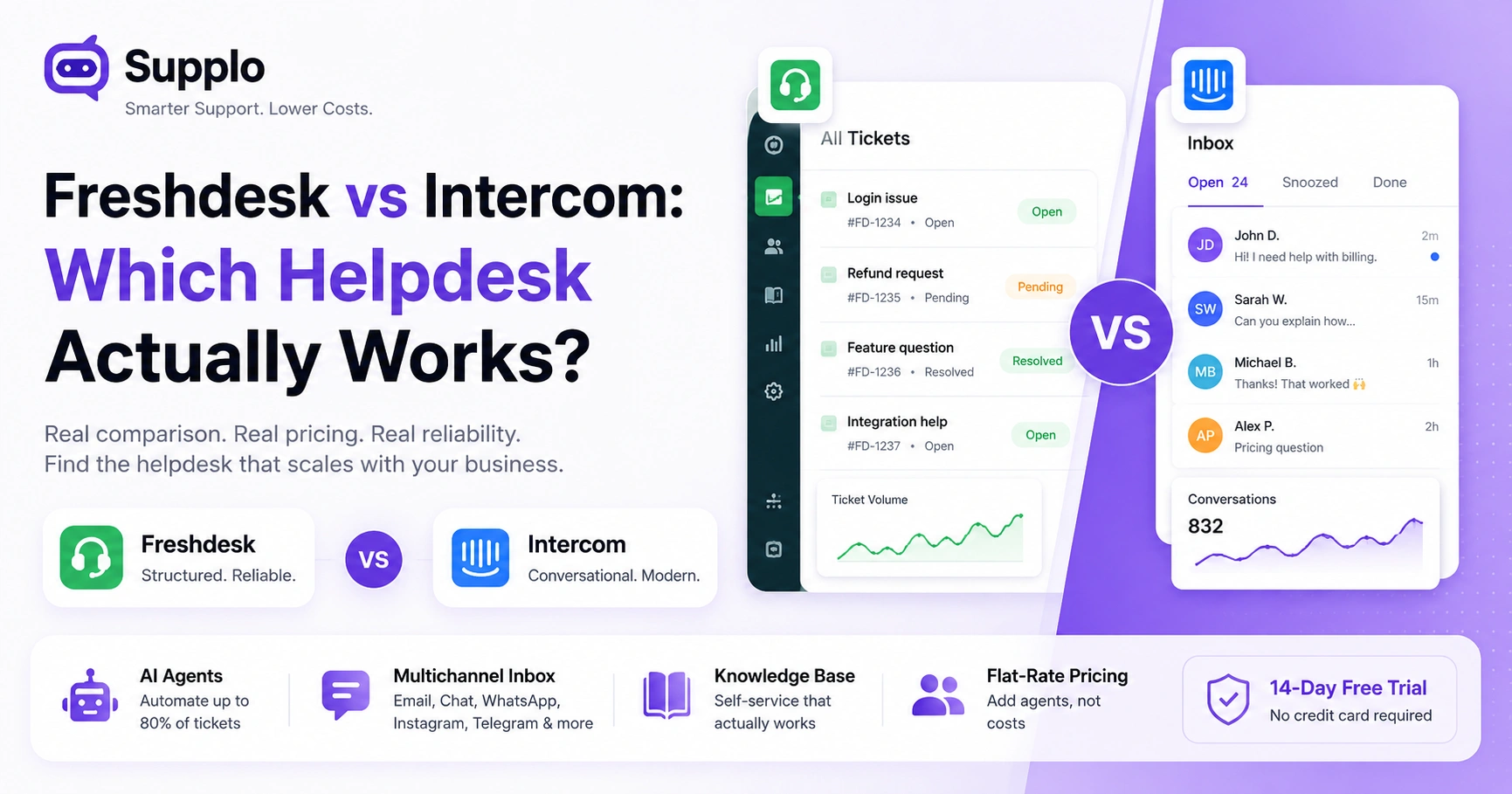
Freshdesk is a traditional ticketing system built for process-heavy teams, while Intercom is a modern communication platform designed for conversational support. This comparison will help you determine which platform truly supports your team's growth without breaking the bank or sacrificing reliability.
Quick Answer
- Freshdesk offers a robust, structured ticketing system, including a free plan for up to 10 agents, but requires more upfront setup.
- Intercom provides a highly polished, conversational shared inbox with quick setup, but its features come at a higher cost, often as add-ons.
- Pricing for both platforms scales per agent per month, leading to rapidly increasing costs as your team grows.
- AI agents from both platforms can automate tasks, but their effectiveness and cost model (per-resolution for Intercom, bundled for Freshdesk) vary significantly.
- Multichannel support is present in both but often requires extensive setup or third-party integrations for social media platforms.
- Alternatives like Supplo offer flat-rate pricing, unified multichannel inboxes and budget-friendly AI automation to avoid the hidden costs of scaling.
Freshdesk vs Intercom: The Core Difference for Small Business & Startups
Freshdesk is a traditional ticketing system built for process-heavy teams, while Intercom is a modern communication platform designed for conversational support. For small businesses with limited support headcount, Intercom's inbox feels more intuitive, but Freshdesk offers a more structured approach that scales better without steep learning curves. The decision comes down to whether you need a strict ticketing workflow (Freshdesk) or a live chat-first inbox (Intercom).
Think of it this way: Freshdesk treats every customer interaction like a case file: statuses, priorities, SLAs, the whole works. Intercom treats them like conversations. Both approaches work, but they feel completely different day to day.
Freshdesk organises everything into tickets with statuses and SLAs (Service Level Agreements); Intercom organises conversations in an inbox with customer profiles. Intercom prioritises real-time chat and email in a single thread; Freshdesk treats every interaction as a unique ticket entry within an email-based ticketing system. Small teams often prefer Intercom's simplicity; growing teams often need Freshdesk's reporting and categorisation.
Freshdesk Pricing vs Intercom Pricing: The Real Cost for an SMB
Freshdesk pricing starts at free for up to 10 agents and scales by agent per month; Intercom pricing starts at per-seat pricing with a limited inbox feature set. The difference adds up fast: a 5-person team on Freshdesk's growth plan might pay around $75/month, while the same team on Intercom's minimal plan could cost nearly $200/month. Neither is cheap once you add AI features, automation or multichannel support.
Here's the kicker: neither tool tells you the real price upfront. You have to dig through add-on menus and sales calls to figure out what you'll actually pay.
Freshdesk's free plan covers ticketing but limits automation and reports; Intercom's free plan was deprecated long ago. Intercom charges extra for "Articles," "Outbound," and "AI Agent" as add-ons; Freshdesk rolls more features into core tiers. Both platforms charge more for seat expansion; adding one agent on Intercom costs more than adding one on Freshdesk.
Freshdesk vs Intercom Features: What You Get vs What You Pay For
Freshdesk includes a built-in knowledge base, SLA management and ticketing automation in its lower tiers. Intercom offers a polished shared inbox, advanced targeting and customizable chatbots, but its article base, help centre and automation are paid add-ons. Small businesses on a budget often find Freshdesk more feature-rich out of the box, while Intercom rewards teams that invest in its ecosystem.
It's a classic trade-off: Freshdesk gives you more for less upfront but feels older. Intercom feels modern but nickel-and-dimes you for basics.
Freshdesk's ticketing engine offers multi-stage workflows, asset management and CSAT (customer satisfaction score) surveys at no extra cost. Intercom's help desk includes contact scoring, visitor auto-assign and app integrations that lean heavily on marketplace apps. Reporting in Freshdesk is granular from day one; Intercom's advanced analytics requires a premium plan or add-on.
Reliability on Day One: Which Platform Is Easier to Set Up?
Intercom wins on initial polish; onboarding wizards walk you through inbox setup, greeting messages and chat widget styling in under an hour. Freshdesk requires more upfront configuration: ticket statuses, automations and email integration are powerful but take time to learn. For a founder or solo operator, Intercom gets you live faster. For a team with defined workflows, Freshdesk's structure pays off quickly.
Intercom's visual chat builder is drag-and-drop; Freshdesk's automation rules follow "if-this-then-that" logic. Both support email-to-ticket conversion, but Freshdesk handles multiple email aliases more cleanly. Setting up a knowledge base in Freshdesk is included; Intercom requires the Articles subscription.
Test both platforms for free right now. Sign up for Freshdesk's free plan and Supplo's 14-day trial side by side, see which one actually gets you to 'live' faster without hidden costs, no credit card needed.
Reliability Under Load: How Do They Handle Growing Teams?
Freshdesk handles growth predictably, adds seats, assigns teams, creates new ticket views and the system scales without performance drops. Intercom can feel smooth for small teams but hits bottlenecks in conversation volume and reporting lag as inboxes get dense. Both offer mobile apps, but Freshdesk's is more focused on field support ticketing, while Intercom's emphasises inbox triage.
Freshdesk's multi-product feature (MSP, asset management) shows its maturity; Intercom keeps things lean, but that can mean fewer tools. Intercom's conversation API is robust for developers; Freshdesk's is solid but requires more manual setup. Both support collaboration, agent notes and internal tools, but Freshdesk offers richer permission hierarchies.
The Automation Reality Check: Are Their AI Agents Actually Useful?
Freshdesk's Freddy AI handles ticket assignment, suggested responses and knowledge base recommendations but is an add-on at higher tiers. Intercom's AI Agent (Fin) provides accurate automated replies and can resolve questions by pulling from your knowledge base, but it's priced per resolution. For small businesses, the cost of AI automation can quickly rival the cost of a base subscription.
Let's be real, both of these AI tools work, but only if you feed them good content. A messy knowledge base means messy AI answers, no matter which platform you pick.
Freddy AI offers canned response suggestions and workflow triggers; Fin uses generative AI to answer customer queries conversationally. Both require well-maintained knowledge bases to avoid inaccurate answers and customer frustration. If AI resolution volume is high, Fin's per-resolution cost may balloon; Freddy is bundled into Freshdesk's pricing tiers.
If AI automation falls flat with your current tool, switch to one that learns from your actual conversations. Start your free trial; if the AI misses a customer question in your first week, we'll help you train it. That's the guarantee.
Multichannel Reliability: Can They Unify Email, Chat and Social?
Intercom unifies email, chat and in-app messaging into a single inbox but lacks native support for social channels like Instagram, WhatsApp or Telegram without paid integrations. Freshdesk connects email, chat, phone and social media via connectors but requires setup to merge channels into a single ticket view. Neither offers a true out-of-the-box multichannel inbox that handles WhatsApp, Messenger, Telegram, email and website chat in one place.
This is honestly one of the biggest gaps in both platforms. If your customers are reaching out from five different channels, you shouldn't need five different tools to manage replies.
Intercom's chat widget supports web and mobile SDKs; Freshdesk has a separate widget product called Freshchat. Native WhatsApp customer support integration in Intercom requires a partner solution; Freshdesk integrates via APIs. Both support email, but merging social DMs like Instagram DMs or Facebook requires third-party middleware and Telegram support is also typically an add-on.
Knowledge Base and Self-Service: Which One Builds a Better Safety Net?
Freshdesk includes a knowledge base with article categorisation, theming and public-facing portals in its core plans. Intercom's Articles are an add-on and without them, you have no self-service documentation. For a small team that needs customers to find answers before reaching out, Freshdesk gives you the tools for free. Intercom's Articles are more polished but cost extra.
Freshdesk's knowledge base supports multi-language articles and SEO-friendly URLs; Intercom's is visually clean but limited in customisation. Both allow inserting images, video and call-to-action links inside articles. Freshdesk's community forum is included; Intercom does not.
The Hidden Cost of Scale: Seat-Based Pricing vs Flat-Rate Models
Both Freshdesk and Intercom charge per agent per month, which means your bill grows linearly with every new hire and can triple or quadruple as you expand. This creates a hidden cost of scale: the software you chose for your 2-person startup becomes prohibitively expensive for a 10-person team. Flat-rate pricing models from newer alternatives avoid this entirely, keeping costs predictable regardless of team size.
Here's the math nobody talks about: If you start with 3 agents paying $75/month, you might think "that's fine." But when you grow to 12 agents, you're suddenly looking at $300+ for Freshdesk or $800+ for Intercom, for the same software.
Freshdesk add-on costs (AI, phone, marketplace integrations) can add 20–50% per seat. Intercom's add-on ecosystem- Articles, Outbound, AI Agent, Campaigns- inflates per-seat costs dramatically. Flat-rate workspaces mean every extra agent costs nothing; this is a critical consideration for scaling SMBs.
Affordable Alternatives to Intercom and Freshdesk That Don't Sacrifice Reliability
If Freshdesk and Intercom stretch your budget, alternatives like Supplo offer a shared team inbox, AI agent automation and multichannel support (WhatsApp, Telegram, Instagram, Facebook) at a flat workspace rate. Supplo handles up to 80% of common tickets automatically and costs $0.04 per AI resolution, not $0.99 like legacy tools. You also get a unified inbox for email, chat and social DMs, plus a built-in knowledge base, all without seat-based pricing that penalises team growth.
Supplo connects email, live chat widget, WhatsApp, Telegram, Instagram DMs and Facebook Messenger into one thread-based inbox. Our AI agent learns from your knowledge base and past conversations, not just canned replies. Pricing is per workspace, not per seat; your bill won't change when you add team members. You can start with a 14-day free trial. Payments are accepted via Crypto, Binance Pay, Payeer, GCash, AmanPay, QIWI Wallet, DOKU, Nigeria and South Africa cards, Skrill and Payoneer.
Supplo is not affiliated with any app or website. Please follow each app's terms and local regulations.
Ready for a help desk that doesn't penalise team growth? Try Supplo free for 14 days, flat-rate pricing, multichannel inbox and AI that actually resolves tickets. Your first 50 conversations are on us.
Key Takeaways
- Freshdesk is ideal for businesses that need structured ticketing and a generous free plan, but it requires more initial setup.
- Intercom excels at conversational support and quick setup, but its premium features quickly drive up per-seat costs.
- Both platforms use seat-based pricing, which can become very expensive as your team scales.
- AI automation effectiveness varies: Intercom's Fin charges per resolution, while Freshdesk's Freddy is bundled into tiers.
- True multichannel unification across email, chat and social media often requires significant setup or the use of third-party tools on both platforms.
- Consider flat-rate alternatives like Supplo to avoid scaling costs and achieve comprehensive multichannel support with intelligent AI.
FAQ
Is Freshdesk or Intercom better for a 2-person startup?
Intercom is easier to get started with thanks to its polished onboarding and conversational interface. Freshdesk requires more setup but gives you structured ticketing and a knowledge base for free. If the budget is tight, Freshdesk's free plan is a stronger fit.
Why does Intercom cost so much more than Freshdesk on paper?
Intercom's core plan covers the inbox, but essential features like knowledge base articles, outbound campaigns and AI automation are paid add-ons. Freshdesk offers more features in its base tiers but charges for AI and phone minutes.
Can I use Freshdesk or Intercom for WhatsApp customer support?
Freshdesk offers WhatsApp integration via API, but it requires technical setup. Intercom has limited native WhatsApp support and often needs a partner integration. Neither offers a native, turnkey WhatsApp inbox without further configuration or third-party tools.
Which platform has better AI automation for small teams?
Freshdesk's Freddy AI suggests responses and triggers workflows but works best with accurate knowledge bases. Intercom's Fin offers generative AI answers at a per-resolution cost that can spike with volume. Both require ongoing maintenance.
Are there free alternatives to Freshdesk and Intercom?
Freshdesk has a generous free plan for up to 10 agents, but it limits automation and reports. Intercom has no free plan. Alternatives like Supplo offer a free trial and flat-rate pricing that doesn't charge per seat or agent.
What's the biggest mistake small businesses make when choosing between these two?
Picking based on features alone without considering actual team size, channel needs and budget growth. A tool that works for 3 agents often breaks for 10 because seat costs stack. Always forecast your 12-month team size before committing.
How do Freshdesk and Intercom handle multiple languages?
Freshdesk supports multi-language articles and ticket tagging. Intercom detects browser language but limits article translation to paid add-ons. Both translate agent replies but do not natively translate incoming messages.
Compliance line: Supplo is not affiliated with any app or website. Please follow each app's terms and local regulations.