On this page
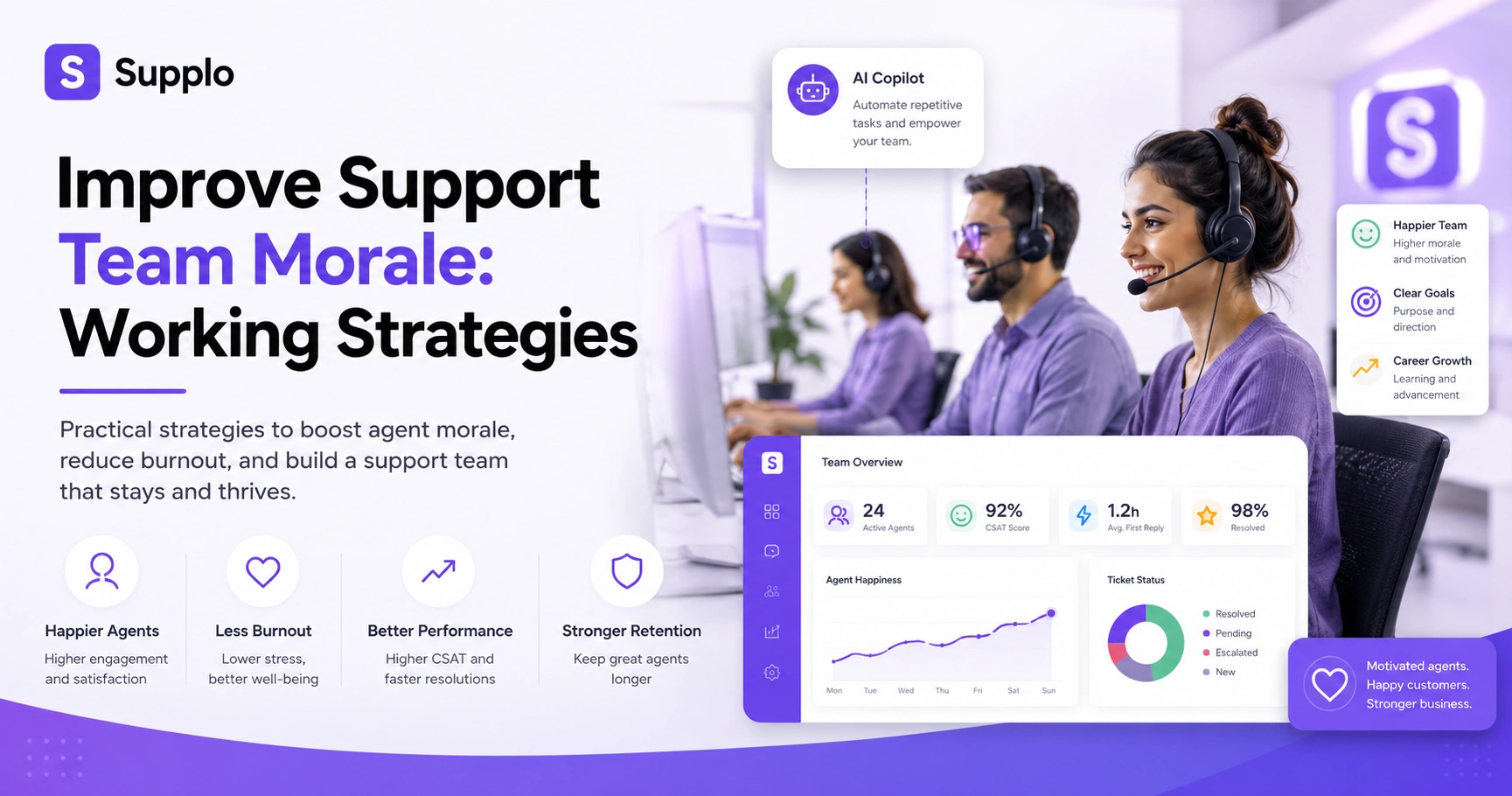
Support agents are the backbone of any customer-first business. But let's be real, their job is emotionally draining, repetitive and often comes with more stress than recognition. This guide is for customer service leaders, ops managers and HR folks who want practical ways to improve support agent morale, reduce burnout and build a team that sticks around.
You'll find system-driven solutions here. Not pizza parties. Not ping-pong tables. Real, structural changes that keep your team motivated and engaged for the long haul.
Quick Answer
- Boost morale by focusing on agent autonomy, mastery and purpose, not just perks.
- Prevent burnout with smart workflow design that automates repetitive tasks and ensures fair ticket distribution.
- Implement stress management techniques agents can use quickly between tickets, like 30-second resets.
- Long-term retention hinges on clear career paths and opportunities for skill development and influence.
- The right tools, especially AI, reduce tedium and free agents for engaging in complex problem-solving.
Why Support Agent Morale Crashes And Why Most Fixes Fail
Let's be honest, support agent morale doesn't just suddenly collapse one day. It erodes slowly. It's the daily grind of repetitive questions, emotionally charged conversations and feeling like you're stuck in a hamster wheel with no way out.
Most companies try to fix this with surface-level stuff. Pizza parties. Fun Fridays. Maybe a branded hoodie. But that's like putting a Band-Aid on a broken leg. The real issues are deeper: unclear expectations, clunky tools that make every task harder than it needs to be and zero visibility into career growth.
The three biggest morale killers? Monotony, lack of decision-making power and feeling invisible despite pouring emotional energy into every interaction. There's this thing called the hero trap, where companies praise agents for handling insane volumes, but that only creates unsustainable pressure. And micromanagement? That's the fastest way to destroy trust and motivation.
The scary part? Low morale doesn't just make people unhappy. It shows up in real metrics: more errors, longer handle times and higher churn. You don't want to wait until your best agents start updating their LinkedIn profiles.
Signs of Burnout in Support Agents You Can't Afford to Ignore
Burnout doesn't always look like someone crying at their desk. Sometimes it's subtle. An agent who used to go the extra mile now gives the shortest possible response. Someone who never missed a shift starts calling in sick. Small errors start creeping in, the kind they never made before.
Watch for these red flags:
- Decreased empathy: Responses get clipped, robotic, or dismissive.
- Physical symptoms: Headaches, irritability, or agents literally dreading the start of their shift.
- Behavioral changes: Going silent in team chats, avoiding challenging tickets, or sudden disengagement from team activities.
- Quality decline: Higher escalation rates, more repeat mistakes, or customers asking to speak to a supervisor more often.
- Cynicism: Sarcastic comments in internal channels about customers. That's not just venting, it's a warning sign.
The dangerous one? Quiet quitting. Agents stay on the payroll but stop caring about outcomes. They're physically present but mentally checked out. And that's harder to spot than a dramatic resignation.
How to Motivate Customer Support Agents Without Relying on Money Alone
Fair pay is non-negotiable. If you're underpaying, nothing else matters. But money alone won't keep your agents engaged in the long term. What actually works? Three things: autonomy, mastery and purpose.
Give them autonomy. Let agents own the ticket types they're good at. Give them discretion to issue refunds or credits without needing manager approval for every single dollar. Trust them.
Invest in mastery. Create clear learning paths. Want to move from Tier 1 to Senior Agent? Here's exactly what you need to learn. Want to become a product expert? Here's the training. Real promotions, not just title changes.
Connect to purpose. Share customer success stories in team standups. Let agents see the human impact of their work. You helped Sarah get her wedding dress delivered on time, which is way more motivating than you hitting your CSAT target.
Recognition that actually works? Peer-to-peer kudos and specific, timely feedback. You handled that angry customer really well, beating Agent of the Month every single time. Meaningful work consistently beats fun perks for long-term motivation.
Practical Strategies for Improving Support Agent Morale That Actually Stick
Here's the truth about sustainable morale strategies: they're boring. They're consistent. They're structural. Not flashy.
But they work.
Try these:
- Rotate ticket assignments. Don't let the same person handle complaints all day. Mix it up, complex, simple, chat, email ticketing. Monotony is a morale killer.
- Give agents focus time. Block out periods with no chat interruptions so they can batch work. Deep work is hard to come by in support.
- Run wins huddles. Fifteen minutes. Every week. Only positive outcomes. One good customer interaction shared by each person.
- Invest in training during work hours. Not after. Not on their lunch break. Agents value growth when you show you value their time.
Checklist for Sustainable Morale Improvement:
- Implement balanced ticket rotation policies
- Schedule dedicated focus time blocks daily
- Establish a consistent channel for sharing positive customer feedback
- Invest in agents' professional development during work hours
- Define clear, actionable performance metrics
Want to See How AI Can Reduce Agent Stress by 50%?
Start your 14-day free trial of Supplo and see how automating repetitive tickets and unifying your inbox can transform your team's workload, no credit card required.
Customer Service Team Building Activities That Build Trust, Not Awkwardness
Let's be real, most team-building activities are cringe. Trust falls? Icebreakers where you have to share a fun fact? Agents hate that stuff. And they're right to.
Instead, choose activities that solve real problems together. Here are some that actually work:
Fix the FAQ session. Have your team rewrite confusing knowledge base articles together. They know what customers actually ask. Let them fix it.
Ticket swap. Each agent exchanges one complex ticket they handled and explains their approach. It's collaborative problem-solving, not forced fun.
Knowledge base cleanup day. Turn it into a competition. Who can simplify the most confusing answer? The winner gets a gift card.
Role-play with a twist. Agents act as customers with absurd requests. The team competes to resolve them. It's funny, but it also builds real skills.
Virtual escape rooms. But focus them on customer scenarios. Generic puzzles are fine, but relevant ones are better.
Keep everything under 30 minutes. Tie it directly to their work. Agents appreciate relevance over recreation.
How to Prevent Support Team Burnout Through Workflow Design
Here's what most companies get wrong: they think burnout prevention is a wellness program. Yoga classes. Meditation apps. A wellness Wednesday email.
No. The most effective way to prevent burnout is a well-designed workflow.
Automate the boring stuff. Let AI handle password resets, order status checks and FAQs. Your agents are too valuable to spend their day answering the same five questions. Our AI agent handles this beautifully.
Use a shared inbox. Distribute tickets evenly so no one gets buried while others have nothing to do. Check out how Supplo's inbox keeps everything in one place.
Force breaks. Set the offline status trigger to after 4 hours of continuous chat. Make it automatic. Agents won't take breaks unless you build them in.
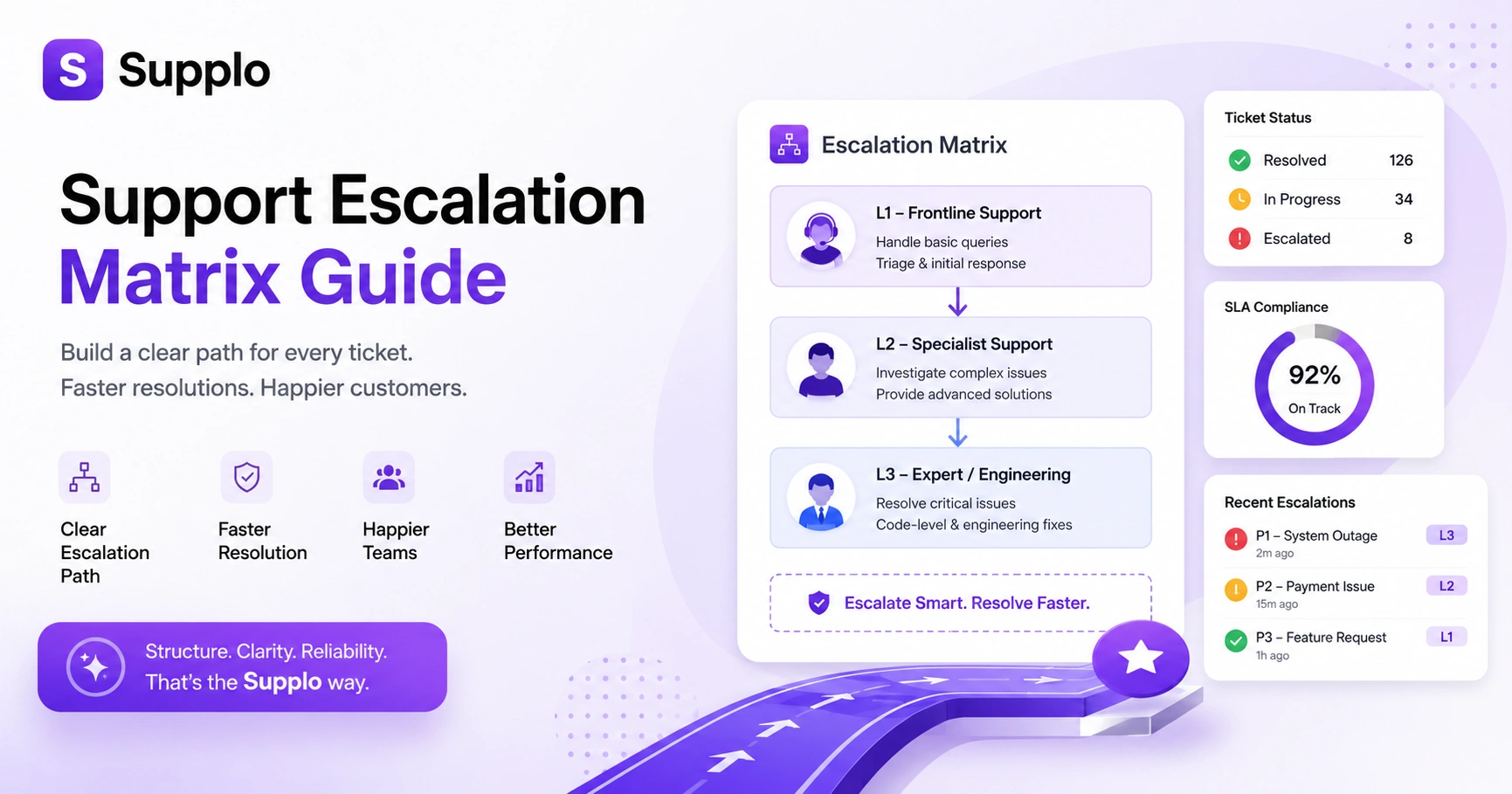
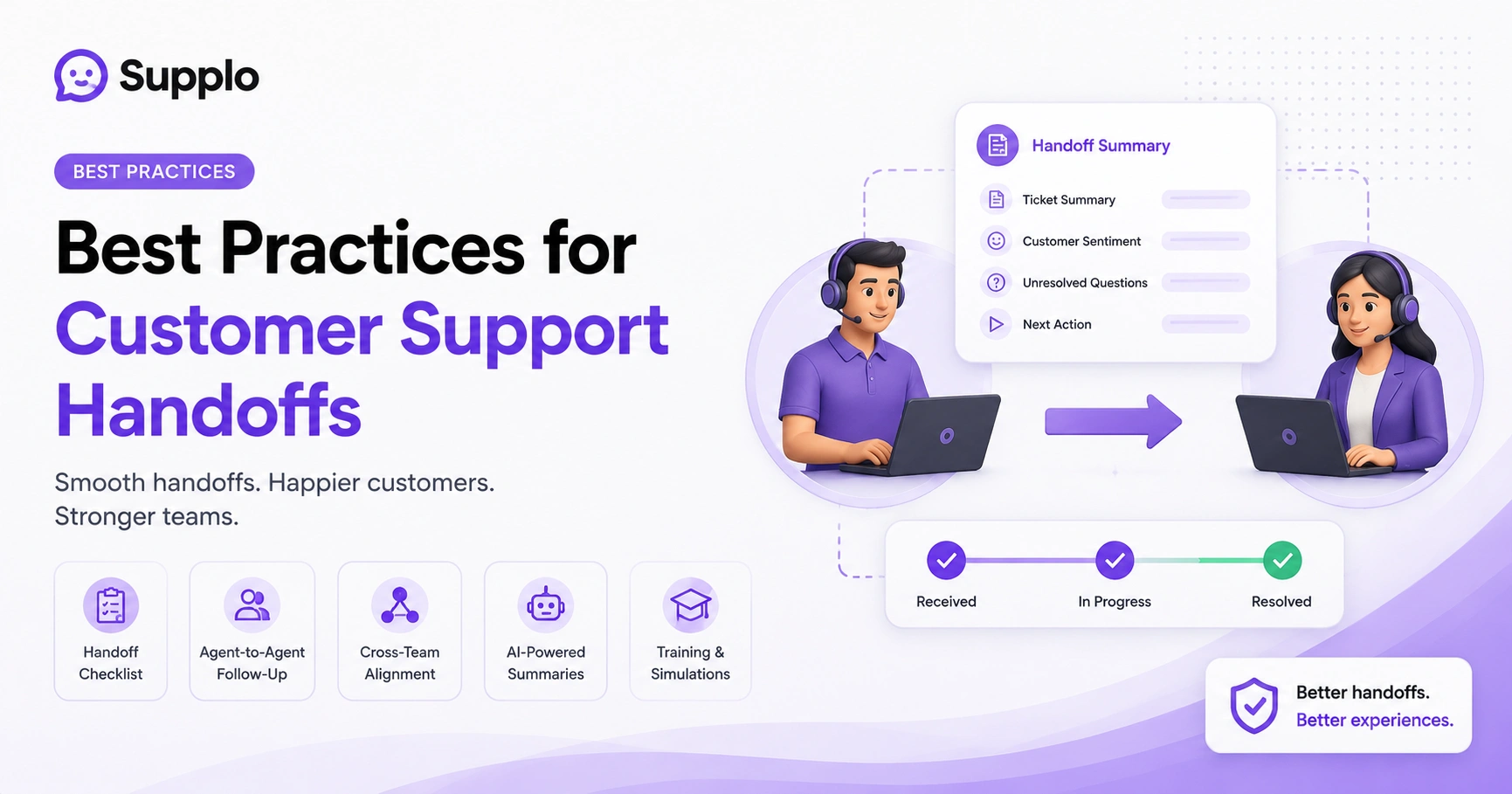
Create clear escalation paths. Nothing frustrates agents more than being stuck on a ticket they can't solve. Give them a clear path to hand it off.
Rotate channels. Phone, email, chat, social, mix it up. No one should be stuck on the hardest interaction all day.
Support Agent Stress Management Techniques Your Team Will Actually Use
Here's the thing about stress management for support agents: it needs to be fast. Like, 30 seconds fast. Nobody has time for an hour-long meditation session between tickets.
The 30-second reset. Before opening the next ticket, take three deep breaths. Stand up. Shake out your hands. It sounds simple, but it prevents emotional carryover from one call to the next.
The 5-4-3-2-1 grounding technique. Name 5 things you see, 4 you feel, 3 you hear, 2 you smell, 1 you taste. Takes 30 seconds. Resets your brain.
Create a #vent-channel. A Slack or Teams channel where agents can vent without judgment. Rule: no fixes, no solutions, just listening. Sometimes people need to be heard.
Encourage physical movement. Stand up between calls. Walk around the room. Change your physical position after every difficult interaction. It helps.
Provide noise-canceling headphones. And a focus mode that pauses chat notifications for 10 minutes. Small investment, huge impact.
Normalize asking for help. Make it part of the culture. Let me find out, it should be celebrated, not seen as a weakness.
Implementing Quick Stress Relief:
- Introduce and practice the 5-4-3-2-1 Grounding Technique daily.
- Encourage standing breaks and movement between interactions.
- Establish a team-only, judgment-free # vent channel or similar.
- Provide and encourage the use of noise-canceling headphones.
- Cultivate a culture where seeking help is seen as a strength.
Retaining Support Agents' Morale Long-Term: Systems Over Pep Talks
Quarterly motivation events won't cut it. You need career architecture. Real paths for growth. Not just do we value you, but here's where you're going.
Build a Level Up path. From Tier 1 to Senior Agent to Subject Matter Expert. Clear milestones. Tangible promotions. No ambiguity.
Give agents ownership. Let them become go-to experts for specific product areas. When they have genuine influence, they stay engaged.
Invite them to product meetings. Your agents know what customers actually want. Bring them to roadmap meetings as the voice of the customer. It's motivating and useful.
Cross-train. Let agents spend time in sales, product, or QA. Support shouldn't be a dead-end role. It should be a launchpad.
Have career conversations every 6 weeks. Not annual reviews. Regular check-ins about growth. Agents who see a future stay.
Promote from within. Nothing kills morale faster than watching an outsider get the promotion you wanted. Hire outside only when you've exhausted internal options.
How the Right Tools, Especially AI, Improve Support Agent Satisfaction
Nothing drains morale faster than clunky tools. You know the drill: juggling six tabs to solve one problem. Copy-pasting between systems. Losing track of conversations.
Modern tools change that. And they can transform how your team feels about their work.
AI that handles the boring stuff. Imagine an AI that resolves up to 80% of repetitive tickets automatically. Password resets, order status, FAQs, gone. Your agents only handle the interesting, human-centric problems. That's what Supplo's AI agent does.
A unified inbox. Email, chat, WhatsApp, Telegram, Instagram DMs, Facebook Messenger, all in one place. No more tab-hopping. Supplo's unified inbox makes it happen.
Email ticketing that actually works. No more drowning in unread messages. Organized, prioritized, manageable.
Multi-language support. One of the biggest stress points for global teams? Translation. Supplo handles it so your agents don't have to guess.
Flat pricing. Per-workspace, not per-seat. So your tool doesn't become a source of financial stress as your team grows. Check out Supplo's pricing.
Supplo is not affiliated with any app or website. Please follow each app's terms and local regulations.
Measuring the Impact: Metrics That Prove Your Engagement Strategies Are Working
Don't just rely on happiness surveys. People lie on surveys. Watch what they actually do.
Track these indicators:
- Ticket ownership rate: How many tickets does an agent resolve from first touch without reassignment? Higher = more engaged.
- Absenteeism rate: Are unscheduled sick days going down? Good sign.
- Sentiment drift: Is the language in team chats getting more negative? That's a leading indicator.
- Peer recognition frequency: More kudos = healthier culture.
- Overtime requests: Agents volunteering for extra shifts (within reason) signal engagement, not burden.
- Churn rate by tenure: Losing agents at month 3? That's an onboarding problem. Month 12? That's a growth problem.
Key Takeaways
- Ticket Ownership Rate: Percentage of tickets agents fully resolve from first contact
- Absenteeism Rate: Track unscheduled sick days and unplanned time off
- Internal Promotion Rate: Frequency of agents moving into higher roles
- Peer Recognition Frequency: Quantify positive internal acknowledgments received
- Churn Rate by Tenure: Analyze agent attrition at specific points in their employment
FAQ
Why do support agents burn out so quickly?
Support agents burn out quickly due to emotional exhaustion from constant problem-solving, a lack of autonomy, repetitive work and a sense of being undervalued. The biggest driver is often unclear career paths, making agents feel stuck in a dead-end role.
Can AI really improve agent morale, or does it just replace them?
AI designed to handle repetitive tickets (like password resets or order status) actually improves morale by freeing agents to tackle more engaging, complex problems. The key is transparency: agents need to see AI as a tool that reduces their boring workload, not a threat to their job.
What's the fastest way to boost support team morale in a week?
The fastest short-term boost comes from giving agents one afternoon off from live chat to work on a passion project (like improving the FAQ or building a customer guide). Follow it immediately with a wins-sharing session where each agent celebrates a positive customer interaction.
How do I know if my support team is burned out vs. just having a bad week?
Burnout is chronic and systemic, not situational. Look for patterns: agents consistently arriving late, taking long breaks, making unusual errors, or becoming cynical in internal chats across multiple weeks. A bad week resolves quickly; burnout gets worse.
Are team-building activities actually effective for remote support teams?
Yes, but only if they're directly relevant to the work. Virtual escape rooms or fix-the-FAQ sessions that solve real problems work well. Generic icebreakers or mandatory social hours often feel like more work, not a break.
What tools help reduce support agent stress the most?
Tools that unify communication channels (email, chat, social, WhatsApp) into one inbox reduce tool-switching fatigue. AI that auto-answers FAQs and translates messages removes two of the biggest stress points for agents.
How often should I check in with agents about their morale?
Formal surveys quarterly, but informal check-ins weekly. The best approach is a 5-minute energy check at the start of each shift, where agents rate their headspace on a 1–10 scale and flag anything that's blocking their work.
Compliance line: Supplo is not affiliated with any app or website. Please follow each app's terms and local regulations.