On this page
Let’s be honest, walking into a CFO’s office to ask for a budget increase is rarely anyone’s favourite part of the job. But if you’re a support leader or ops manager, you already know the tool you need will pay for itself. The trick is proving it; in their language, not yours. This guide is all about building a data-driven argument that turns new software from a scary expense into a smart investment.
This isn't about throwing feature lists at the wall. It's about framing your proposal as a strategy to protect revenue, handle more volume without adding headcount and keep customers from leaving. No guesswork, just numbers and logic.
Quick Answer
- Frame support software as a revenue protection and cost avoidance tool, not just an expense.
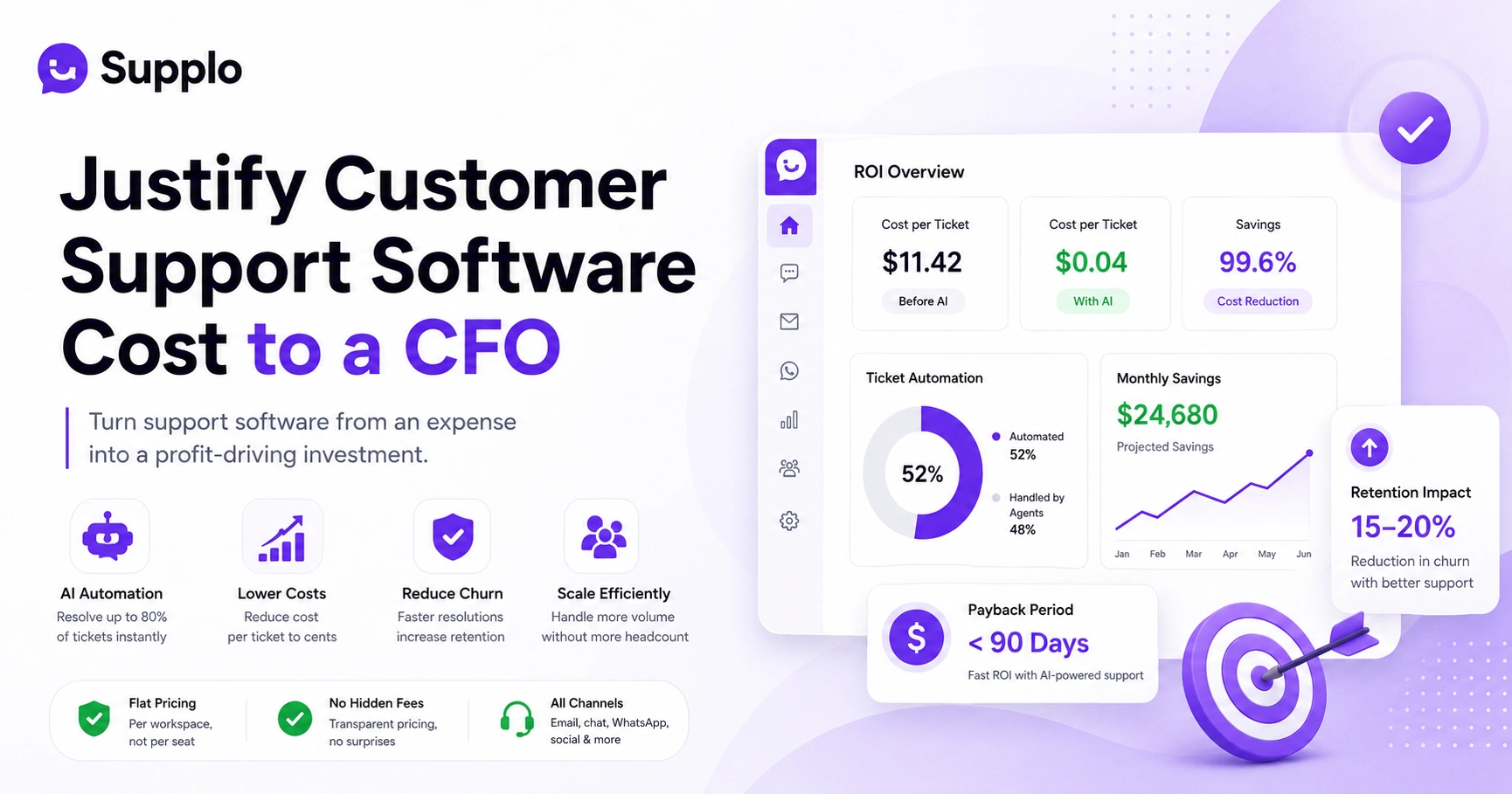
- Calculate ROI by comparing your current cost per ticket against the projected cents per ticket with AI automation.
- Focus on how AI reduces churn by improving resolution times and automatically handling routine queries.
- Highlight predictable, flat pricing models (per workspace, not per seat) to assure the CFO against budget creep.
- Show how AI enables your existing team to handle more volume and complex issues without additional headcount.
Why Cost Savings Isn't Enough: The Real CFO Argument for AI in Support
Here’s the thing: telling a CFO this will save us money is table stakes. They hear that all day. What actually moves the needle is connecting the software to unit economics. Instead of pitching a cost cut, frame it as a cost avoidance tool.
Think about it: support costs usually scale right alongside headcount. Every new customer means more tickets, which means another hire. Support software that automates the easy stuff breaks that chain. Flat, per-workspace pricing (not per-seat) prevents that nasty budget creep, too. You're not just buying a tool; you're making sure your support operation doesn't get more expensive as you grow. Tie every single feature to a financial outcome; faster replies equal lower churn and that is a number the CFO will sit up for.
How AI Reduces Customer Support Costs: The Mechanics Behind the Math
So, how does the math actually work? AI cuts costs by swallowing up all the repetitive tickets that don't need a human brain. Password resets, where's my order?, basic FAQs; an AI agent handles these instantly. Over a quarter, that shifts thousands of tickets from costing you over a dollar each to just a fraction of that.
Automated resolution brings per-ticket costs down to pennies. The AI learns from your existing knowledge base and past chats, becoming more accurate over time. This means your senior team isn't wasting time on Level 1 stuff and you don't need to hire for overflow or overnight shifts. With flat-rate resolution pricing, what you budget is what you spend. No surprises.
AI Support Software ROI: How to Model It Before You Buy
You need a simple, two-column model. On the left, your current cost per ticket. On the right, the projected cost with AI. Grab your monthly ticket volume, average handle time and fully-loaded agent cost. Then, apply a conservative automation rate (say, 40-50%). The delta between the two columns is your argument.
Manual support tickets typically run $5 to $15 each, depending on complexity. Automated resolutions with an AI agent are usually just cents. Don't forget to add hidden costs to your current column: hiring lag, training time and the expense of turnover. Then, add a revenue line saved by showing how faster responses can reduce churn. Most AI tools can show a return in under 90 days.
Steps to Model AI Support Software ROI:
- Calculate Current Cost Per Ticket: Divide total monthly support costs (salaries, tools, overhead) by total monthly ticket volume.
- Estimate AI Automation Rate: Start with a conservative estimate of 40-50% of tickets being fully automated by an AI agent for customer support.
- Project AI Cost Per Resolution: Use the AI provider's flat rate per resolution (e.g., $0.04).
- Compare Total Costs: Multiply (automated tickets * AI cost) + (human-handled tickets * current cost).
- Calculate Payback Period: Determine how quickly the savings offset the software's initial investment.
Cost Justification for AI Chatbot: From Headcount to Handle Time
The chatbot justifies its existence by letting you do more with the same headcount. The magic metric is deflection rate; the percentage of incoming chats the bot resolves without a human. At 50% deflection, you’ve effectively doubled your agent capacity overnight.
Use this formula to show agents saved: (ticket volume) x (deflection rate) ÷ (tickets per agent per day). Even for escalated tickets, the bot can pre-fetch context, slashing handle time. This means fewer escalations, shorter queues, happier customers and no need for expensive overtime or contractors during peak hours.
How an AI Chatbot Boosts Efficiency:
- Deflection Rate: Reduces the number of tickets reaching human agents.
- Average Handle Time (AHT): AI provides context, speeding up human agent interactions.
- 24/7 Availability: Handles queries outside business hours without human intervention.
- Scalability: Manages sudden spikes in ticket volume effortlessly.
- Cost Efficiency: Replaces costly human labour for routine tasks.
Test the ROI model yourself.
Enter your current ticket volume to see projected savings. Start a free 14-day trial with no credit card required.
Customer Retention Value of Support Software: Why a CFO Should Care About Churn
Here's a stat that always works: a 5% improvement in retention can boost profits by 25% to 95%. That's not a marginal gain; that's a massive swing. And support software is a direct lever for retention, because most customers leave after a bad service experience. Frame the software as a revenue retention tool.
First-contact resolution is the strongest predictor of loyalty and long wait times are the number one reason people leave. AI ensures no ticket gets ignored, even after hours. A multichannel inbox that pulls in email, chat, WhatsApp and social DMs means you meet customers on their terms. Every retained customer has a lifetime value that makes the software subscription look tiny in comparison.
Impact of Customer Service on Loyalty: The Data That Moves a CFO
The data is pretty clear: 89% of consumers are more likely to repurchase after a positive service experience. On the flip side, nearly half will switch to a competitor after just one bad interaction. Loyalty isn't built by discount codes; it's built in the moments a customer needs help and gets it fast.
Faster responses lead to higher NPS. Consistent service across every channel builds trust faster than any marketing campaign. AI translation features mean you can support global customers without hiring a multilingual team. Show the CFO a simple churn cost table: lost MRR from X customers vs the software cost. The math usually speaks for itself.
Reducing Churn with Better Support: The Retention ROI Spreadsheet
Build a spreadsheet. List your current monthly churn rate, average customer lifetime value (CLTV) and total customer count. Calculate the annual revenue you're losing to churn right now. Then, estimate a conservative 15-20% reduction from better support. That saved revenue is your return.
The formula is: (monthly churn % x total customers x monthly revenue per customer) x 12. For SaaS, aim for less than 1% monthly churn; for ecommerce, less than 3%. Faster resolutions boost CSAT, which predicts renewals. A shared inbox stops tickets from falling through the cracks and self-service options (a knowledge base plus AI) let customers solve problems 24/7.
Steps for a Retention ROI Spreadsheet:
- Calculate Annual Lost Revenue to Churn: (Current Monthly Churn Rate % * Total Customers * Average Revenue Per Customer) * 12.
- Estimate Churn Reduction: Set a realistic target for churn reduction (e.g., 15-20%) due to improved support.
- Calculate Revenue Saved: Multiply Annual Lost Revenue by the estimated Churn Reduction percentage.
- Compare to Software Cost: Show how the revenue saved significantly outweighs the cost of the support software.
Cost Justification for Customer Loyalty Programs That Start with Support
Most loyalty programs fail because they’re expensive and don't fix the experience. A better bet? Make your support itself the loyalty driver. A customer who gets a fast, helpful answer is more loyal than any points system could create. The software justifies its cost by consistently delivering that experience.
The support experience is a leading indicator of retention. AI agents that remember past conversations make customers feel valued. Features like WhatsApp customer support automation and multilingual replies build loyalty in international markets without the expense of localisation. Freeing up your human agents lets them provide deeper, more personalised service where it counts.
The Reliable Pitch: Picking a Support Platform That Won't Blow the Budget Later
The cheapest tool is rarely the most reliable and the most expensive usually has hidden fees. What you want is transparent, flat pricing. Look for per-workspace billing (not per-seat), no surprise fees for adding channels and an AI that learns on its own without costing you extra for retraining.
Flat per-workspace pricing is your best friend. It means adding agents doesn't cost a cent more. A self-learning AI reduces maintenance costs. A multichannel inbox means you don't need separate tools for email, chat and social media. The result is a platform that works the same whether you have 3 people or 30.
See how much you can automate.
Let our AI agent handle up to 80% of incoming tickets while your team focuses on complex issues. Flat $0.04 per automated resolution, no per-seat fees.
See AI Agent Features
Compliance Statement:
Supplo is not affiliated with any app or website. Please follow each app's terms and local regulations.
Key Takeaways
- CFOs prioritise financial impact: frame support software as a revenue protection and cost-optimisation tool.
- Quantify ROI through reduced cost per ticket, decreased churn and increased customer lifetime value.
- Emphasise AI's role in automating routine tasks, freeing human agents to focus on complex issues and scaling efficiently.
- Always highlight transparent, flat pricing models to prevent unforeseen budget increases.
- Focus on measurable outcomes: faster resolution times, higher CSAT and improved customer retention.
The affordable alternative to legacy support tools
Supplo gives you AI automation, multichannel inbox and transparent pricing. No hidden fees, no per-seat surprises. Start your 14-day free trial today.
FAQ
How do I convince my CFO to approve customer support software?
Start with unit economics. Show current cost per ticket, projected cost with AI and the revenue saved from reduced churn. The CFO responds to numbers, not features.
What metrics should I include in my ROI model for support software?
Include current agent cost per ticket, ticket volume, average handle time, churn rate and customer lifetime value. Add a projected automation rate of 40-50% and calculate the delta.
How does AI support software reduce costs without harming customer satisfaction?
AI handles repetitive tickets instantly, so customers get faster answers. Complex issues escalate to humans, who now have more time to provide quality support, the result: lower costs, higher satisfaction.
What's a realistic automation rate for AI customer support?
Most teams see 40-60% of incoming tickets automated within a few months, depending on ticket complexity and the quality of their knowledge base. Simple FAQs and order inquiries often resolve at higher rates.
How does better support directly impact customer retention?
Faster resolution times and consistent multichannel service increase CSAT scores, which strongly correlate with renewal rates. Customers who receive good support tend to stay longer and spend more.
Is support software worth it for a small team?
Yes, especially with per-workspace pricing instead of per-seat. A team of 3-5 can automate hundreds of tickets per week without adding headcount, making the ROI clear even at low volume.
What hidden costs should I watch for when evaluating support software?
Look out for per-seat pricing, per-channel fees, AI usage overages and onboarding charges. Transparent flat pricing per workspace helps to avoid most of these surprises.
Compliance line: Supplo is not affiliated with any app or website. Please follow each app's terms and local regulations.