On this page
Let's be real for a second. Traditional support agent training is a pain. It's slow, expensive and the results are all over the place. You end up pulling senior agents off the queue to shadow new hires and even then, what sticks varies from person to person.
Using AI to train support agents isn't a futuristic mystery anymore. It's practical, it's available and it actually works.
This guide is for support leaders and managers who want to streamline onboarding, upskill their teams faster and stop wasting time on training methods that don't scale.
Quick Answer
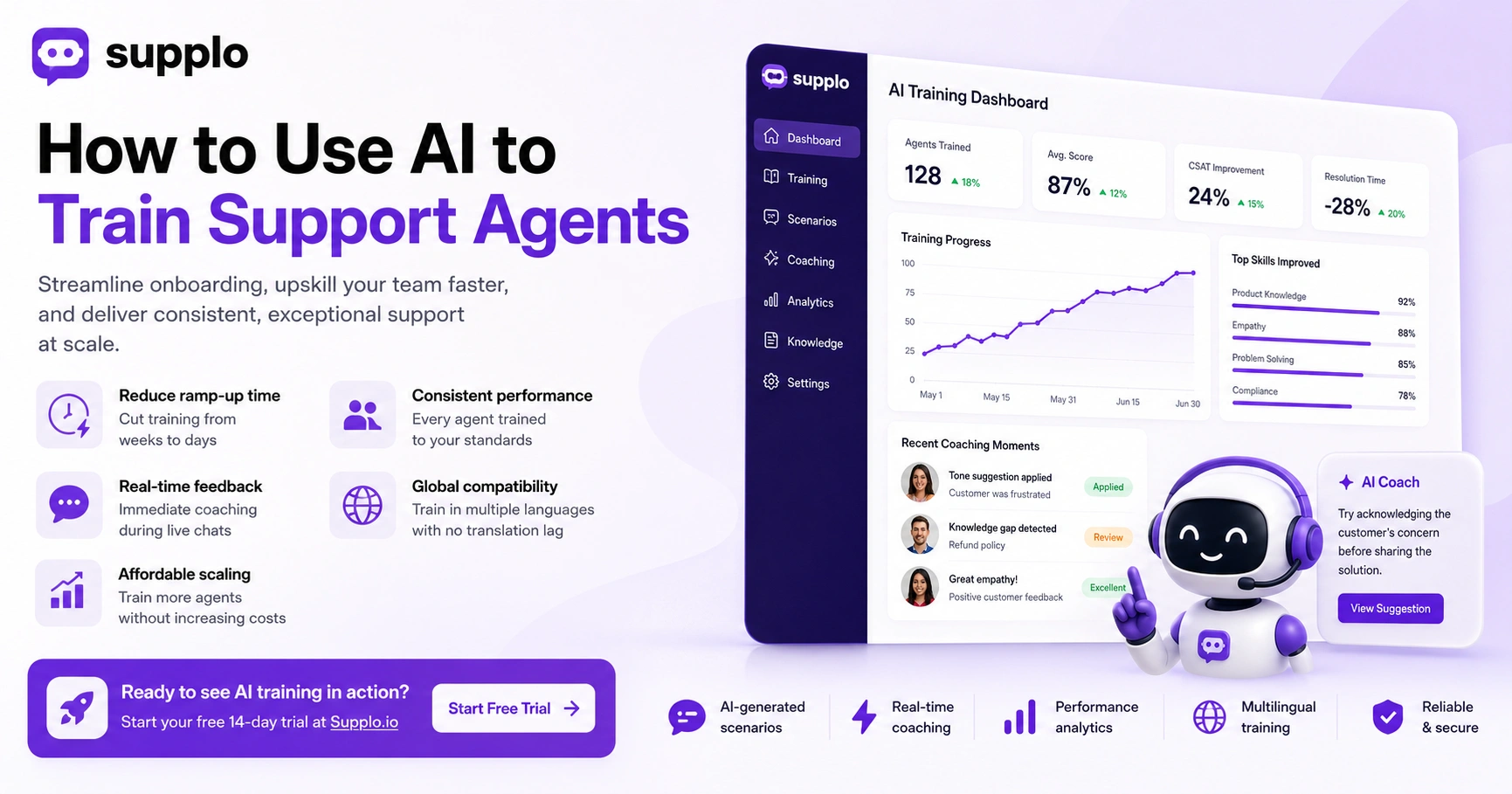
- Reduce ramp-up time: Cut training from weeks to days with AI
- Consistent performance: Every agent gets the same quality training
- Real-time feedback: Live coaching during actual chats
- Global compatibility: Train in multiple languages, no translation lag
- Affordable scaling: Add more agents without blowing your budget
Why Traditional Agent Training is Costing You Time and Money
Let's talk about the elephant in the room. Traditional training methods- shadowing, role-plays, those endless PDF binders- they eat up time like crazy. Your best agents lose hours babysitting new hires. And the results? Inconsistent at best.
Here's what's actually happening:
- The hidden cost of buddy training: You're losing productivity from both the buddy and the learner
- Why static knowledge bases fail new hires: They don't adapt to messy, real-world customer queries
- Compliance risk: Untrained agents handling sensitive billing or account issues can create real legal problems
- Knowledge silos: Manual training creates isolated pockets of knowledge that break down as your team grows
The math doesn't work when you're scaling. And that's exactly where AI changes the game.
What is Customer Support AI Training?
Here's the thing: AI training for customer service isn't about replacing your agents. Think of it as giving them a super-smart assistant that's always available.
It's a system that learns from your knowledge base and past conversations to serve up the right answer, flag gaps in your documentation and simulate real customer interactions for practice. It's not a black box making decisions for you. It's a tool that makes your team faster and more consistent.
- Difference between AI agent and AI coach: The first resolves tickets; the second trains your team
- Self-learning AI: Gets better with more use, minimal manual updates needed
- Not a replacement: AI doesn't do empathy and human judgment. Period
- Unlike e-learning courses: AI training is interactive and dynamic. It responds to how your agents actually perform.
The Core Methods: Using AI to Automate Agent Training for New Hires
This is where things get practical. Automating agent training with AI means you cut ramp time from weeks to days. No exaggeration.
Start by feeding your AI your top 50 past support tickets and your most up-to-date knowledge base articles. Then watch your new hires get confident fast.
Method 1: AI-generated scenario training pulled straight from your actual ticket history
Method 2: Real-time answer suggestions during live chats to cut hesitation
Method 3: Automated feedback loops that flag when a new hire's answer drifts from the knowledge base
Method 4: Performance dashboards showing knowledge retention, no manual grading required
Method 5: Multilingual training simulations for global teams (translate the scenario, not just the answer)
The core methods for using AI to train support agents boil down to one simple idea: practice on real data, get immediate feedback and learn by doing.
AI-Assisted Agent Development: Moving Beyond the Old Playbook
Forget handing agents a thick PDF of policies. AI-assisted development means your team learns by doing.
Your AI can role-play an angry customer, walk agents through refund flows and even flag their tone. This isn't just for onboarding, either; it's ongoing development that makes your veteran agents better, too.
- Stretch scenarios for veteran agents: Handling escalation situations they rarely see
- Identify training needs: Let AI spot knowledge gaps you didn't know existed
- Tie outcomes to metrics: Link AI training to real QA scores and CSAT
- Cross-training for multiple channels: Email, chat and social media, all in one system
How to Build Custom AI Training Modules for Your Support Agents
Building custom training modules starts with your own data. Upload your top 100 resolved tickets, your style guide and any compliance requirements. The AI generates modules that test your agents on your actual products and policies, not generic scenarios.
Best part? Update a single knowledge base article and the training modules update automatically, no more outdated training materials.
Step 1: Gather your "gold standard" tickets, best examples of correct resolutions
Step 2: Define your scoring rubric (accuracy, empathy, speed, whatever matters to you)
Step 3: Let the AI generate multiple-choice, open-ended and role-play modules
Step 4: Run a test cohort and refine based on feedback
Step 5: Set a recurring schedule for module updates (every new product launch, for example)
AI Coaching for Support Staff
Here's where AI coaching gets really interesting. Instead of waiting until after the call to review performance, the AI coaches during the interaction.
Your AI agent can whisper an answer, suggest a softer phrasing, or flag a compliance risk while the agent is typing. It's like having a senior support lead hovering over every chat, without the awkward hovering.
- Set up guardrails: Agents must acknowledge suggestions before accepting them
- Difference between coaching and automation: Coaching suggests; automation does
- Sentiment alerts: "This customer is getting frustrated, try apologizing first"
- Post-chat summaries: Create a "coaching moment" for both the agent and the AI
Ready to see AI training in action? Start a free 14-day trial at Supplo.io. Connect your knowledge base and watch the AI generate training modules for your team in minutes. No credit card required. It's the most practical way to test if AI-assisted onboarding fits your workflow.
Using AI to Improve Support Agent Skills Through Simulated Conversations
Simulated conversations are the fastest way to build agent confidence without risking actual customer relationships.
Your AI can mimic a difficult customer, follow a scripting path and even push back if the agent gives a wrong answer. Think of it like a flight simulator for support: practice makes permanent, but only if you practice the right things.
- Practice ticket queue: Using AI-generated customer personas
- Fire drill simulations: Handling payment issues or account disputes
- Measure response time and tone: Under pressure, in real-time
- Fail forward approach: Let agents make mistakes and review them together
Automate Agent Training with AI
Here's the exact workflow that works:
Step 1: Data ingestion (tickets, knowledge bases, chat logs)
Step 2: Module generation (AI creates scenarios and quizzes from your data)
Step 3: Adaptive assignment (AI identifies weak spots and assigns relevant modules)
Step 4: Live coaching (AI whispers suggestions during real chats)
Step 5: Analytics & iteration (AI suggests updates to training content based on results)
Done right, this loop runs continuously. Every resolved ticket becomes a future training lesson. Your training never goes stale.
AI for Agent Performance Improvement
AI tracking gives you granular data without the bean-counting vibe. You'll see which agents excel at fast resolutions and which need more coaching on empathetic responses.
The key: Use AI analytics as a diagnostic tool, not a firing mechanism. Track trends over time and watch your team improve organically.
- Metrics to track: Resolution time, CSAT, knowledge base utilization, sentiment shift
- Spot the "AI crutch": Agents who rely too much on suggestions versus those who adapt
- Benchmark against history: Not against other agents
- Flag common misses: In your knowledge base itself, fix the source, not just the symptom
AI-Driven Skill Development Support for Remote and Global Teams
When your team spans time zones, AI training becomes the great equalizer.
Everyone gets the same scenarios, the same coaching and the same knowledge base, in their own language. No more "well, the training was different for the Manila office." AI translates and standardizes, so your Nairobi agent learns exactly what your New York agent learns.
- Real-time translations: For training modules and live coaching
- Asynchronous training: Manage teams across 24/7 shifts
- Compliance advantage: Ensure consistent policy understanding globally
- Equal support for remote agents: No more "second-class citizen" feeling
Don't settle for $0.99 per resolution. If you're worried about AI reliability or training costs, see the difference with Supplo's $ 0.04-per-resolution model. Our AI learns from your team and improves over time- consistent, affordable training that scales. Start your free trial now.
Why Reliability Matters More Than Speed in AI Training
A fast AI that gets things wrong is worse than no AI at all.
Reliability means your AI has been trained on your actual data, not generic public models. And it knows when to say "I don't know" and hand off to a human. The most important feature in AI training isn't flashy automation. It's confidence that the suggestions your agents learn from are correct.
- Hallucinations: Can teach bad habits fast
- Solid knowledge base: The foundation for reliable AI
- Self-learning model: Improves from team corrections over time
- Pilot testing: Always test before full deployment
How Supplo's AI Agent Helps You Train and Scale Your Team
Supplo's AI agent doesn't just resolve 80% of tickets automatically; it learns from those resolutions to train your team.
Every correctly answered query becomes a training module. Every handoff to a human becomes a coaching moment. And because Supplo costs $0.04 per resolution (not $0.99 as with legacy tools), you can afford to train and scale simultaneously.
Plus, it unifies email, chat, WhatsApp, Telegram, Instagram DMs and Facebook Messenger into one unified inbox, so your team learns one system, not six.
How it works:
- AI learns from your knowledge base and past conversations
- Training features include AI-generated answer suggestions, performance analytics and live coaching
- Flat pricing, no per-seat cost, so your bill doesn't balloon
- Quick start: Connect your data and it starts learning in minutes
- Global payments: Including crypto, Binance Pay, GCash and more
Supplo is not affiliated with any app or website. Please follow each app's terms and local regulations.
Keep your team learning without breaking the bank. With Supplo's flat-per-workspace pricing, you can train your whole support staff, from new hires to vets, without per-seat fees ballooning your budget. Plus, it supports global payments via crypto, Binance Pay, Skrill and more. Try Supplo free for 14 days and see why teams are switching from legacy tools.
Key Takeaways
- Reduce ramp-up time: Cut training from weeks to days with AI
- Consistent performance: Every agent trained to your standards
- Real-time feedback: Immediate coaching during live chats
- Global compatibility: Train in multiple languages with no translation lag
- Affordable scaling: Train more agents without increasing costs
- Reliability over speed: Prioritize AI that can say "I don't know" and hand off to humans
FAQ
Is it safe to let an AI train my support agents?
Yes, as long as you feed it reliable data (your own knowledge base and past tickets). A well-trained AI is actually more consistent than training that relies solely on humans. Just review the training modules it generates, especially for sensitive topics like payment disputes or account security.
Will AI training replace the need for human managers?
No. Think of AI as a tool that handles the repetitive parts of training (scoring quizzes, suggesting answers, simulating customers). Your human managers are still essential for reviewing nuanced performance, building culture and making judgment calls on tricky interactions.
How do I know if my AI training modules are actually working?
Track the right metrics: time-to-first-resolution for new hires, knowledge base utilization by agents and CSAT scores. If these improve, the training is working. Most AI tools (including Supplo) provide dashboards that clearly show this data.
Can I use AI training for agents who speak different languages?
Absolutely. AI tools like Supplo translate messages and training modules in real time. So your Spanish-speaking agent gets the same quality coaching as your English-speaking one, no translation lag, no dropped context.
What if the AI gives a wrong answer during training?
That's why you need a system that lets agents flag incorrect suggestions. Reliable AI tools log every suggestion, so you can audit and correct them. Over time, the AI learns what works and what doesn't; that's the "self-learning" part.
How long does it take to set up AI-powered agent training?
If you already have a knowledge base and a history of resolved tickets, setup can take less than an hour. The AI needs that data to learn your specific policies and tone. Supplo, for example, connects to your existing systems in minutes.
Does AI training work for one-time agents or seasonal staff?
Yes. AI training is actually ideal for seasonal hires because it's repeatable and doesn't require a senior agent's time. You can run a seasonal agent through a condensed training module in a single day and have them ready for basic queries immediately.
Compliance line: Supplo is not affiliated with any app or website. Please follow each app's terms and local regulations.