On this page
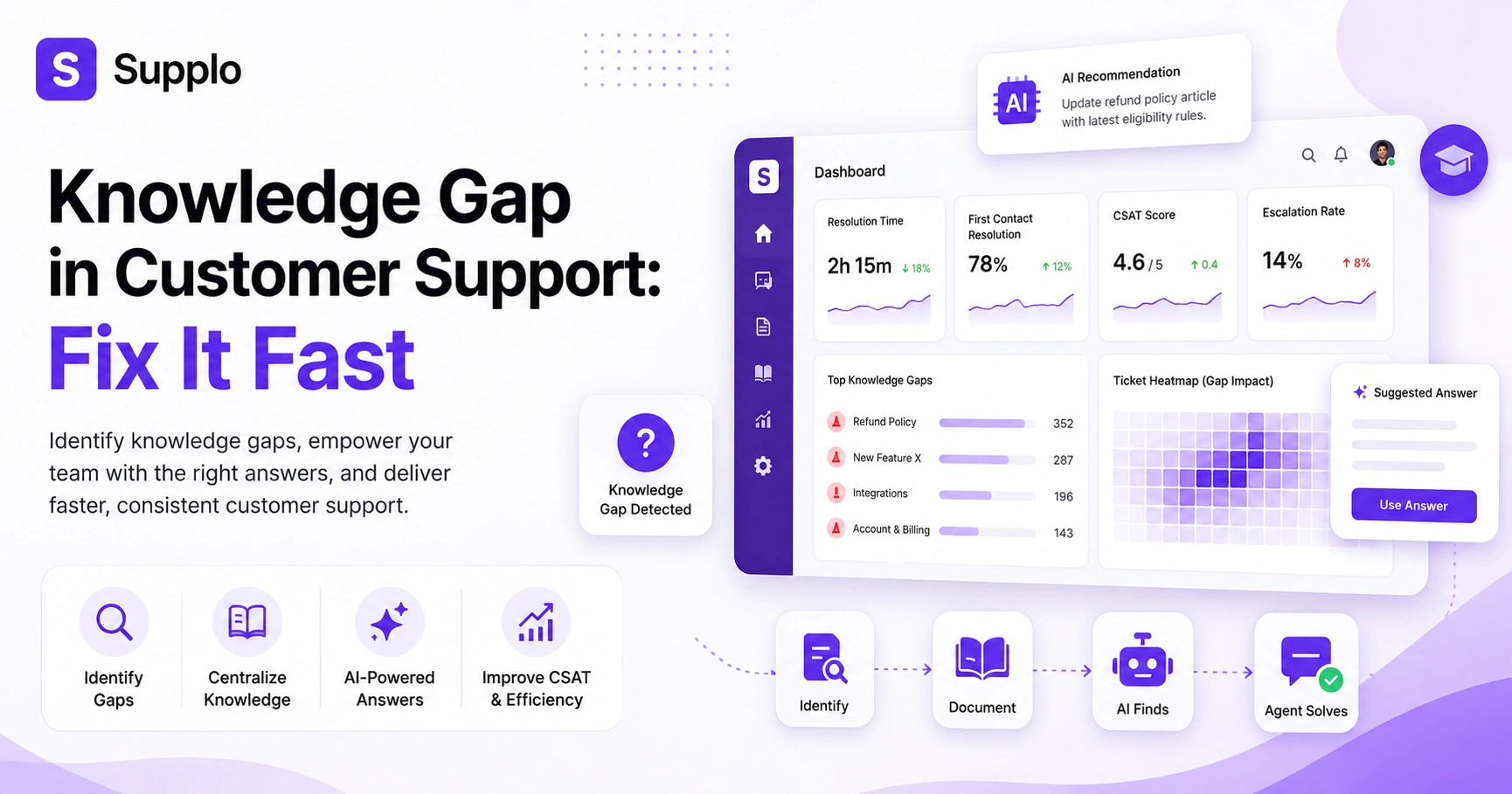
Whether you're running a small startup or a large enterprise, customers expect quick, accurate answers. When your customer support team can't deliver, it's often due to a hidden problem: a knowledge gap. This comprehensive guide will define knowledge gaps, show you how to identify them and explain how AI can transform your support operations to bridge them effectively.
It's for customer service leaders, support team managers and business owners who want to improve efficiency, reduce operational costs and boost customer satisfaction by ensuring their team always has the right information.
Quick Answer
- A knowledge gap in customer support is the difference between what agents need to know and what they do know.
- It leads to longer resolution times, inconsistent answers and lower customer satisfaction.
- Common types include product, process, policy and context knowledge gaps.
- Identifying gaps involves auditing tickets, tracking escalations and asking agents directly.
- AI can reduce gaps by learning from interactions and instantly surfacing relevant answers.
What is a Knowledge Gap in Customer Support? Defining the Core Problem
Here it is in plain English: a knowledge gap in customer support is the difference between what your team needs to know to solve a customer's problem and what they actually do know. Think of it as the silent killer of first-contact resolution rates. It hides in outdated documentation, expertise locked away in just one person's head, or new product features that nobody thought to brief the frontline about.
When you're defining knowledge gaps, imagine blind spots in your team's collective understanding. The answer exists somewhere in the company, maybe in engineering, maybe in a Slack thread from three months ago, but it's not accessible to the person staring at a customer's question right now. Knowledge gaps aren't just about training failures; they're often systemic issues in how information flows between product, engineering and support teams.
A customer support knowledge deficit can be temporary (like a new feature rollout that caught everyone off guard) or chronic (long-standing confusion about a complex policy that nobody's bothered to clarify). These gaps are expensive: every minute an agent spends hunting for an answer is a minute they're not helping the next customer. And the most dangerous gaps? The ones you don't know you have. Trust me, your customers notice before you do.
How to Identify Knowledge Gaps in Your Support Team Before They Hurt You
Spotting knowledge gaps in customer support comes down to watching three key signals: repeated escalations, unusually long resolution times for specific topics and a spike in follow-up questions from customers. Start by auditing your most common ticket categories and look for patterns where agents are parking tickets or transferring them to senior staff.
The best way to identify knowledge gaps is to compare what your knowledge base says against what your agents are actually asking for help with in Slack or team chat. Here's a practical checklist:
- Run a sentiment analysis on your support tickets. Unhappy customers often point directly to the knowledge gap.
- Conduct a mystery shopper test where a team member asks a common question across different channels. Are answers consistent?
- Track your escalation rate by topic in your helpdesk reports. Anything above 20% is a red flag for a knowledge deficit.
- Ask your agents directly: What is one question you're tired of answering because you don't have a good answer? That question right there? That's your gap.
The Real Impact of Knowledge Gaps on Customer Service And Your Bottom Line
The customer support knowledge gap impact is measurable and it's brutal. You're looking at longer handle times, lower CSAT scores and higher churn rates. When agents don't have the right information, they have three options and none of them are good: they guess (which creates more problems), they escalate (which frustrates everyone), or they put the customer on hold to find the answer (which destroys the experience).
The effects of knowledge gaps on customer service compound over time. A small gap today turns into a reputation-damaging pattern of inconsistency tomorrow. Here's what the numbers look like in practice:
- Each knowledge gap costs roughly 3–5 minutes of extra handle time per ticket. Multiply that by hundreds of tickets and you're losing days of productivity weekly.
- Customers who experience a knowledge gap failure are 4x more likely to mention the competition in their negative feedback.
- The impact hits hardest in high-velocity channels like live chat and WhatsApp, where customers expect instant answers.
- Knowledge gaps in billing or policy areas are especially dangerous; they can create legal or compliance exposure.
Common Knowledge Gaps in Support Teams And Why They Keep Happening
The most common knowledge gaps in support teams fall into four buckets. Let me break them down:
Product knowledge gaps: Agents don't know how new features work. This is the most frequent one, sales and marketing hype features, but support only finds out when customers start asking questions.
Process knowledge gaps: Teams aren't trained on return policies or escalation paths. Cross-departmental process gaps happen when the way we do X is understood by one team but not documented for others.
Policy knowledge gaps: Confusion about refunds, warranties, or compliance rules. These gaps persist because support teams are often the last to be informed about changes and the first to be blamed when things go wrong.
Context knowledge gaps: No access to customer history or previous interactions. This is the I need to ask you to repeat every problem that drives customers crazy.
Bonus gaps you might not have thought of: Language and translation gaps are a silent killer if you support global customers; an answer in English doesn't always translate cleanly. And the undocumented workaround gap? That's common in small teams where one person knows the trick, but nobody else does.
How Poor Support Due to Knowledge Gaps Drives Customer Dissatisfaction
Poor support due to knowledge gaps doesn't just annoy customers, it actively erodes trust. When a customer gets inconsistent answers from two different agents on the same day, they stop seeing your company as reliable. Customer dissatisfaction and knowledge gaps become visible in high refund rates, negative social media mentions and support tickets that turn into retention calls.
Here's the thing: customers rarely blame the agent. They blame the company for failing to equip their team properly. And they're right.
A single knowledge gap failure can turn a simple question into a 30-minute ordeal. The customer feels like they're wasting their time. And once they've had that experience, they're less likely to use self-service options in the future, creating a vicious cycle of ticket volume. The I'll check and get back to you response is the most common symptom of a knowledge gap and it costs you the immediate resolution. Dissatisfaction escalates fastest in billing and technical support, where accuracy is non-negotiable.
AI Knowledge Gaps in Customer Support: Can AI Actually Help or Hurt?
AI knowledge gaps in customer support are a real concern and the answer depends entirely on how you deploy the AI. A poorly trained AI agent that doesn't have access to your full knowledge base will create new gaps faster than human agents can fix them. That's the bad news.
The good news? The right AI, one that learns from your support conversations and knowledge base, can actually reduce knowledge gaps by surfacing the right answer to the right agent at the right time. The key is transparency: AI should tell you what it knows and what it doesn't.
The biggest AI knowledge gap risk is hallucination, an AI confidently giving a wrong answer because it was trained on incomplete or outdated data. AI that only copies your existing knowledge base will replicate your gaps, not solve them. The best AI solutions for supporting knowledge deficits are designed to escalate with context when they hit a gap, so the human agent has a head start. AI knowledge gaps are often smaller than human knowledge gaps because AI can be updated instantly with new information.
How AI Reduces Knowledge Gaps in Support
How AI reduces knowledge gaps in support comes down to three functions: it learns from every interaction, it surfaces relevant answers instantly and it escalates intelligently when it doesn't know something. A well-implemented AI agent connects to your knowledge base, past resolved tickets and product documentation, then uses that context to answer questions or prepare notes for the human agent. The result? A support team that always has the right information at their fingertips, regardless of who's on shift.
Reduce Knowledge Gaps with AI:
- Connect your AI to your knowledge base and existing ticket history so it learns from the data you already have.
- Configure the AI to auto-resolve known answers (like password resets or shipping status) and escalate complex questions.
- Monitor the AI's confidence score for each answer; low-confidence answers indicate your knowledge gaps.
- Use the AI's gap reports to identify what topics your team needs to document or train on.
- Continuously feed the AI new product updates and policy changes so it never falls behind.
AI Solutions for Support Knowledge Deficits: What to Look For
AI solutions for supporting knowledge deficits should be measured by three criteria: how well they learn from your existing data, how transparent they are about their limitations and how cleanly they hand off to human agents. Avoid tools that promise 100% automation; they're lying. Instead, look for platforms that give you a flat rate per resolution, not per seat, so your costs stay predictable as you scale.
The right AI doesn't replace your team; it gives them superpowers. Look for AI that supports your actual channels: email, live chat, WhatsApp Customer Support, Instagram DMs and Telegram, not just a single portal. The best AI solutions integrate with your existing knowledge base and learn from every conversation, not just the ones you've manually tagged.
Pricing matters too. Avoid per-seat models that penalize you for growing your team. Flat per-workspace pricing lets you add agents without penalty. A good AI agent that resolves tickets automatically will tell you I don't know gracefully and hand you off with full context, so the human doesn't have to start from scratch.
If your AI isn't reducing your knowledge gaps, you're paying too much.
Supplo resolves tickets at a flat $0.04 per resolution, not $0.99. Try it for free and see the difference.
How to Start Closing Your Customer Support Knowledge Deficit Today
Closing your customer support knowledge deficit doesn't require a massive overhaul; start with a knowledge audit. Pick your top 10 most common ticket types and check whether your team can answer them consistently without help. Then, document the answers in a central knowledge base and connect it to your support channels.
If you're using AI, train it on those 10 answers first and measure how many tickets it resolves before you scale. The goal isn't perfection; it's progress.
Practical Steps to Close Knowledge Gaps:
- Start with a knowledge gap walkthrough where your support team answers every common question without looking anything up. Track what they miss.
- Create a simple knowledge base in your helpdesk tool, even a Google Doc is better than nothing.
- Use a shared inbox that surfaces the customer's history and past tickets so agents don't have to ask Can you tell me what you already tried?
- If you use AI, start with a 14-day trial to get real data on what your team actually needs to know.
A shared team inbox that unifies all your channels is a crucial step. Opt for transparent pricing at a flat rate per workspace instead of per seat, so your bill doesn't balloon as your team grows.
The Role of AI for Customer Service Knowledge Management Long-Term Strategy
AI for customer service knowledge management is about turning your support team into a learning engine. Instead of relying on static documentation that ages the moment it's written, AI can continuously update your knowledge base based on real conversations and resolved tickets. Over time, this creates a self-healing support system: every time a human agent answers a new question, the AI learns it and the next customer gets that answer automatically.
The long-term payoff is a knowledge base that's always current, always accurate and always accessible. AI-driven knowledge management closes the gap between what we think we know and what customers actually need to know. The best AI tools generate knowledge base articles from resolved tickets, turning past work into future assets.
AI can also detect when a knowledge base article is outdated by flagging when customers stop accepting the answer. Over time, this reduces the need for manual knowledge base maintenance; the AI does the heavy lifting. This approach scales globally: AI translates knowledge into multiple languages, so your team can support customers anywhere, all from a unified multichannel inbox.
Your knowledge base should never be a guessing game.
Supplo unifies email, live chat, WhatsApp, Telegram, Instagram DMs and Facebook Messenger into one inbox so your team always has context. Start your free trial today.
Key Takeaways
- Knowledge gaps directly impact customer satisfaction and operational costs.
- Systematic identification of these gaps is crucial for effective resolution.
- AI is a powerful tool for reducing knowledge gaps by learning and surfacing information.
- However, AI deployment requires careful training and transparency to avoid creating new issues.
- A start-small, continuous-iteration approach is best for addressing knowledge deficits.
FAQ
What is a knowledge gap in customer support?
A knowledge gap is the difference between what a support agent needs to know to resolve an issue and what they actually know. It's usually caused by poor documentation, outdated training, or siloed information across departments.
How do you identify knowledge gaps in a support team?
You can identify knowledge gaps by tracking repeated escalations, long resolution times for specific topics and inconsistent answers across different agents. Running a ticket audit or a mystery shopper test is the most effective method.
Can AI actually fix knowledge gaps, or does it create new ones?
AI can fix knowledge gaps if it's trained on accurate, up-to-date data and connected to your knowledge base. But poorly trained AI can create new gaps by hallucinating answers. The key is to use AI that's transparent about its limitations and escalates cleanly.
What are the most common knowledge gaps in customer support teams?
The most common gaps are product knowledge (new features), process knowledge (how to handle returns or escalations), policy knowledge (refund rules) and context knowledge (customer history). These gaps often happen because support teams are the last to learn about changes.
How do knowledge gaps affect customer satisfaction?
Knowledge gaps lead to longer wait times, inconsistent answers and frustrated customers. When a customer gets different answers from different agents, they lose trust in your company and are more likely to churn or leave negative reviews.
What's the fastest way to start closing a knowledge gap?
Start with a knowledge audit of your top 10 most common ticket types. Document the answers in a central knowledge base, train your team on it and connect it to your support channels. If you're using AI, train it on those 10 answers first.
Do I need a separate tool for knowledge management, or can AI handle it?
Modern AI tools can handle knowledge management by learning from past conversations and automatically updating your knowledge base. Look for a platform that combines a shared inbox, AI agent and knowledge base in one workspace to avoid tool sprawl.
Compliance line: Supplo is not affiliated with any app or website. Please follow each app's terms and local regulations.