On this page
Let's be real for a second, a real multilingual customer support strategy isn't about toggling "French" on in your chat widget and calling it a day. It's a whole different beast, one that needs to handle accurate translations, cultural nuances and timely responses across time zones, all without burning out your team.
This guide is for business leaders and support teams who are ready to go global but want to do it right. Whether you're scaling into three new markets or finally fixing that broken translation flow, we've got you.
Quick Answer
- Real multilingual support needs a unified inbox, a self-learning AI agent and a translated knowledge base, not just a translate button.
- Cultural expectations vary wildly: politeness in Japan looks different than directness in the Netherlands and your AI should know the difference.
- Track language-specific resolution rates, not just overall CSAT scores
- Flat-rate tools like Supplo ($0.04 per AI resolution) let you add languages without the sticker shock of per-seat pricing.
Why Adding a Language Isn’t a Multilingual Customer Support Strategy
Slapping a translate button on your chat widget isn't a strategy; it's a band-aid. A proper multilingual customer support strategy involves thoughtful workflows around translation accuracy, cultural tone, agent training and channel availability. Yet most teams treat language support as a settings-menu checkbox, then wonder why their international customers ghost them.
- The gap between translated and resolved is massive in support contexts.
- Machine translation without context leads to refunds, escalations and unhappy customers.
- Real example: a German customer gets a literal translation of a casual English phrase and takes offense; trust erodes immediately
- This is why reliability matters before a human ever types a reply.
How to Map Cross-Cultural Communication in Business to Your Support Flow
Cross-cultural communication in business isn't just about language; it's about expectations: response time, formality, directness, hierarchy. Japanese customers typically expect a formal, deferential tone, while Dutch customers prefer straight talk and fast problem-solving. A reliable multilingual support setup respects these differences instead of assuming a one-size-fits-all voice.
- The three biggest cultural friction points: politeness hierarchy, response urgency and directness
- Latin American markets may tolerate slower replies but expect warm, personal greetings.
- Scandinavian markets penalize overly salesy or flowery language; keep it clean.
- Practical tip: build a style guide per region, not per language. It makes all the difference.
Automating Translation Without Losing Your Customer’s Voice
Modern automated multilingual tools can translate tickets, replies and knowledge base articles in real time. But here's the thing: the translation layer needs to preserve intent and emotional tone, not just words. An AI that turns "I'm furious about this" into "I am experiencing displeasure regarding this matter" isn't helping anyone. The best approach combines real-time translation with a human-review toggle for tricky cases.
- How AI handles context: domain-specific terminology vs. general chat
- When to let AI run fully automated vs. when to require agent confirmation
- The danger of over-automation: translating "I'm sick of this" to "I am unwell regarding this"
- Real test: what happens when a Hindi customer uses mixed-language speech (Hinglish)? Does your AI handle it?
Ready to see an AI agent handle your Spanish, French and German customers without the awkward translations?
Start your 14-day free trial at Supplo and connect your chat widget or email in under 5 minutes.
The Tech Stack for a True Global Customer Support Operation
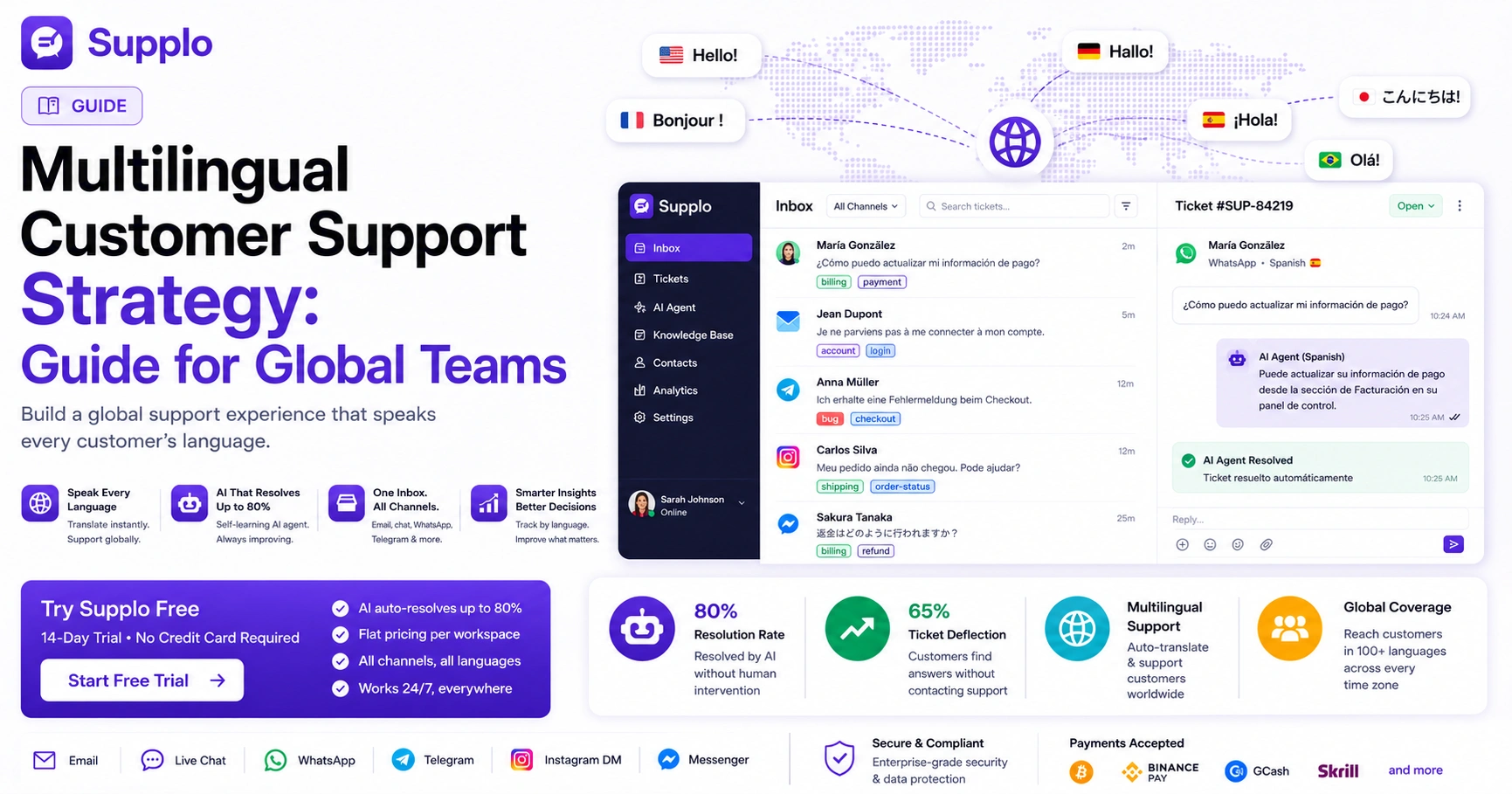
For customer support across global teams, your tech stack needs a unified inbox that handles email, live chat, WhatsApp and social DMs, translating them into a single clean thread. Multilingual chat support software like Supplo is built exactly for this, with a self-learning AI agent that resolves up to 80% of incoming tickets automatically at a flat $0.04 per resolution.
You don't want to buy a translation tool and a chat tool and hope they play nice together. You want a single workspace where language is just a filter, not a headache.
- What to look for in international live chat tooling: native channel support, not just APIs
- Why WhatsApp and Telegram support that needs your phone online is a failure for global teams
- Real-time translation chat support should handle back-and-forth without lag
- Critical feature: preview your translation before sending, not after
Supplo's shared inbox for all channels handles emails, live chats and social DMs in one place, with automatic email ticketing.
Building a Knowledge Base That Works in Any Language
Your knowledge base is the backbone of AI-powered support. If your self-service articles are only in English, your AI can't resolve tickets for Spanish or French customers. Reliable automated multilingual support starts with a translated, maintained knowledge base that covers the top 20% of issues causing 80% of your tickets.
Supplo's knowledge base feature lets you feed both original articles and AI-generated translations into the agent, so it learns from cross-lingual data, no more duplicate work.
- Single-source-of-truth approach: write once, translate intelligently
- Please don't use Google Translate for your KB unless you're okay with embarrassing errors
- Automated hand-off: if a customer asks in Spanish and the KB has a Spanish translation, the AI answers directly
- Measure what percentage of queries the AI resolves in each language, spot gaps fast
Use Supplo's multilingual knowledge base creation to ensure your AI agent is always up to date.
Training Your Team for Supporting International Customers
Here's something most guides skip: your agents probably don't speak every language your customers do. And that's okay. But you need to train them on how to use translation tools safely, when to escalate to a native speaker and how to de-escalate culturally. For customer support across global teams, you want agents who can spot when a translation softens a complaint or makes it harsher.
- Test your team's translation literacy: can they flag obvious machine-translation tells?
- Create a simple rubric: "If the customer's original tone is angry but the translation reads neutral, escalate"
- Have a native-language supervisor for your top 3 markets; it's worth the investment.
- Time zone coverage vs. language coverage: know which matters more for your customers
Real-Time Multilingual Chat: What Live Chat Translation Actually Requires
Live chat translation sounds simple until a customer sends a message in mixed Arabic-English, or a Japanese customer uses keigo (honorific) forms with no direct English equivalent. Reliable customer chat software for multilingual support needs to handle code-switching and flag uncertain translations. This is where the AI agent's confidence score matters; if it's below 80% in a high-stakes language, it should kick to a human rather than guess.
- Code-switching: Spanish-English bilingual customers switch mid-sentence; what does your AI do?
- Honorifics and formality levels: Japanese, Korean and Thai need different handling than European languages
- Chat latency problem: if translation takes 2+ seconds, the conversation dies.
- A self-learning AI gets better over time at your specific product's vocabulary; that matters.
Handling Tricky Cases: Slang, Idioms and Regional Nuances
Every multilingual strategy hits a wall with idioms. "Break a leg" translated literally into French is nonsense. AI for global support needs to recognize common idioms and either replace them with the local equivalent or flag them for a human. The most reliable approach? Build a custom idiom dictionary for your product and top markets and feed it into your AI's training data.
- Examples of idiomatic failures: "It's raining cats and dogs" in Hindi, "I'm pulling your leg" in Japanese
- Regional nuance: "Cerveza" means different things in Mexico vs. Spain, "football" means different things in the US vs. the UK
- Emoji and slang vary across cultures; the thumbs-up emoji is offensive in some places.
- When to use a human-in-the-loop for sarcasm detection (spoiler: more often than you think)
For complex cases, Supplo's WhatsApp customer support integration ensures seamless hand-offs to your team.
Supplo is not affiliated with any app or website. Please follow each app's terms and local regulations.
Measuring Success in a Global Customer Support Strategy
You can't improve what you don't measure. A global strategy needs language-specific metrics. Track resolution rate per language, not just overall CSAT. A reliable multilingual support operation should show consistent resolution rates across English and, say, Thai; if Thai is 20% lower, your translation layer or knowledge base is failing. Also watch first-contact resolution by language, since that's the clearest signal your AI is working properly.
- Language-specific CSAT vs. translation accuracy score
- Set up a monthly "translation audit": pull 10 tickets per language, have a native speaker review the AI translation.
- The danger of averaging: a 94% overall CSAT might hide a 70% CSAT in one language
- Cost per resolution by language should be roughly equal if the AI is working well.
The Cost Trap: Why Per-Seat Pricing Fails Global Teams
Most legacy tools charge per agent seat, which means your bill explodes as your team grows to cover more languages. For a global customer support strategy, you need flat-rate pricing that doesn't penalize you for adding people. Supplo charges per workspace, not per seat, so adding a Portuguese speaker for Brazilian support doesn't double your bill. And our AI agent costs a flat $0.04 per resolution, not the $0.99+ you'll see from older vendors.
- The math: 10 agents at $100/seat vs. one workspace at a flat rate, it adds up fast
- Per-seat pricing pushes teams to understaff critical languages.
- Flat pricing makes it easier to experiment with new markets: add a language, add an agent, no incremental software cost.
- Payment flexibility: Supplo supports payments via Crypto, Binance Pay, GCash, Skrill and more, so global teams can actually get onboarded without friction
Don't let per-seat pricing keep you from adding that next language market. Supplo gives you all channels, a self-learning AI and a flat workspace price, plus we support payments via Crypto, Binance Pay, GCash, Skrill and more so global teams actually get onboarded fast. Start free trial →
Key Takeaways
- Real multilingual support isn't just a translate button; it's an accurate, culturally sensitive service
- Cross-cultural communication matters: understand the expectations of your markets
- Automate translation while preserving the customer's voice and emotional tone
- Use a unified tech stack that handles all channels and translates seamlessly
- Translate your knowledge base so AI can resolve tickets in any language
- Train your team to use translation tools effectively and know when to escalate
- Real-time chat should handle mixed languages and cultural nuances
- Measure language-specific resolution rates and costs to ensure consistency
- Avoid per-seat pricing to scale your team without exploding costs
FAQ
Can an AI really handle multilingual customer support reliably without humans?
Yes, for the 80% of tickets that are repetitive and fact-based (password resets, order status, basic troubleshooting). For complex emotional or nuanced issues, or when translating slang and sarcasm, a human should always be in the loop. Treat AI as your first responder, not your only responder.
How do you handle translation errors in live chat without slowing down the conversation?
The best approach is to use multilingual chat support software that allows the agent to review the translation before sending. The AI translates the customer's message and suggests a response in the agent's language; the agent approves or tweaks it, then the AI translates the reply back. This adds oversight without breaking flow.
Is it safe to use automated translation for sensitive or legal support tickets?
No. For compliance, regulatory, or financial issues, you need a native-speaking human agent or a certified translation service. Supplo is not affiliated with any app or website. Please follow each app's terms and local regulations.
What's the best way to test if my multilingual strategy is actually working?
Run a silent audit, pick your top 3 non-English languages, pull 10 tickets each and have a native speaker rate the translation accuracy and resolution quality. Compare against English CSAT scores. If any language drops 15% or more, you have a systemic issue.
Do I need to hire native speakers for every language I support?
Not necessarily. With a good AI translation layer and a style guide for each region, you can start with one multilingual agent per market and scale through AI automation. But you should always have at least one native speaker on retainer for the trickier cases in each language you feature heavily.
How do you handle time zone differences when supporting customers globally?
That's where AI excels; your AI agent works 24/7 in every language. It resolves up to 80% of tickets automatically, so customers wake up to a completed ticket or a clear hand-off summary for your team in their time zone.
What's the biggest mistake companies make when going multilingual?
Assuming a direct translation of your English support flow will work. They skip the cultural training, the idiom handling and the knowledge base translation. Then they wonder why Japanese customers complain about rude responses when the AI was just being literal.
Compliance line: Supplo is not affiliated with any app or website. Please follow each app's terms and local regulations.