On this page
Let's be real for a second. Per-seat pricing sounds simple enough: pay for each person using the software, and you're done. But if you've ever tried scaling a support team, you already know the punchline: that simple model turns into a budgeting headache faster than you can say seasonal hiring spree.
This article digs into why per-seat pricing is broken for support teams, walks through the alternatives that actually make sense and helps you figure out what fits your growing business.
Quick Answer
- Per-seat pricing punishes flexible staffing (part-timers, seasonal hires) by charging full price for partial usage.
- It often forces costly upgrades to higher tiers for more seats, not necessarily for needed features.
- Hidden fees for channels, AI, or integrations can inflate per-seat costs beyond initial expectations.
- Flat per-workspace pricing or smart usage-based models offer predictable costs that scale transparently with your actual needs, not just headcount.
Why Per-Seat Pricing Feels Fair but Falls Apart When You Scale
Here's the thing about per-seat pricing: it looks great on paper. One agent, one price. Simple math.
But the moment you hire a part-time contractor? Or onboard a seasonal CS rep for the holidays? Or let an agent work across different shifts? That simple model turns into a billing nightmare. You're paying full price for partial usage, and your per-seat support software costs keep rising, even as ticket volume remains unchanged.
Think about seasonal businesses. They often double their support team for 3 months, and end up paying triple the software cost for agents who sit idle the rest of the year. That's not scaling. That's just wasting money.
Common per-seat pricing issues for support teams include:
- Paying for logins that are rarely used
- Paying for managers who oversee but don't handle tickets
- Paying for agents covering late shifts at the same rate as full-timers
The real kicker? When you need a flex agent who handles overflow only, you're charged the same $89/month as a full-time power user. That's not flexible. That's punitive.
The Hidden Tax of Per-Seat Models: Part-Time Agents and Seasonal Spikes
If your support team includes part-timers, interns, or seasonal holiday reps, per-seat pricing punishes you for being agile. Period.
You pay the same monthly license for a 10-hour-a-week contractor as you do for a 40-hour-a-week team lead. The result? Those scaling-support pricing issues become a real blocker to flexible hiring. You're caught between overpaying during slow months and understaffing during peak periods.
Here's what nobody tells you about per-seat contracts:
- Many require annual commitments for each user, locking you into costs even if you downsize mid-year
- Seasonal spikes (Black Friday, product launches) force you to choose between slow response times and paying for 20 underutilized seats post-spike
- The average per-seat cost for support software from legacy tools is $50–$100 per user per month, even if that user handles only 50 tickets per month.
That's not a pricing model. That's a tax on growth.
Tiered Pricing SaaS: The Pay for What You Don't Use Trap
Tiered pricing SaaS plans (Starter, Growth, Pro, whatever they call them) seem organized. But they're designed to push you up a tier long before you actually need the features.
Here's how it usually plays out: You upgrade not because you want automation or advanced reporting, but because your agent count just exceeded the Starter cap. That upgrade costs you 2–3x more per seat, even if most of your team still only needs basic ticketing.
Most common SaaS pricing models for support force you into a higher tier when you add 2–3 extra agents, not when your ticket volume demands it. You end up paying for features you may never use (fancy reporting, workflow automation, AI bots you don't need yet) to unlock a higher seat count.
Support team pricing challenges like this erode trust. Your costs jump unpredictably from month to month, leaving you wondering what you're actually paying for.
Worried about hidden pricing traps in your current support tool? Start a free 14-day trial of Supplo and see exactly what you'd pay, no surprises, no seat caps.
Usage-Based Pricing vs. Per-Seat Pricing: Which Actually Saves You Money?
Usage-based pricing sounds fair on the surface. Pay per ticket or per resolution, you only pay for what you use. What could go wrong?
Plenty, actually.
Many usage-based models bury fees in tiered rate cards and charge $0.99 per resolution, turning a scalable cost into a runaway line item. The core problem with usage-based vs. per-seat pricing is predictability: you have no idea what your bill will be next month. One busy season and suddenly your software costs have doubled.
Usage-based pricing works great for low-volume teams. But as your support scales, the per-resolution cost compounds faster than a flat-rate seat-based model.
What actually works? Better pricing models than per-seat support combine a flat base rate with actual usage, not unlimited plans capped by agent count. The per-seat support model fails here because it ignores volume entirely: 10 agents handling 5,000 tickets costs the same as 10 agents handling 500.
For instance, some legacy support software charges based on the number of agents, regardless of their activity, which can lead to unpredictable costs. You're paying for headcount, not output.
Feature-Based Pricing SaaS: When the Pro Plan Isn't Optional
Feature-based pricing SaaS models segment features into paid tiers. Multilingual support? That's in the premium plan. Advanced reporting? Locked behind a higher price tag. AI automation? You'll need to upgrade for that too.
This creates a hidden cost problem: you don't upgrade for seats; you upgrade for the AI chatbot or analytics your team genuinely needs. The result is a bloated per-seat support cost that feels like a bait-and-switch.
Some tools charge extra for basic email-to-ticket integration or WhatsApp channels. Features that should be standard in a modern support platform are suddenly premium add-ons.
Feature-based pricing SaaS forces you to buy an entire Pro plan to get one or two features you actually need, even when your seat count is small. That's not a good deal.
Flexible support pricing means unbundling what matters like AI agent, multichannel inbox and charging for it transparently, not hiding it behind a tier. Multichannel automation, like combining email, web chat, and social media, should be a must-have feature, not a premium upsell.
Common SaaS Pricing Models for Support and Where They Fail Teams
Let's break down the four most common SaaS pricing models for support:
The four common SaaS pricing models for support each present unique structures and limitations: per-seat pricing involves paying a set fee per agent but punishes flexibility and seasonal hiring by charging full rates for part-time usage; tiered pricing utilizes fixed plans with caps, which often forces unnecessary upgrades based on headcount rather than feature needs; usage-based pricing charges per ticket or resolution, frequently leading to unpredictable costs and hidden rate cards; and flat-rate pricing charges one single price per workspace, a model that is only effective if the base price remains transparent.
Per-seat punishes flexibility. Tiered forces upgrades you don't need. Usage-based is unpredictable. Flat-rate (when done right) offers transparency.
Understanding SaaS support pricing requires comparing not just the dollar amount, but also how the model behaves as your team grows and contracts. Per-seat pricing issues for support emerge when you have part-timers, cross-functional users, or seasonal spikes.
Usage-based models often have hidden volume tiers that spike your rate once you cross a threshold. Support team pricing challenges aren't about the starting price; they're about what happens when you add one more person or one more channel.
Understanding SaaS Pricing for Support: What Your CFO Should Ask
When evaluating support software, your CFO should ask three tough questions:
- What happens to the per-user price when we add 10 more agents?
- Does the cost per resolution decrease as volume increases?
- Are there hidden fees for features like AI, multi-language, or channel integrations?
Problems with per-seat support pricing often surface only after the contract is signed. That's when you realize:
- Many per-seat plans have a growth cap: adding a few agents can trigger a tier change and double your rate.
- Some providers charge extra for integration with WhatsApp, Telegram, or Instagram, channels your customers expect to be included.
- Your per-seat support software cost keeps rising, yet service quality hasn't improved.
Flexible support pricing means you don't pay for unused seats, unused features, or pro tiers you don't need. It's that simple.
Don't wait until your next contract renewal to discover your per-seat cost is bloated. Try Supplo free for 14 days and compare the pricing model side-by-side with your current tool.
Alternatives to Per-Seat Pricing: Flexible Support Pricing That Scales With You
So what actually works? Here are the better pricing models than per-seat for support:
- Flat-rate per workspace: Pay one predictable price for your entire team
- Usage-based with fair caps: Low base rate + transparent resolution fees
- Hybrid models: Combine a low base with reasonable per-resolution charges
The key is flexibility. Your bill shouldn't double because you hired two more agents during a product launch. Flexible support pricing treats your team's size as fluid rather than fixed.
A flat per-workspace model means you pay the same whether you have 5 agents or 50; the cost is tied to the workspace, not the headcount. Other support pricing structures, like pay-per-resolution, can work if the rate is low enough (think $0.04 per resolution vs. $0.99).
Alternatives to per-seat support pricing must also include no penalty for adding channels or languages. You shouldn't be nickel-and-dimed for using WhatsApp alongside email.
How Supplo Replaces the Per-Seat Model With Transparent, Flat-Rate Pricing
Here's where the rubber meets the road.
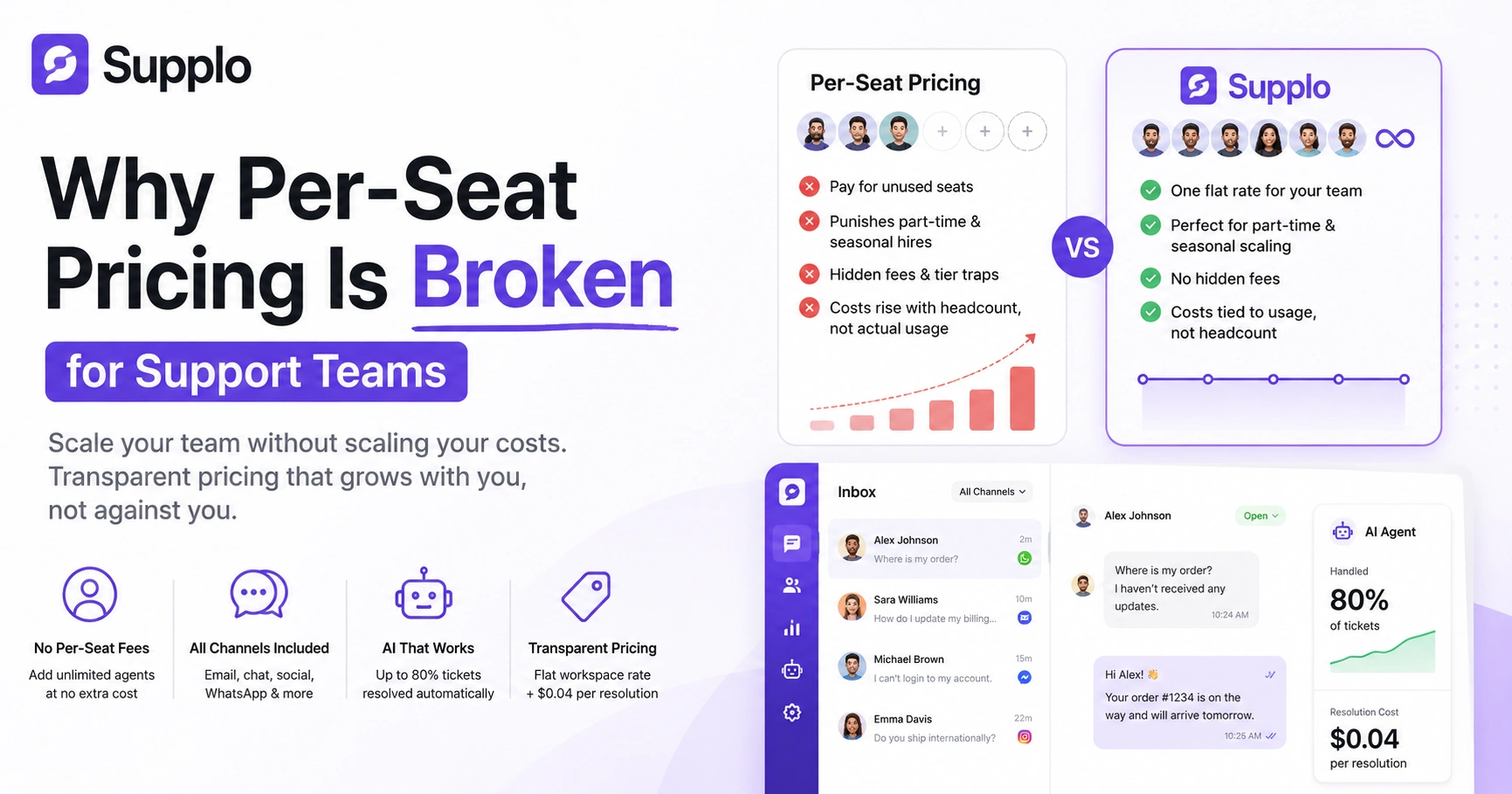
Supplo replaces broken per-seat pricing with a flat per-workspace model. You pay one predictable price for your entire support team, whether that's 3 agents or 30. And the AI agent automatically handles up to 80% of incoming tickets at a flat $0.04 per resolution, not the $0.99 that legacy tools charge.
That means your per-seat support cost disappears entirely.
Supplo unifies email, website chat widget, WhatsApp, Telegram, Instagram DMs, and Facebook Messenger into a single shared team inbox, with no per-channel fees. Your bill doesn't balloon as your team grows.
The flat per-workspace pricing covers every agent, manager, and contractor within a workspace. Flexible support pricing with Supplo means you can:
- Hire seasonal staff without penalty
- Assign agents to overnight shifts
- Add channels without surprise fees
- Never face a surprise bill
Payments are accepted via credit card, Crypto, Binance Pay, Payeer, GCash, AmanPay, QIWI Wallet, DOKU, Nigeria and South Africa cards, Skrill and Payoneer.
Is Per-Seat Pricing Ever the Right Move?
Let's be honest.
Per-seat pricing works for exactly one type of team: small, stable teams that never hire part-timers, never see seasonal spikes and never need cross-functional access. Suppose that's you, great. Keep your per-seat plan.
For everyone else- growing teams, startups, ecommerce stores, and agencies- per-seat is a tax on growth. The smarter long-term bet is a pricing model that decouples headcount from cost and charges for what you actually use.
If your team is 2–3 people and stays that way forever, per-seat is simple. But the moment you scale, switch to a flexible model. The per-seat support model fails because it treats every agent equally, even when their usage is wildly different.
Flexible support pricing tiers for support software should reflect volume, not headcount. Your bill should grow with your success, not your org chart.
Per-seat pricing doesn't have to be your reality. Supplo's flat workspace pricing grows with you, not against you. Start your free trial today, and if you need help migrating, we're here for that too.
Key Takeaways
- Traditional per-seat pricing models create hidden costs and prevent flexible team scaling
- Be wary of tiered pricing that forces upgrades based on headcount rather than feature need
- Usage-based pricing offers predictability challenges if not structured with transparent, low per-resolution costs
- Prioritize pricing models that offer flat rates per workspace or predictable per-resolution fees, allowing your team to grow without budget surprises
FAQ
Is per-seat pricing cheaper than usage-based pricing for small teams?
For teams with 1–3 agents and stable volume, per-seat can be cheaper upfront. But as soon as you add one part-time agent or see a seasonal spike, usage-based or flat-rate models often cost less.
Why does per-seat pricing feel unfair for support managers?
Per-seat charging punishes you for hiring flexibly; part-timers, interns, and overflow agents cost the same as full-time leads. You pay for seats that sit idle, which erodes budget control.
What is the best alternative to per-seat pricing for support software?
Flat-rate per workspace or usage-based pricing with transparent caps. Models that charge by resolution or by workspace, not by headcount, give you predictable billing and let you scale without penalty.
Does Supplo charge per agent?
No. Supplo uses flat per-workspace pricing, so you pay one price for your entire team, whether you have 3 agents or 30. You only pay extra for AI resolutions at a flat $0.04 per resolution.
Can I use per-seat pricing for a seasonal support team?
You can, but you'll overpay. Seasonal spikes mean doubling or tripling seats for 2–3 months, then paying for idle licenses the rest of the year. A flexible pricing model avoids that waste.
Are there hidden fees in tiered pricing SaaS plans?
Yes. Many tiered plans charge extra for integrations, multichannel support, or advanced reporting. You often upgrade to a higher tier to unlock basic features, which raises your effective per-seat cost.
What should I look for in a pricing model for my support team?
Look for predictability, fairness for part-time users, and no penalty for adding channels, languages, or seasonal agents. The best models decouple cost from headcount and tie it to actual usage.
Compliance line: Supplo is not affiliated with any app or website. Please follow each app's terms and local regulations.