On this page
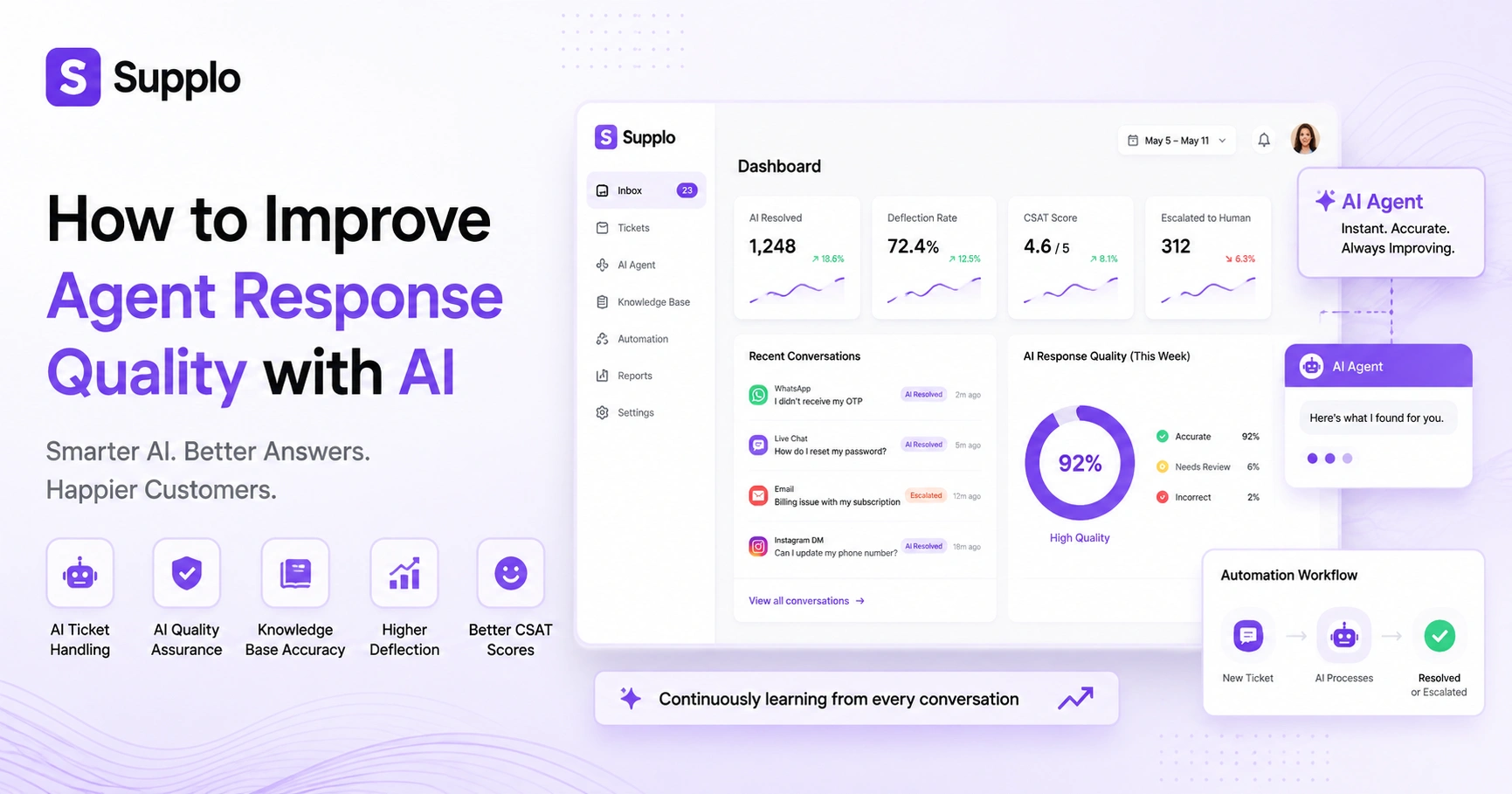
AI isn't some far-off fantasy anymore. It's here and it's running your customer support whether you're ready or not. But here's the thing: just slapping an AI agent on your help desk won't magically fix everything. The real trick? Knowing how to improve agent response quality with AI so your customers actually like talking to your bot. This guide is for support managers, ops leaders and anyone trying to make their automated systems less robotic and more helpful. We'll walk through ticket handling, knowledge base fixes, quality checks and everything in between.
Quick Answer
- Audit and update your knowledge base regularly to ensure AI has accurate, current information.
- Implement continuous feedback loops where customer interactions and agent corrections retrain the AI.
- Utilise automated AI quality assurance (QA) to review every response for accuracy, tone and completeness.
- Centralise all communication channels into a single inbox to provide complete conversation context.
- Define clear handoff triggers for when AI should escalate complex or sensitive issues to a human agent.
Why Response Quality Still Matters When AI Handles the First Touch
A fast AI response that misses the mark? That'll frustrate customers faster than a slow human reply ever could. Response quality matters because it's the very first impression of your support brand. It directly impacts ticket deflection rates and customer trust. If your AI agent sounds like a robot reading from a script, misunderstands what someone's actually asking, or gives half-baked answers, you'll see more escalations and lower satisfaction scores even if your resolution time looks great on paper.
Customers can tell when they're talking to an unpolished bot. One bad interaction can undo weeks of positive brand perception. High-quality AI responses reduce repeat contacts by resolving the issue completely the first time. Quality isn't just about accuracy; it's about tone, clarity and knowing when to ask clarifying questions rather than guessing. And honestly? It affects internal metrics like first reply time, CSAT and the number of tickets that need human eyes.
How to Optimise AI Ticket Handling for Faster, More Accurate Replies
Optimising AI ticket handling starts with clean, structured data. Your AI agent needs access to your knowledge base, past ticket resolutions and product documentation. But it also needs rules about when to pull from which source. Tag your content by intent category (billing, troubleshooting, account access) so the AI knows exactly where to look for the right answer.
Using a shared inbox like Supplo that centralises tickets from email, chat, WhatsApp and social DMs ensures AI sees the full context. And that unified view is crucial for enhancing agent response quality with AI. Train your AI to recognise ticket priority and urgency; urgent issues need faster handling, even when automated. Periodically review resolved tickets to spot patterns where the AI misread intent, then adjust your triggers accordingly. Set up handoff triggers that pass complex tickets to a human without delaying the customer's experience.
Using AI Quality Assurance for Support Tickets to Spot Gaps Faster
AI quality assurance (QA) tools can automatically review every ticket response, both automated and human, for accuracy, tone and completeness. Instead of manually sampling 5% of tickets, you can flag every low-quality reply in real time and coach your team or retrain your AI. This turns QA from a once-a-month chore into a continuous improvement loop.
Automated QA can score each AI response against your knowledge base to catch hallucinations or outdated info instantly. Flag replies that contain hedging language ("I think," "maybe") and review them for confidence gaps in your AI training. Use QA insights to identify which topics your AI struggles with and prioritise content updates in those areas. Human review should focus on edge cases, not repetitive tickets; let AI QA handle the volume.
How to Improve AI Knowledge Base Accuracy for Fewer Wrong Answers
Your AI agent is only as good as the knowledge base it pulls from. Outdated, contradictory, or poorly written articles lead to wrong answers and frustrated customers. Improving knowledge base accuracy means auditing existing content, removing duplicates and structuring information in a way the AI can parse cleanly: short paragraphs, clear headings and specific step-by-step instructions.
Create a single source of truth for each product or service topic, then deprecate older versions to avoid confusion. Use AI-powered knowledge-base quality-management tools to flag articles that haven't been updated in 90+ days. Include plain language definitions of common customer terms so the AI maps user queries to the correct internal jargon. To improve the AI knowledge base's accuracy, test your AI's retrieval accuracy weekly by running sample queries and verifying that it returns the intended article.
Improving AI Ticket Deflection Without Sacrificing Customer Satisfaction
Ticket deflection is a double-edged sword. High deflection rates can lower support costs but also frustrate customers if they feel brushed off by a bot. The trick? Aim for "good deflection", resolving the issue completely in one AI exchange, rather than just reducing ticket volume. Measure deflection alongside CSAT and resolution rate to make sure you're not just pushing problems away.
Set up AI fallback messages that acknowledge when the AI can't help and offer a warm handoff to a human. Use conversation summaries so that when a ticket escalates, the human agent has full context and the customer doesn't have to repeat themselves. Track which topics have the highest reopen rates after AI deflection and prioritise them for knowledge base updates. Good deflection means the customer walks away satisfied, even if they didn't talk to a human.
How to Use AI for Better Customer Service Responses Across Channels
Customers expect the same quality of AI response whether they're reaching out via email, WhatsApp, Instagram DMs, or your website chat widget. A unified AI agent that adapts to each channel's tone and formatting, while pulling from the same knowledge base, ensures consistency. Supplo's multichannel inbox keeps every conversation in one threaded view, so the AI context isn't lost when a customer switches channels.
Train your AI to recognise channel-specific cues, such as WhatsApp customer support's informal tone vs email's more structured expectations. Translate responses automatically for language-mixed inboxes so quality isn't lost in translation. Maintain channel-specific response templates that still pass through the same QA and accuracy checks. Consistent AI voice across channels builds trust and reduces cognitive load for both your team and your customers.
Boosting AI Agent Response Quality Through Continuous Feedback Loops
AI agent response quality doesn't stay good on its own; it degrades without regular feedback loops. Every time a customer rates a response, asks a follow-up, or escalates to a human? That's a signal. Build a system where those signals automatically feed back into your AI training data, so the AI agent learns from its mistakes without waiting for a quarterly retrain.
Use "thumbs up/down" widgets in your AI chat responses to collect real-time feedback on answer quality. Flag tickets where the customer asked for clarification or rephrased their question; that's often a sign the AI missed context. Have human agents tag resolved tickets with correction notes that the AI can reference for future similar queries. Run weekly reports on AI confidence scores and investigate any sudden drops in performance to maintain high quality.
Test your AI response quality for free with Supplo's 14-day trial. See how our AI agent handles real tickets from email, chat and social DMs in one clean inbox.
Common Pitfalls That Tank AI Response Quality And How to Avoid Them
Even well-trained AI agents stumble into predictable traps: answering confidently but incorrectly (hallucinations), repeating the same generic response for different questions, or missing context from previous messages. These pitfalls occur when the AI lacks clear boundaries, has an outdated knowledge base, or isn't tuned to detect customer frustration. The fix is usually better training data, clearer handoff rules and regular QA audits.
Hallucinations spike when your knowledge base has conflicting information; deduplicate before training. Repetitive responses happen when the AI's retrieval system favours a single article over relevant alternatives. Missing context occurs when the AI doesn't have access to the full conversation thread, especially when it spans multiple channels. A common mistake? Over-engineering the AI with too many rules, making it rigid instead of helpful.
If your AI's answers are still missing the mark, try Supplo. Flat pricing at $0.04 per resolution, not per seat, plus a knowledge base that keeps your AI sharp.
How to Measure AI Support Ticket Resolution Quality Over Time
Measuring AI support ticket resolution quality means looking beyond deflection rate alone. Track first contact resolution rate for AI-handled tickets, average reply quality score (via automated QA) and post-resolution customer satisfaction. Watch for trends over weeks, not days, because one bad knowledge base update can tank quality scores until you catch and fix it.
Set a baseline quality score from your first 1000 AI ticket resolutions, then track deviations week over week. Monitor shifts in sentiment in customer replies; if replies get shorter or more negative, the AI might be missing the mark. Track re-open rate for tickets resolved by AI vs human to identify topics where AI quality consistently lags. Use a dashboard that combines QA scores, feedback and escalation rate for a single-pane view of quality health.
When to Let AI Answer and When to Hand Off to a Human
Knowing when the AI should step aside is just as important as knowing when it should answer. Handoff is right when the customer expresses frustration, asks for a human, or presents a complex issue the AI has resolved poorly in the past. A quality AI agent recognizes its own limits and triggers a smooth transition, with full conversation context, so the human can pick up without forcing the customer to repeat themselves.
Define escalation triggers based on keywords, sentiment scores and the number of failed AI attempts to resolve. Let the AI draft a summary of the conversation so the human agent doesn't have to read the full transcript. Use AI for the first response in every channel, but keep human backup ready with a response time SLA of under 2 minutes. A clean handoff builds more trust than a hesitant AI that keeps guessing wrong.
Start free at Supplo.io/pricing. No long contracts, no per-seat fees, just transparent support automation. Supports Crypto, Binance Pay, Payeer, GCash, AmanPay, QIWI Wallet, DOKU, Nigeria and South Africa cards, Skrill and Payoneer.
Compliance Note: Supplo is not affiliated with any app or website. Please follow each app's terms and local regulations.
Key Takeaways
- Prioritise knowledge base accuracy: An AI is only as good as its data. Keep your knowledge base clean, current and structured.
- Embrace continuous feedback: Use customer interactions and human-agent corrections to improve AI performance continually.
- Measure quality beyond deflection: Track CSAT, resolution rate and re-open rates to ensure positive customer outcomes.
- Ensure seamless handoffs: Train your AI to recognise its limits and smoothly transfer complex issues to human agents with full context.
- Unify communication channels: A centralised inbox helps AI maintain full conversation context across all customer touchpoints.
FAQ
Can AI really match human quality in customer support responses?
Yes, for most repetitive and knowledge-based inquiries. AI can deliver consistent, accurate answers faster than humans, but complex, emotional, or highly account-specific issues still benefit from human judgment.
How do I know if my AI agent is giving bad answers?
Track metrics like repeat contact rate, negative feedback on chat widgets and an increase in escalation requests. Automated QA tools can also flag low-confidence replies in real time.
Does using AI for ticket deflection hurt customer satisfaction?
Only if the AI deflects without resolving; good deflection means the customer walks away satisfied; bad deflection delays the conversation. Measure CSAT alongside deflection rate to catch this early.
How often should I update my knowledge base for AI accuracy?
At least monthly, with weekly spot checks. If you release new features or change policies, update the knowledge base immediately and test whether the AI retrieves the new content correctly.
What's the biggest factor that ruins AI response quality?
Outdated or contradictory knowledge base content. Your AI can't know what's accurate if its source material is messy. Clean, structured, single-source content is the foundation of quality.
Is AI quality assurance just for chatbots, or does it apply to human agents too?
It works for both. Automated QA can review all responses, AI and human, for tone, accuracy and completeness, giving you a full picture of support quality.
Can I use AI to improve my team's response quality without replacing them?
Absolutely. AI can draft responses, suggest knowledge base articles and flag quality issues so human agents work faster and make fewer mistakes. It's a coaching tool, not just a replacement.
How does Supplo ensure the quality of AI responses across different channels?
Supplo's AI pulls from a unified knowledge base and adapts tone for each channel within a shared inbox. Every response passes through the same quality and QA logic regardless of whether it came from email, WhatsApp, or Instagram DMs.
Compliance line: Supplo is not affiliated with any app or website. Please follow each app's terms and local regulations.