On this page
Rapid growth is what every business dreams about. But for customer service teams? It can turn into a nightmare fast. Soaring ticket volumes, burned-out agents, frustrated customers, sound familiar? Successfully managing customer service growth means having a clear strategy to scale support without sacrificing quality or your team's sanity.
This guide is for founders, support leaders, and ops managers who are either growing fast right now or can see it coming. We'll focus on practical stuff: intentional team structures, smart automation that actually works, and proactive planning that keeps the chaos at bay.
Quick Answer
- Structure your team early: Move beyond generalists with tiered or pod-based models before volume overwhelms you.
- Invest in self-learning AI: Automate repetitive queries so humans can focus on the complex stuff.
- Build a solid knowledge base: Make it the single source of truth for customers and agents.
- Unify your channels: One inbox to rule them all, no more context-switching.
- Protect your team's well-being: Track outcomes over speed. Burnout isn't a badge of honor.
Why Customer Support Challenges During Rapid Growth Can Derail Your Business
Here's the thing nobody warns you about: when your customer base doubles, your support volume doesn't just double, it triples. Those little annoyances at 100 customers become existential crises at 1,000. Long wait times, inconsistent answers, and exhausted agents all chip away at retention. And that's exactly when churn spikes.
The real problem isn't just volume. It's that rapid growth exposes every gap in your processes, your tooling, and your team's capacity, all at once.
Response times slip from hours to days, and customers notice immediately. Especially if they're used to fast replies. Without a solid system, agents start answering the same questions differently, eroding trust and forcing customers into repeat conversations. Growth also reveals weak handoffs between sales, support, and product, leaving customers with fragmented experiences. Too often, founders and support leads end up firefighting instead of building systems that actually scale.
The hidden cost of reactive support as you scale
A reactive approach to customer support during rapid growth is expensive, not just in dollars, but in churn, re-engagement costs, and agent turnover. Every customer who leaves because of a bad support experience takes their potential lifetime value with them. These losses are harder to quantify than a software subscription, but they're far more damaging.
Structuring a Customer Support Team Structure for Scaling That Actually Works
There's no single right structure for every team. But the worst mistake? Keeping everyone as a generalist past 15 agents. At that point, you need intentional layers.
Start with tier 1 for common requests. Add tier 2 for technical or complex issues. Reserve a small escalation path for those edge cases nobody saw coming. Another approach gaining traction is pod-based structures: small cross-functional teams that own a customer segment end-to-end. This works well for product-led growth companies.
A tiered model lets you route simple tickets to AI or junior agents while reserving senior staff for the conversations that actually need their expertise. Pods create ownership and reduce context switching, but they require careful workload balancing. Whichever structure you pick, document it before you need it. Don't wait until you're drowning.
Tiered support vs. pod-based models for growing teams
Tiered System:
- Tier 0 (Self-Service/AI): Handles common FAQs, how-to guides, and proactive info.
- Tier 1 (Frontline): Addresses routine questions, basic troubleshooting, and direct inquiries.
- Tier 2 (Specialist): Handles complex technical issues and escalations from Tier 1.
- Tier 3 (Expert/Developer): Reserved for product bugs, critical system issues, or truly unique edge cases.
Pod-Based System:
- Small, cross-functional teams (3-5 agents) assigned to specific customer segments, product features, or regions.
- Each pod acts as an autonomous unit for its assigned area.
- Fosters deep product knowledge and stronger customer relationships within the pod's domain.
The Right Way to Approach Hiring Customer Support Staff for Growth
Hiring for rapid growth means looking beyond perfect resumes. You need people who can handle ambiguity, learn fast, and communicate clearly under pressure, because the playbook is still being written as you scale. Prioritize candidates who show curiosity and systems thinking over those with years of ticket volume under their belt.
And please: don't hire in bursts. A steady, intentional cadence of hiring prevents knowledge gaps and cultural drift. Write job descriptions that reflect the real speed and messiness of a scaling support environment; don't sugarcoat it. Use practical scenario tests during interviews to see how candidates handle vague or unfamiliar customer problems. Hire a lead agent or team lead before you think you need one; they'll build the scaffolding for the next hires. Diversity in background (industry, language, channel experience) often beats uniformity when you're scaling globally.
Hiring for adaptability over experience in high-volume environments
In a rapidly scaling environment, procedures and product features evolve constantly. The agents who thrive are those who embrace change, adapt to new tools, and solve problems creatively rather than strictly following a rigid script. Look for evidence of quick learning, resilience, and a positive mindset during the interview process. Ask about times they've had to navigate ambiguity or learn a complex new system quickly.
How to Make Onboarding New Support Agents Fast and Consistent
Consistent onboarding is the single highest-leverage investment you can make in scaling support. Without it, every new agent learns and answers differently, creating variability that frustrates customers. The fastest way to standardize training? Build a living knowledge base that doubles as both your agent training material and your customer self-serve hub. Then pair new hires with a mentor for their first two weeks of real conversations.
Shadow calls and ticket reviews should be structured, not optional; schedule them like any other meeting. Use real past tickets as case studies; it's way more effective than hypothetical training scenarios. Give new agents a graduation milestone: resolving 10 tickets independently with mentor sign-off before they go fully solo. Update your knowledge base every time a new question reveals a gap; it's the fastest way to keep onboarding current.
Using your knowledge base as your primary training tool
Your knowledge base should be the central hub for everything: product information, troubleshooting guides, policy clarifications. New agents should be expected to navigate and use it extensively during training. This empowers them to find answers independently and reinforces the habit of relying on a single source of truth, reducing the need to bug senior agents for every question.
Automating Customer Support Growth: Where AI Actually Delivers
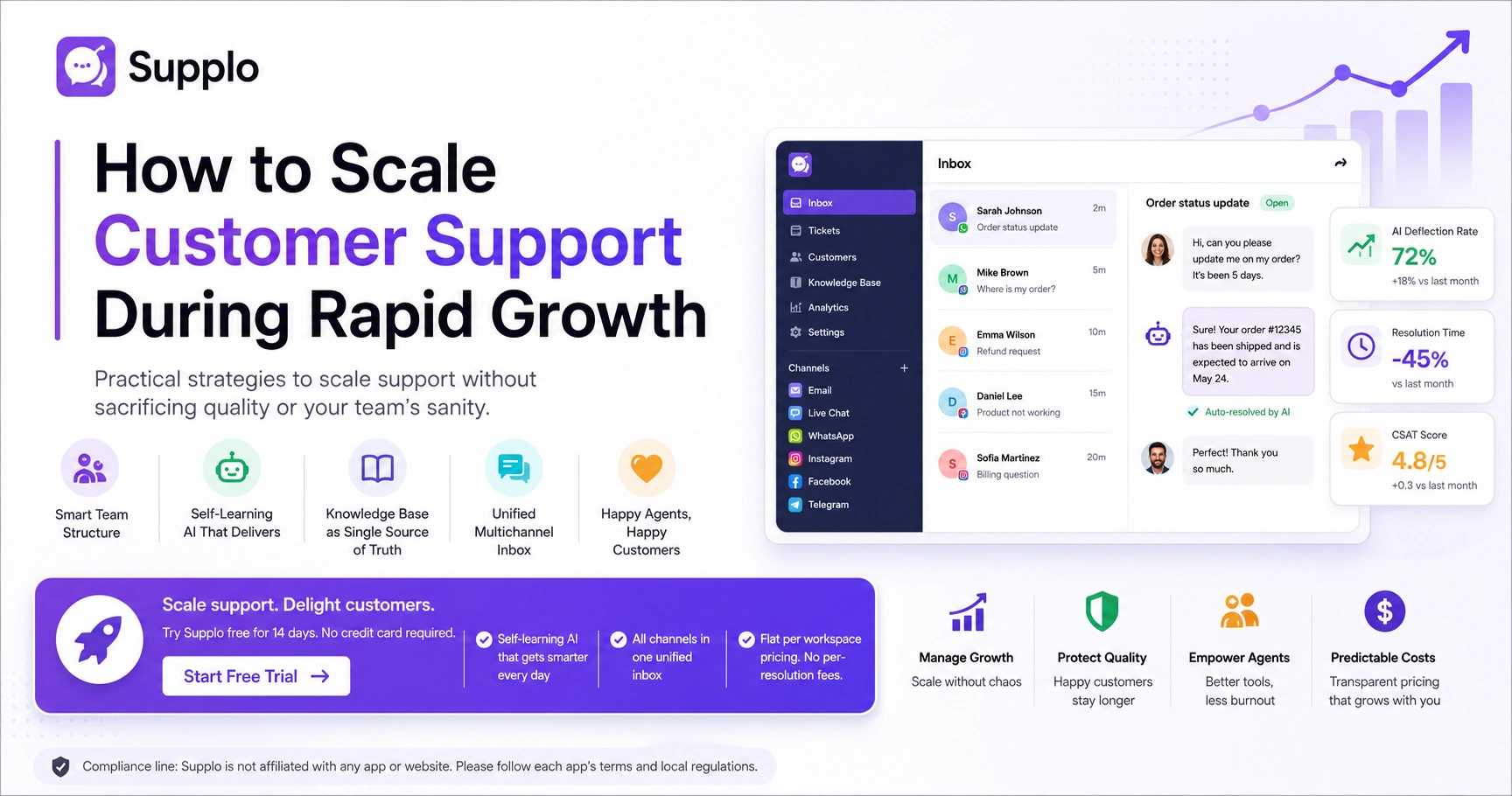
AI gets a bad rap when it's oversold. But used right, it's the most reliable lever for scaling support without scaling headcount proportionally. The sweet spot isn't replacing humans, it's automating the repetitive, high-volume questions that eat up 60-80% of your team's time. A self-learning AI agent that trains on your knowledge base and past conversations can handle those resolutions instantly, at a fraction of the cost of legacy tools, and hand off cleanly when a human is needed.
The best AI for scaling support learns continuously from what works and what doesn't, no manual retraining required. Automating common questions (order status, password resets, shipping info) frees your team to handle nuanced issues that actually need human judgment. Look for tools that unify all channels, email, chat, WhatsApp, Instagram, into one unified inbox so your AI isn't siloed. And pay attention to pricing: some tools charge per resolution and balloon as you grow; flat-rate models keep costs predictable.
Try the AI that actually learns as you grow.
Start your 14-day free trial at Supplo. Train your AI agent on your most common questions, connect your channels, and see for yourself how it handles real volume: no credit card required, no per-resolution pricing surprises.
AI customer support scaling with a self-learning AI agent
A self-learning AI agent observes interactions, learns from successful resolutions, and proactively updates its understanding of your customers' needs and your product. This iterative process means your AI becomes more accurate and efficient over time, requiring less manual intervention and truly enabling scalability. Your AI grows smarter as your business grows larger.
AI chatbot for scaling support that doesn't feel robotic
A good AI chatbot isn't about simulating a human perfectly. It's about providing instant, accurate answers and guiding customers efficiently. It does not feel robotic when it understands context, offers relevant solutions, and knows when to seamlessly hand off to a human agent with full conversation history. Being transparent about it being AI and setting clear expectations are key to a positive customer experience.
Training Rapid Growth Support Teams on Judgment Calls
Automation handles the repeatables. But rapid growth surfaces edge cases that no playbook covers. That's where your team's judgment matters most. Training agents to make good escalation decisions, when to bend a policy, when to loop in product, when to apologize and fix, is the difference between a support team that feels competent and one that feels magical. Role-play these gray-area scenarios during onboarding and revisit them monthly as your product evolves.
Create a judgment framework with guiding principles, not rigid scripts. Agents need autonomy to make good calls fast. Use a shared internal channel where they can quickly ask peers how you would handle this without slowing down. Celebrate good judgment publicly when an agent handles a tricky situation well; it reinforces the culture you want. Avoid punishing agents for mistakes made in good faith; encourage debriefings rather than blame.
When to escalate and how to empower agents to decide
Empowering agents means giving them clear boundaries, access to resources, and the authority to make decisions within those boundaries. Establish an escalation matrix that clearly defines criteria for when to involve a supervisor, another team, or a technical expert. Encourage agents to articulate why they chose to escalate or resolve a situation a certain way, fostering critical thinking instead of rote memorization.
Managing a Growing Support Team Without Burning Out Your Best People
As your team scales, burnout becomes a structural problem rather than a personal one. The agents who've been with you longest often carry the heaviest load because they're the most knowledgeable, and they're the ones most at risk of leaving. Protect them by distributing knowledge broadly, setting clear expectations for after-hours responsiveness, and measuring outcomes rather than just response volume. A team stretched too thin won't scale; it'll break.
Track time-to-resolution and customer satisfaction per ticket closed per hour; the latter encourages gaming the system. Implement a mandatory offline rotation for agents who handle complex tickets to provide recovery time. Consider a four-day work week or compressed schedule as a retention tool, especially if you're competing for talent. Use your AI agent to absorb predictable volume spikes (weekends, product launches) so humans aren't always on call. Transparent pricing models that don't penalize growth also protect against budgetary stress.
Metrics that matter for team health, not just speed
Focus on metrics like First Contact Resolution (FCR), Customer Satisfaction (CSAT), and Employee Net Promoter Score (eNPS). Response times matter, but obsessing over them can lead to rushed interactions. FCR demonstrates efficiency and resolution quality. CSAT directly reflects customer happiness. eNPS can flag early signs of agent burnout or low morale. Regular 1:1s and anonymous feedback channels are invaluable for qualitative insights.
Making Machine Learning Customer Service Growth Work in Practice
Machine learning isn't magic; it's pattern recognition at scale. For customer service, that means an AI that improves every time it encounters a new question, learns from how your agents resolve it, and gets smarter without you having to tweak it manually. The practical benefit for a growing team is simple: your AI catches up to your product changes and customer behavior shifts faster than any human team could manually update rules.
A self-learning AI that trains on your knowledge base and past conversations reduces the cold start problem significantly. The best setups let you review AI responses and approve or reject them, so you maintain quality control while it learns. Machine learning works best when it has access to all your customer conversation data, not just one channel. Avoid tools that require constant manual retuning; the whole point is that they scale with you autonomously.
How a self-learning AI improves over time without constant tuning
A truly intelligent AI platform continuously processes new inbound queries and agent responses. It identifies patterns between customer questions and successful resolutions, refining its understanding and ability to provide accurate answers. This continuous feedback loop means the AI systematically learns and adapts as your product, policies, and customer interactions evolve. The human role shifts from constant tuning to strategic oversight and occasional correction.
Why Most AI for Rapid Growth Customer Service Tools Overpromise
Let's be honest: a lot of AI support tools look great in a demo and fall apart under real volume. They can't handle nuance. They hallucinate answers. Or they charge per resolution, so your bill triples as you scale. The reliable alternatives are transparent about where AI works and where it doesn't, and they price in a way that doesn't punish you for success. You don't need the flashiest AI; you need one that actually resolves tickets without creating more work for your team.
Beware of tools that claim 100% automation for complex support. The best AI hands off to humans gracefully when needed. Per-resolution pricing models sound appealing until you hit a growth spike and your costs explode; flat per-workspace pricing is much more predictable. Look for tools that integrate with your existing stack, like email ticketing, without requiring a full tech rebuild. The AI should be easy to train on your knowledge base, not require weeks of configuration by a data scientist.
Worried about hidden costs? Supplo is flat per workspace, not per seat or per resolution.
Most affordable AI tools get expensive fast when you scale. Supplo's pricing is transparent and predictable: one flat rate for unlimited agents and up to 80% auto-resolution. Compare for yourself, no surprises.
The trap of per-resolution pricing and hidden costs
Per-resolution pricing models can seem budget-friendly initially. But they become prohibitively expensive as your business scales. Every automated interaction, regardless of how simple, adds to your bill. This structure disincentivizes automation and penalizes growing businesses for their success. Flat-rate, per-workspace pricing avoids this trap completely, giving you predictable costs even with exponential growth in customer interactions.
Your Practical Roadmap for Scaling Support Reliably Without Rebuilding Every Quarter
Scaling support reliably comes down to three things: a unified system that captures every conversation, an AI that handles the predictable volume, and a team structure that lets humans focus on what they do best. You don't need to overhaul everything at once. Start by consolidating your channels into a single inbox, train your AI on your 10 most common questions, and build your team around the gaps that remain. Iterate from there.
Unify all channels like: email, chat, WhatsApp Customer Support, Instagram, Telegram, Facebook, into one threaded inbox so nothing falls through the cracks. Deploy AI to handle the top 20% of question types, that's usually 60-80% of total volume. Structure your team in tiers or pods based on your product complexity and customer base. Review your metrics monthly: response time, resolution time, customer satisfaction, and AI deflection rate. Choose a platform that grows with you without surprise price jumps; flat per-workspace pricing is your friend, whether through your website widget or direct messages.
Ready to scale support without the chaos?
Start your free trial today. You'll get a unified inbox, a self-learning AI, and multichannel support that works out of the box. And when your team grows, your bill doesn't.
Key Takeaways
- Proactive planning and intentional team structuring beat reactive hiring every time during growth.
- Self-learning AI is crucial for deflecting high-volume, repetitive queries, freeing humans for complex work.
- A centralized knowledge base is indispensable for consistent answers and efficient agent onboarding.
- Unifying communication channels streamlines workflows and prevents customer queries from getting lost.
- Transparent pricing models in support tools are essential for predictable costs as you scale.
FAQ
At what point in rapid growth should I implement AI customer support?
If your team is answering the same 10 repetitive questions 50 times a day, you're ready for AI. There's no minimum ticket volume. AI is useful as soon as you have predictable patterns in your support queries. Start small, train it on your most common questions, and scale from there.
Will AI customer support replace my human agents when I scale?
Not if you're using it effectively. The goal of AI in customer support is to automate repeatable tasks, allowing your human agents to focus on complex, high-judgment issues that truly require an empathetic touch. Teams that leverage AI effectively often grow their headcount, but at a pace that matches their ticket volume.
How do I maintain quality and consistency as my support team grows?
A living knowledge base is your single best tool. Document every answer, update it as your product changes, and make it the single source of truth for both your AI and human agents. Pair that with structured onboarding processes and regular quality assurance reviews of agent interactions.
What's the biggest mistake companies make when scaling customer support?
The biggest mistake is usually not planning for structure and automation early enough. Companies often keep everyone as generalists, avoid investing in scalable AI, and hire in panic bursts. This typically results in agent burnout, inconsistent customer experiences, and a support team unable to keep pace with demand.
How do I choose between a tiered and a pod-based support model?
A tiered model generally works best for broad consumer products with a high volume of similar, low-complexity tickets. A pod-based model is usually more effective for B2B or complex, niche products where agents benefit from deep product knowledge for specific customer segments and dedicated client relationships.
What metrics should I track when managing a growing support team?
Key metrics include Response Time, Resolution Time, Customer Satisfaction (CSAT), First Contact Resolution rate, and AI Deflection Rate. It's important to avoid over-emphasizing metrics like tickets closed per hour, which can inadvertently encourage agents to rush interactions and compromise quality.
How do I handle support for new channels (WhatsApp, Instagram, Telegram) as I scale?
To efficiently manage support across new channels, implement a unified inbox that consolidates communications from email, live chat, WhatsApp, Telegram, and Instagram DMs into a single, threaded view. This eliminates the need for agents to switch between apps, improving efficiency and allowing your AI to learn from all conversations.
Compliance line: Supplo is not affiliated with any app or website. Please follow each app's terms and local regulations.