On this page
Building a robust support team culture goes way beyond free snacks or monthly ping-pong tournaments. It's about creating a resilient system where your team consistently delivers exceptional service without burning out. This guide walks you through practical strategies for customer support leaders, team managers, and founders who want to move past surface-level initiatives and build something that actually sticks.
Quick Answer
- A strong support culture is the foundation for reliability, reducing agent burnout, and improving customer experience
- Focus on psychological safety, transparent feedback, and efficient tools rather than superficial perks
- Remote teams can build strong cultures through deliberate asynchronous communication and shared digital workspaces
- Define clear values, codify them in onboarding and processes, and actively champion them
- Prioritise tools that automate tedious tasks and clarify ownership, allowing agents to focus on complex interactions
- Address toxicity swiftly and directly; unaddressed issues can rapidly erode a positive culture
Why Culture Is the Secret to a Reliable Support Team, Not Just KPIs
Here's the thing: you can obsess over average handle time and first response metrics all day, but if your team's culture is broken, those numbers won't save you. A strong culture of support directly shapes your team's reliability and resilience. Without it, you'll likely face burned-out agents, inconsistent customer interactions, and higher churn rates.
Culture is the underlying system that empowers your team to approach every interaction with empathy and ownership, even when nobody's watching over their shoulder. Key cultural pillars include fostering a safe environment to speak up, aligning on shared goals, and consistently recognising contributions. These elements build trust and intrinsic motivation, which is far more powerful than any dashboard metric alone.
Reliability isn't just about system uptime. It's about how customers feel and are supported across every single interaction. And that starts with how your team feels about showing up every day.
What Does a Supportive Customer Service Culture Actually Look Like?
A supportive customer service culture is one where agents feel psychologically safe. This means they're comfortable asking for help, admitting mistakes, and proactively suggesting improvements without fear of being blamed.
You'll know it's working when a team member flags a recurring technical issue and gets celebrated for their vigilance rather than questioned about why they didn't fix it themselves. You'll see public shoutouts for expertly handling challenging tickets, transparent post-mortems that focus on learning (not blame), and skip-level feedback loops that give everyone a voice.
Metrics that correlate with a strong culture? Internal satisfaction scores, agent retention rates, and contributions to the knowledge base. But honestly, the biggest signal is leadership modelling that behaviour. If managers cultivate transparency and admit their own limitations, agents will feel empowered to do the same.
How to Foster a Positive Support Team Environment Without Forcing It
Here's a hard truth: forcing fun activities rarely builds genuine culture. Paintball outings and pizza parties aren't going to fix broken processes.
Instead, focus on creating systems that reduce friction in agents' daily work. This means flexible scheduling, asynchronous feedback mechanisms, and tools that respect agents' focus time. A genuinely positive environment naturally emerges when agents feel trusted and equipped to succeed, not when they're being micromanaged or dragged to another forced team-building event.
Consider removing low-value rituals like unnecessary meetings. They hurt morale more than they help. Utilise tools that reduce manual repetition, things like AI-powered triage or automation, so that agents can concentrate on complex, empathetic conversations. And set clear boundaries around availability. Constant expectations of Slack responsiveness aren't healthy, and they certainly aren't free.
Practical Steps to Develop Team Culture in Customer Support
If you truly want to build a support team culture, start by defining core values in clear, actionable language. Instead of vague terms like excellence, use specifics as we respond by the end of the day without guessing. These values need to be codified and actively integrated into onboarding, performance reviews, and daily standups.
Create a concise culture handbook, a single page, not a fifty-page manifesto. Include culture fit as a structured component in every hiring interview with a consistent rubric. To maintain momentum, establish a revolving culture champion role within the team.
Test your culture ideas in a real environment. Try a shared inbox tool that respects your team's focus time. Start a free 14-day trial of Supplo at supplo.io, no credit card required.
How to Nurture Supportive Team Dynamics When Tensions Run High
High-tension situations are the ultimate test of your team's culture. When a difficult customer interaction escalates, the team dynamic either solidifies or starts to fracture.
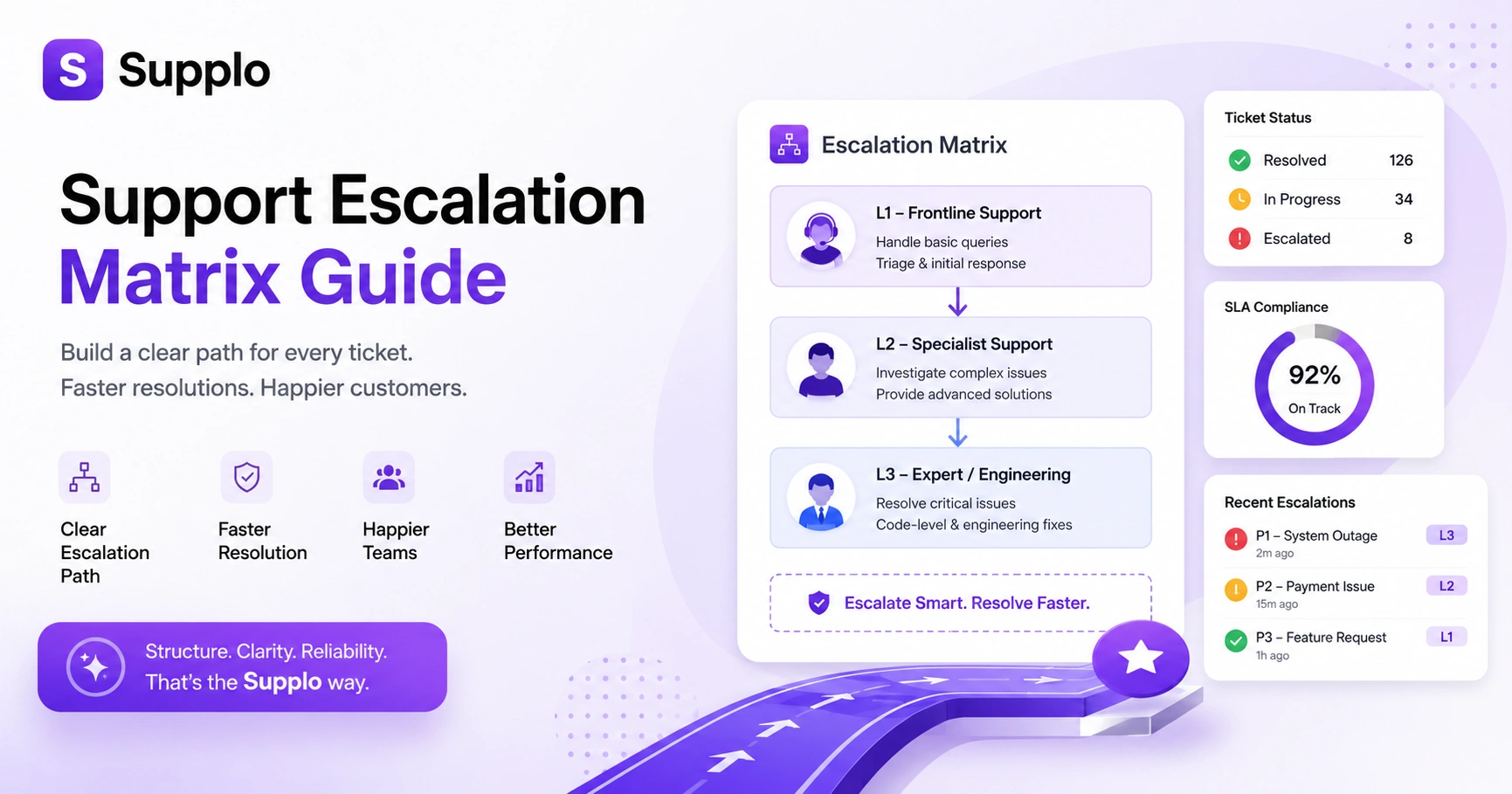
To handle this well, implement normalised debriefing sessions, establish a clear escalation protocol, and maintain zero tolerance for blame games. After any significant incident or challenging support case, conduct start-stop-continue retrospectives. Encourage agents to flag emotionally draining tickets without judgment.
Leadership matters most here. If you model calm, clear decision-making during crises rather than panic, your team will follow suit.
5 Best Practices for Support Team Culture You Can Start Using Today
- Daily 5-minute standups focused on blocks: These should prioritise identifying obstacles and asking for help, not giving status updates. Keep it efficient.
- No-dumb-question policy + private channel: Create a safe space where agents can ask anything without fear. This promotes learning and reduces context-switching errors.
- Peer recognition tied to behaviours: Implement a system in which peers acknowledge specific positive actions, not just outcomes. This reinforces desired behaviours.
- Transparent workload visibility: Share a clear overview of ticket volume and queue status. This fosters empathy and helps the team self-organise when traffic spikes.
- One free learning hour per week: Allocate dedicated time for agents to develop new skills or explore tools. It invests in their growth and builds versatility.
Effective Support Team Culture Strategies That Scale With Growth
What works perfectly for a five-person team will break down at fifty. Scaling support culture means implementing rituals and processes that don't rely on personal relationships or physical proximity.
You'll need well-documented escalation paths, clear norms for asynchronous communication, and tooling that keeps everyone aligned. Using a unified inbox solution ensures no ticket falls through the cracks. It streamlines communication channels, such as WhatsApp customer support, into a single, manageable view.
Implement buddy systems for new hires across different time zones. Rotate agents through various support channels to break monotony and build empathy for different customer segments. Growth doesn't have to mean losing your culture, but it does mean being intentional about preserving it.
Improving Customer Service Team Culture: The Tools That Help or Hurt
Your tools can either amplify a positive customer service team culture or actively sabotage it.
Clunky, inefficient software that floods agents with unnecessary notifications? That will erode patience and create frustration. Modern tools should automate repetitive tasks, clarify ownership, and protect agents' focus time. A fast AI agent that resolves a significant portion of incoming tickets allows your human team to breathe and focus on complex, empathetic interactions.
Tools bad for culture: Shared inboxes without proper threading, excessive, noisy Slack channels, and a lack of ticket visibility.
Tools good for culture: Collaborative ticket views, automatic assignment based on skill or availability, and AI features that tag sentiment to help agents prepare for tough conversations.
Oh, and transparent pricing matters too. Flat-rate subscriptions instead of per-seat charges build trust and cost predictability. Check out Supplo's pricing to see how this can work.
How to Encourage Teamwork in Customer Support When Everyone Is Remote
Remote teams need deliberate rituals to maintain connection. This means asynchronous standups, collaborative documentation, and occasional synchronous problem-solving sessions that encourage interaction without mandating constant video calls.
Leverage a shared knowledge base as a central, collaborative artefact where agents can contribute and reference solutions. Supplo's knowledge base feature is built for exactly this. Consider implementing monthly shadow sessions with random pairings so agents can learn from each other's approaches. Publicly celebrating cross-timezone collaboration, it reinforces the value of working together across geographical divides.
Building a Collaborative Support Environment Across Teams
Your support department shouldn't operate in a silo. Cultivating strong collaboration with product, sales, and engineering teams is crucial for a unified customer experience.
Set up shared communication channels for continuous feedback loops. Invite support agents to product demos and include them in roadmap discussions. Schedule regular lunch and learns where support shares top customer pain points with the development team. Implement shared CRM tags for support-identified bugs or feature requests.
Quarterly cross-functional retrospectives provide a forum for everyone to review experiences and align strategies. When support has a seat at the table, everyone wins.
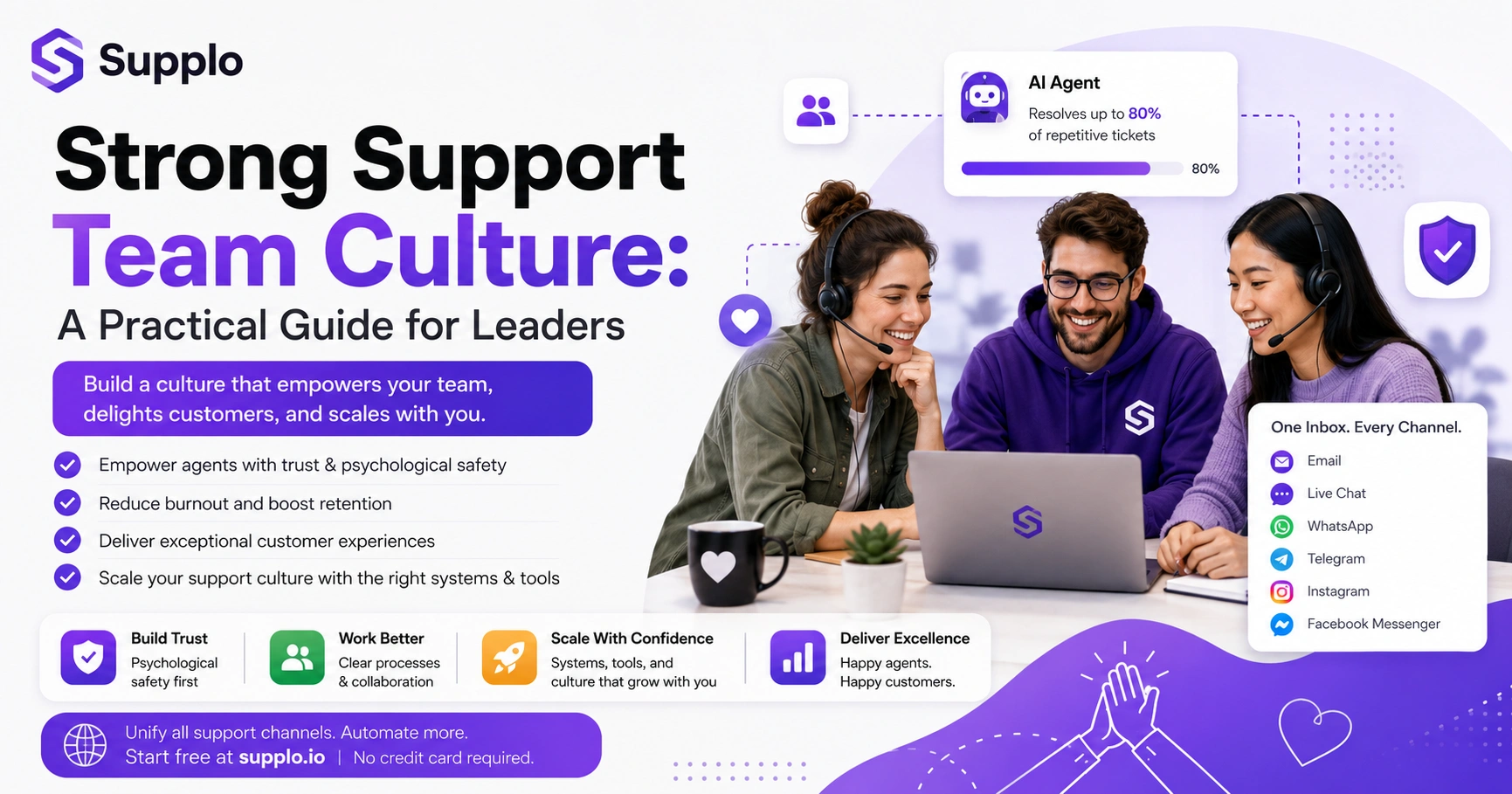
Your support team culture is a living system. Feed it the right tools. Get a single inbox that unifies email, chat, WhatsApp, Telegram, Instagram, and Facebook Messenger. Supplo's AI Agent handles up to 80% of repetitive tasks, so your team can focus on the conversations that matter. Start free at supplo.io.
Key Takeaways
- Culture over fleeting metrics: A strong culture is the bedrock for long-term reliability, reducing turnover and improving customer interactions more effectively than rigid KPIs
- Psychological safety first: Empower agents to be honest without fear of blame
- Systems, not perks: Build positive environments by reducing friction through flexible processes and efficient tools
- Codify and champion values: Translate abstract values into actionable behaviours integrated into every employee touchpoint
- Strategic tool use: Choose tools that automate the mundane, clarify ownership, and protect agent focus
- Remote-first cohesion: Cultivate teamwork through deliberate asynchronous rituals and shared knowledge
- Cross-functional alignment: Break down silos by integrating support with other departments
FAQ
How long does it take to build a strong support team culture?
It usually takes 6–12 months of consistent, deliberate effort. The first 90 days are the most critical for establishing foundational norms and building trust.
What's the biggest mistake teams make when trying to improve culture?
Trying to fix culture with superficial perks like free snacks or ping-pong tables, instead of addressing underlying process friction and communication deficiencies.
Can remote support teams have a strong culture?
Absolutely. Remote teams can build strong cultures through asynchronous communication rituals, transparent documentation, and deliberate moments of connection.
How do I measure if my culture improvements are working?
Track agent retention rates, internal satisfaction scores, knowledge base contributions, and voluntary participation in team initiatives.
What role does leadership play in support team culture?
Leadership sets the tone and the ceiling for culture. If leaders fail to model vulnerability, recognition, and fairness, culture initiatives won't succeed.
Should I address toxicity in my support team immediately?
Yes. Unaddressed toxicity erodes positive culture faster than any initiative can build it. Address it swiftly using documented protocols.
How do tools like AI impact support team culture?
Effective AI tools reduce burnout by automating repetitive tickets. Poorly implemented tools add noise and complexity. Choose transparent, lightweight tools that respect agent focus.
Compliance line: Supplo is not affiliated with any app, tool, or organisation mentioned in this guide. Please follow each platform's terms and local regulations.